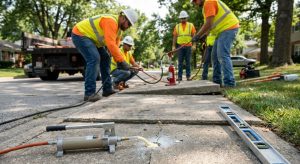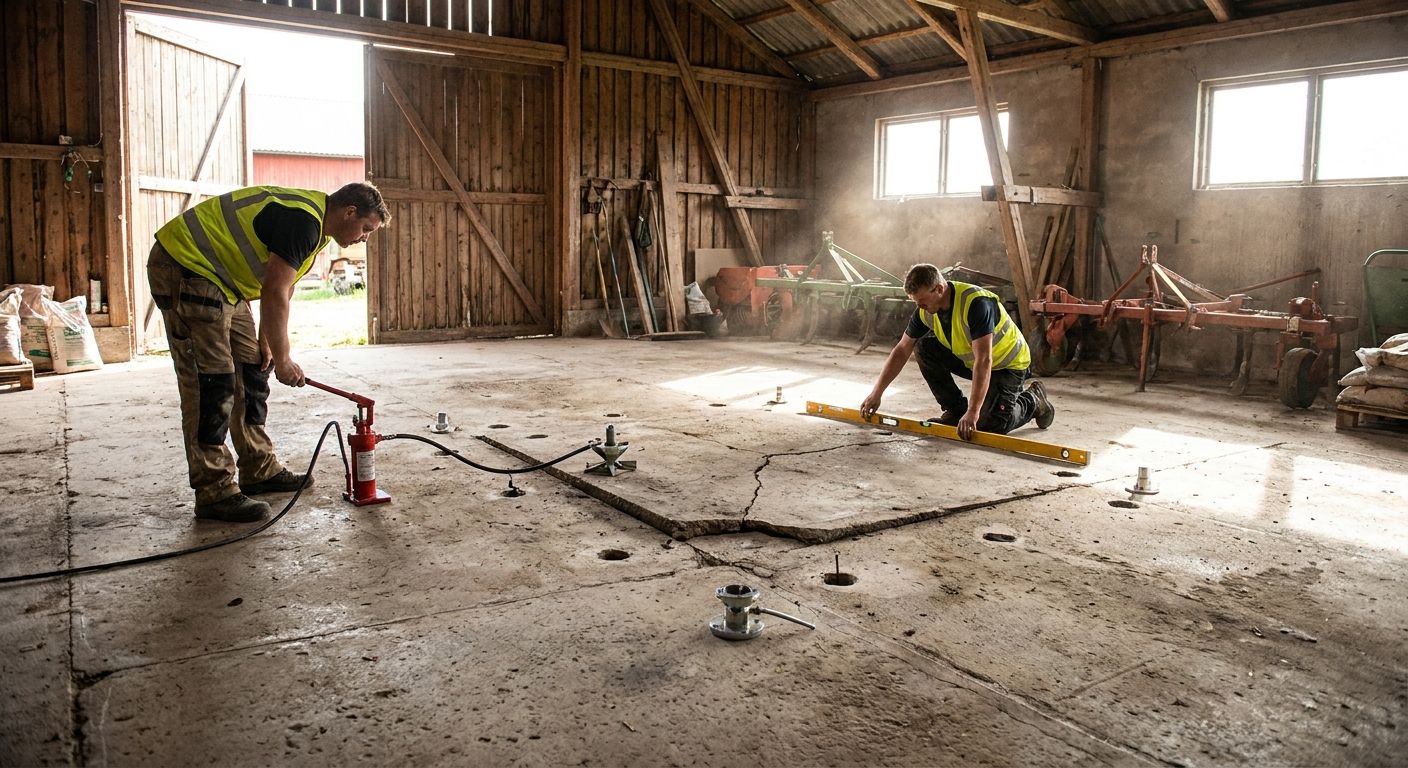
Barn and shop floor concrete lifting raises a settled slab back to level by injecting polyurethane foam beneath it, restoring an even surface without tearing out the pad. Barn and shop floors carry heavier point loads than a typical driveway — tractors, skid steers, livestock, and stacked equipment — and they sit in unheated or seasonally heated buildings across Calgary, Okotoks, High River, and Lethbridge that see repeated freeze-thaw cycles every Alberta winter.
- Concrete lifting barn floor jobs use polyurethane foam injection to raise settled slabs without demolition or a multi-day shutdown.
- A settling gap of a half inch or more at door tracks and equipment ramps is the point to start planning a lift.
- Polyurethane foam cures in roughly 15-30 minutes and typically supports full weight the same day, unlike mudjacking’s slower slurry cure.
- Foundation settling and slab settling look similar but need different fixes — check stem walls before booking any lift.
- Aztec Spray Systems services barn and shop slabs across Calgary, Okotoks, High River, and Lethbridge, Alberta.
Why concrete lifting matters for barn and shop floors
A level barn or shop floor is a safety issue before it's a cosmetic one. A settled slab under a hay stall, wash bay, or equipment ramp creates a trip hazard for animals and a tipping hazard for loaded pallet jacks and skid steers moving at an angle instead of flat. If you've already noticed a gap where the slab meets a doorway or foundation wall, the diagnostic questions in how to tell if your garage floor needs concrete lifting apply almost line for line to a shop pad, just at a larger scale.
Barn and shop slabs also fail differently than a house slab. Manure, urine, and wash-down water erode the base material under a stall floor faster than plain soil settling under a garage. Larger unbroken slab spans in a shop mean a single soft spot under the middle of the pad can drop the whole section instead of just one corner. The fix — polyurethane foam lifting — is the same technology used on residential slabs, but the diagnosis and prep work take longer on a working farm or shop building in 2026 than they do on a suburban driveway.
Walk the slab and map the low spots
Start with a visual walk of the entire floor before you call anyone. This costs nothing and takes 20-30 minutes on most shop floors.
- Roll a ball or round tool bit across the slab and watch where it comes to rest
- Check the base of support posts and columns for gaps or rocking
- Note any spot where water pools after a wash-down or rain
- Photograph problem areas now so you have a seasonal comparison later
- Mark low corners with chalk or tape so you can measure them precisely next
Measure how much the slab has dropped
A visual check tells you where to look. A measurement tells you whether the problem is cosmetic or structural.
- Set a 4-foot level across each marked low spot and record the gap in inches
- Use a laser level for shop floors over 800 square feet, where a straightedge won't span the whole slab
- Run a string line across stall dividers to catch dips a level might miss
- Compare the drop against door frames, equipment ramps, and overhead door tracks
- Log the numbers with a date — a repeat measurement in 6 months tells you if settling is active or stable
Rule out foundation settling before you treat it as a slab problem
Not every dip is a slab issue. If the exterior stem wall or foundation is moving too, foam injection under the slab alone won't solve it.
- Check for stair-step cracks in block or poured foundation walls near the affected slab area
- Look for doors and windows in the same structure that have started sticking
- Check whether support posts are leaning, not just settling straight down
- Compare crack patterns against the signs covered in how to identify foundation settling before it worsens
- Get a second opinion if the drop shows up on both the slab and an adjoining wall
Decide whether the slab is a lift candidate or a tear-out candidate
Most settled barn and shop floors are lift candidates. A smaller share need replacement instead.
- Cracks under roughly a half inch wide with no vertical offset usually lift cleanly
- Shattered corners, exposed rebar, or crumbling edges usually mean tear-out, not injection
- A slab that has dropped more than 2 inches in one section may need combined mudjacking and foam, not foam alone
- Slabs poured over unconsolidated fill sometimes need base stabilization before any lifting method holds
- If in doubt, get a contractor to core or probe the slab rather than guessing from the surface
Compare your lifting options before you book anyone
Mudjacking, polyurethane foam, and full replacement all solve settling, but they solve it at different speeds and different disruption levels. This is the point where most barn and shop owners start pricing out contractors, and it's worth understanding the tradeoffs first — the method breakdown in best concrete lifting method for sunken slabs walks through the same decision in more depth.
| Option | Best for | Downtime | Key limitation |
|---|---|---|---|
| Polyurethane foam injection | Working shops and barns that can't sit idle for days | Same-day return to use in most cases | Higher cost per hole than mudjacking on very large slabs |
| Mudjacking (slurry) | Large, thick slabs where cost per square foot matters more than speed | Cure time runs longer before full load is safe | Heavier fill material can stress an already-weak base |
| Full slab replacement | Shattered, heavily cracked, or undersized slabs | Building closed for the pour and cure period | Highest cost and longest shutdown of the three |
| Monitor only, no repair | Slabs with less than a quarter inch of stable, non-worsening settling | None | Risk grows every freeze-thaw cycle if the drop is still active |
Verdict: for a barn or shop that needs to stay operational, polyurethane foam injection wins on downtime; mudjacking wins on raw cost for oversized slabs with less time pressure.
Schedule the lift around barn and shop downtime
Once you've picked a method, timing the work matters almost as much as the method itself.
- Avoid scheduling around calving or lambing season if the barn houses livestock
- Move stored equipment off the affected slab section before injection day
- Block ventilation as instructed while foam cures, then clear the space before reopening
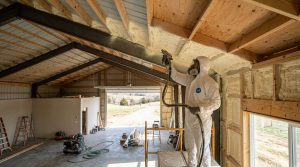
- Coordinate with any planned insulation upgrades to the same building, since spray foam insulation for pole barns and shops work is often bundled with a concrete lift in the same visit
- Confirm access for injection equipment if the barn sits on an acreage with a longer or narrower driveway
Protect the repair after the lift
A lifted slab that isn't sealed at the perimeter is prone to repeat settling within a few seasons.
- Reseal control joints and the perimeter gap where the slab meets the foundation
- Grade soil away from the building if surface water was pooling near the slab edge before the lift
- Avoid parking heavy equipment on the freshly lifted section for the first 24 hours
- Photograph the repaired area each spring and fall to catch any new movement early
- Re-measure with the same level and shim method from earlier if you notice a new dip
Get a concrete lifting quote for your barn or shop
Serving Calgary, Okotoks, High River, and Lethbridge property owners.
Common mistakes barn and shop owners make
- Waiting until the ramp is unsafe. A quarter-inch dip is a maintenance note; a 2-inch drop at an equipment ramp is a safety incident waiting to happen.
- Ignoring drainage as the root cause. Manure and wash-down water erode the base under a stall floor faster than plain soil, so a lift without a drainage fix often settles again.
- Assuming the slab is the only thing moving. Foundation walls and support posts can be settling too, and foam injection under the slab won't fix a moving wall.
- Overloading a freshly lifted slab. Rolling a loaded skid steer across a section within an hour of injection risks re-settling the exact spot you just paid to fix.
- Skipping perimeter joint resealing. An unsealed edge lets water back under the slab within one Alberta freeze-thaw season, undoing the lift.
“If the slab drops more than a half inch at any point, both mudjacking and polyurethane foam are viable — waiting past 2 inches usually means you’re looking at replacement instead.”
FAQ
What is concrete lifting for a barn floor?
Concrete lifting for a barn floor is a repair method that raises a settled slab back to level by injecting polyurethane foam or slurry beneath it through small drilled holes, avoiding full demolition.
How much does concrete lifting cost for a shop floor?
Cost depends on slab size, drop depth, and method chosen; request a site-specific quote since barn and shop slabs vary widely in square footage and access.
Is polyurethane foam better than mudjacking for a barn floor?
Polyurethane foam wins on downtime, curing in roughly 15-30 minutes versus a longer set time for mudjacking slurry; mudjacking can cost less per square foot on very large, less urgent slabs.
How long does concrete lifting take for a shop floor?
Most polyurethane foam lifts finish in a single visit, with the floor able to bear full weight the same day in most cases, though very large or heavily settled slabs take longer.
Can a shop stay open during concrete lifting?
Yes for most polyurethane foam jobs — work is typically confined to the affected section and the floor returns to use the same day, though the specific area being lifted needs to be cleared first.
Does concrete lifting work in Alberta winter conditions?
Polyurethane foam lifting can be done in cold weather, but active freeze-thaw movement is worth monitoring separately from the repair, since the same cycles that caused settling continue every winter.
How do I know if it’s slab settling or foundation settling?
Check for stair-step cracks in the foundation wall and leaning support posts — if only the slab has dropped and the walls are level, it’s a slab-only repair; if walls are cracking too, get the foundation checked first.
Is a lifted slab a permanent fix?
A properly lifted and resealed slab holds for years, but repeat settling can happen if the underlying drainage or base erosion problem that caused the original drop isn’t addressed.
One last thing
The lift fixes the symptom, not always the cause. If a barn or shop floor settled because of poor drainage or an eroded base, resealing the perimeter and correcting site grading after the lift matters as much as the injection itself — a slab lifted in 2026 without that follow-up work is the one most likely to need lifting again in a few years. If you're weighing this repair against an insulation upgrade in the same building, tackling both in one visit usually means less downtime overall.
Related guides
- Spray foam insulation for pole barns and shops
- Spray foam insulation for acreages and rural properties