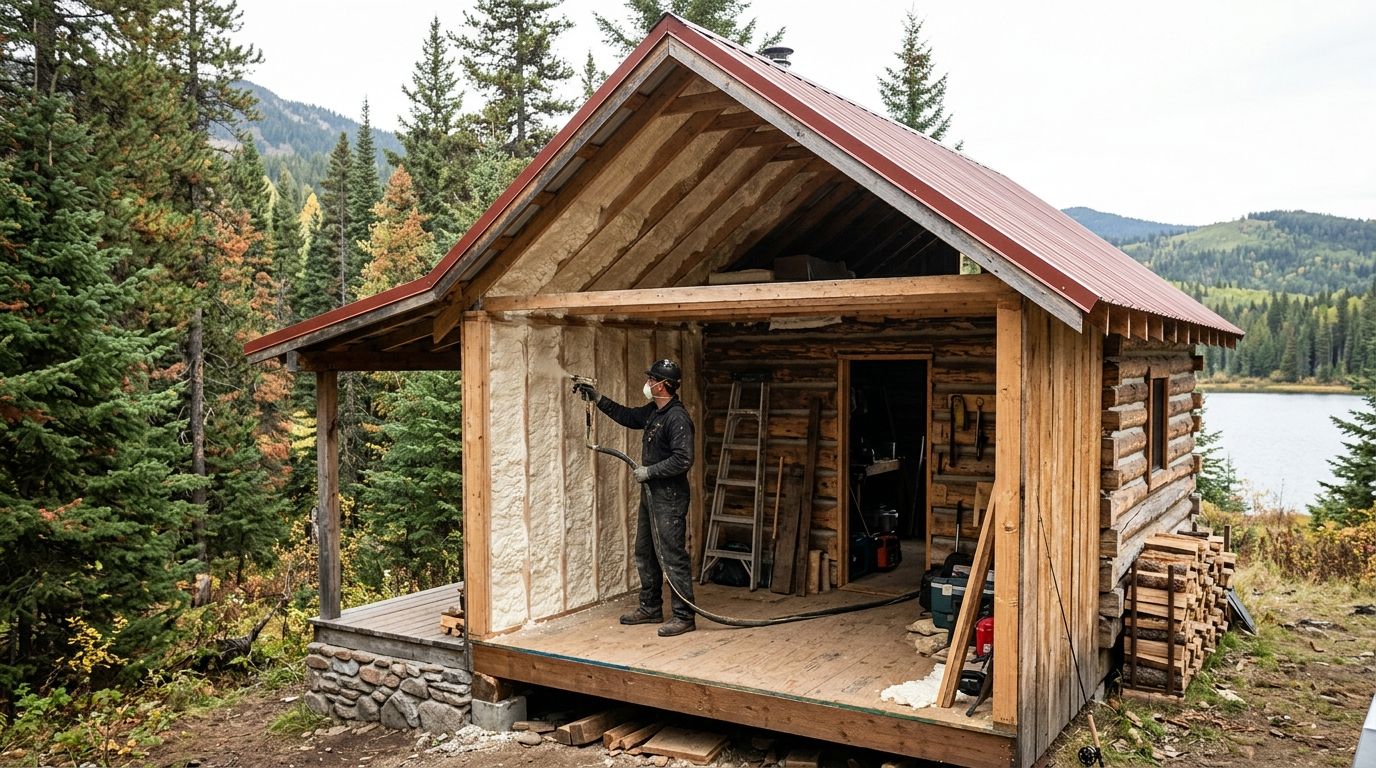
Spray foam insulation for hunting cabins means sealing and insulating a structure that sits empty for weeks at a time, then gets asked to hold heat fast when a truck rolls up at 5 a.m. before opening morning. The building science is the same as any home, but the priorities shift: air sealing against rodents, moisture control near water, and freeze protection for plumbing you can't check on daily.
- Closed-cell spray foam insulation is the right call for hunting and fishing cabins that sit near lakes or rivers and take on moisture year-round.
- Air sealing rim joists and sill plates first stops the mice and drafts that ruin an unattended cabin between visits.
- Alberta’s building code targets roughly R-50 in attics and R-22 in walls for climate zone 7 — most older cabins fall well short.
- Spray foam insulation for hunting cabins runs faster to install than batt insulation when the job window is a single weekend.
- Aztec Spray Systems services cabin insulation projects across Calgary, Okotoks, High River, and Lethbridge, Alberta, into 2026.
Why spray foam insulation matters for hunting and fishing cabins
A cabin used four or five weekends a season behaves differently than a house lived in daily. Nobody's there to notice a mouse chewing through fiberglass batt in the rim joist, or a pipe that froze solid in a January cold snap because the crawl space was never sealed. Aztec Spray Systems sees this pattern constantly on rural properties: the insulation looks fine from inside the wall cavity, but the air sealing behind it failed years ago.
Seasonal cabins near lakes and rivers also fight humidity that a typical suburban Calgary attic never sees. Wood cabins built in the 1970s and 1980s often have no vapor control at all, which means condensation builds inside wall cavities every time the woodstove runs hot after a cold morning duck hunt. Closed-cell spray foam solves both problems at once — it air-seals and it resists moisture wicking, which matters more on a cabin than almost any other building type in this region.
Cabins have different failure points than houses
- Uninsulated pier or crawl space foundations lose heat fast when nobody's topping up the woodstove
- Cathedral or vaulted ceilings common in A-frame cabins leave almost no room for thick batt insulation
- Rim joists near grade are the number-one rodent entry point on rural properties
- Plumbing runs through unheated space freeze solid during a hard early-winter cold snap
Seal the building envelope before insulating anything
Insulation without air sealing is half a job. On a cabin that sits empty for stretches at a time, the gaps you don't seal are exactly where mice, wasps, and cold air get in while nobody's watching.
- Caulk or foam every wire and plumbing penetration through exterior walls and floors
- Weatherstrip the door to the woodshed or tackle room, not just the main entry
- Check window and door rough openings for gaps left from the original build
- Seal around the chimney or stovepipe penetration with high-temperature sealant rated for the application
- Inspect the foundation sill plate for daylight gaps — a common spot on older pier-built cabins
Choose closed-cell spray foam for exterior walls and the roof deck
Once the envelope is sealed, the insulation choice matters more on a cabin than on a typical house. Fiberglass batt does nothing to stop air movement and sags over time in a building that isn't climate-controlled between visits. Closed-cell spray foam insulation runs roughly R-6 to R-7 per inch, compared with about R-3.5 per inch for open-cell foam and R-3.2 to R-4 per inch for standard fiberglass batt — meaning a 2×6 wall cavity filled with closed-cell foam gets close to R-40 in the same space that batt gets to R-19.
- Closed-cell foam on exterior walls resists bulk water intrusion better than open-cell in a cabin exposed to lake spray or splashback
- Roof deck application under a metal roof stops ice-damming on cabins with no attic ventilation to speak of
- Rigid foam board over the exterior sheathing adds a second layer of thermal break for a modest labor cost if spray foam isn't in the budget yet
- A licensed contractor like Aztec Spray Systems applies closed-cell foam directly to roof decking in cathedral-ceiling cabins where batt physically won't fit the rafter depth
Insulate the crawl space or pier foundation
Most hunting and fishing cabins built before 2000 sit on piers, skids, or a shallow crawl space rather than a poured basement. That space is almost always the single biggest source of heat loss and the easiest one to ignore because nobody sees it.
- Skirt the underside of a pier-built cabin with rigid foam board as a low-cost starting point
- Seal the crawl space vents shut for winter if the cabin isn't heated year-round
- Spray foam the underside of the subfloor directly for a cabin that gets shoulder-season use
- Check for existing vapor barrier on the crawl space floor — bare dirt pulls moisture straight into the framing above it
Foam the rim joists and sill plates against rodents and drafts
Rim joists are where most rodent problems start on a rural cabin. A mouse needs a gap the size of a dime, and stick-framed rim joists on a cabin built decades ago usually have several.
- Closed-cell spray foam fills irregular rim joist cavities completely, unlike batt which leaves gaps around wiring and plumbing
- Steel wool packed into larger gaps before foaming stops rodents from chewing through cured foam
- Check the sill plate to foundation connection specifically — it's rarely sealed on cabins built without a building permit
- A single afternoon of rim joist foaming often does more for a cabin's comfort than a full attic top-up
Address the attic or the vaulted ceiling
Alberta's building code calls for roughly R-50 in attics across climate zone 7, which covers Calgary, Okotoks, High River, and Lethbridge. Most cabins built before current code sit closer to R-20 or R-28 if they have any attic insulation at all, and cathedral-ceiling A-frames often have almost none because there's no attic space to blow cellulose into.
- Flat-ceiling cabins can take blown cellulose as a budget option, though it settles over 10-15 years and needs topping up
- Vaulted or cathedral ceilings need spray foam applied directly to the roof deck since there's no attic cavity to fill from above
- Check for existing knob-and-tube or old wiring before spraying — foam over unrated wiring is a fire code issue, not just an insulation one
- A contractor with WCB coverage should confirm ventilation requirements before closing up a vaulted roof assembly with closed-cell foam
Protect plumbing lines for freeze prevention
A cabin plumbed for a kitchen sink or a bathroom needs its water lines protected differently than a house, because nobody's there in January to notice a slow leak until the pipe has already split.
- Route water lines through conditioned space wherever the original plumbing layout allows it
- Foam directly around any pipe run through an exterior wall or unheated crawl space
- Install heat tape on exposed runs as a backup, not a substitute, for proper insulation
- Drain and winterize the system fully if the cabin won't see use between November and March
Plan for permits and code compliance in rural municipalities
A hunting or fishing cabin on an acreage often falls under a different building department than a Calgary infill, and the rules on habitable outbuildings vary by county. Confirm permit requirements before a spray foam job, especially if the cabin will be used as a secondary dwelling rather than a seasonal shelter.
- Check whether the cabin's municipality requires a building permit for insulation retrofits on existing rural structures
- Confirm fire code clearance requirements around any wood-burning appliance before foaming nearby framing
- Ask about Canada Greener Homes Grant or provincial rebate eligibility before the job starts, not after
- A licensed and insured contractor handles the permit conversation directly rather than leaving it to the property owner
Comparison of insulation options for hunting and fishing cabins
| Option | Best for | R-value per inch | Key limitation |
|---|---|---|---|
| Closed-cell spray foam | Exterior walls, roof decks, crawl spaces near water | R-6 to R-7 | Higher material cost per cavity than batt or cellulose |
| Open-cell spray foam | Interior walls, sound dampening between rooms | R-3.5 | Not moisture-resistant enough for exterior applications |
| Fiberglass batt | Budget flat-wall retrofits with easy access | R-3.2 to R-4 | Does nothing to stop air leakage or rodent entry |
| Blown-in cellulose | Flat attic ceilings with full access | R-3.2 to R-3.8 | Settles over time and needs periodic top-ups |
| Rigid foam board | Crawl space skirting, exterior sheathing add-on | R-4 to R-6.5 | Seams need careful sealing or performance drops |
Verdict: closed-cell spray foam insulation is the right choice for hunting and fishing cabins near water or exposed to freeze-thaw cycles, and it's the option Aztec Spray Systems recommends most often for rural Alberta cabins going into 2026.
Common mistakes hunting and fishing cabin owners make
- Insulating over unsealed air leaks. Adding batt or blown cellulose without air sealing the envelope first just traps the draft problem behind a thicker wall.
- Ignoring the crawl space or pier foundation. Owners spend money on attic insulation while the biggest heat loss happens straight through the uninsulated floor.
- Skipping vapor control near water. A cabin close to a lake or river without a vapor barrier or closed-cell foam traps moisture inside wall cavities every time the woodstove runs.
- Foaming over old wiring without checking it. Knob-and-tube or unrated wiring under spray foam is a fire code problem, not a cosmetic one.
- Treating a hunting cabin like a summer cottage. Insulation specs that work for a June-through-September lake property don't hold up for a cabin used through late-fall hunting season and ice fishing into February.
Get a cabin insulation quote
Aztec Spray Systems services rural cabins across Calgary, Okotoks, High River, and Lethbridge.
FAQ
What’s the best spray foam insulation for hunting cabins near water?
Closed-cell spray foam is the best option for hunting and fishing cabins exposed to lake or river moisture because it resists water wicking and runs R-6 to R-7 per inch. Open-cell foam works for interior partitions but shouldn’t go on exterior walls or roof decks in a cabin near water.
Is spray foam insulation better than fiberglass batt for a cabin?
Yes, spray foam air-seals and insulates in one step, while fiberglass batt does nothing to stop drafts or rodent entry through the same cavity. For a cabin sitting empty between visits, that air sealing matters as much as the R-value.
How much does spray foam insulation cost for a cabin in Alberta?
Cost depends on square footage, cavity depth, and whether the job covers walls, roof deck, and crawl space or just one area. Get a project-specific quote rather than estimating from a per-square-foot average, since cabin framing varies a lot from standard house construction.
Do I need a permit to insulate a hunting cabin in rural Alberta?
It depends on the municipality and whether the structure is classified as a seasonal shelter or a habitable dwelling. Confirm with the local building department before the spray foam job starts, since requirements differ between counties.
Can spray foam insulation stop mice from getting into a cabin?
Closed-cell spray foam fills irregular gaps around rim joists and sill plates completely, which removes the entry points mice use most on rural cabins. It works best combined with steel wool in any larger gap before the foam cures.
Will spray foam insulation prevent frozen pipes in a cabin?
Spray foam around exterior wall and crawl space plumbing runs reduces freeze risk significantly, but it doesn’t replace draining the system for cabins left unheated through winter. Heat tape on exposed runs is a reasonable backup, not a substitute.
What R-value does Alberta’s building code require for a cabin roof?
Climate zone 7, which covers Calgary, Okotoks, High River, and Lethbridge, targets roughly R-50 for attic assemblies under current code. Cabins built before current code often sit at R-20 to R-28, well short of that target.
Is closed-cell or open-cell spray foam better for a hunting cabin?
Closed-cell spray foam is better for exterior walls, roof decks, and crawl spaces on a hunting cabin because of its moisture resistance and higher R-value per inch. Open-cell foam is a reasonable, lower-cost choice for interior partition walls where sound dampening matters more than moisture control.
One last thing
Closed-cell spray foam doesn't just insulate — it adds shear strength to the stud wall it's sprayed into, which matters on a pier-built cabin taking wind load without a poured foundation anchoring it down. That's a structural bonus most cabin owners never factor into the decision, and it's one more reason spray foam insulation for hunting cabins holds up better over a decade of freeze-thaw cycles than batt ever will.
Related guides
- Spray foam insulation for acreages and rural properties
- How to qualify for spray foam insulation rebates in Alberta