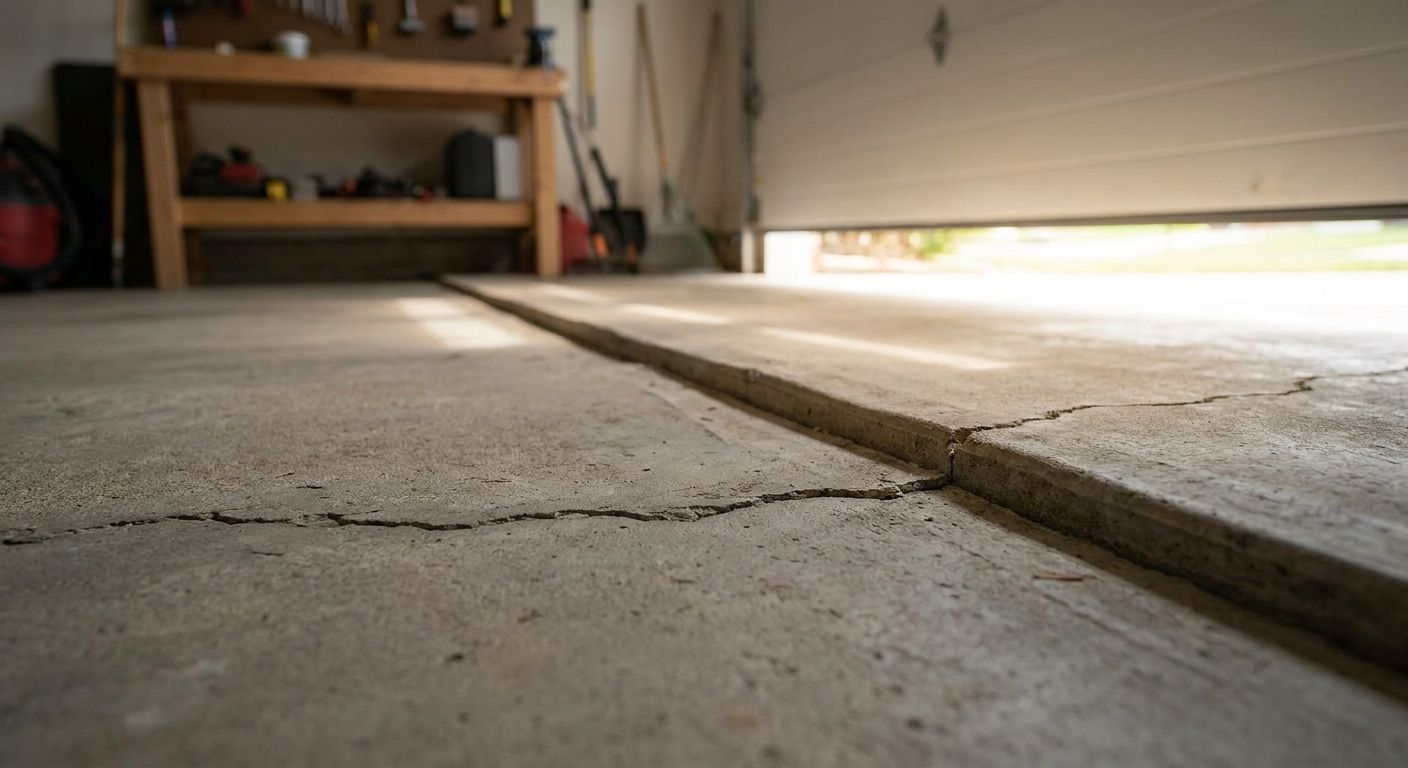
Alberta's freeze-thaw cycle moves more concrete than most homeowners realize, and a garage slab that drops even half an inch at one corner changes how the whole structure behaves. This guide walks through the exact checks a contractor runs before recommending concrete lifting, so you know whether your garage floor needs it in 2026 or can wait another season.
- A gap over 1/4 inch where the slab meets the foundation wall signals settling that needs concrete lifting, not just caulk.
- A garage door that binds or won’t seat flush often means the slab shifted, not the door hardware.
- Cracks wider than 1/4 inch or that run diagonally toward a corner point to soil movement under the slab.
- Ponding water at the same spot after every rain in 2026 usually means a low corner, and that’s a lifting job.
- Aztec Spray Systems checks slope, gaps, and crack direction on-site before recommending polyurethane concrete lifting for garage floors.
Why this matters
A garage slab sits on graded fill, not bedrock, and Calgary-area soils shrink and swell as moisture content changes through the year. When the fill under one section comprests faster than the rest, the slab tips instead of staying flat.
Ignoring it doesn't make it cheaper to fix later. A slab that's dropped an inch usually needs the same concrete lifting for garage floors treatment as one that's dropped two — but the wider the gap gets, the more water and de-icing salt work their way under the slab and into the foundation wall behind it. Catching the signs early keeps the repair simple.
What you'll need
- A flashlight or phone light for checking the slab-to-wall joint
- A 4-foot level or a long, straight 2×4
- A marble, ball bearing, or golf ball for a quick slope test
- A tape measure for gap and crack width
- 15 to 20 minutes with the garage door both open and closed
- Photos from the same angle if you plan to track changes over a season
None of this requires special equipment. If you find something worth a second opinion, that's the point where a contractor takes over.
The steps
1. Check the joint where the slab meets the foundation wall
This tells you whether the slab is pulling away from the house, which is the most common early sign of settling. Kneel at the wall and run the flashlight along the seam where the garage floor meets the foundation.
A gap under 1/8 inch with no step or ridge is normal seasonal movement. A gap over 1/4 inch, especially one that's wider on one side than the other, means the slab has dropped relative to the foundation and needs attention. Expect this check to take about two minutes per wall.
Common mistake: people assume the gap is just old caulking that fell out. Caulk doesn't explain a step where one side of the joint sits lower than the other — that's movement, not aging sealant.
2. Run the marble test for slope
This is the fastest way to find a low spot without any tools beyond something round. Set a marble or ball bearing in the middle of the slab and watch which direction it rolls.
If it rolls toward a specific corner and picks up speed rather than drifting, that corner has dropped. Garage floors are built with a slight pitch toward the door for drainage — a marble rolling toward the door in a straight line is normal; one curving toward a side corner is not.
3. Check how the garage door operates
A slab shift changes the geometry the door tracks were installed for, so the door tells you what's happening below the surface. Open and close the door slowly and watch the bottom seal.
If the seal makes contact on one side before the other, or the door binds partway through its travel, the slab under the track on that side has likely moved. This is one of the earliest signs homeowners notice because it affects daily use immediately.
4. Measure crack width and note the direction
Crack direction tells you whether you're looking at surface shrinkage or structural settling. Hairline cracks running straight across the slab, especially near control joints, are typically shrinkage from the original pour and aren't urgent.
Cracks that widen at one end, run diagonally toward a corner, or exceed 1/4 inch in width point to soil movement underneath. Measure with a tape measure at the widest point and record the date — a crack that's the same width in six months is stable; one that's grown is active.
5. Look for water pooling in a consistent spot
Standing water after every rain in the same location means gravity is finding a low point, and that low point is where the slab has settled. Watch the floor during or right after the next rainfall in 2026 and mark where water collects.
A puddle near the door apron that drains within an hour is normal. A puddle that sits for a day, or one that shows up even without recent rain because of groundwater, usually means concrete lifting for garage floors is warranted rather than a drainage fix alone.
6. Compare the garage slab to the driveway apron
Settling rarely stops at the garage threshold, so checking the adjoining concrete tells you how far the problem extends. Stand at the garage door opening and sight along the transition between the garage floor and the driveway.
A visible dip or lip where the two meet, even a small one, means the settling affects more than one slab. This changes the scope of the fix and is worth mentioning to whoever assesses the property.
7. Rate how fast the problem is changing
Slow, seasonal shifts of a few millimeters are common in Alberta and don't always need intervention. A slab that's visibly dropped in a single season, or where a crack doubled in width over a few months, is moving faster than normal soil settlement accounts for.
Take photos every few months from the same spot. If the change is measurable inside a year, that's the signal to book an assessment rather than keep monitoring.
Troubleshooting specific problems
- Hairline crack, no gap at the wall, door works fine — likely shrinkage cracking from the original pour. Monitor it once a season; no lifting needed yet.
- Slab sloped toward one back corner, marble rolls fast — soil compaction under that corner is the usual cause. This is a textbook case for polyurethane concrete lifting.
- Gap at the foundation wall wider on the door side than the back — the slab is rotating, not just dropping evenly, which usually means uneven fill density under the pour.
- Door binds only in cold months — frost heave can lift one side seasonally; get it checked in both winter and summer before deciding, since frost-related movement sometimes settles back on its own.
- Water pooling near the door and the driveway apron also dips — the settling has spread beyond the garage. Ask about whether driveway settling protection should be part of the same visit.
- Crack that widened noticeably over one winter — this is active movement, not old shrinkage. Book an assessment before the next freeze-thaw cycle makes it worse.
Get a garage floor assessment
Aztec Spray Systems checks slope, cracks, and gaps before recommending a fix.
Tools and resources
- A 4-foot level and tape measure cover most of the checks above
- Photos taken at the same time each season for comparison
- The foundation settling guide if the gap at the wall looks like more than a garage-floor issue
- A written note of crack width and date so changes are easy to compare later
What to do next
If two or more of the checks above came back positive, book an on-site assessment before the next Alberta freeze-thaw season adds more water infiltration under the slab. Aztec Spray Systems evaluates the slab, the adjoining driveway apron, and the foundation joint together, since garage floor settling rarely happens in isolation.
FAQ
How do I know if my garage floor needs concrete lifting?
Check for a gap over 1/4 inch at the foundation wall, a slab that slopes toward one corner, a garage door that binds, or standing water in the same spot after every rain. Two or more of these signs together usually means concrete lifting is the right fix in 2026 rather than a cosmetic repair.
Is a cracked garage floor always a sign of settling?
No, hairline cracks near control joints are usually shrinkage from the original concrete pour and aren’t urgent. Cracks over 1/4 inch wide, or ones that run diagonally toward a corner and keep growing, point to soil movement underneath.
How much does concrete lifting cost for a garage floor in Alberta?
Cost depends on slab size, how far it’s dropped, and how many injection points are needed, so pricing varies by property. An on-site assessment gives an accurate number rather than a general estimate.
Can I fix a sunken garage slab myself?
DIY mudjacking kits exist but don’t match the precision of professional polyurethane injection, and getting the lift wrong can crack the slab further. Most homeowners get a proper assessment before attempting a fix themselves.
Does a garage door that won’t close mean the slab has shifted?
Often, yes. If the door binds partway through its travel or the bottom seal contacts unevenly, the slab under one side of the track has likely dropped relative to the other side.
How long does concrete lifting take for a garage floor?
Polyurethane concrete lifting for a standard garage slab is typically a same-day process, with the surface usable again within hours rather than the days required for traditional mudjacking.
Will concrete lifting fix water pooling in my garage?
Lifting the low section back to grade removes the collection point, which resolves pooling caused by a sunken slab. Pooling caused by poor exterior drainage needs a separate fix alongside the lift.
Is settling in one garage slab a sign my whole foundation is at risk?
Not necessarily, since garage slabs are floating pads not tied structurally to the foundation the way basement walls are. But if the gap at the house wall keeps growing, it’s worth ruling out foundation settling as a separate issue.
One last thing
The marble test catches slope problems long before a crack ever shows up, and it costs nothing. Run it once each spring after the frost comes out of the ground in 2026 — that's when settling from the winter freeze-thaw cycle shows up most clearly, and it's the cheapest early-warning check a homeowner has.
Related guides
- Best concrete leveling method for foundation settling
- How to protect a driveway from future concrete settling