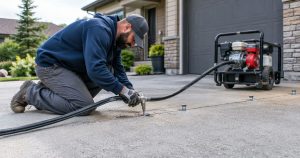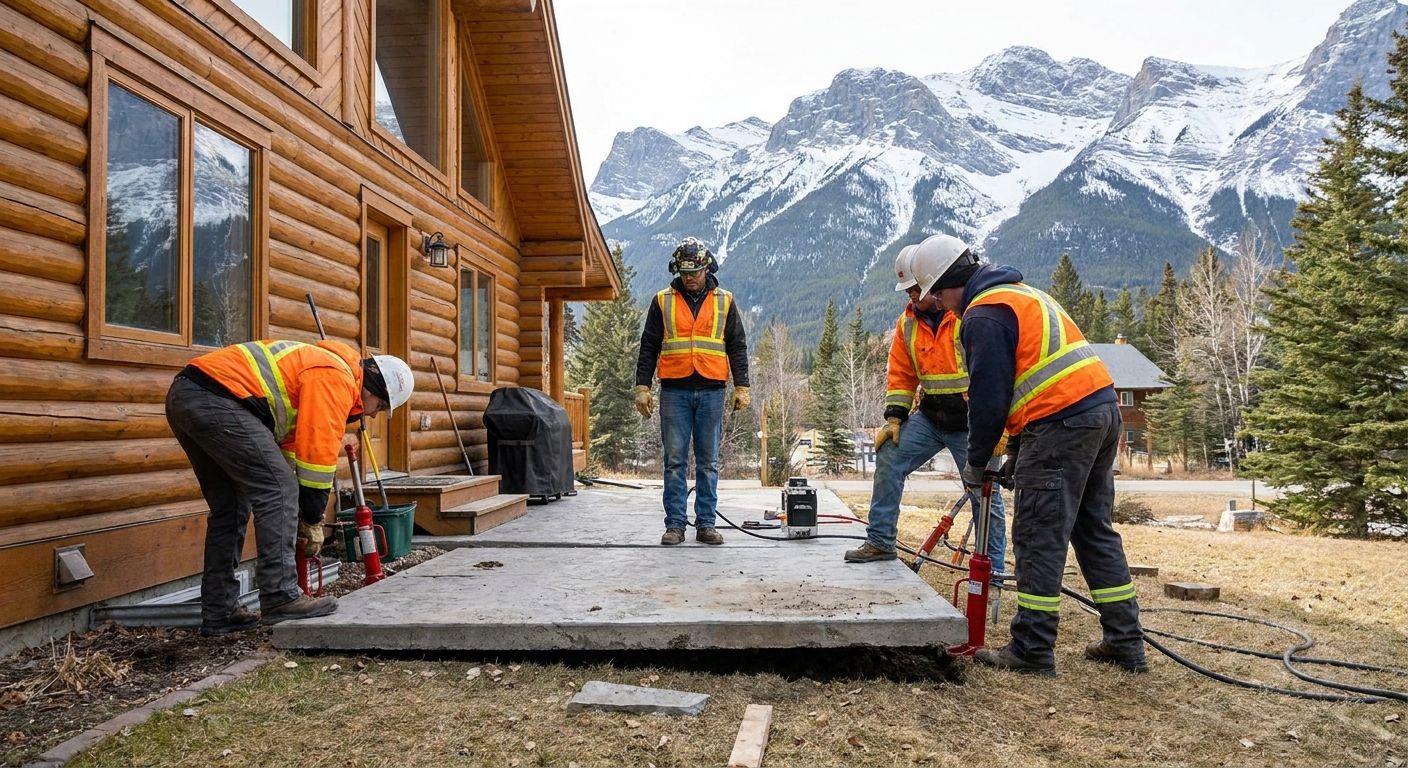
Concrete lifting for Canmore properties fixes sunken slabs, tilted walkways, and settling garage floors caused by the Bow Valley's freeze-thaw swings and shallow, rocky soils, and it does it without tearing out the existing slab. Canmore's terrain sits closer to bedrock than most Alberta towns, so settling here often shows up faster and in more places on a property than it does in flatter Calgary-area subdivisions.
- Concrete lifting canmore projects typically use polyurethane foam injection, which bears weight in about 15 minutes.
- Mountain-town freeze-thaw cycles accelerate slab settling faster than in flatter Alberta communities.
- Aztec Spray Systems handles concrete lifting for driveways, garage floors, and walkways without full slab replacement.
- Skipping drainage fixes before lifting is the most common reason a lifted slab settles again.
Why concrete lifting matters for Canmore properties
Canmore properties sit on a mix of glacial till, gravel, and rock outcrop that drains unevenly, and that unevenness is what pushes slabs down over time. A driveway or patio poured on loose fill near a rock shelf settles at a different rate than the section poured over compacted gravel, which is why Canmore slabs crack in a stair-step pattern more often than they sag evenly.
The fix isn't always a new slab. The best concrete lifting method for sunken slabs usually raises the existing concrete back to grade in a single visit, which matters in a town where driveway and walkway access can't sit torn up for a week during ski season or summer rental turnover. Concrete lifting is the faster, less disruptive option for most Canmore settling issues, and full replacement should be the last resort, not the first call.
Inspect your slab for settling signs
Walk the property before booking anyone. Look for:
- Gaps wider than 1/4 inch between slab sections or between the slab and the house foundation
- Pooling water on a patio or walkway after rain instead of draining away from the structure
- Doors or gates that used to swing freely now dragging on a slab threshold
- Visible tilt in a single slab section compared to its neighbors
- Cracking that runs in a stair-step pattern rather than a straight line
Check your soil and drainage conditions
Canmore's mix of rock and glacial fill drains unevenly, and bad grading around a slab is often what starts the settling in the first place.
- Confirm downspouts discharge at least a few feet from the foundation, not directly onto the slab
- Check that ground slopes away from the house rather than toward it
- Look for erosion channels near retaining walls or slab edges
- Note any recent excavation, tree removal, or grading work nearby that could have disturbed soil compaction
Try DIY fixes for minor cosmetic cracks
Hairline cracks under 1/8 inch with no vertical offset are usually cosmetic, not structural, and don't need a lifting crew.
- Seal small surface cracks with concrete caulk to keep water out before winter
- Re-grade soil by hand around a slab edge that's just starting to erode
- Fill minor gaps with polymeric sand on walkways and patios
- Monitor the crack with a pencil mark and date to see if it's actively widening
These fixes buy time on genuinely minor issues, but they don't stop settling that's already underway.
Get a professional evaluation before it worsens
Once a gap exceeds 1/4 inch or a slab section has visibly tilted, DIY patching stops being useful and turns into a way to hide a bigger problem. A professional evaluation checks what's happening under the slab, not just what's visible on top, which is the only way to identify foundation settling before it worsens.
Aztec Spray Systems evaluates Canmore-area slabs for void size, soil compaction, and drainage before recommending a method, and that evaluation is what determines whether foam injection, mudjacking, or replacement makes sense for a specific slab.
Choose a lifting method that fits the slab
Not every settled slab needs the same fix, and the wrong method wastes money on a slab that will settle again within a season.
- Polyurethane foam injection for driveways, garage floors, and walkways with moderate voids
- Mudjacking (mortar slurry) for larger slabs where foam cost would run high
- Soil stabilization injection alongside lifting when drainage has undermined the base
- Full replacement only when the slab is cracked through in multiple places or reinforcement has failed
Schedule lifting before winter freeze sets in
Ground temperature affects how well foam or slurry bonds to the soil under a slab, and Canmore's freeze window arrives earlier than Calgary's.
- Book evaluations in late summer or early fall before ground temperatures drop
- Prioritize driveways and walkways that see heavy foot or vehicle traffic in winter
- Address drainage issues before the first freeze, not after
- Avoid scheduling major exterior work during active frost, which limits which methods are viable
Maintain the slab after lifting
A lifted slab holds if the conditions that caused settling get addressed too, not just the slab itself.
- Re-check downspout discharge points each spring
- Reseal expansion joints annually to keep water out of the base
- Watch for new gaps forming at slab edges after the first winter
- Keep grading maintained around any slab that's been lifted
Comparison: concrete lifting options for Canmore properties
| Option | Best for | Cure/wait time | Key limitation |
|---|---|---|---|
| Polyurethane foam injection | Driveways, garage floors, walkways with moderate voids | Bears weight in about 15 minutes | Not suited to slabs with severe structural cracking |
| Mudjacking (mortar slurry) | Larger slabs, patios, and lower-cost projects | Cure time runs 24 to 48 hours before use | Heavier material can add stress to already-weak soil |
| Full slab replacement | Slabs cracked through in multiple sections | Days to a week depending on scope | Highest cost and most disruption to access |
Verdict: for most Canmore driveways and garage floors, polyurethane foam injection is the better call over mudjacking or replacement, because it's faster to cure and lighter on already-uneven soil.
Get a concrete lifting evaluation
Aztec Spray Systems evaluates Canmore-area slabs before recommending a method.
Common mistakes Canmore property owners make
- Ignoring stair-step cracking as cosmetic. On Canmore's uneven soil, that pattern usually means active differential settling, not surface wear.
- Waiting until multiple slabs are affected before calling anyone. One sunken walkway in 2026 often becomes three by 2027 if the underlying drainage issue isn't fixed.
- Sealing cracks without checking why they formed. Caulk stops water intrusion; it doesn't stop the soil movement causing the crack.
- Choosing full replacement by default. Many Canmore slabs qualify for foam injection at a fraction of the disruption of tear-out and repour.
- Regrading only the visible problem spot. Water diverted from one slab edge often just resurfaces at the next low point on the property.
FAQ
What is concrete lifting and how does it work in Canmore?
Concrete lifting raises a sunken slab back to grade by injecting polyurethane foam or mortar slurry beneath it, filling the void that caused the settling. In Canmore, uneven glacial soil and freeze-thaw cycles make this a common fix for driveways, walkways, and garage floors.
Is polyurethane foam injection better than mudjacking for Canmore slabs?
Polyurethane foam is generally the better choice for Canmore driveways and garage floors because it bears weight in about 15 minutes and adds less weight to already-uneven soil. Mudjacking works for larger patios but needs 24 to 48 hours to cure before use.
How much does concrete lifting cost in Canmore?
Cost depends on slab size, void depth, and which method fits the project, so an on-site evaluation is the only reliable way to get a number. Request a quote directly rather than relying on general estimates that don’t account for local soil conditions.
Can a sunken driveway be fixed without full replacement?
Yes, most sunken driveways with moderate settling qualify for foam injection or mudjacking rather than a full tear-out and repour. Full replacement is usually reserved for slabs cracked through in multiple sections.
How do I know if my garage floor needs concrete lifting?
Look for gaps wider than 1/4 inch at the floor’s edges, visible tilt toward one corner, or cracking in a stair-step pattern. These signs point to settling under the slab rather than a surface-only issue.
Does winter affect when concrete lifting can be done in Canmore?
Yes, ground temperature affects how well foam or slurry bonds to soil, so scheduling before the first hard freeze gets better results. Late summer through early fall is the more reliable window for Canmore properties.
Will a lifted slab settle again?
It can if the drainage or grading issue that caused the original settling isn’t addressed alongside the lift. Fixing downspout discharge and grading around the slab is what keeps a lift from needing a repeat visit.
Is concrete lifting worth it for a rental property in Canmore?
For short-term rental driveways and walkways, lifting is usually worth it because it restores access in a single visit instead of shutting the property down for a repour. That matters most during peak booking seasons.
One last thing
The detail most Canmore owners miss: foam injection cures fast enough to bear weight in about 15 minutes, which means a driveway or walkway lift often finishes in the same day it starts. That single fact is why concrete lifting beats full replacement for most Canmore properties in 2026, not just on cost but on how little the fix disrupts a property that depends on year-round access.
Related guides
- How to tell if your garage floor needs concrete lifting
- Best concrete leveling method for foundation settling
- Concrete lifting for sunken driveways