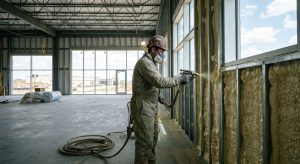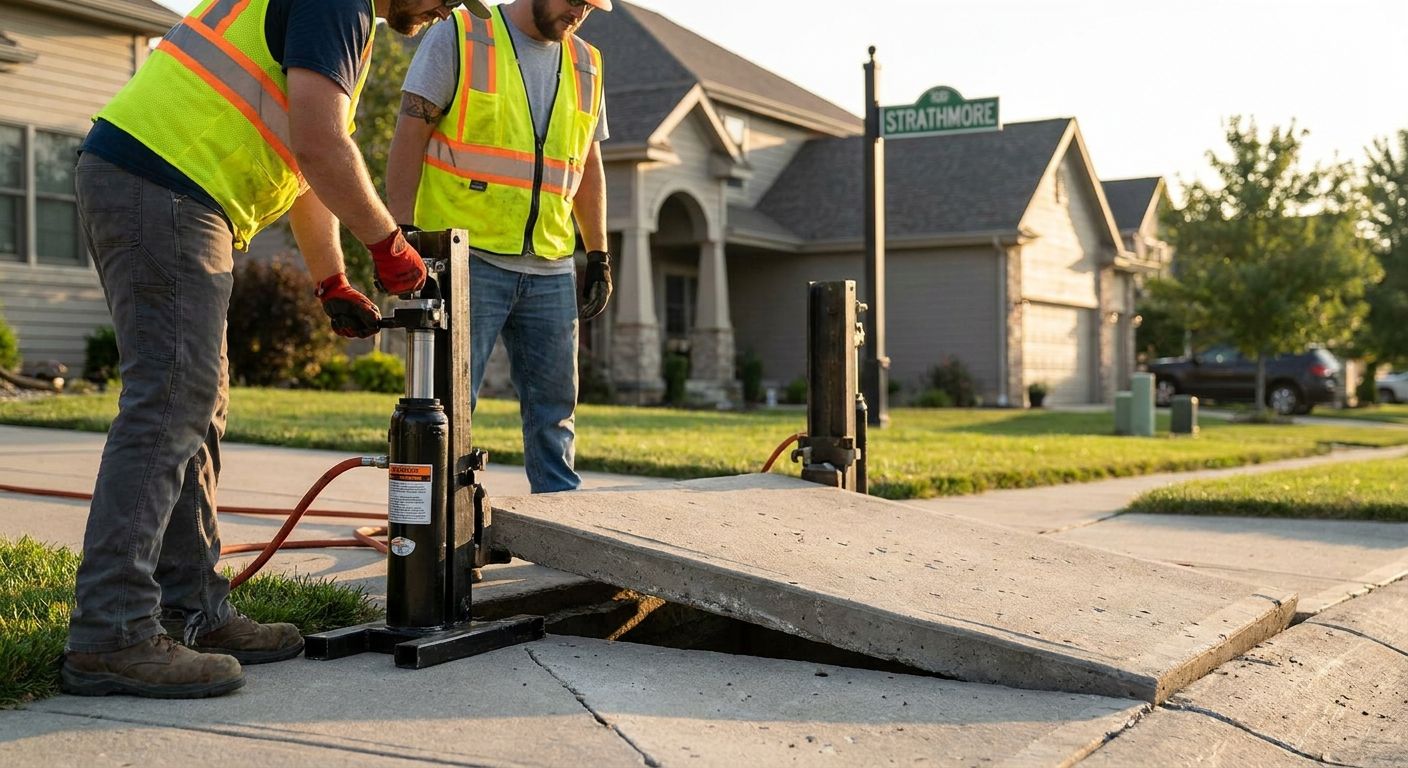
Strathmore concrete lifting is a polyurethane foam injection process that raises sunken driveways, walkways, and garage slabs back to level without ripping out the old concrete, with the aim of stopping trip hazards and drainage problems before they reach the foundation. Strathmore sits on the same expansive clay that runs through the Calgary region, and that clay swells and shrinks hard through freeze-thaw cycles every winter and spring — a pattern that settles slabs faster here than in areas with sandier, more stable soil.
- Concrete lifting Strathmore properties use polyurethane foam injection to raise slabs in about 15-30 minutes of cure time, not days.
- Aztec Spray Systems handles driveways, sidewalks, garage floors, and patios for Strathmore homeowners and commercial property owners.
- Mudjacking costs less upfront but adds weight to already-settled clay soil and needs 24-48 hours before full load.
- Full slab replacement only makes sense once cracking, rebar failure, or multiple voids show up together.
- Ignoring a 1-2 inch dip near a foundation wall in 2026 usually means a bigger repair by 2027.
Why concrete lifting matters for Strathmore properties
Strathmore's soil profile is the whole story here. The town sits east of Calgary on prairie clay that expands when it's wet and contracts hard when it dries out, and that movement is what pulls voids open under slabs over a handful of winters. Add freeze-thaw cycling — common across southern Alberta from November through March — and a slab that looked fine in October can show a visible dip by April.
Property owners searching for concrete lifting Strathmore solutions are almost always dealing with one of three triggers: a driveway that's pooling water at the garage apron, a sidewalk slab that's become a trip hazard, or a garage floor that's pulling away from the foundation wall. None of those get better on their own. Aztec Spray Systems treats concrete lifting as a foundation-protection measure first and a cosmetic fix second — the goal is stopping water intrusion and soil erosion under the slab, not just making it look level again.
Inspect your slab for settling signs
Start with a walk-around before calling anyone. Most settling is visible if you know what to look for.
- Measure the gap where the slab meets the garage threshold or foundation wall — anything over half an inch is worth flagging
- Check for pooling water within 24 hours of rain, especially near downspouts
- Look for stair-step cracking along control joints, which usually means differential settling rather than simple shrinkage
- Note any spots where the slab rocks underfoot when you walk or drive over it
- Photograph cracks in spring and again in late summer to see if they've widened
Diagnose the cause before lifting
Lifting a slab without knowing why it dropped just delays the next drop. A void from soil erosion behaves differently than settling from a leaking downspout or a poorly compacted base from the original pour.
- Trace downspout discharge points and confirm they carry water at least 4-6 feet from the slab
- Check for a nearby leaking pipe, sump discharge, or window well drain feeding the soil under the slab
- Ask whether the original grading sloped away from the structure — many older Strathmore properties were graded flat or even reversed over time
- Rule out tree roots pulling moisture from under a walkway, which is common with mature spruce and poplar
- Bring in a contractor for a probe test if the cause isn't obvious from the surface
Choose the right lifting method
There are really only two lifting technologies worth comparing for residential and light commercial work, plus replacement as the fallback when lifting won't hold.
- Polyurethane foam injection: lightweight, expands through small ports, cures fast enough to drive on the same day
- Mudjacking: cement-based slurry pumped through larger holes, heavier material, longer cure window
- Full replacement: demolition and repour, reserved for slabs with structural cracking or multiple failed sections
- Self-leveling compound: surface-only fix for interior floors with minor unevenness, not a true lift
- Aztec Spray Systems runs polyurethane foam injection as the primary method for Strathmore driveways, sidewalks, and garage floors because the lighter material doesn't add the load that heavier slurry does to soil that's already proven unstable
For a full side-by-side breakdown of how these methods hold up on different slab types, the best concrete lifting method for sunken slabs guide covers the tradeoffs in more depth than a single paragraph can.
Time the job around Alberta's freeze-thaw calendar
Concrete lifting works best when the ground isn't actively freezing or fully saturated from spring melt.
- Late spring through early fall is the reliable lifting window in the Strathmore area
- Avoid scheduling lifts during active frost heave, typically December through February
- If a slab needs urgent attention mid-winter, expect the contractor to test ground conditions before committing to a date
- Book ahead of the fall rush — most Alberta lifting contractors see demand spike in September and October before the ground firms up
Prepare the property for lift day
A little prep keeps the job fast and avoids surprises once the crew arrives.
- Clear vehicles, planters, and patio furniture off the slab at least a day ahead
- Mark any known utility lines or sprinkler heads near the injection area
- Confirm access for the equipment truck, especially on narrower Strathmore lots with shared driveways
- Ask what the injection ports will look like after the fill sets — usually a dime-sized patch
Maintain the slab after lifting
Lifting solves the immediate problem, but the soil conditions that caused it don't disappear on their own.
- Re-grade any area where water was pooling before the lift
- Extend downspouts that were discharging too close to the foundation
- Reseal control joints annually to keep water from re-entering the same void
- Watch the same trouble spot for two full freeze-thaw cycles before calling it fully stable
Know when full replacement beats lifting
Lifting isn't always the right call. A slab with extensive rebar corrosion, multiple large voids spread across the surface, or cracking that runs through the full thickness of the concrete usually needs replacement instead.
- If more than 40% of the slab surface shows cracking, replacement is usually more cost-effective long-term
- Slabs poured without rebar or wire mesh often crack again after lifting because there's nothing tying the sections together
- A slab that's been lifted twice in under five years is a signal the underlying soil problem was never fixed
Comparing your options
| Option | Best for | Typical cure/set time | Key limitation |
|---|---|---|---|
| Polyurethane foam injection | Driveways, sidewalks, garage floors needing fast return to use | About 15-30 minutes | Small injection ports need patching for a fully seamless finish |
| Mudjacking | Larger slabs where the priority is filling a big void | 24-48 hours before full load | Heavier slurry adds weight to soil that's already proven unstable |
| Full slab replacement | Slabs with severe cracking, failed rebar, or multiple voids | Standard concrete cure schedule | Highest disruption, full demolition required |
| DIY crack sealing | Cosmetic hairline cracks with no vertical drop | Immediate | Does nothing to fill the void causing the settling |
Polyurethane foam injection is the right call for most Strathmore driveways and walkways settling less than two inches; full replacement is the right call once cracking runs through the slab in multiple places.
Get your Strathmore slab assessed
Find out if lifting or replacement fits your driveway, walkway, or garage floor.
Common mistakes Strathmore property owners make
- Waiting for a bigger drop before calling anyone. A half-inch settle in 2026 becomes a two-inch settle by 2027 once the same void keeps eroding under freeze-thaw cycling.
- Fixing the crack but not the drainage. Sealing a joint without redirecting the downspout that's feeding water under the slab just delays the next settle.
- Assuming lifting fixes a drainage problem on its own. Lifting restores grade; it doesn't replace proper slope away from the structure.
- Choosing mudjacking for a garage floor with an already-unstable subgrade. The added weight from slurry can accelerate settling on soil that's already proven it can't support load.
- Treating a lifted slab as permanently fixed. Without addressing the root cause, the same spot can drop again within a few seasons.
FAQ
What is concrete lifting and how does it work in Strathmore?
Concrete lifting injects polyurethane foam through small drilled ports under a settled slab, and the foam expands to fill the void and raise the concrete back to grade. In Strathmore, expansive clay soil and freeze-thaw cycling are the most common causes of the void forming in the first place.
Is polyurethane foam better than mudjacking for Strathmore driveways?
Polyurethane foam is generally the better fit because it’s lighter and cures in about 15-30 minutes versus 24-48 hours for mudjacking. The lighter material also avoids adding extra load to clay soil that’s already shown it can’t fully support the slab.
How do I know if my slab needs lifting or full replacement?
If cracking is limited to one or two spots and the slab hasn’t dropped more than a couple inches, lifting usually works. Once cracking spans more than about 40% of the surface or rebar has failed, full replacement is the more durable fix.
Can concrete lifting be done in winter in Alberta?
It’s possible but not ideal, since active frost heave and fully saturated ground make results less predictable. Late spring through early fall is the reliable window for concrete lifting in the Strathmore area.
How long does a garage floor lift take to cure?
Polyurethane foam injection typically sets within 15-30 minutes, meaning the floor can usually take vehicle weight the same day. Mudjacking needs 24-48 hours before it can handle full load.
Does concrete lifting stop the slab from settling again?
Lifting fixes the immediate void, but the soil conditions that caused the settling don’t disappear on their own. Re-grading, extending downspouts, and resealing joints after the lift are what actually prevent a repeat.
What causes concrete slabs to sink in Strathmore specifically?
Expansive clay soil that swells and shrinks with moisture, combined with seasonal freeze-thaw cycling, is the most common driver. Poor original compaction and downspouts discharging too close to the slab are the next most common causes.
Is DIY crack sealing a real fix for a sunken slab?
Sealing a crack only stops surface water from entering; it does nothing to fill the void underneath that caused the slab to drop. It’s a reasonable short-term step for cosmetic hairline cracks but not a substitute for lifting when there’s measurable vertical displacement.
One last thing
Polyurethane foam used in concrete lifting is roughly one-tenth the weight of the mudjacking slurry it replaced, which is exactly why it doesn't add the load that pushes already-settled clay further down — that weight difference, more than the injection technique itself, is what separates a lift that holds for years from one that needs a repeat visit within a couple of freeze-thaw cycles.
Related guides
- Best concrete lifting method for sunken slabs
- How to tell if your garage floor needs concrete lifting
- How to identify foundation settling before it worsens
- Spray foam insulation for Strathmore homeowners