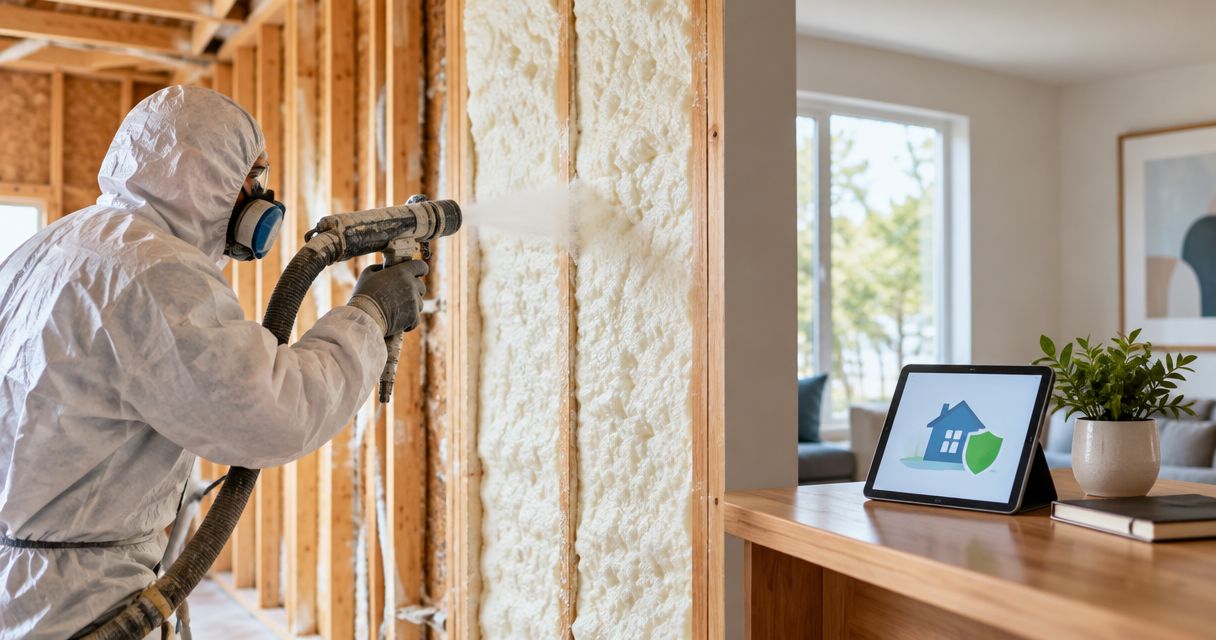
Spray foam insulation does not automatically lower your home insurance premium; count on a reduction only when your insurer confirms one for your policy. Better insulation and lower heating demand are separate from an insurance discount. Before you schedule work in 2026, ask your insurer whether the proposed installation affects your premium, coverage, or documentation requirements.
- A spray foam insulation home insurance premium reduction requires confirmation from your insurer, not a contractor’s estimate.
- Alberta homeowners should separate energy savings, insurance discounts, and coverage for damaged insulation.
- Aztec Spray Systems provides insulation services; your insurer decides policy terms and any premium adjustment.
- Get the proposed installation reviewed before work begins, then retain the completed project records.
Can spray foam insulation lower your home insurance premium?
Do not budget for an insurance saving until your insurer confirms it in writing. There is no policy-specific discount established here, and an insulation upgrade alone does not establish eligibility for one.
Start by separating the questions below. They involve different decisions, even though each concerns the same renovation.
| Question | What establishes the answer | What does not establish it |
|---|---|---|
| Will the premium decrease? | Your insurer’s written assessment of your policy and proposed work | A general claim that insulation saves energy |
| Will the installation be acceptable? | Your insurer’s response to the actual installation details | A statement that all spray foam projects are treated alike |
| Will damaged insulation be covered? | Your policy wording and the circumstances of the loss | Confirmation that the material was professionally installed |
| Will the home use less heating energy? | The building’s condition, project design, and energy performance | An insurance discount or coverage decision |
If your immediate concern is replacing damaged material, read about attic insulation and home insurance in Alberta. A claim for damage is not the same as a premium reduction for an improvement.
Why this matters
A renovation decision becomes harder when an assumed insurance benefit gets added to the expected comfort and energy benefits. You need to know which benefits belong to the building and which require a separate agreement with an insurer.
For your 2026 project budget, keep an unconfirmed discount out of the calculation. That protects your decision from depending on a benefit you have not secured.
The practical goal is not simply a lower bill. You also want the insurer to understand the work, the contractor to document the installation, and your records to match the finished home. Treat those as separate tasks rather than expecting one invoice to settle everything.
How do you check whether your insurer offers a reduction?
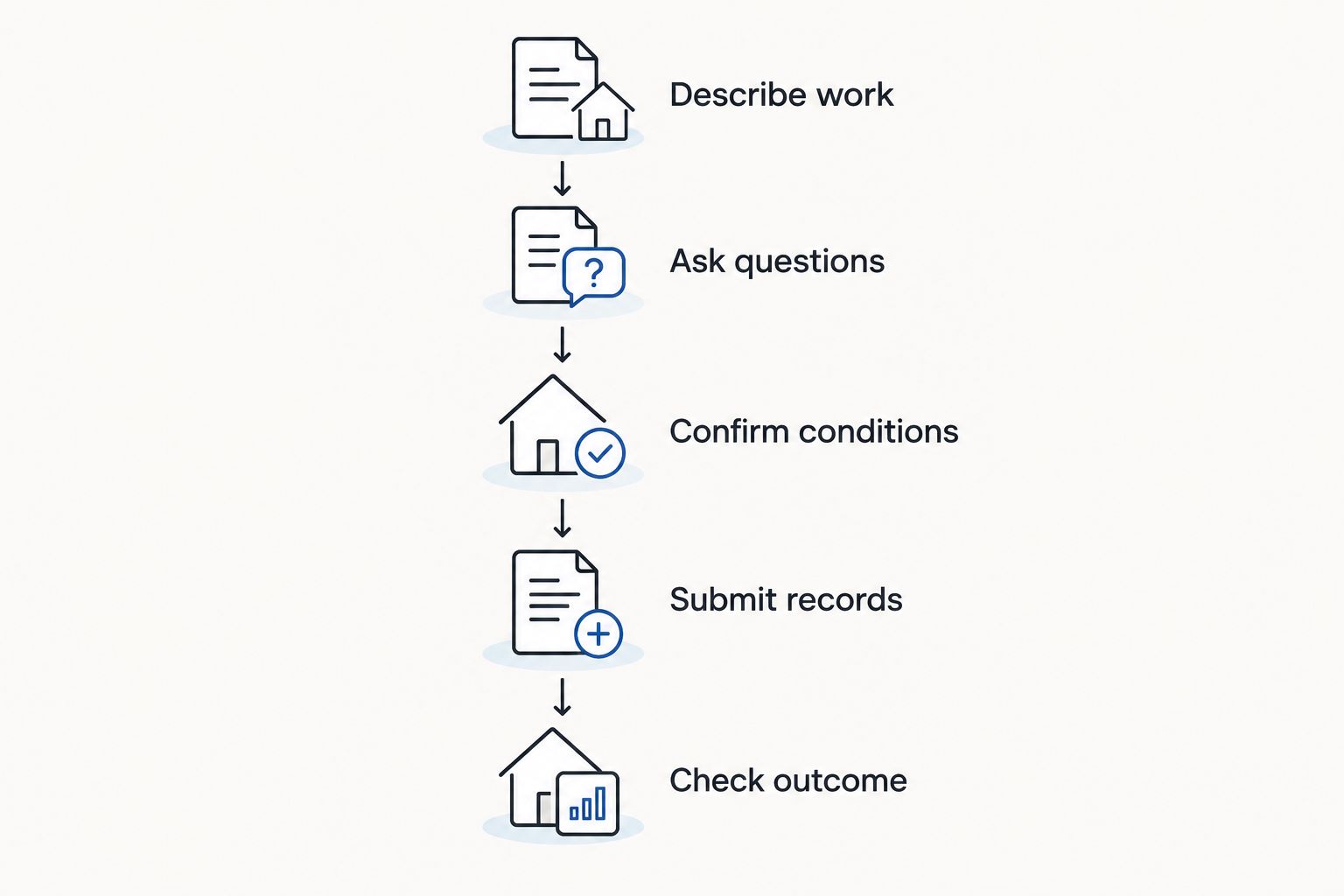
Use the following process before authorizing the installation. Ask about your actual project, not spray foam in the abstract. A description of where the material will go gives the insurer a clearer basis for responding.
Describe the work before requesting a discount
Send your broker or insurer the proposed scope. Identify the property, the area being insulated, and whether the work changes an existing wall, attic, basement, or roof assembly.
Include the product information supplied by the contractor. If the scope is still being developed, say so; do not present a preliminary plan as the final installation design.
Ask separate questions about premium and coverage
Ask whether the installation qualifies for a premium adjustment, whether the insurer needs to approve any details, and what completion records it wants. Request a written response that identifies your property or policy.
A statement that the work is acceptable does not necessarily answer the discount question. Likewise, a discussion about a possible discount does not replace a clear answer about coverage conditions.
Confirm any conditions before work begins
Give the contractor the insurer’s relevant requirements before the installation is scheduled. Resolve requests for product documents, photographs, or inspections while those items can still be incorporated into the project.
If the insurer requests something the contractor cannot provide, settle that issue first. Do not rely on a promise to sort out the paperwork after the work is concealed.
Submit the completion records
After installation, send the records the insurer requested. Keep your own copy alongside the written scope and any changes agreed during the project.
Ask the insurer to confirm whether it has everything needed to complete its review. Sending documents is a step in the process, not proof that a discount has been applied.
Check the policy outcome
Review the insurer’s final response and any updated policy documents. Confirm the effective date of an adjustment and check whether coverage, deductibles, or other terms also changed.
For a 2026 renewal comparison, use matching coverage wherever possible. A different premium does not, by itself, tell you how much of the change relates to insulation.
What should you ask your broker or insurer?
A useful request is specific enough to answer without guessing. Send the proposed scope and ask the insurer to address each point separately.
- Discount eligibility: Does this installation qualify for any adjustment under my current policy?
- Installation acceptance: Are there conditions concerning the proposed material, location, or assembly?
- Project notification: What information do you need before work starts?
- Completion evidence: Which documents or photographs should I submit afterward?
- Policy changes: Will the work affect any coverage terms, exclusions, or deductibles?
- Effective date: If an adjustment is approved, when does it take effect?
Keep the reply with your project records. If you speak by telephone, send a short written follow-up asking the insurer to confirm your understanding.
You can organize the discussion into 3 questions: Is the installation acceptable, is a discount available, and what evidence is required? This is a communication checklist, not an insurer’s mandatory form.
Why the insurance answer varies
The answer belongs to the policy and the proposed work, not the material name alone. These are the details to establish rather than assume:
- The policy involved. Ask your current insurer for its decision; do not substitute another homeowner’s experience.
- The installation scope. Specify whether the project concerns an attic floor, roofline, wall, basement, or another location.
- The finished assembly. Describe the complete proposed work, including any protective covering and related changes.
- The evidence requested. Confirm what the insurer needs to assess the project and record completion.
- Other policy changes. Separate the insulation discussion from changes to coverage, deductibles, or property use.
These points do not establish a discount or predict an increase. They establish what your insurer needs to answer the question accurately.
Do not treat an insurer’s request for more information as either approval or refusal. Ask what remains unresolved and who will provide the answer.
What installation details deserve attention?
Spray foam is part of a building assembly. Its suitability depends on more than whether it fills a gap, so the project discussion should include the substrate, moisture conditions, air control, and the finished protective layers.
Foam plastic insulation is combustible, and applicable requirements for protection depend on the assembly. Review fire-code requirements for spray foam insulation with the contractor rather than assuming exposed foam is acceptable everywhere.
Before work starts, ask how existing leaks or damp materials will be addressed. Insulation is not a substitute for repairing a roof leak or correcting a water-entry problem.
Also ask how the proposed work fits the home’s ventilation and moisture-control approach. Adding insulation and controlling air leakage are related building tasks, but neither eliminates the need for a suitable ventilation plan.
For a 2026 retrofit, keep the technical and insurance reviews separate. A suitable assembly still needs a policy-specific insurance answer; an insurer’s acceptance does not replace the contractor’s installation responsibilities.
What records should you keep?
Build one project file that explains what was proposed, what was installed, and what the insurer accepted. You should be able to understand it without reconstructing a series of telephone conversations.
Use 3 record groups to keep the file manageable:
- Before installation: Written scope, product information, photographs of accessible areas, and the insurer’s instructions.
- At completion: Final invoice, installation records supplied by the contractor, photographs, and applicable inspection documents.
- After insurer review: Written acceptance, any confirmed adjustment, and updated policy documents where issued.
These groups are an organizing recommendation, not a universal documentation requirement. Follow the insurer’s actual instructions and the requirements applicable to your project.
Photograph areas that will later be covered, where it is safe and practical to do so. Ask the contractor to identify the location shown in each image; an unexplained close-up of foam tells a future reader very little.
Where does an insulation contractor fit?
Aztec Spray Systems is best suited to homeowners seeking spray foam installation in Calgary, Okotoks, High River, and Lethbridge—not insurance advice. The licensed and insured contractor provides spray foam and attic insulation services to homeowners and commercial property owners in those communities.
Ask Aztec Spray Systems for a written scope that you can send to your insurer. Confirm which product and completion records will be supplied before you authorize work.
The benefit of involving a contractor early is a defined installation proposal rather than a vague description. The limit is equally important: a contractor cannot establish your insurer’s discount eligibility or interpret coverage on the insurer’s behalf.
Do not confuse contractor insurance with your home insurance. They concern different parties and different responsibilities; one does not confirm the terms of the other.
Will lower heating bills reduce my insurance premium?
Lower heating bills do not establish eligibility for a home insurance discount. Energy performance and insurance terms are separate matters, even when both relate to the same property improvement.
Evaluate the insulation project against the building problems you want to address. Drafts, uneven temperatures, and inadequate insulation call for a building assessment, not an assumed insurance benefit.
For your 2026 decision, record the energy and comfort objectives separately from the insurer’s response. That makes it easier to judge whether the project meets its purpose even when the premium stays unchanged.
Should I compare insurance quotes after the upgrade?
Compare quotes when you want to review your policy, but give each insurer the same accurate description of the completed work. Otherwise, the offers are not answering the same question.
If you request 2 policy quotes, compare the coverage, deductibles, exclusions, and declared property details alongside the premium. Two is a practical starting point for a comparison, not a claim about how many quotes every homeowner needs.
Ask each insurer to identify any adjustment it attributes to the insulation. Do not label the entire difference between quotes a spray foam saving.
FAQ
Does spray foam insulation automatically lower home insurance in Alberta?
Spray foam insulation does not automatically lower home insurance in Alberta. Count on a reduction only after your insurer confirms eligibility and the adjustment for your policy.
Should I tell my insurer before installing spray foam?
Tell your insurer about the proposed spray foam project before work begins and ask what notification or approval your policy requires. Send the written scope so the response concerns the actual installation.
Can a spray foam contractor guarantee an insurance discount?
A spray foam contractor cannot guarantee an insurer’s discount decision. Aztec Spray Systems can discuss the installation scope, while your insurer determines policy terms and any adjustment.
Does an energy-efficiency improvement prove I qualify for a discount?
An energy-efficiency improvement does not prove insurance-discount eligibility. Ask your insurer whether a relevant adjustment exists and what evidence it requires.
Will my insurer pay to replace damaged spray foam insulation?
Coverage for damaged spray foam depends on your policy and the circumstances of the loss. Ask the insurer to assess the damage rather than treating an upgrade discussion as a claims decision.
What paperwork should I keep after spray foam installation?
Keep the written scope, supplied product and installation records, final invoice, photographs, and insurer correspondence. Include applicable inspection documents and any updated policy documents.
Does an unchanged premium mean the insulation failed?
An unchanged premium does not establish that the insulation failed. Assess installation quality and building performance separately from the insurer’s pricing decision.
One last thing
Ask for two written answers: whether the installation is acceptable and whether it changes the premium. An answer to the first question is not an answer to the second.
Keep both responses in your 2026 project file. That small distinction prevents an accepted renovation from becoming an assumed discount.
Related guides
- Is a permit required for spray foam insulation in Calgary?
- Connecting a home inspection report to a spray foam repair
- How to air-seal an attic before adding insulation