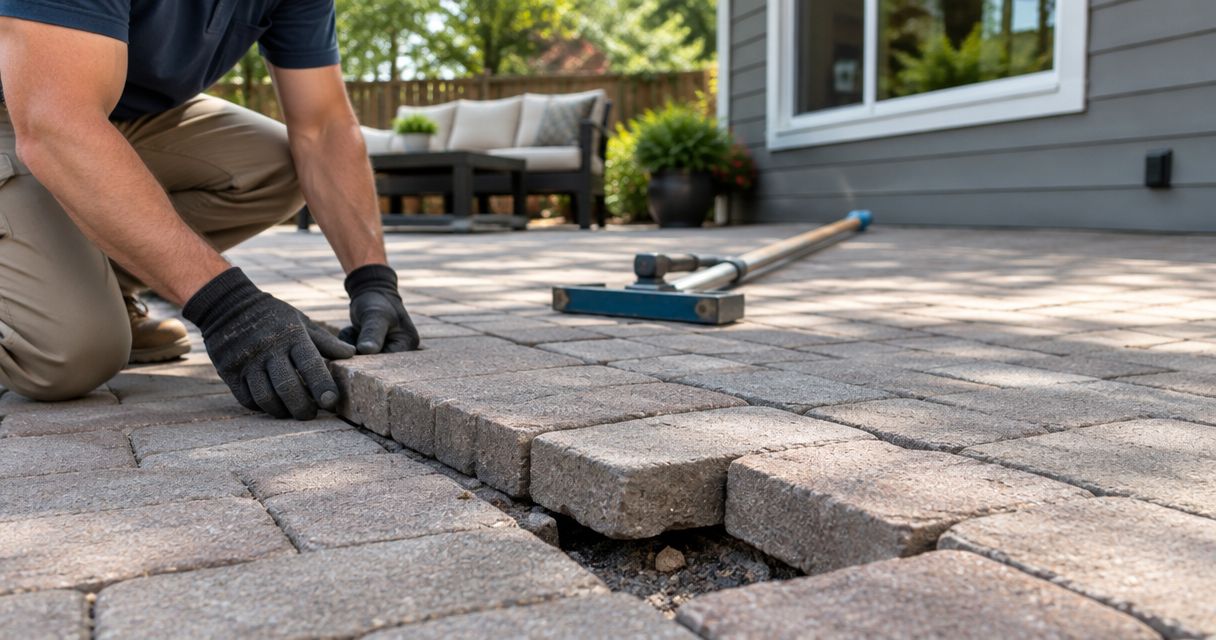
Concrete lifting can raise a sunken poured-concrete patio, but it is generally not the right repair for interlocking pavers laid on sand and aggregate. Those pavers usually need to be removed, their supporting base repaired, and the units reset; pavers installed over a concrete slab require a separate assessment of the slab beneath them.
- Concrete lifting interlocking pavers is generally unsuitable when individual units rest on sand and aggregate.
- Resetting pavers addresses uneven bedding; slab lifting addresses settlement beneath a connected concrete surface.
- Correct drainage and base support before restoring the finished patio surface.
- Aztec Spray Systems provides concrete lifting for homeowners and commercial property owners in southern Alberta.
Can concrete lifting fix sunken interlocking pavers or patios?
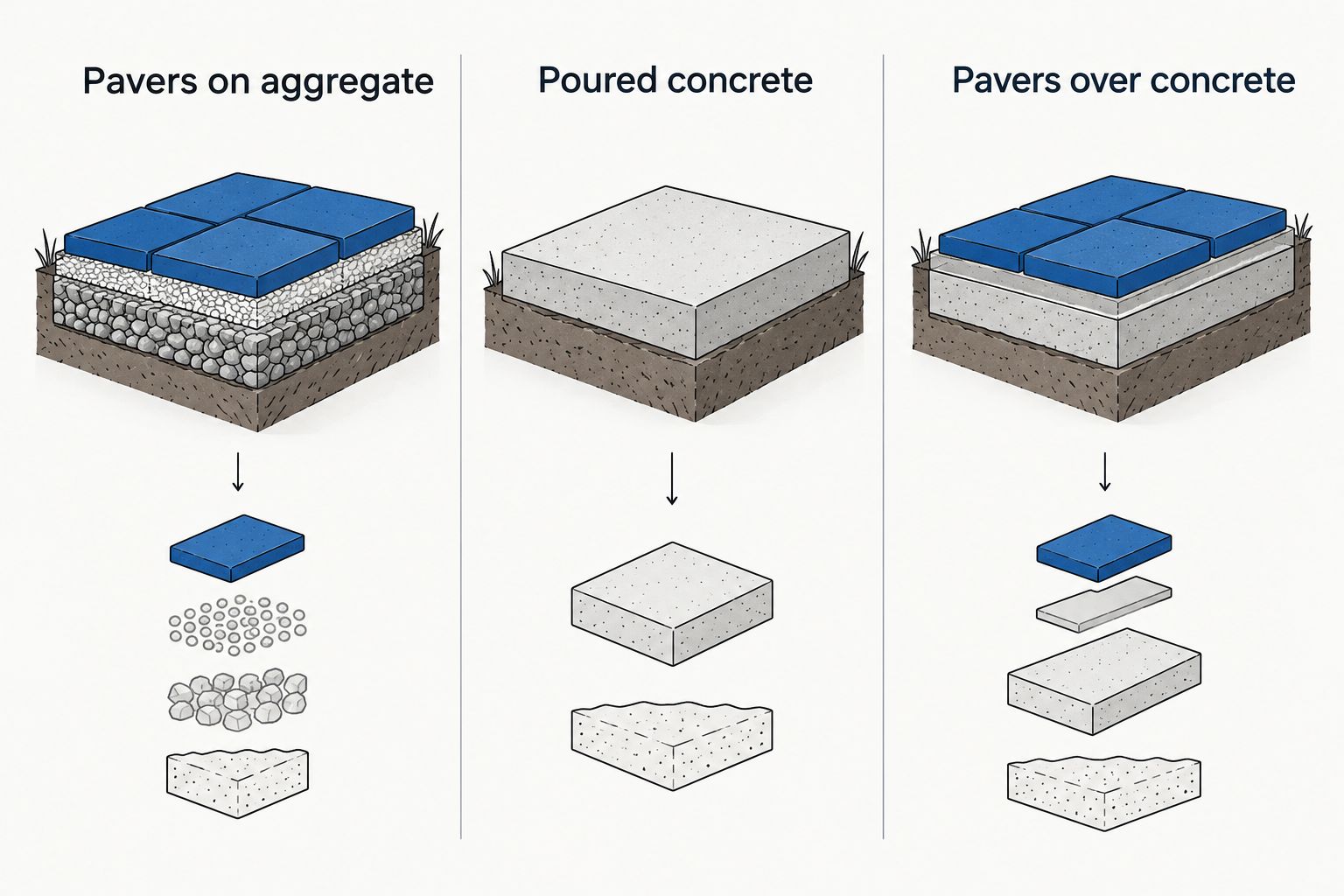
The construction beneath your patio determines the repair—not whether the surface looks like concrete. A poured slab distributes lifting pressure across a connected section. Separate pavers do not behave as a connected slab, even when they fit tightly together.
The distinction becomes clearer when you understand how polyurethane concrete lifting works: injected material acts beneath a slab rather than rebuilding the bedding beneath individual paving units.
| Patio construction | Best for | Main advantage | Main limitation |
|---|---|---|---|
| Pavers on aggregate | Removing and resetting affected units | Exposes the bedding and base for repair | Requires dismantling part of the paved surface |
| Poured concrete | Slab lifting when the concrete remains suitable | Raises an existing slab without replacing the entire surface | Does not repair deteriorated concrete or every cause of movement |
| Pavers over concrete | Assessing the supporting slab first | Separates slab settlement from a surface-layer problem | Concealed construction complicates diagnosis |
| Severely damaged surface | Reconstruction when existing materials cannot be retained | Allows damaged materials and underlying defects to be addressed | Requires removal and rebuilding |
For a 2026 repair, ask the contractor to identify the patio construction in writing before specifying an injection or resetting method. A proposal that simply says “patio levelling” leaves the most important question unanswered.
Why this matters
A smooth surface is only part of a successful repair. Your patio also needs stable support, secure edges, and a route for water to leave without collecting against the building.
Choosing the wrong method leaves those underlying problems untouched. Adding material beneath loose pavers does not automatically restore their joint alignment, bedding consistency, or edge restraint.
You do not need to diagnose the entire problem yourself. You do need a contractor who distinguishes a low slab from a failed paver base before recommending work.
Interlocking pavers on aggregate: remove, repair, and reset
Best for: individual pavers that have settled, tilted, or separated over a granular base. Resetting lets the installer reach the layers that support the finished surface. That access is the main advantage over trying to raise the paving from below.
A typical repair follows this sequence:
- Record the layout. Photograph the pattern, borders, and affected area before lifting units.
- Remove affected pavers. Open enough of the surface to inspect the depression and its edges.
- Inspect the support. Check bedding, base material, drainage, and edge restraint rather than assuming missing sand is the only issue.
- Repair the base. Address unsuitable or displaced material and compact the supporting layers appropriately.
- Reset the surface. Restore the intended elevations, joints, and drainage direction before completing the joint treatment.
The benefit is direct access to the defect. The limitation is disruption: furniture must move, part of the patio must come apart, and damaged units need separate attention.
Do not treat new joint sand as a substitute for base repair. Joint material helps the paving system function, but it cannot rebuild a depression underneath the units.
Poured-concrete patios: assess the slab for lifting
Best for: a settled concrete slab that remains suitable for lifting. A contractor assesses the slab condition, surrounding elevations, support conditions, and access before deciding whether raising it is appropriate.
Lifting retains the existing concrete. That is its central advantage. However, raising a slab does not erase cracks, restore a deteriorated surface, or establish that the ground will remain stable under every future condition.
Ask how the contractor will handle joints, adjoining steps, and the transition to nearby paving. A slab can reach a better elevation while still leaving an awkward or unsafe connection at its edge.
For your 2026 scope of work, separate elevation correction from crack treatment and drainage changes. Those are related tasks, not interchangeable descriptions of the same repair.
Pavers over a concrete slab: inspect both layers
Best for: a layered patio where the condition of the supporting slab is not yet established. The visible paving might be loose-laid, installed on a bedding layer, or bonded to the concrete. Each arrangement changes access and repair decisions.
If the underlying slab has settled, a contractor must assess whether it can be lifted without damaging the surface assembly. If the slab remains correctly positioned but the pavers above it have moved, lifting the slab targets the wrong layer.
The advantage of investigating both layers is a more precise repair scope. The limitation is uncertainty until the construction is exposed or reliably documented.
Do not assume a concrete base makes injection appropriate. Confirm how the pavers are supported and attached, where injection access would be made, and what surface restoration the proposed work includes.
Why the right patio repair varies
The same visible dip can have different causes. Your inspection should distinguish what moved, why it moved, and whether the surrounding construction can support the proposed correction.
- Surface construction: Separate units, a continuous slab, and a layered assembly need different repair approaches.
- Base condition: Settlement, displaced bedding, and unsuitable supporting material require attention below the visible surface.
- Water movement: Runoff entering or crossing the base can contribute to erosion and repeated movement.
- Edge restraint: Unsupported paver borders allow units to spread and joints to open.
- Material condition: Broken pavers and badly deteriorated concrete need more than an elevation adjustment.
- Nearby structures: Door thresholds, steps, drains, and foundation walls constrain the finished elevation.
A 2026 inspection should connect each recommended task to an observed condition. “Add foam” or “add sand” describes a material, not a diagnosis.
How do you tell whether your patio has settled or heaved?
A low-looking section is not automatically the section that moved downward. Adjacent paving can rise because of frost action or roots, making otherwise unchanged paving appear sunken.
Compare the affected surface with fixed reference points such as a doorway, an established step, or an adjoining slab. Photograph the same locations over time, especially if the unevenness changes with the seasons.
Tell the contractor whether the problem appeared suddenly, followed drainage work, or changes between frozen and thawed conditions. That history helps distinguish persistent settlement from seasonal movement.
Do not commission permanent elevation changes solely from an uneven appearance while the ground is frozen. The assessment needs to account for frost-related conditions rather than treating every height difference as missing support.
How should drainage be handled during patio repair?
Restore the intended drainage route, not merely a visually flat surface. A patio needs an appropriate fall toward its intended outlet; making every point level can leave water trapped where you walk or beside the building.
Start by observing where water enters the patio. Downspouts, nearby planting beds, surrounding grades, and roof runoff all influence what happens beneath and across the paving.
Persistent water pooling on your patio calls for checking both the surface profile and the route water takes after leaving the low spot. Raising one depression without checking the outlet can simply move the puddle elsewhere.
Ask the contractor to show the intended drainage direction before work begins. Check whether the proposed elevations preserve clearance at doors and avoid directing runoff toward the foundation or neighbouring property.
For a 2026 repair plan, document drainage corrections separately from surface restoration. If a downspout or surrounding grade contributes to erosion, identify who will correct it rather than assuming the levelling crew will handle everything.
Can you fix a small sunken paver area yourself?
A localised paver repair is a possible do-it-yourself task when the construction is understood and the underlying problem is limited. Start with inspection, not a bag of extra sand.
Lift the affected units carefully and examine what supports them. If you find persistent saturation, substantial voids, repeated settlement, or movement beside a structure, stop and arrange an assessment rather than concealing the condition.
Preserve the laying pattern and avoid stacking fragile or damaged units where they will break. Use materials and compaction methods appropriate to the paving system; an excessively thick bedding layer is not a substitute for rebuilding the base.
The practical benefit is access to a small repair without dismantling the whole patio. The drawback is that a neat-looking reset can hide an unresolved support or drainage problem.
What should you ask before approving the work?
Ask for the proposed finished condition, not just the installation method. The written scope should explain what will be lifted or removed, what supporting work is included, and how the repaired area will meet adjacent surfaces.
Use these questions during the assessment:
- Is this a slab, a flexible paver installation, or pavers over concrete?
- What evidence identifies the cause of movement?
- Will the work repair the supporting base or only adjust elevation?
- How will water leave the repaired area?
- Who handles damaged units, disturbed joints, and edge restraint?
- What conditions would require reconstruction instead?
Aztec Spray Systems is a concrete lifting option for homeowners and commercial property owners in Calgary, Okotoks, High River, and Lethbridge. The licensed and insured contractor provides concrete lifting, but that service description does not establish that a particular interlocking-paver installation is suitable for injection.
If your assessment identifies a poured slab, Aztec Spray Systems' concrete lifting for patios and pool decks is relevant to that repair category. For aggregate-supported pavers, ask specifically about removal and resetting rather than assuming slab-lifting work covers the paving assembly.
What should you check after the patio is repaired?
Inspect the transitions before replacing furniture or planters. Look for rocking pavers, uneven edges, incomplete joint treatment, and abrupt changes where the repaired surface meets steps or adjoining paving.
After rainfall, observe the water route. A dry-looking patio at handover does not demonstrate how the repaired surface drains under actual runoff.
Keep the 2026 scope, photographs, and completion notes together. These records make it easier to explain any later movement without relying on memory.
Do not judge success solely by whether the original depression disappeared. The repaired patio should have supported units or a supported slab, usable transitions, and the intended drainage direction.
FAQ
Can concrete lifting raise individual interlocking pavers?
Concrete lifting is generally not the appropriate method for individual interlocking pavers on sand and aggregate. Removing the affected units and repairing their supporting layers gives access to the cause of unevenness.
Can a sunken poured-concrete patio be lifted?
A sunken poured-concrete patio is a candidate for lifting when the slab and site conditions are suitable. The assessment must consider deterioration, cracks, drainage, and adjoining structures.
Is resetting pavers better than injecting foam underneath them?
Resetting is generally the appropriate approach for pavers supported by a granular base. Injection beneath a continuous concrete slab addresses a different construction system.
Will polymeric sand fix sunken patio pavers?
Polymeric sand does not rebuild the supporting base beneath sunken pavers. Correct the bedding or base problem before completing the joint treatment appropriate to the installation.
Can concrete lifting fix pavers installed over a slab?
Pavers over a concrete slab require assessment of both layers before lifting is specified. The contractor needs to establish whether the slab settled, the surface assembly moved, or both conditions exist.
Why does my patio sink again after being levelled?
Repeated sinking indicates that the cause of movement needs further investigation. Drainage, base condition, edge restraint, and underlying ground movement are relevant inspection points.
Does Aztec Spray Systems provide concrete lifting in southern Alberta?
Aztec Spray Systems provides concrete lifting to homeowners and commercial property owners in Calgary, Okotoks, High River, and Lethbridge. Suitability for a specific patio depends on its construction and condition.
One last thing
A patio can look wrong because the neighbouring section rose—not because the apparent low spot sank. Before approving a repair, ask the contractor to identify a reliable elevation reference and explain which part actually moved.
That simple question separates diagnosis from guesswork. Choose the repair that addresses the supporting construction and water movement, not the method with the most appealing name.
Related guides
- How long does polyurethane concrete lifting last?
- How does mudjacking compare to polyurethane concrete lifting?
- Can concrete lifting be done in winter in Alberta?