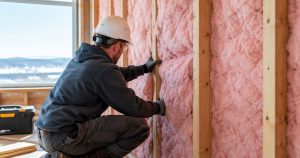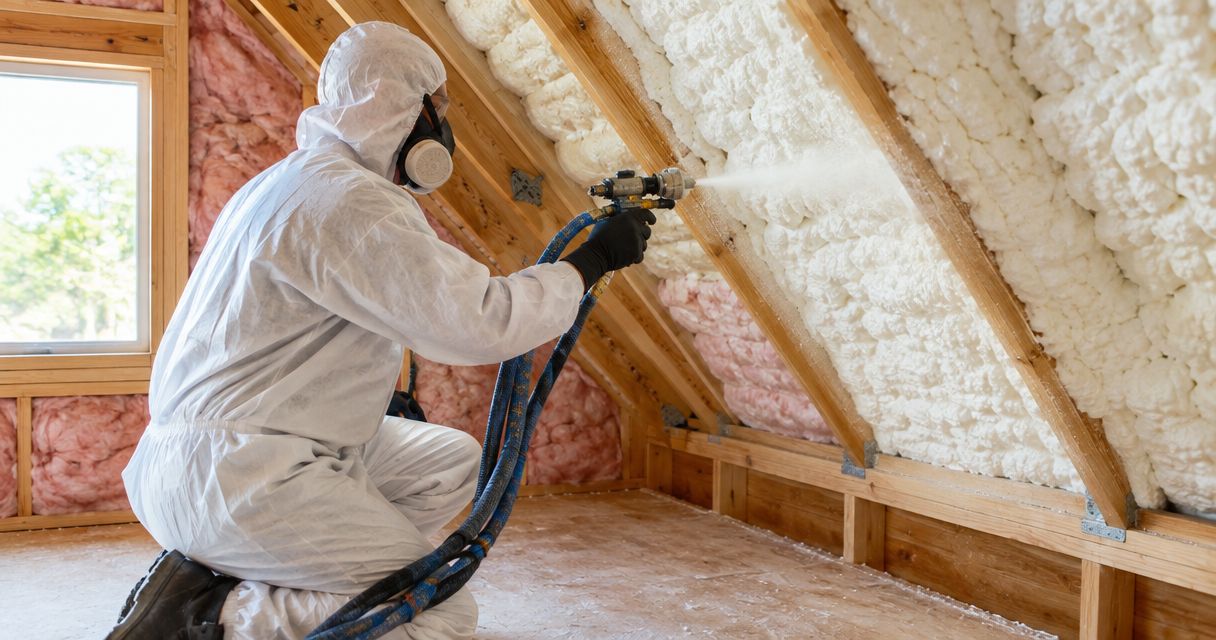
No—do not spray foam directly onto existing fibreglass insulation. For a 2026 retrofit, remove or move the fibreglass away from the application area so the foam can bond to a suitable, clean, dry substrate. You can combine spray foam and fibreglass in a properly designed assembly, but covering old batts with foam is not the same thing.
- Can you spray foam over fiberglass insulation? No—expose a suitable substrate before applying spray foam.
- Fibreglass can remain elsewhere when it does not obstruct adhesion, inspection, ventilation or the assembly design.
- A hybrid assembly puts spray foam against the substrate, with fibreglass added only where the design permits.
- Aztec Spray Systems provides spray foam and attic insulation services for homeowners and commercial property owners in southern Alberta.
Can you spray foam over existing fiberglass insulation?
Spray foam needs an appropriate application surface, not a layer of loose fibres. Existing fibreglass hides the framing, sheathing and other surfaces that need inspection before spraying. It also prevents the installer from seeing whether the foam makes continuous contact with those surfaces.
For local installation services, Aztec Spray Systems serves Calgary, Okotoks, High River and Lethbridge. The important distinction is between leaving insulation elsewhere in the building and leaving it directly in the spray path.
| Approach | Best for | Main advantage | Main limitation | Recommendation |
|---|---|---|---|---|
| Spray directly onto existing fibreglass | Not recommended for a conventional retrofit | Avoids moving material initially | Obstructs substrate inspection and reliable attachment | Do not use this shortcut |
| Remove fibreglass from the application area, then spray | Areas receiving a designed spray foam upgrade | Exposes the substrate for inspection and preparation | Requires removal, cleanup and protection of nearby areas | Use when the assembly calls for spray foam |
| Install foam against the substrate, then add fibreglass | A specifically designed hybrid assembly | Combines different insulation materials | Needs moisture-control and installation details suited to the assembly | Use only with a documented design |
| Retain suitable fibreglass and improve the existing attic assembly | A vented attic with serviceable insulation | Preserves material that still performs its intended role | Does not eliminate the need for separate air sealing | Assess before choosing wholesale replacement |
If removal is part of your project, review how to remove old attic insulation before a spray foam upgrade. Removal should expose the work area without spreading dust or disturbing unidentified materials.
Why this matters
Insulation and air sealing solve related but different problems. Fibreglass slows heat transfer, but it does not function as a continuous air barrier by itself. Spray foam can provide insulation and air control when the product, thickness, continuity and installation meet the assembly requirements.
Covering fibreglass with foam does not prove that the ceiling, wall or roof is airtight. Gaps can remain underneath the new layer, around framing and at penetrations. Judge the upgrade by the completed assembly—not by whether the old insulation disappears beneath foam.
For a 2026 renovation, decide where the building's thermal boundary belongs before choosing what to remove. An attic insulated at the ceiling is a different project from a roof assembly insulated at the roof deck.
Removing fibreglass before applying spray foam
Remove fibreglass wherever it blocks the intended spray surface. That gives the installer access to inspect for leaks, damaged wood, dust, wiring and other conditions that affect preparation. The surface must meet the selected foam manufacturer's requirements before application starts.
Removal does not automatically mean stripping every insulated area in the building. If the work concerns an exposed rim joist, insulation in unrelated walls is a separate question. If the work concerns an attic floor, material across that application area needs assessment and a removal plan.
Do not reinstall wet, contaminated or damaged batts simply because they came out intact. Correct the source of moisture or contamination first. New insulation is not a repair for a roof leak, an exhaust duct discharging into the attic or damaged framing.
Best for: an upgrade where foam needs direct access to an existing concealed substrate. The benefit is a visible, prepared work area; the drawback is the additional handling and cleanup before spraying.
Combining spray foam and fibreglass in a hybrid assembly
A hybrid assembly uses the materials in a deliberate sequence. Spray foam goes against the suitable substrate, and fibreglass occupies the remaining space only where the design allows. This arrangement is fundamentally different from spraying a cap over existing batts.
The design must address condensation and drying. Foam properties vary, and a layer that changes vapour movement also changes how moisture behaves within the wall or roof. Do not choose foam thickness by subtracting the thickness of an old batt from the cavity depth.
Existing polyethylene, faced insulation and other vapour-control layers also matter. Adding foam without accounting for those layers can restrict drying. Ask for the intended layer arrangement in writing rather than accepting a general assurance that the materials work together.
Best for: a wall or roof assembly with a documented hybrid insulation detail. The advantage is combining materials to meet a specific design; the limitation is that the design cannot be transferred unchanged to every cavity or building.
Keeping fibreglass in a vented attic
Serviceable fibreglass does not need replacement solely because spray foam exists. In a conventional vented attic, improving ceiling-level air sealing and correcting insulation gaps can preserve the existing approach. The attic still needs its intended ventilation paths and clearances.
To air-seal concealed ceiling penetrations, the installer needs access beneath the insulation. That can mean temporarily moving batts or removing material from selected areas, rather than spraying across the top. Suitable insulation can then be restored as the work plan permits.
Spraying the underside of the roof deck is a different decision. It changes the location of the insulated boundary and requires a roof-assembly assessment. Do not block soffit vents or convert an attic to an unvented arrangement as an incidental part of topping up insulation.
Best for: a vented attic with dry, serviceable fibreglass and repairable air leaks. Retaining insulation avoids unnecessary replacement, but it does not excuse gaps, blocked ventilation or unresolved moisture problems.
Why the right approach varies
The existing assembly determines the preparation—not simply whether you prefer spray foam or fibreglass. These 5 factors decide what can stay and what needs removal:
- Application location: An attic floor, roof deck, exterior wall and rim joist have different substrates and moisture conditions.
- Material condition: Wet, contaminated, compressed or poorly fitted insulation needs a different response from dry, correctly installed material.
- Air-barrier continuity: The installer must connect the air-control layer across joints, edges and penetrations rather than treating isolated patches.
- Vapour control and drying: Existing membranes and the selected foam's properties affect the completed assembly's drying potential.
- Access and safety: Concealed wiring, heat-producing equipment, restricted access and unidentified insulation affect preparation and sequencing.
These factors also explain why a photograph of the attic surface is not enough to specify the entire job. The contractor needs to understand what lies below the insulation and how that area connects to the rest of the building enclosure.
What should happen before the installer sprays?
Use this 5-step sequence when discussing a 2026 insulation retrofit. It puts inspection and design before material application, so hidden conditions do not become permanently covered.
- Inspect. Identify the insulation, substrate, signs of moisture, ventilation arrangement and nearby services. Stop before disturbing suspected hazardous material.
- Design. Establish the thermal boundary, air barrier, vapour-control approach and required protective coverings. Confirm the foam system is suitable for the intended use.
- Clear. Remove or relocate fibreglass from the spray area. Protect adjacent spaces and keep debris away from the prepared surface.
- Repair. Correct leaks and other defects, then prepare the substrate to the product requirements. Do not use foam to conceal unresolved damage.
- Verify. Inspect the application and its connections before covering it. Document the installed product and follow the manufacturer's ventilation and re-entry instructions.

The sequence matters because removal can uncover conditions that change the scope. Ask who approves changes and how the installer records concealed work. A clear photograph before spraying is more useful than a photograph showing only the finished foam surface.
Do you have to remove all the old attic insulation?
No—you need to clear the application area, not automatically every insulated space. The amount removed depends on where the foam will bond, what inspection requires and whether the existing material is suitable to retain.
For a ceiling-level upgrade, targeted removal and air sealing can be appropriate. For a change to roof-deck insulation, the contractor must assess the whole attic assembly, including the role of insulation left on the attic floor.
Can you put fibreglass over cured spray foam?
Yes, when the assembly design permits fibreglass over the installed spray foam. That does not mean any foam thickness or layer arrangement is suitable. The design still needs to address condensation, vapour control and drying.
Adding fibreglass also does not automatically satisfy requirements for protecting spray foam from fire. Confirm the required covering for the specific installation before closing the cavity.
Is closed-cell foam a reason to skip removal?
No—closed-cell foam still needs a suitable application surface. Its properties do not turn loose fibreglass into a prepared substrate or remove the need to inspect concealed conditions.
Choose open-cell or closed-cell foam through the assembly design, not as a workaround for leaving old insulation in the spray path. Neither choice makes substrate preparation optional.
What to request in your written scope
A useful 2026 scope describes the existing condition and the intended finished assembly. It should distinguish insulation removal from air sealing, moisture repairs and foam application. Those are connected tasks, not interchangeable descriptions.
Ask the contractor to specify:
- Which areas receive foam and which retain fibreglass.
- What material is removed, relocated or disposed of.
- How leaks, contamination and concealed defects are handled.
- Which foam product and installation requirements apply.
- How ventilation paths, electrical clearances and protective coverings are addressed.
- What documentation and re-entry instructions you receive.
Aztec Spray Systems is best suited to homeowners and commercial property owners seeking local spray foam or attic insulation services in its stated southern Alberta service areas. The contractor is licensed and insured; the assembly details still need to be established for your particular building.
That is the practical limit of a general answer: Aztec Spray Systems' spray foam insulation services do not make every existing fibreglass assembly a candidate for the same treatment. Your written scope should explain why the chosen approach fits your property.
FAQ
Can you spray foam over fiberglass insulation without removing it?
Do not spray directly onto existing fibreglass insulation. Clear it from the application area so the foam can bond to a suitable substrate and the installer can inspect concealed conditions.
Can I leave old fibreglass elsewhere in my attic?
Yes, suitable fibreglass can remain where it does not conflict with the planned assembly, inspection or installation. Leaving insulation on an attic floor while insulating the roof deck requires assessment of the complete attic design.
Is spray foam over fibreglass the same as a hybrid assembly?
No, a hybrid assembly places spray foam against the suitable substrate and adds fibreglass where the design permits. Spraying over old batts reverses that sequence and obstructs substrate access.
Should I remove wet fibreglass before insulating?
Yes, wet fibreglass and the cause of the wetting need attention before the area is reinsulated. Correct leaks or condensation problems and confirm the substrate meets the foam manufacturer’s requirements.
Can I spray foam over the paper facing on a batt?
Do not assume a batt’s paper facing is an approved spray surface. Follow the foam manufacturer’s substrate requirements and account for the facing in the assembly’s vapour-control design.
Can I stay home while spray foam is installed?
Follow the selected product’s occupant-exclusion and re-entry instructions. Ask the installer for the written requirements before work begins rather than relying on a general waiting period.
Do I need to disturb insulation that might contain asbestos?
Do not disturb suspected asbestos-containing insulation yourself. Arrange assessment by a qualified professional before removal or other work that could release fibres.
One last thing
More insulation is not a substitute for a continuous air barrier. A deep fibreglass layer can still conceal an unsealed ceiling penetration, while a patch of foam can leave adjacent leakage paths untouched.
Before approving your 2026 retrofit, ask the installer to show where the air barrier runs and how its edges connect. That answer tells you more about the proposed work than a promise to spray over everything.
Related guides
- How to air-seal an attic before adding insulation
- How to top up attic insulation with blown-in product
- How to meet fire-code requirements for spray foam insulation