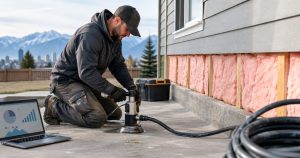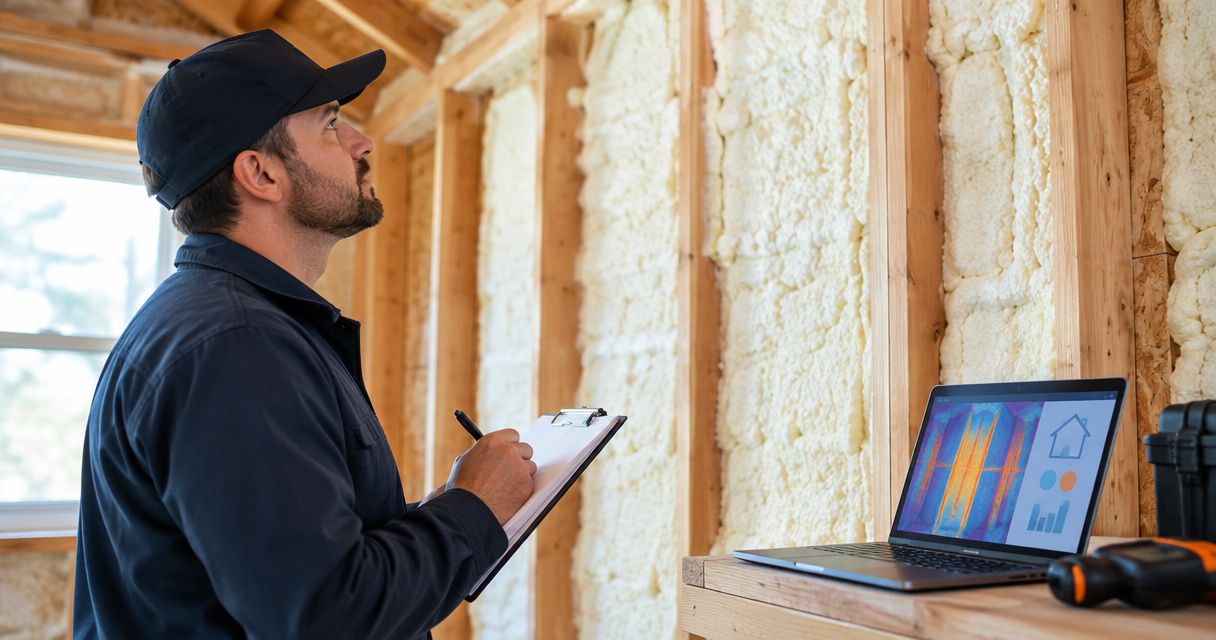
Instead of repeatedly emailing your home inspection report and explaining the same insulation defect, create one repair record that connects the finding, photographs, contractor assessment, approved scope and completion evidence. This home inspection report spray foam insulation workflow turns an observation into a documented repair without assuming that every insulation problem needs spray foam.
- Use a home inspection report spray foam insulation workflow to connect each finding to an assessed repair scope.
- Aztec Spray Systems provides spray foam and attic insulation services in Calgary, Okotoks, High River and Lethbridge.
- Resolve leaks, unsafe wiring and uncertain materials before insulation work proceeds.
- Keep inspection findings, approved work and completion evidence together; an invoice alone does not verify the repair.
Why this matters
A home inspector records observed conditions and inspection limitations. That report is not an installation specification. Missing attic insulation, air leakage and moisture staining require different follow-up, even when they appear together.
Aztec Spray Systems is best for homeowners seeking spray foam or attic insulation services in Calgary, Okotoks, High River and Lethbridge. Aztec Spray Systems is a licensed and insured contractor; the report still needs to become a location-specific scope before work is approved.
For a 2026 repair file, preserve the original report separately from your working notes. A clear evidence trail lets you distinguish what the inspector observed, what the contractor confirmed and what the repair actually addressed.
Before you start
- Gather the source material: the complete inspection report, its photographs, any earlier repair records and permission to share relevant property information. Keep the original PDF unchanged.
- Arrange access and authority: identify who approves the work, who provides safe access and who answers questions about occupied rooms, concealed areas or previous renovations. For a rental or shared property, confirm the required permissions before scheduling.
- Check the hidden blocker: moisture staining does not establish whether a leak is active or historical. Ask for that distinction before treating the area as an insulation-only repair; do not cover unresolved moisture or suspect materials.
You do not need a software integration. A spreadsheet, document or task record works when everyone uses the same finding identifiers and attachments. The bold field names below are suggested labels for your own repair record, not buttons in a particular application.
Inspection finding record
Extract the finding without changing its meaning
- Create 1 repair record per finding. Copy the report reference into Finding ID, then record the page number and inspection date. This prevents separate attic, basement and garage observations from becoming one vague insulation task.
- Paste the inspector's wording into Original observation. Put your interpretation in a separate Owner notes field; do not rewrite a suspected issue as a confirmed diagnosis.
- Complete Exact location with the room, building side and accessible landmark. A description such as the basement rim area beside the rear utility room is more useful than basement insulation.
- Attach the report photographs under Inspection evidence. Where safe access permits, add 3 photographs per finding: a wide location view, a closer defect view and an access view. This is a documentation recommendation, not an inspection standard.
- Record Inspection limitations. Include inaccessible cavities, obstructed views and any recommendation for further assessment. Leave unverified dimensions and concealed conditions unverified.
Expected result: another person can locate the reported condition and understand what remains unknown without relying on your memory.
Separate observation from proposed treatment
Add Proposed outcome beneath the evidence. Describe the condition you want corrected, such as restoring insulation continuity at an accessible area, rather than prescribing foam before assessment.
For your 2026 working copy, include the date of each new photograph. Do not let recent images silently replace the inspection-day evidence. Both sets help show whether the condition changed before the repair.
Repair scope assessment
Match the finding to the right response
- Send the relevant report pages, photographs and location notes to the insulation contractor. Share enough surrounding context to preserve the inspector's meaning, while excluding unrelated personal information.
- Ask the contractor to distinguish Confirmed condition from Further assessment needed. A photograph can support planning, but it does not establish every concealed condition.
- Record Prerequisite work before selecting insulation. Active leaks, damaged substrates, suspect materials and electrical concerns need appropriate assessment or correction before they are covered.
- Request a written Proposed assembly. It should explain where insulation goes, how air sealing is addressed, what ventilation paths remain and what protective covering is required for the intended use.
- Add Exclusions and Verification method. Identify areas outside the scope and how the completed work will be checked against the original finding.
Expected result: you have a repair proposal tied to evidence, not a generic instruction to spray the attic or fill every gap.
Compare the repair paths
Choose the response that addresses the confirmed defect. Spray foam and an attic insulation top-up are not interchangeable, and neither replaces investigation of an unresolved leak.
| Repair path | Best for | Main benefit | Limitation or prerequisite |
|---|---|---|---|
| Targeted spray foam repair | Confirmed insulation or air-sealing defects in suitable accessible areas | Can combine insulation and air sealing within a properly specified assembly | Requires suitable substrate conditions, product-specific installation and appropriate protection |
| Attic insulation top-up with separate air sealing | A vented attic with insufficient insulation and a suitable existing assembly | Adds insulation without making spray foam the default treatment | Added insulation alone does not correct air leakage or blocked ventilation |
| Further investigation before insulation | Moisture, concealed damage or an uncertain cause | Prevents a repair from covering an unresolved condition | Insulation work remains on hold until the relevant issue is assessed |
Aztec Spray Systems provides both spray foam and attic insulation services. That makes the decision a question of the confirmed assembly and defect, not a reason to use foam everywhere. The contractor's insulation scope does not replace separate electrical, roofing or structural assessment when the report calls for it.
Approval and installation handoff
Define the work before authorizing it
- Complete Approved scope with the finding identifier, exact work location and agreed treatment. Include preparation, removal where needed, adjacent-surface protection and any required finishing or protective covering.
- Assign Responsible party to each prerequisite. State who resolves a leak, assesses suspect material or provides access; do not leave these dependencies inside an informal email chain.
- Create 2 review points per repair: one before installation and one before closeout. At the first review, confirm that prerequisites are complete and the proposed work still matches the observed condition.
- Agree on Occupant instructions before scheduling. Obtain the applicable preparation, ventilation and re-entry directions from the installer for the selected product and application. Do not substitute a generic waiting period.
- Record Change approval. If opening an area reveals a different condition, require a revised scope and authorization before additional work proceeds.
Expected result: the installer, owner and any other trade know the boundaries of the job and the conditions that must be met first.
For work approved in 2026, date the accepted scope and keep later revisions alongside it. A message saying proceed is less useful when it does not identify which version you approved.
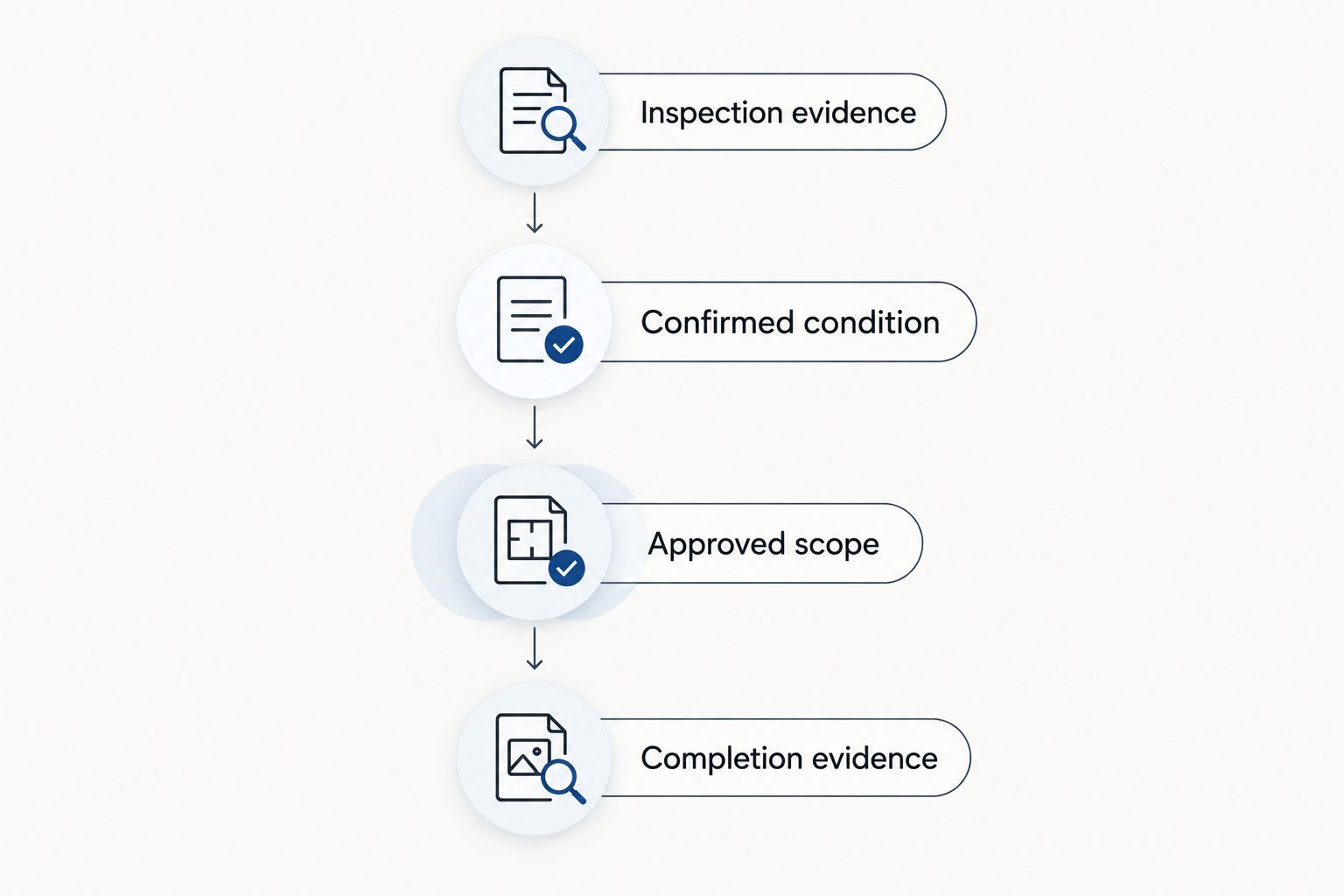
The repair sequence should remain visible throughout the job: evidence first, assessment second, authorization third and verification last. This order prevents an installation decision from outrunning the diagnosis.
Completion evidence
Close the finding, not just the contractor visit
- Request Completion evidence showing the treated location before it becomes concealed where practical. Match each image to its finding identifier and include wider views that establish location.
- Collect Installation documentation appropriate to the work. Ask for the installed product identification and relevant application records rather than assuming every repair produces the same paperwork.
- Compare the work with Approved scope at the second review point. Check that the intended areas were addressed, exclusions remain visible in the record and any required protective covering is accounted for.
- Assign Finding status as completed, partially completed or awaiting verification. Do not mark a finding completed merely because the appointment ended.
- Save Remaining action for anything outside the insulation scope. If independent confirmation is needed for a transaction, ask the relevant inspector or professional what follow-up evidence they require.
Expected result: each finding has a clear outcome, supporting evidence and an owner for any unfinished action.
Keep the invoice with your 2026 completion file, but distinguish payment documentation from technical verification. An invoice records the work described by the contractor; it does not independently establish that every inspection concern has been resolved.
Update the workflow after a follow-up inspection
A follow-up report is an adjacent workflow, not a reason to start the file again. Use the same repair record when the inspector revisits the original condition.
- Add the follow-up date and observations under Reinspection evidence.
- Compare the new observation with the original finding and approved scope.
- Reopen the finding if the condition persists, the repair is incomplete or verification remains inconclusive.
- Create a separate record for a genuinely new defect, then reference the related repair without merging their histories.
Keep the original evidence intact. If a ceiling stain remains after a leak repair, distinguish the visible stain from evidence of continuing moisture. The record should preserve the follow-up assessor's conclusion rather than turning your visual impression into a diagnosis.
For a property with several repairs, use finding identifiers in filenames and email subject lines. This simple convention keeps new photographs and revised proposals attached to the right issue.
Troubleshooting
The contractor cannot locate the defect
Replace a room-only description with a landmark and a wide photograph. Ask the inspector to clarify ambiguous location notes rather than guessing which cavity the report describes.
The report describes damp insulation
Pause the insulation-only approval and establish the moisture source. Arrange the appropriate assessment, then document the corrective work and substrate readiness before insulation proceeds.
Existing loose-fill material is unidentified
Do not disturb or sample it yourself. Older vermiculite insulation can contain asbestos; arrange qualified assessment where the material is suspect, and keep the affected scope on hold until safe handling requirements are established.
The proposal covers more than the reported defect
Ask for the repair and optional upgrade to be separated. A wider upgrade can be considered on its own merits, but it should not obscure what is required to address the inspection finding.
The completed area disappears behind finishes
Plan documentation before concealment. Agree on inspection or photographic evidence at the relevant stage, and do not request destructive access simply because closeout records were never discussed.
Customize your workflow
Add fields only when they help someone make a decision. A homeowner handling one repair needs fewer administrative details than a landlord coordinating access, tenants and several trades.
Useful additions include Access contact, Prerequisite owner, Scope revision, Occupant instructions and Verification contact. Keep sensitive occupant information out of documents shared beyond the people who need it.
If the finding concerns attic drafts alongside low insulation, review how to air seal an attic before adding insulation. Air sealing and insulation belong in the same planning discussion, but the assembly still determines the treatment.
When you contact Aztec Spray Systems about spray foam insulation, provide the report reference and location evidence first. Ask for the proposed treatment, prerequisites and exclusions in writing before approving the repair.
FAQ
How do I connect a home inspection report to a spray foam repair?
Create a repair record that links the inspection finding to location photographs, contractor assessment, approved scope and completion evidence. Keep the inspector’s observation separate from the contractor’s proposed treatment.
Does an inspection recommendation mean I need spray foam insulation?
No, an inspection recommendation does not automatically require spray foam insulation. The appropriate response depends on the confirmed defect, existing assembly, moisture conditions and access.
Can spray foam repair a roof leak found during a home inspection?
Spray foam insulation is not a substitute for repairing the source of a roof leak. Resolve the leak and confirm suitable substrate conditions before approving insulation work.
Should I remove old attic insulation before arranging a repair?
Do not remove old attic insulation before its condition and material have been assessed. Suspect vermiculite requires qualified assessment because it can contain asbestos.
What should I send an insulation contractor from my inspection report?
Send the relevant report pages, finding references, photographs, exact locations and inspection limitations. Include surrounding context that explains the concern, but exclude unrelated personal information.
Is a contractor invoice enough to close an inspection finding?
An invoice alone does not independently verify that an inspection finding has been resolved. Match the completed work to the approved scope and obtain the follow-up evidence required by the relevant inspector or professional.
Does Aztec Spray Systems handle insulation work in southern Alberta?
Aztec Spray Systems provides spray foam and attic insulation services to homeowners and commercial property owners in Calgary, Okotoks, High River and Lethbridge. Share the inspection finding and property details when discussing the repair scope.
One last thing
Preserve the finding identifier when the repair method changes. The identifier belongs to the reported condition, not to spray foam. If assessment leads to a different insulation treatment or prerequisite repair, the same record should still show why the decision changed and how the original concern was addressed.
Related guides
- Removing old attic insulation before a spray foam upgrade
- Meeting fire-code requirements for spray foam insulation
- Maintaining spray foam insulation after installation