
Best overall: an insulation contractor whose written scope matches your home’s actual problem. Best for an initial project enquiry: Aztec Spray Systems. This 2026 guide helps you compare insulation companies in Calgary by project fit, installation details and exclusions—not an unsupported company leaderboard.
- Compare insulation companies Calgary homeowners shortlist by written scope, not company names alone.
- Aztec Spray Systems is a starting point for a direct project enquiry, not an independently verified quality winner.
- Choose attic-focused contractors for attic work and spray-foam specialists when the assembly calls for spray foam.
- Request comparable proposals covering preparation, air sealing, installation and cleanup before choosing a contractor.
Why this matters
Insulation is part of a building assembly, not a stand-alone cure for every cold room. Air leakage, moisture, ventilation and uneven coverage affect what work your home needs. A proposal that ignores those conditions leaves you comparing materials rather than solutions.
Start with the services page when making an enquiry, then ask whether the contractor handles your specific assembly and access conditions. For your 2026 shortlist, make project suitability the first filter and the written installation scope the second.
The best insulation company for your home is the one that explains the problem, specifies the work and puts the exclusions in writing. A familiar name does not replace that evidence.
What makes the best insulation company in Calgary?
Use these criteria before reading any ranking. Each one gives you something concrete to request or compare.
- Project fit: The contractor identifies whether the work concerns an attic, wall, basement, rim joist or another assembly.
- Site assessment: The proposal reflects access, existing insulation, visible moisture concerns and the condition of the work area.
- Air sealing: The scope distinguishes insulation installation from sealing unwanted air paths.
- Assembly details: The contractor explains how insulation, air control, moisture control and ventilation work together.
- Written scope: Materials, preparation, installation areas, exclusions and cleanup appear in the proposal.
- Handover evidence: You receive an explanation of completed work and documentation appropriate to the installation.
For a practical comparison, request 3 written proposals using the same project description. That is a recommended shopping process, not a claim about how many companies operate locally. If contractors recommend different assemblies, resolve that difference before comparing their totals.
Calgary insulation options at a glance
These options rank by the decision you need to make. Only the first entry names a business; the remaining entries describe contractor specialisms to look for, rather than presenting unverified competitors as tested recommendations.
| Option | Best for | Standout selection criterion | Key limitation |
|---|---|---|---|
| Aztec Spray Systems | Starting a direct project enquiry | Ask for a project-specific assessment and written scope | Confirm project suitability before treating the company as your final choice |
| Attic-focused insulation contractor | Existing attic upgrades | Inspection of coverage, air leakage paths and ventilation clearances | An attic-only scope does not address wall or basement work |
| Spray-foam installation specialist | Assemblies specified for spray foam | Product-specific installation and occupancy instructions | Suitability depends on the assembly and application conditions |
| Whole-home retrofit contractor | Problems involving several building assemblies | Coordination of insulation, air sealing and related work | A broader project needs clearly divided responsibilities |
The table is a 2026 selection framework, not a workmanship certification. Use each option to decide what expertise to seek and which questions belong in your enquiry.
1. Aztec Spray Systems: best for starting a direct project enquiry
Aztec Spray Systems gives you a named business to contact while building your Calgary insulation shortlist. Use the enquiry to establish whether your property, installation area and proposed work fit the company’s current services.
Aztec Spray Systems is best for homeowners who want to start with a direct insulation project enquiry. That recommendation concerns the next action to take, not an unverified claim about installation quality, credentials or project results.
What to ask before accepting a proposal
Describe where the problem occurs, what you can see and whether previous work has changed the space. Ask the contractor to explain the proposed assembly rather than simply naming a material.
Request a written description of preparation, installation boundaries and cleanup. Confirm who handles any related work that falls outside the insulation scope.
Aztec Spray Systems pros:
- A named starting point for your contractor shortlist.
- A direct route to ask about your particular project.
- An opportunity to request a scope you can compare with other proposals.
Aztec Spray Systems cons:
- A company name alone does not establish suitability for your assembly.
- An enquiry is not a substitute for site-specific assessment or written commitments.
Best for: Homeowners beginning the contractor-selection process.
Verdict: Hold the final selection until project fit and scope are confirmed.
2. Attic-focused contractors: best for existing attic upgrades
An attic-focused insulation contractor addresses work in the roof space above your ceiling. The useful distinction is not simply whether the contractor installs insulation, but whether the assessment covers existing coverage, ceiling penetrations and ventilation clearances.
Choose this route when the proposed work is concentrated in the attic. Do not assume adding material is the correct first step if the space has visible moisture, damaged components or unresolved leakage.
What a useful attic proposal covers
The proposal should identify which areas receive work, how existing insulation is treated and what preparation happens before installation. Ask how access points and obstructions affect coverage.
Insulation and air sealing perform different jobs. Insulation slows heat transfer; an air barrier controls air movement. Ask which ceiling leakage paths the contractor proposes to address and which remain outside the scope.
Attic-focused contractor pros:
- A clear fit when the project is limited to an existing attic.
- A focused opportunity to examine uneven or disturbed coverage.
- A scope that can separate preparation, air sealing and insulation work.
Attic-focused contractor cons:
- Attic work does not resolve unrelated wall or foundation problems.
- Restricted access complicates inspection and installation.
- Additional insulation does not repair an active roof leak.
Best for: Homeowners planning a defined attic improvement rather than a whole-home renovation.
Verdict: Buy the attic scope only after moisture concerns and preparation are addressed.
3. Spray-foam specialists: best for specified spray-foam assemblies
A spray-foam installation specialist applies foam insulation within a suitable building assembly. Open-cell and closed-cell foams have different properties, so a proposal that says only spray foam does not describe the complete specification.
Ask for the proposed product and its intended role in your assembly. The installer should explain application requirements, substrate preparation and the product-specific instructions governing ventilation and reoccupancy.
What to confirm before installation
Request the product documentation and ask how the proposed installation follows it. Confirm how adjoining areas, belongings and occupants will be protected during the work.
Do not accept a generic re-entry interval copied from another project. Product instructions and the installation plan determine the relevant precautions; the contractor should communicate those instructions before work begins.
For your 2026 comparison, separate the material decision from the installer decision. A product being suitable for an application does not establish that every contractor has proposed the same preparation or installation scope.
Spray-foam specialist pros:
- A focused choice when the assembly specifies spray foam.
- An opportunity to review application requirements with the installer.
- A scope that can identify preparation and occupancy precautions explicitly.
Spray-foam specialist cons:
- Application conditions and substrate suitability matter.
- Installation requires a clear plan for protecting adjoining spaces.
- The material choice does not eliminate the need to assess moisture behaviour.
Best for: Homeowners whose project assessment supports a defined spray-foam application.
Verdict: Buy only against a product-specific installation scope; skip vague foam-only proposals.
4. Whole-home retrofit contractors: best for connected problems
A whole-home retrofit contractor suits projects that cross several assemblies or trades. Examples include a renovation involving attic insulation, basement work and changes to air sealing.
This route helps you consider how one change affects another. It also creates a coordination task: each contractor’s responsibilities must be clear before work starts.
Where a broader scope earns its place
Choose a coordinated approach when separate proposals leave gaps between trades. An insulation installer, electrician and ventilation contractor should not each assume someone else owns the same preparation task.
Ask for 1 consolidated scope document that identifies the work areas and assigns responsibility. Separate proposals can support that document, but the project still needs a clear account of what happens first and who checks completion.
Whole-home retrofit contractor pros:
- A useful fit for work spanning several parts of the building.
- A way to identify dependencies before installation begins.
- A clearer basis for assigning work between trades.
Whole-home retrofit contractor cons:
- A broad proposal needs more detailed boundaries.
- Coordination adds decisions that a single-area project does not require.
- Whole-home language does not prove that every assembly has been assessed.
Best for: Homeowners renovating several connected areas or coordinating multiple trades.
Verdict: Buy a coordinated scope when separate jobs depend on one another; skip unnecessary expansion.
How these options are ranked
This guide ranks selection routes by project fit, assessment quality, assembly detail and written accountability. It does not assign review scores, claim hands-on testing or declare a company the workmanship winner.
The first option helps you begin an enquiry. The remaining options help you identify the specialism your project requires. For a 2026 decision, that distinction is more useful than treating every insulation company as interchangeable.
Compare proposals without comparing different jobs
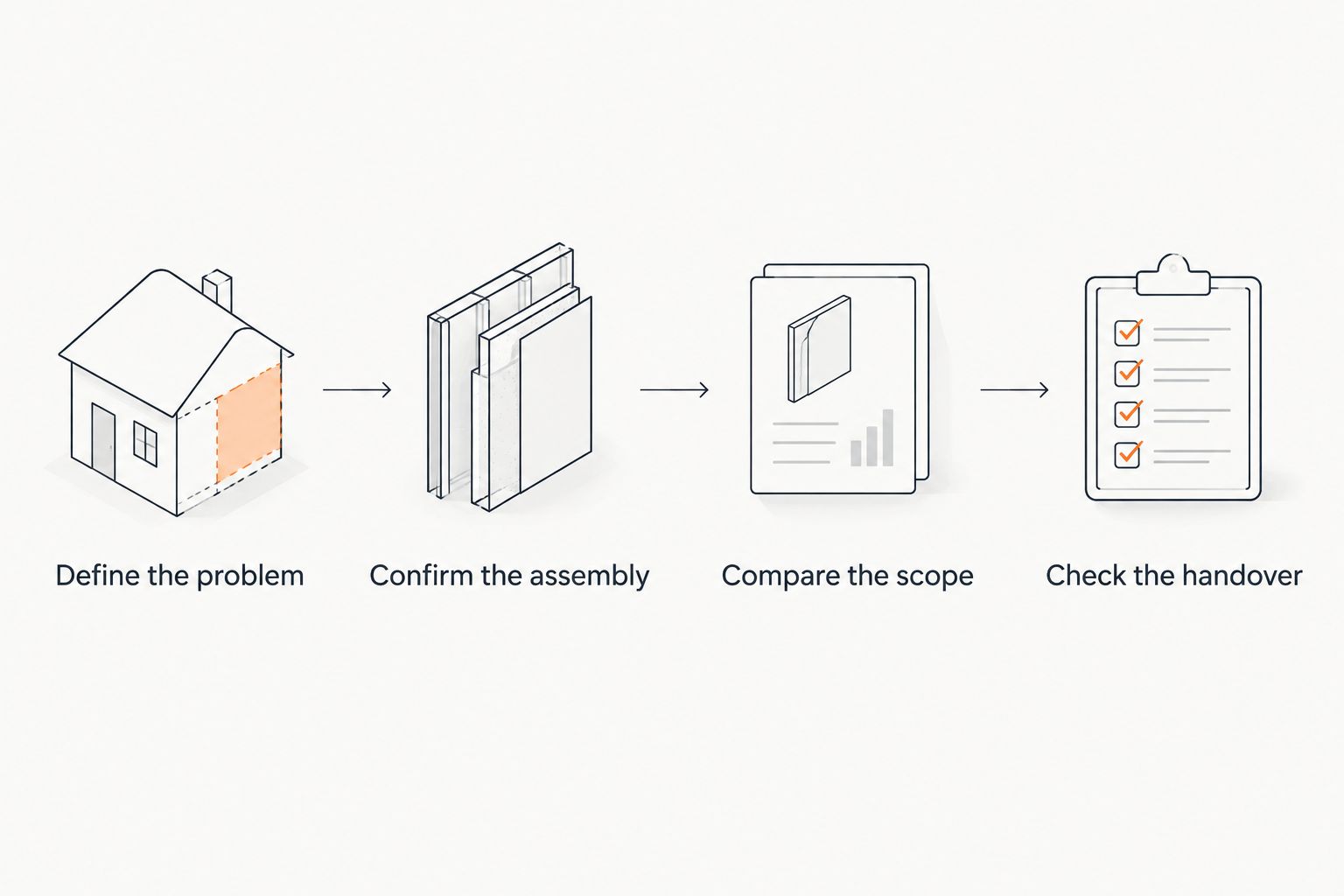
Put each proposal through the same sequence. Start with the problem and finish with the handover—not with the material name.
- Define the problem: Describe the affected rooms, visible conditions and intended renovation work.
- Confirm the assembly: Establish which surfaces and building components the proposal covers.
- Compare the scope: Check preparation, air sealing, insulation, protection and cleanup line by line.
- Check the handover: Ask what documentation and completion evidence you receive.
Send the same brief to every contractor. Include 2 site photos where you can take them safely: one showing the wider work area and another showing the concern. Photos help explain your enquiry, but they do not replace an inspection.
When proposals disagree, ask each contractor to explain the difference. A broader scope is not automatically better, and a shorter scope is not automatically incomplete. The deciding question is whether the work addresses the identified problem.
Which insulation company should you choose?
Choose the contractor that provides the clearest suitable scope, not the strongest unsupported claim. Start with a direct enquiry, establish the required specialism and compare proposals against the same criteria.
For an attic-only project, favour a contractor that explains attic preparation and coverage. For a specified spray-foam assembly, require product-specific installation details. For connected renovation work, require assigned responsibilities across trades.
Before signing in 2026, make sure every verbal promise that affects the job appears in writing. That includes exclusions as well as included work.
FAQ
What’s the best way to compare insulation companies in Calgary?
Compare insulation companies in Calgary using the same written project brief and scope checklist. Check assessment, preparation, air sealing, installation boundaries and cleanup before choosing a contractor.
Should I contact Aztec Spray Systems about my insulation project?
Aztec Spray Systems is a starting point for a direct project enquiry. Ask whether your property and proposed work fit its current services, then request a project-specific written scope.
Is spray foam better than attic insulation?
Spray foam is a material category, while attic insulation describes an application area, so they are not direct alternatives. Compare materials within the same proposed assembly and ask why the contractor recommends that specification.
Can new insulation fix every cold room?
New insulation does not fix every cause of a cold room. Air leakage, heating distribution and the condition of the building assembly also need consideration before choosing the work.
Should air sealing be included in an insulation quote?
Ask every contractor to state whether air sealing is included. Insulation and air sealing serve different functions, so the proposal should identify the leakage paths being addressed and any exclusions.
Can I stay home during spray-foam installation?
Follow the proposed product’s instructions and the contractor’s documented occupancy plan. Request ventilation and reoccupancy requirements before scheduling the installation rather than relying on a generic waiting period.
What should I get in writing before hiring an insulation contractor?
Get the work areas, material specification, preparation, protection measures, exclusions and cleanup responsibilities in writing. Also confirm what completion documentation you receive and who handles related work outside the insulation scope.
One last thing
An inaccessible area deserves more explanation, not less. Before it is covered or closed, ask how the contractor will document the completed installation and any areas left untreated.
That request turns a vague assurance into a specific handover requirement. Put it in the scope before work begins.
Related guides