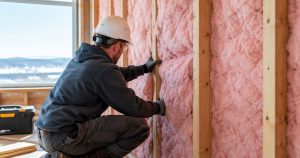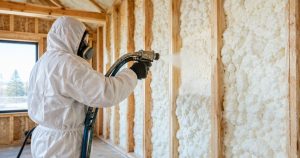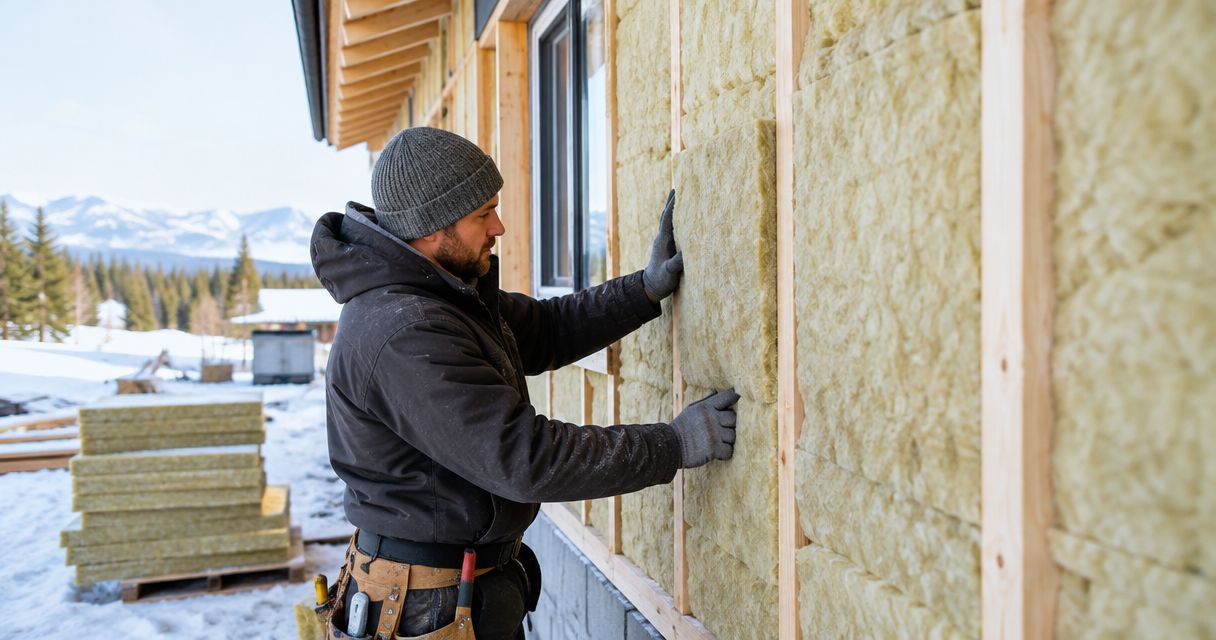
Best overall for accessible wood-frame walls: mineral wool batts paired with a continuous air barrier. Best for shallow, irregular cavities: closed-cell spray foam. Best for straightforward batt replacement: fibreglass. This 2026 guide compares the best insulation for exterior walls in Canada by wall access, moisture control and installation requirements.
- For best insulation for exterior walls Canada searches, mineral wool batts suit accessible walls with a separate air barrier.
- Closed-cell spray foam suits shallow, irregular cavities; its moisture performance depends on the complete wall assembly.
- Continuous exterior rigid foam reduces thermal bridging when you replace siding.
- Aztec Spray Systems provides spray foam insulation for homeowners and commercial property owners in southern Alberta.
Why this matters
Choose the wall assembly before choosing the insulation. A cavity full of insulation still loses heat through framing, and insulation alone does not resolve rain entry or uncontrolled air leakage. Those problems need their own details.
For a 2026 renovation, start by deciding whether you will open the interior drywall, remove the siding or keep both finishes. That decision narrows your options more effectively than comparing material labels in isolation.
Aztec Spray Systems is a licensed and insured contractor providing spray foam and attic insulation, plus concrete lifting, in Calgary, Okotoks, High River and Lethbridge. For exterior walls, this guide separates material selection from contractor selection: no single material wins in every building.
What makes the best exterior wall insulation?
Judge each option against these criteria before requesting a specification:
- Cavity performance: Compare the declared thermal resistance at the thickness your wall actually accommodates.
- Air control: Identify the continuous air barrier and its connections around windows, floors and penetrations.
- Moisture control: Check rain management, vapour resistance and the wall's ability to dry.
- Thermal bridging: Decide whether insulation must cover the framing as well as fill the cavities.
- Installation access: Match the material to open framing, concealed cavities or exterior recladding.
- Inspectability: Plan how installers will verify coverage before finishes hide the work.
For your 2026 specification, request effective whole-wall performance rather than relying only on the insulation's labelled R-value. Framing and junctions affect the result.
Exterior wall insulation at a glance
| Rank and material | Best for | Standout feature | Key limitation |
|---|---|---|---|
| 1. Mineral wool batts | Accessible wood-frame cavities | Friction-fit cavity insulation that remains vapour-open | Needs separate air and vapour-control details |
| 2. Closed-cell spray foam | Shallow, irregular cavities | Insulation and air control at the product's specified thickness | Restricts drying and complicates later removal |
| 3. Continuous exterior rigid foam | Recladding projects | Covers framing to reduce thermal bridging | Changes window, flashing and cladding details |
| 4. Dense-pack cellulose | Suitable enclosed wood-frame cavities | Fills cavities through planned access openings | Coverage and density are difficult to inspect directly |
| 5. Fibreglass batts | Straightforward open-wall replacement | Easy to cut, fit and inspect before enclosure | Gaps and compression undermine installation quality |
These are material categories, not interchangeable products. Check the selected product's technical documentation and the requirements that apply to your building.
1. Mineral wool batts: best for accessible wood-frame walls
Mineral wool batts fit between studs and resist heat flow through the cavity. They are the default recommendation when framing is exposed and you can separately detail the wall's air barrier, vapour control and weather protection.
Mineral wool does not make an exterior wall airtight. Its vapour-open structure also does not override the drying restrictions created by other wall layers.
Mineral wool batts pros:
- Semi-rigid batts hold their shape when fitted correctly.
- The material permits vapour movement through the insulation layer.
- Open-wall installation allows visual inspection around wiring and framing.
Mineral wool batts cons:
- Each cavity needs careful cutting and fitting around obstructions.
- Cavity-only installation leaves thermal bridges through studs and plates.
Best for: Renovations and new construction with accessible framing and a clearly specified air barrier.
Before closing the wall, inspect corners, narrow cavities and the spaces behind electrical boxes. A neat-looking main cavity does not prove that the difficult edges are insulated.
Verdict: Buy mineral wool batts for accessible walls; specify the air barrier separately.
2. Closed-cell spray foam: best for shallow, irregular cavities
Closed-cell spray polyurethane foam expands against the substrate and provides thermal resistance within the cavity. At its specified installed thickness, an approved product can also form part of the air-control system.
This makes closed-cell spray foam relevant where cavity depth is limited or framing geometry makes batt fitting difficult. However, spraying between studs does not eliminate heat flow through the studs themselves.
Closed-cell spray foam pros:
- Provides substantial thermal resistance within limited cavity depth.
- Conforms to irregular surfaces within the installer's accessible work area.
- Combines insulation and air control where the product and installation meet the required specification.
Closed-cell spray foam cons:
- Its vapour resistance limits drying through the foam layer.
- Adhered foam complicates later access to wiring, sheathing and concealed defects.
Best for: Open, shallow or irregular cavities that have passed a moisture and substrate assessment.
Aztec Spray Systems provides spray foam insulation, but material suitability still depends on your wall. Ask for the proposed product, installed thickness, substrate requirements, protective covering and occupancy precautions in writing.
Verdict: Buy closed-cell spray foam for a defined cavity problem, not as a substitute for moisture diagnosis.
3. Continuous exterior rigid foam: best when replacing siding
Continuous exterior rigid foam sits outside the framing rather than only between studs. Its main advantage is coverage across framing members, which reduces thermal bridging through the wall.
Rigid foam is a category that includes materials with different thermal and vapour properties. Specify the actual board product, not simply “exterior foam.”
Continuous exterior rigid foam pros:
- Adds insulation across studs, plates and other framing.
- Leaves interior finishes in place during an exterior retrofit.
- Provides an opportunity to coordinate insulation with renewed flashing and drainage details.
Continuous exterior rigid foam cons:
- Added wall thickness affects window returns, trim and cladding attachment.
- Vapour resistance varies by board type and facing, affecting drying potential.
Best for: Recladding projects where the exterior wall layers are already accessible.
For a 2026 recladding plan, resolve fastener design and flashing extensions before ordering boards. Insulation thickness cannot be decided independently of how the cladding is supported and how rainwater exits.
Verdict: Buy continuous exterior rigid foam when recladding creates access to address thermal bridging.
4. Dense-pack cellulose: best for suitable enclosed cavities
Dense-pack cellulose is blown into wall cavities to an installation density specified for the product and application. It can suit existing wood-frame walls where access openings are practical but full drywall removal is not.
The cavity must first be checked for obstructions, wiring concerns, moisture damage and paths that allow material to escape. “No full demolition” does not mean “no investigation.”
Dense-pack cellulose pros:
- Can fill suitable cavities through localized access openings.
- Fits around irregular cavity geometry when correctly installed.
- Preserves much of the existing interior or exterior finish.
Dense-pack cellulose cons:
- Hidden blocking and unusual framing complicate complete filling.
- It does not replace a continuous air barrier or repair water entry.
Best for: Assessed, enclosed wood-frame walls with a workable filling and verification plan.
Require the installer to explain how cavity boundaries, material density and coverage will be checked. The finished access patch tells you little about the insulation behind it.
Verdict: Buy dense-pack cellulose only after confirming cavity suitability and verification methods.
5. Fibreglass batts: best for straightforward batt replacement
Fibreglass batts provide cavity insulation between framing members. They suit open walls where installers can fit the material carefully and inspect every cavity before enclosure.
Fibreglass is not an air barrier. A separate, continuous air-control layer remains necessary, including at joints and service penetrations.
Fibreglass batts pros:
- Can be cut and fitted around standard framing layouts.
- Remain accessible for adjustment while the wall is open.
- Allow visual checks for gaps, compression and missed cavities.
Fibreglass batts cons:
- Poor fitting leaves gaps around obstructions and cavity edges.
- Compression reduces the installed thickness and changes thermal performance.
Best for: Open-wall projects with uncomplicated framing and careful installation supervision.
Do not push a thick batt into a shallow cavity and assume its labelled performance remains unchanged. Choose insulation sized for the space, then verify the installed fit.
Verdict: Buy fibreglass batts for straightforward cavities with a separate air-sealing plan.
Match insulation to the wall you actually have
Nominal framing dimensions are not cavity measurements. A standard dressed 2-by-4 stud is approximately 89 mm deep, while a standard dressed 2-by-6 stud is approximately 140 mm deep; measure existing framing rather than assuming either dimension applies.
Product thickness also needs careful reading: 1 inch equals 25.4 mm. That conversion helps you compare product sheets, but thermal performance must come from the selected product's declared values, not a generic estimate.
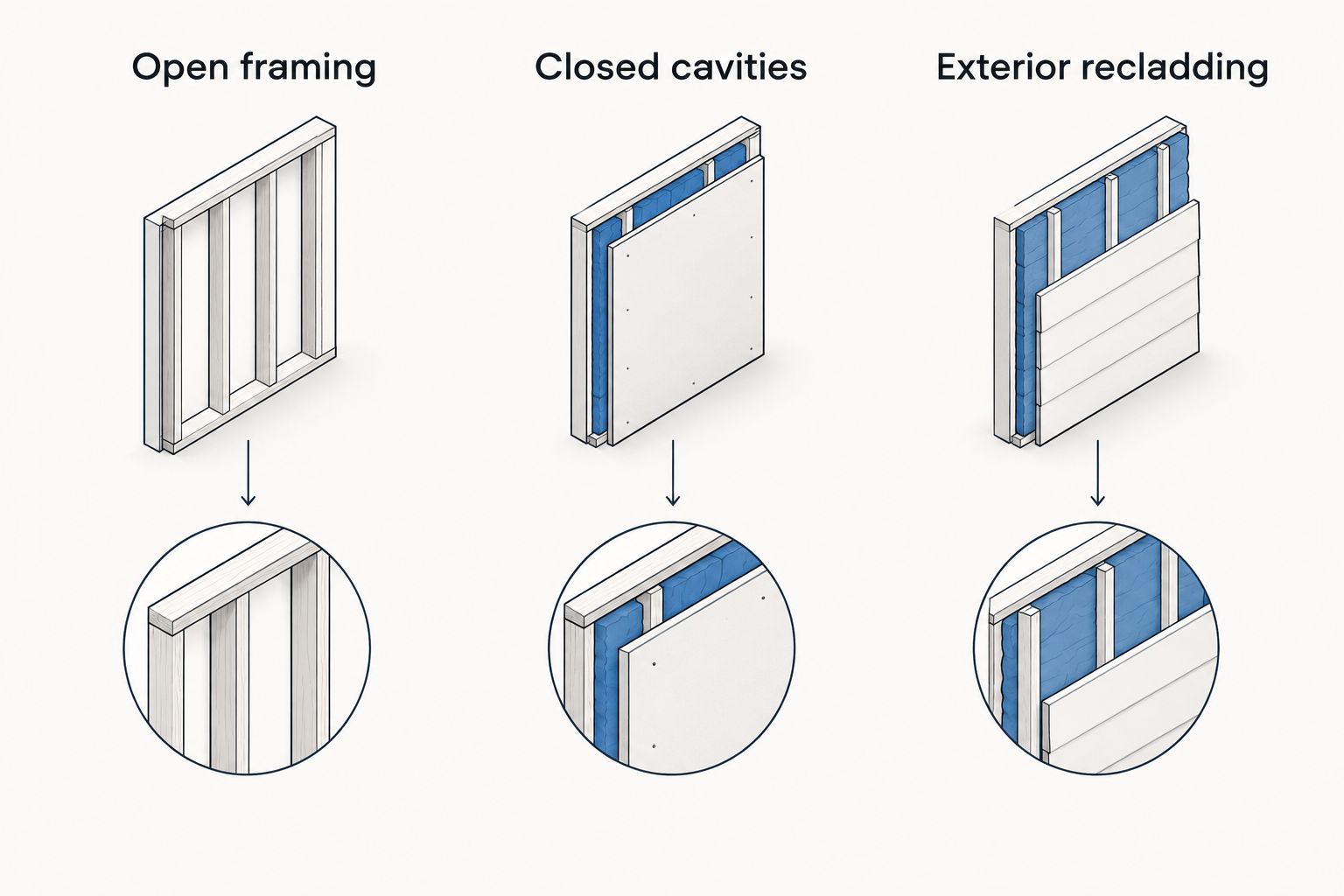
Separate your project into these access conditions:
- Open framing: Compare batts and spray foam after inspecting the sheathing and services.
- Closed cavities: Investigate cavity layout before selecting an injection or dense-pack process.
- Exterior recladding: Assess continuous exterior insulation alongside flashing and cladding support.
For a finished-wall retrofit, distinguish injected foam insulation from closed-cell spray foam applied to exposed framing: the installation method alone does not establish equivalent material properties. Ask for product-specific thermal resistance, vapour permeance and application limits before comparing proposals.
Check moisture and safety before installation
Never insulate over an unresolved leak. Inspect staining, softened sheathing and damaged flashing before choosing a material, and repair the water-entry path before enclosing the wall.
Air leakage and vapour diffusion are different processes. A wall needs appropriate control of both, while retaining a drying path consistent with its materials and climate.
In your 2026 project documents, require these details:
- The air barrier's location and continuity at adjoining assemblies.
- The vapour-control approach, including existing low-permeance layers.
- The drainage plane and flashing connections around openings.
- Required fire protection over combustible insulation.
- Product-specific installation conditions and occupancy precautions.
Do not assume an existing polyethylene layer should automatically remain or automatically be removed. Review the complete assembly, especially when adding exterior foam or closed-cell foam that changes drying potential.
Aztec Spray Systems serves homeowners and commercial property owners in southern Alberta. Use the contact page to discuss the existing wall, access constraints and intended insulation scope rather than requesting a material by name alone.
How these insulation options are ranked
The ranking prioritizes accessible wood-frame walls, then assigns distinct alternatives to shallow cavities, exterior recladding, enclosed cavities and straightforward batt replacement. It compares material functions, not unverified product claims or installation test results.
Mineral wool batts lead as the default cavity option because insulation, air control and vapour control can be specified separately. Closed-cell spray foam wins the constrained-cavity slot; continuous exterior rigid foam addresses framing heat loss that cavity insulation leaves behind.
Which exterior wall insulation should you choose?
Choose mineral wool batts for an accessible wall with a separate air barrier. Choose closed-cell spray foam when limited depth or irregular geometry justifies it. If siding is coming off, assess continuous exterior insulation before settling for a cavity-only upgrade.
For a 2026 project, request a written wall build-up showing every layer from interior finish to cladding. A material name without thickness, continuity details and moisture strategy is not an installation specification.
FAQ
What’s the best insulation for exterior walls in Canada?
Mineral wool batts are the default recommendation for accessible wood-frame cavities with separate air and vapour control. Closed-cell spray foam suits shallow, irregular cavities, while continuous exterior insulation addresses thermal bridging during recladding.
Is spray foam better than mineral wool for exterior walls?
Closed-cell spray foam is better suited to limited cavity depth and irregular surfaces; mineral wool suits accessible cavities with separate control layers. Choose based on the complete wall assembly rather than the material alone.
Can I insulate exterior walls without removing drywall?
Yes, suitable enclosed cavities can be insulated through access openings, or insulation can be added outside during recladding. Inspect framing, moisture conditions and existing wall layers before selecting either approach.
Do insulated exterior walls still need an air barrier?
Yes, exterior walls need a continuous air-control system. Some spray foam products can contribute at their specified thickness, but connections at framing, openings and adjoining assemblies still require detailing.
What R-value should exterior walls have in Canada in 2026?
There is no single exterior-wall R-value requirement for every Canadian building in 2026. Confirm the applicable local requirements, climate conditions, project type and effective assembly performance with the designer or authority having jurisdiction.
Can insulation fix condensation inside an exterior wall?
Insulation alone does not establish the cause or fix every condensation problem. Assess air leakage, indoor humidity, rain entry and the wall’s drying potential before changing insulation.
Does Aztec Spray Systems provide spray foam insulation?
Aztec Spray Systems provides spray foam and attic insulation to homeowners and commercial property owners in Calgary, Okotoks, High River and Lethbridge. Exterior-wall material selection requires assessment of the existing assembly and installation access.
One last thing
Photograph every open cavity before the wall is closed. Capture insulation fit, service penetrations, air-barrier connections and repaired sheathing; those records preserve details that finished drywall hides.
For exterior recladding, photograph flashing and insulation connections before the cladding covers them. The best time to correct an incomplete detail is while you can still reach it.
Related guides
- How to insulate an older home without gutting the walls
- How to meet fire-code requirements for spray foam insulation
- How an EnerGuide evaluation connects to a spray foam retrofit