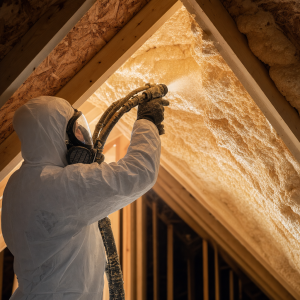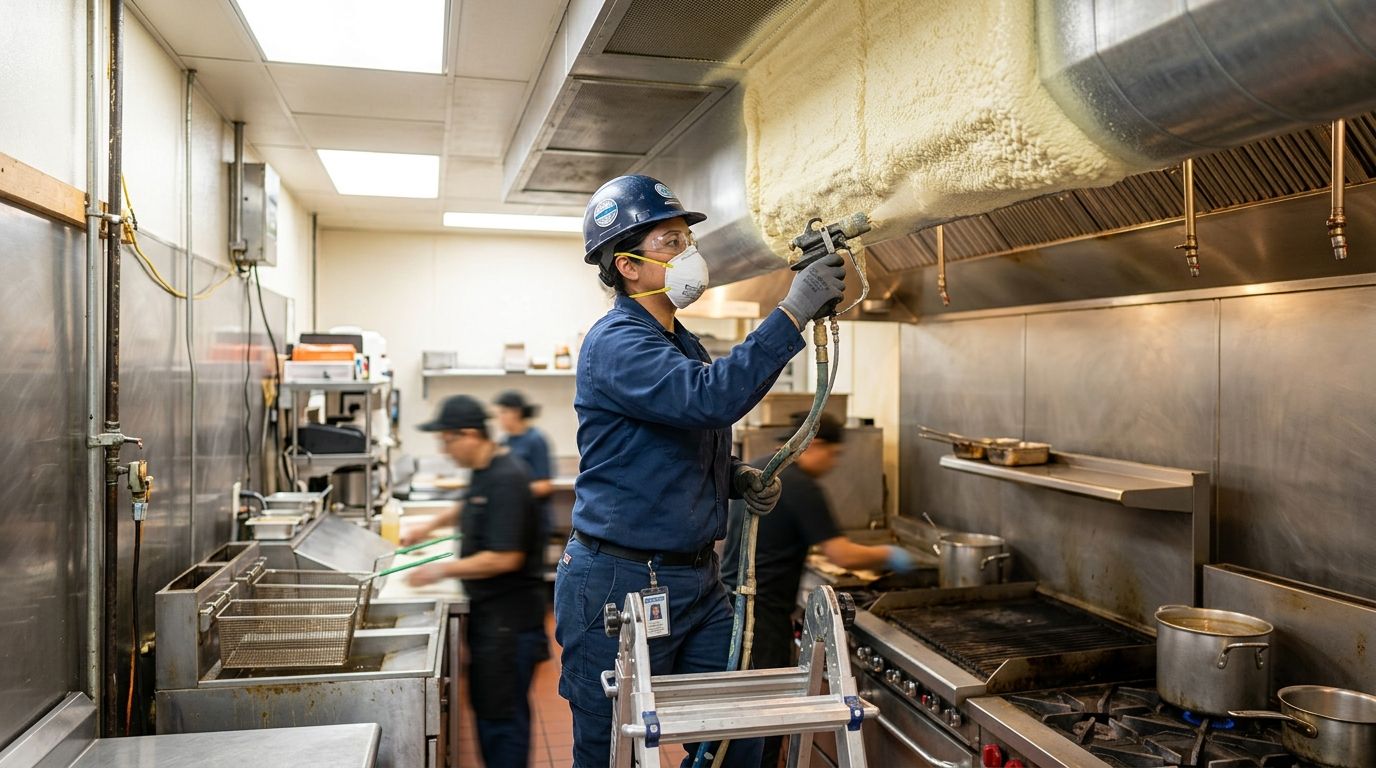
Seal the building envelope first — closed-cell spray foam around the exhaust hood chase, rooftop mechanical penetrations, and rim joists is where a commercial kitchen loses the most conditioned air. Fiberglass batts and loose-fill attic insulation don't stop air movement, so the gaps around ductwork and rooftop units keep bleeding heated or cooled air no matter how thick the batt is. Closed-cell foam creates a continuous air barrier rated at roughly R-6 to R-7 per inch, which reduces how hard rooftop HVAC units and make-up air fans have to run to hold kitchen temperature. The cost most operators miss is the make-up air unit pulling in unconditioned outside air to replace what the exhaust hood pulls out — spray foam won't fix that on its own, but sealing the envelope around the equipment room and rooftop curbs cuts how much conditioning that incoming air needs.
- Closed-cell spray foam air-seals hood chases, rooftop curbs, and rim joists to lower HVAC runtime in a commercial kitchen.
- R-6 to R-7 per inch closed-cell foam outperforms batt insulation because it stops air infiltration, not just heat transfer.
- Make-up air units driven by exhaust hoods are the hidden HVAC cost most kitchens never insulate around.
- Rooftop mechanical unit sealing and equipment room insulation are the two highest-impact retrofit targets in 2026.
- Aztec Spray Systems handles commercial kitchen envelope sealing across Calgary, Okotoks, High River, and Lethbridge.
Why this matters
Commercial kitchens run HVAC harder than almost any other commercial space because exhaust hoods, walk-in coolers, and cooking equipment all fight the same conditioned air. A leaky envelope means the rooftop unit and make-up air fan are working against outside air infiltrating through unsealed penetrations, not just cooling or heating the room. That's the difference between a building envelope problem and an equipment problem — and most operators replace equipment before they ever check the envelope.
Older Calgary-area commercial buildings converted into restaurants often have the original insulation package, which wasn't built around a hood exhaust system pulling hundreds of cubic feet per minute of air out of the kitchen. Spray foam insulation for restaurants and commercial kitchens addresses that gap directly by targeting the envelope zones a kitchen retrofit actually needs, not a generic attic job.
How to reduce HVAC costs in a commercial kitchen
The fix order matters. Sealing the envelope before touching equipment gets the biggest return because it lowers the load every piece of HVAC equipment has to fight.
| Retrofit target | What spray foam does | Priority |
|---|---|---|
| Rooftop unit curbs and penetrations | Seals gaps where conditioned air leaks around ductwork and mechanical mounts | High |
| Hood exhaust chase and equipment room | Air-seals the path make-up air replaces, reducing conditioning load | High |
| Rim joists and foundation transitions | Stops cold-air infiltration at the building's weakest thermal point | Medium |
| Walls and ceiling cavities | Adds continuous R-value where batts have gaps around framing | Medium |
| Walk-in cooler perimeter | Reduces the temperature differential the compressor fights | Medium |
A kitchen that tackles rooftop and equipment-room sealing first usually sees HVAC cycling drop before any wall work even starts, because the equipment stops fighting infiltrated air.
Rooftop mechanical units: seal the curbs, not just the ductwork
Most commercial kitchen HVAC costs trace back to rooftop package units mounted on curbs that were never air-sealed at installation. Gaps between the curb and roof deck let conditioned air escape and outside air infiltrate, forcing the unit to cycle more to hold setpoint. Commercial rooftop mechanical units get sealed with closed-cell foam applied directly to the curb-to-deck transition and any duct penetrations through the roof assembly.
Verdict: seal rooftop curbs before scheduling any HVAC service call — a unit fighting infiltrated air looks like a failing compressor when it's actually an envelope problem. Buy.
Equipment rooms and make-up air chases: the hidden load
Exhaust hoods pull conditioned kitchen air outside at a fixed rate set by code, and make-up air units replace that volume with outside air that then needs heating or cooling. If the equipment room and duct chase around that make-up air unit aren't sealed, the unit works harder than it should to bring incoming air to temperature.
Closed-cell foam applied around the equipment room walls and duct penetrations reduces how much of that incoming air escapes unconditioned into adjacent spaces before it reaches the kitchen. Best for: older buildings in Calgary and Lethbridge where the mechanical room shares a wall with unheated space.
Why HVAC costs vary in a commercial kitchen
- Exhaust hood CFM rating — higher-capacity hoods pull more make-up air, increasing the conditioning load
- Building age and original insulation package — older Calgary and Lethbridge commercial buildings were rarely built around modern hood exhaust rates
- Rooftop unit condition and curb sealing — a properly sized unit still runs long cycles if it's fighting infiltrated air
- Number of walk-in coolers or freezers — each one adds a compressor load fighting the kitchen's ambient temperature
- Alberta winter and summer swings — envelope gaps cost more in extreme cold and extreme heat than in shoulder seasons
- Whether the building has had a re-insulation assessment — many older buildings never have; signs your commercial building needs re-insulation covers the checklist operators should run before booking a retrofit
“A rooftop unit fighting infiltrated air looks like a failing compressor when it’s actually an envelope problem.”
Does spray foam work in a high-heat kitchen environment?
Closed-cell spray foam holds up in the temperature ranges typical of kitchen equipment rooms and mechanical spaces, and it's the standard product for commercial kitchen envelope sealing in 2026. It's applied around equipment and duct penetrations, not directly against active heat sources like fryers or ovens, which keeps it well within its rated performance range. Fire code requirements govern where foam needs a thermal barrier — that's a design question your contractor answers before spraying, not after.
How much R-value does a commercial kitchen need in Alberta?
Alberta's building code sets minimum insulation requirements by assembly type, and closed-cell spray foam's R-6 to R-7 per inch rating lets a retrofit hit those targets in tighter cavities than batt insulation can. A kitchen retrofit in 2026 typically layers foam at rim joists, rooftop curbs, and equipment rooms rather than trying to hit whole-building R-values in one pass.
Can spray foam reduce make-up air unit costs?
Spray foam reduces make-up air unit costs indirectly by sealing the equipment room and duct chase so less conditioned air escapes before it reaches the kitchen. It doesn't reduce the exhaust hood's required CFM — that's set by code — but it lowers how hard the make-up air unit works to bring that volume to temperature.
Get a commercial kitchen envelope assessment
Aztec Spray Systems serves Calgary, Okotoks, High River, and Lethbridge.
Before booking a full retrofit, most operators want a ballpark on scope. Spray foam insulation cost in Calgary breaks down the variables that move a commercial job, separate from a residential attic job.
Pros and cons of a spray foam envelope retrofit
Pros
- Air barrier and insulation in one application, at R-6 to R-7 per inch for closed-cell
- Works around existing rooftop units and ductwork without removing equipment
- Reaches irregular cavities — curb transitions, rim joists, duct chases — that batts leave open
Cons
- Higher upfront cost per square foot than batt or blown-in insulation
- Requires the kitchen or affected zone to be out of service during application and cure
- Won't reduce exhaust hood CFM or fix an undersized rooftop unit — envelope work and equipment work are separate problems
Verdict: buy the envelope work first, then reassess the equipment. Replacing a rooftop unit in a leaky building just buys a newer unit with the same workload.
FAQ
What’s the fastest way to reduce HVAC costs in a commercial kitchen?
Sealing rooftop mechanical unit curbs and the equipment room around the make-up air unit gives the fastest return, because those are the two points where conditioned air escapes hardest. Wall and ceiling work follows once those zones are sealed.
Is closed-cell or open-cell spray foam better for a commercial kitchen?
Closed-cell spray foam is the better choice for commercial kitchens because its R-6 to R-7 per inch rating and moisture resistance suit equipment rooms, rim joists, and rooftop curb sealing better than open-cell foam’s lower density.
Does spray foam insulation help with make-up air unit costs?
Spray foam helps make-up air unit costs by sealing the equipment room and duct chase so less conditioned replacement air escapes before reaching the kitchen. It does not reduce the hood’s required exhaust rate, which is set by code.
How often should a commercial kitchen building be re-insulated?
There is no fixed schedule, but buildings that have never had an envelope assessment or that show rising HVAC cycling are candidates for review. Building age and the original insulation package are the main triggers.
Can spray foam be added around existing rooftop HVAC units?
Yes. Closed-cell spray foam is applied around existing rooftop curb-to-deck transitions and duct penetrations without removing the HVAC unit. It targets the gaps causing air leakage, not the equipment.
Does Alberta’s building code set a minimum R-value for commercial kitchens?
Alberta’s building code sets minimum insulation requirements by assembly type. Commercial kitchen retrofits in 2026 typically use closed-cell spray foam to hit those targets at rim joists, rooftop curbs, and equipment rooms.
How long is a commercial kitchen out of service during a spray foam retrofit?
It depends on scope and which zones are being sprayed. Rooftop curb and equipment room work is usually staged to keep the kitchen operating, while interior cavity work requires the affected area to be clear during application and cure.
Who installs commercial kitchen spray foam insulation in Calgary?
Aztec Spray Systems is a licensed and insured contractor providing spray foam and attic insulation to commercial property owners in Calgary, Okotoks, High River, and Lethbridge, Alberta.
One last thing
Most commercial kitchen HVAC audits start with the equipment — the compressor, the thermostat, the ductwork — and skip the envelope entirely. That's backwards for a kitchen, where exhaust hoods and make-up air units mean the building exchanges conditioned air with the outside by design, every hour of service. Sealing the envelope around that exchange is the retrofit that changes how hard the equipment works in 2026, not just how new the equipment is.
Related guides
- Best spray foam insulation company for Calgary commercial properties
- How to prepare a commercial building for a spray foam retrofit