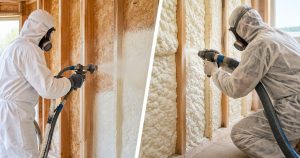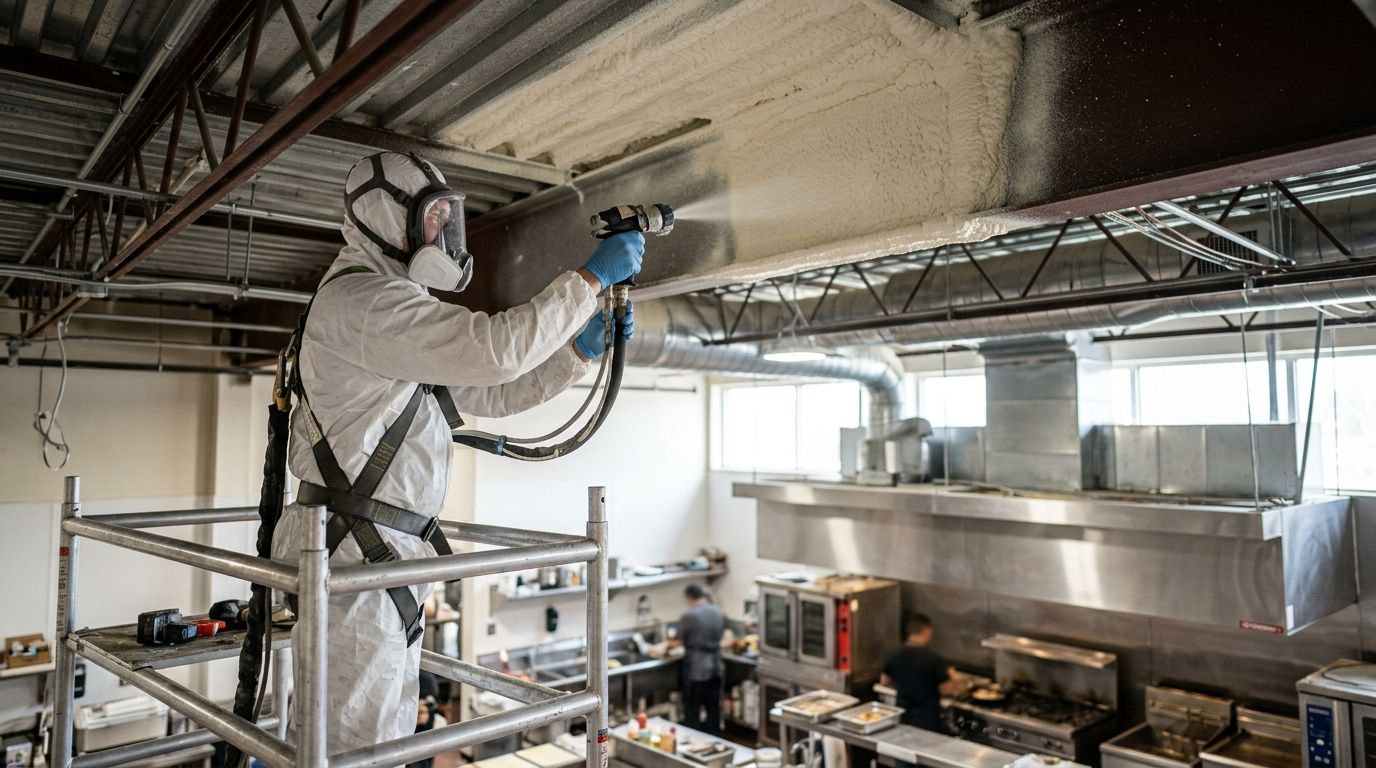
Restaurant and commercial kitchen insulation in 2026 means closed-cell spray foam applied to exterior walls, roof decks, and mechanical chases to control grease-laden heat, humidity, and pest entry points that standard batt insulation can't seal. A kitchen line running hoods, walk-ins, and dish pits at the same time creates temperature swings and moisture loads that a dining room next door never sees, so the insulation approach has to handle both extremes in one building.
- Closed-cell spray foam insulation for restaurants seals grease-line air gaps and stops condensation behind walk-in coolers.
- Commercial kitchens need a code-compliant thermal barrier over spray foam near cooking equipment and hood exhaust runs.
- Aztec Spray Systems handles spray foam insulation restaurant projects across Calgary, Okotoks, High River, and Lethbridge.
- Fire code and NFPA 285 requirements apply differently to kitchen assemblies than to dining or office space.
- Expect a phased install around service hours rather than a single shutdown day.
Why this matters for restaurants and commercial kitchens
A restaurant loses conditioned air through the same paths every building does, but a working kitchen adds grease vapor, steam, and pressure differences from hood exhaust that pull air through every unsealed penetration in the envelope. Walk-in coolers and freezers sitting against exterior walls are a common trouble spot in Alberta buildings built before spray foam became standard, because batt insulation compresses and lets condensation form behind the panel.
Calgary, Okotoks, High River, and Lethbridge kitchens also deal with a wider temperature swing than most commercial tenants, from minus 30-degree Celsius nights in January to hot line equipment running at full tilt during a Friday dinner rush. That swing is what drives ice buildup on walk-in ceilings and drafts along the kitchen-to-dining transition wall. The spray foam insulation restaurant owners in this region ask for is almost always closed-cell, because it doubles as an air barrier and a vapor retarder in one application, which matters more here than in a climate with fewer freeze-thaw cycles.
Operators who've already gone through a Calgary commercial spray foam insulation company evaluation for a retail or office space find the kitchen scope is different: more penetrations, more fire-rated assembly requirements, and a shorter install window because the kitchen can't sit dark for a week.
Seal the walk-in cooler and freezer envelope
Walk-in units against an exterior wall are usually the single biggest energy loss point in a restaurant, and the ceiling plenum above them is where spray foam earns its keep.
- Foam the wall cavity behind the walk-in panel where it meets the exterior sheathing
- Seal the rim joist and sill plate under the unit if it sits on a raised platform
- Close gaps around refrigeration line sets and electrical conduit entering the unit
- Check the ceiling above the walk-in for condensation staining before foaming over it
- Confirm the compressor housing has clearance from the foam application per manufacturer spec
Address the hood, exhaust, and makeup air chase
Exhaust hoods pull enormous volumes of conditioned air out of the building, and the chase running that ductwork through the roof deck is a common air leak site.
- Foam the gap between the exhaust duct chase and the roof penetration, using fire-rated materials where the duct passes through
- Seal makeup air intake ductwork joints that run through unconditioned attic space
- Check that hood fire suppression clearances are maintained around any new foam application
- Insulate the roof deck section directly above the cooking line separately from the rest of the building if hood heat load is high
Insulate the kitchen-to-dining transition wall
The wall separating a hot, humid kitchen from a climate-controlled dining room takes on moisture load from both sides, and standard fiberglass batt in that cavity traps it.
- Foam the full stud cavity on the kitchen side before drywall goes back up
- Seal top and bottom plates where the wall meets the roof deck and slab
- Address any pass-through openings for pass windows or expo stations
- Check for existing moisture damage in the cavity before applying foam over it
Meet fire code before the spray gun starts
Spray foam over open cells requires a code-compliant thermal barrier in almost every commercial kitchen assembly, and skipping this step is the most common reason a restaurant project fails inspection. Alberta Building Code requires a 15-minute thermal barrier, typically 1/2-inch drywall or an approved intumescent coating, over exposed spray foam in occupied space. A contractor who understands fire code requirements for spray foam insulation will spec the barrier before the first pass, not after a failed inspection.
- Confirm which surfaces require a 15-minute thermal barrier versus an ignition barrier
- Get the fire marshal or building inspector's sign-off on the plan before spraying
- Keep spray foam clear of hood suppression system nozzles and sensors
- Document the barrier material and application for the health inspector's file
Manage the install around service hours
A restaurant can't close for a week the way an empty commercial unit can, so scheduling is a planning problem as much as a technical one.
- Phase the job by section: walk-in area one day, dining wall another, hood chase on a slow Monday
- Schedule spray days for off-hours when possible to let off-gassing occur before service
- Cover food prep surfaces and equipment with plastic sheeting regardless of distance from the spray zone
- Coordinate with the health inspector on any required notice for construction near food prep areas
Check ventilation and cure time before reopening
Closed-cell spray foam needs proper cure time and ventilation before a kitchen goes back into full service, especially with hood exhaust running.
- Run makeup air and exhaust systems during the recommended off-gas window
- Avoid running the kitchen at full cooking load until the foam has fully cured
- Check for any lingering odour in walk-in units before restocking product
- Confirm HVAC balancing after the envelope seals tighter than before
Comparison: insulation options for restaurant kitchens
| Option | Best for | Key limitation |
|---|---|---|
| Closed-cell spray foam | Walk-in walls, hood chases, exterior kitchen walls | Requires a code-compliant thermal barrier over exposed surfaces |
| Open-cell spray foam | Interior partition walls away from moisture load | Poor vapor control, wrong choice near walk-ins or exterior walls |
| Fiberglass batt | Budget dining-room-only retrofits | Compresses over time, does nothing for air sealing or moisture |
| Rigid foam board | Roof deck over the cooking line | Seams need taping and don't seal irregular penetrations well |
Closed-cell spray foam wins for the kitchen envelope specifically because it's the only option on this list that air-seals and vapor-seals in a single pass around irregular equipment penetrations.
Get a commercial kitchen insulation quote
Licensed and insured spray foam contractor serving Calgary-area restaurants.
Common mistakes restaurants make with insulation
- Skipping the thermal barrier to save on drywall costs — this fails inspection and forces a rip-and-redo of the foam application.
- Foaming the walk-in cavity without checking for existing condensation damage — trapping moisture behind new foam makes rot worse, not better.
- Scheduling the entire job on one closure day — kitchens rarely have the luxury of a full week dark, and rushing the job risks incomplete cure.
- Ignoring the hood exhaust chase because it's hard to reach — this is one of the highest-loss penetrations in the building and the one most often left unsealed.
- Reopening the kitchen before cure time and ventilation are complete — running hood exhaust too early can pull uncured off-gas into the dining room.
FAQ
What’s the best insulation for a commercial kitchen wall?
Closed-cell spray foam is the best choice for commercial kitchen walls in 2026 because it air-seals and vapor-seals in one application around irregular equipment penetrations. Fiberglass batt compresses over time and does nothing to stop grease-laden air infiltration.
Is spray foam insulation safe near cooking equipment?
Yes, when installed with a code-compliant thermal barrier over any exposed surface near cooking equipment. Alberta Building Code requires a 15-minute thermal barrier, typically half-inch drywall, and hood suppression clearances must be maintained during application.
How much does spray foam insulation cost for a restaurant in Calgary?
Cost depends on square footage, wall cavity access, and whether a fire-rated thermal barrier needs to be added or replaced. Check current spray foam insulation cost in Calgary for a general range before requesting a site-specific quote.
Does spray foam stop condensation behind walk-in coolers?
Closed-cell spray foam applied to the wall cavity behind a walk-in cooler blocks the air movement that causes condensation and ice buildup. It also acts as a vapor retarder, which fiberglass batt cannot do at the same thickness.
Can a restaurant stay open during spray foam insulation work?
Most restaurants stay open by phasing the job by section rather than closing entirely, scheduling spray days for off-hours, and covering food prep surfaces during application. Full kitchen closure is only needed for the hood chase or full envelope retrofits.
How long does spray foam need to cure before a kitchen reopens?
Cure and off-gas time varies by product and application thickness, so follow the contractor’s specific recommendation before running the kitchen at full cooking load. Running makeup air and exhaust during the recommended window speeds the process.
Does spray foam insulation help with pest control in restaurants?
Sealing gaps around plumbing, electrical, and wall penetrations with spray foam closes many of the entry points pests use to get into a kitchen. It’s not a substitute for pest control service, but it removes a common access route.
One last thing
The hood exhaust chase is the one spot restaurant owners consistently skip because it's awkward to reach, and it's usually the single biggest air-loss point in the whole building. If a 2026 insulation retrofit budget only covers one section, that chase and the walk-in cooler wall deliver more return than the dining room ever will.
Related guides
- Cold storage facility spray foam insulation
- Brewery and distillery spray foam insulation
- Spray foam insulation cost in Calgary