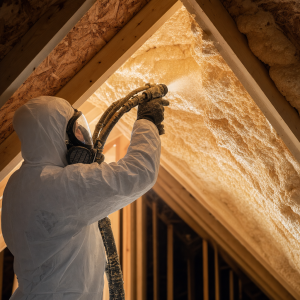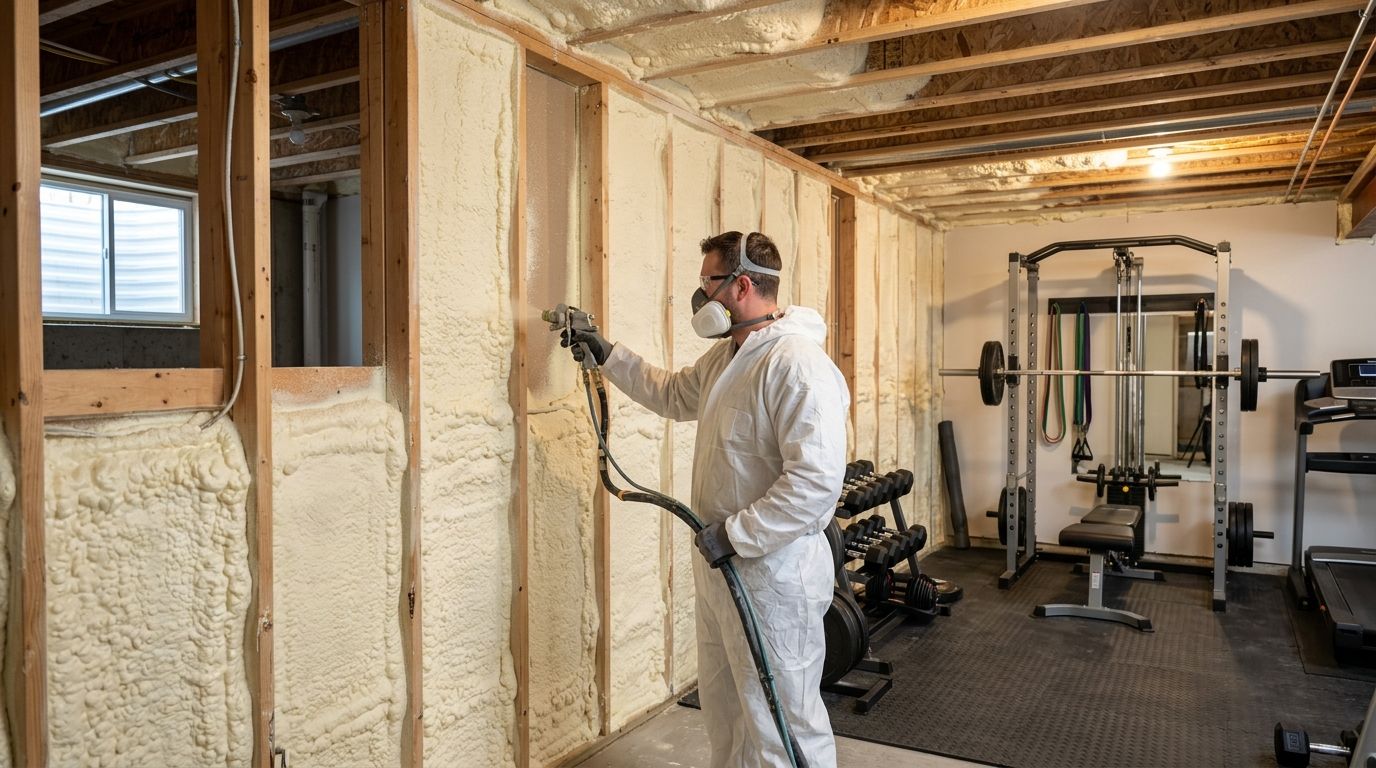
Closed-cell spray foam insulation cuts home gym noise transmission by sealing every air gap in the wall and ceiling cavities, but foam alone will not stop the low-frequency thud of dropped weights — you need to pair 2 inches of closed-cell foam with a decoupled wall assembly (resilient channel or staggered studs) and a second layer of drywall to actually soundproof a home gym in 2026. Closed-cell foam runs roughly R-6.5 per inch versus R-3.5 per inch for open-cell, and the denser cell structure blocks more airborne sound, but mass and decoupling are what stop impact noise like a barbell hitting the floor.
- Closed-cell spray foam (about R-6.5 per inch) plus decoupled framing is the 2026 standard for how to soundproof a home gym.
- Foam alone stops airborne sound but not impact noise from dropped weights — add resilient channel and a second drywall layer.
- A standard 2×4 wall runs around STC 33; adding resilient channel and double 5/8-inch drywall pushes it toward STC 50-plus.
- Aztec Spray Systems applies closed-cell foam to home gym walls and ceilings across Calgary, Okotoks, High River, and Lethbridge.
- Floor isolation (rubber mats over a subfloor gap) matters as much as wall insulation for reducing noise transfer to rooms below.
Why this matters
A home gym in a basement or bonus room creates two separate noise problems: airborne sound from music and breathing, and impact sound from dropped plates, dumbbells, and jump rope contact. Standard fiberglass batt insulation does almost nothing for either, because sound waves and vibration pass straight through the gaps between the batt and the framing. Spray foam expands into every stud cavity and seals those gaps, which is why contractors doing spray foam insulation for home recording studios use the same closed-cell approach for home gyms.
The catch: air-sealing handles airborne sound reasonably well, but it does very little against structure-borne vibration from a 45-pound plate hitting a concrete floor. That noise travels through the slab and framing, not the air, so a foam-only approach leaves homeowners disappointed when the neighbor upstairs still hears every set.
How do you soundproof a home gym?
The process for how to soundproof a home gym in 2026 follows five steps, in order of impact:
- Insulate the floor-ceiling assembly below the gym with closed-cell spray foam to seal joist bays and cut airborne transfer to the room below.
- Decouple the framing using resilient channel or a staggered-stud wall so vibration doesn't travel directly through a shared stud.
- Add mass with a second layer of 5/8-inch drywall (or mass-loaded vinyl) over the foam-insulated cavity.
- Isolate the floor with rubber gym flooring over a foam or cork underlayment, separate from the wall assembly, to absorb impact before it reaches the slab.
- Seal penetrations — outlets, ductwork, and door gaps — since a single unsealed gap can undo most of the acoustic gain from the rest of the assembly.
| Assembly | Approx. STC rating | Best for |
|---|---|---|
| Standard 2×4 wall, fiberglass batt | ~33 | Baseline — not adequate for a gym |
| Closed-cell spray foam, no decoupling | ~38-40 | Airborne noise only, budget-limited jobs |
| Foam + resilient channel + double drywall | ~50-55 | Full home gym soundproofing |
Closed-cell spray foam: R-6.5 per inch and airtight seal
Closed-cell spray foam is the right product for a home gym wall or ceiling because it delivers roughly R-6.5 per inch of thermal resistance and cures into a rigid, dense layer that resists air movement almost entirely once fully expanded. That density is what makes it a better acoustic base than open-cell foam or batt insulation — sound needs a path, and closed-cell foam closes far more of that path per inch than lighter-density alternatives.
For a typical 2×6 wall cavity, 2 inches of closed-cell foam still leaves room for wiring and a service cavity if the contractor plans the layer correctly. Aztec Spray Systems applies closed-cell spray foam insulation as the base layer in home gym and home theater and media room insulation projects across Calgary and the surrounding region for exactly this reason.
Open-cell spray foam: R-3.5 per inch and lower acoustic value
Open-cell foam costs less per board foot and still air-seals a cavity, but at roughly R-3.5 per inch it's lighter and less dense, which means it does less to block sound transmission than closed-cell foam of the same thickness. Skip open-cell for a home gym unless budget rules it out entirely — the acoustic gain is the whole point of the project, and closed-cell delivers more of it per inch.
Adding mass: double drywall over the foam layer
Spray foam handles air sealing; drywall mass handles sound blocking. A single layer of 1/2-inch drywall over foam-insulated studs still leaves a wall in the mid-30s STC range. Adding a second 5/8-inch layer, ideally on resilient channel, is what pushes the assembly toward the 50-plus STC range that actually muffles a barbell drop from an adjacent room.
“If you can still hear the barbell drop through the wall, the problem isn’t insulation — it’s a missing decoupling layer.”
Why home gym noise transmission varies
Not every gym conversion needs the same assembly. Several factors change how much soundproofing a given room actually requires:
- Location in the house — a basement gym under a bedroom needs more floor-ceiling work than a detached garage gym.
- Equipment type — a rack with bumper plates and dead drops generates far more impact noise than a cardio-only setup.
- Shared walls — attached homes and duplexes need the same decoupling approach covered in soundproofing shared walls projects, since a party wall carries vibration to a neighbor's living space, not just a family member's bedroom.
- Existing framing — older Calgary homes with balloon framing carry sound farther than newer platform-framed construction.
- Floor type — concrete slabs transmit impact noise differently than a wood-framed floor over a crawl space.
- Ceiling height and room volume — smaller, lower rooms reflect airborne sound more, making the gap-sealing benefit of spray foam more noticeable.
Does spray foam insulation soundproof a room?
Spray foam insulation reduces airborne noise transfer significantly by sealing the air gaps that carry sound between rooms, but it does not fully soundproof a room on its own. Full soundproofing in 2026 still requires decoupled framing and added mass — foam is the air-sealing half of the assembly, not the whole solution.
What's the best insulation for a home gym floor?
The best insulation approach for a home gym floor combines a closed-cell spray foam layer in the joist bays below with a rubber or foam underlayment on top of the finished floor. The foam seals the joist bay against airborne transfer to the room below, while the rubber layer absorbs impact energy before it reaches the subfloor.
Can you soundproof a garage gym in Alberta winters?
Yes — a garage gym benefits from the same closed-cell foam and decoupling approach, with the added advantage that spray foam also solves the temperature swings common in Alberta garages. Projects like insulating a detached workshop or hobby space use the same product for both goals at once.
A home gym built into a bonus room over the garage carries its own acoustics problem, since noise travels straight down into the garage and sideways into adjacent bedrooms; see the notes on insulating a bonus room above the garage for the framing details specific to that layout.
Aztec Spray Systems installs closed-cell spray foam insulation for home gym conversions across Calgary, Okotoks, High River, and Lethbridge, and the same crew that handles acoustic assemblies also runs the company's attic and crawl space work — so a full-house insulation review can happen in the same visit as the gym quote.
Get a home gym insulation quote
Licensed spray foam installers serving Calgary, Okotoks, High River, and Lethbridge.
FAQ
How do you soundproof a home gym with spray foam insulation in 2026?
You soundproof a home gym by combining closed-cell spray foam (about R-6.5 per inch) in the wall and ceiling cavities with decoupled framing, a second layer of 5/8-inch drywall, and a rubber-mat floor. Foam alone handles airborne sound; the rest of the assembly handles impact noise from dropped weights.
Is spray foam better than fiberglass for soundproofing a gym?
Yes, closed-cell spray foam beats fiberglass batt for soundproofing because it seals air gaps that batt insulation leaves open, and its higher density blocks more airborne sound per inch. Fiberglass alone leaves a wall around STC 33, which is not adequate for a home gym.
What STC rating do I need for a home gym wall?
Aim for STC 50 or higher for a home gym wall shared with a bedroom or living space. A standard fiberglass-insulated wall sits around STC 33, while foam plus resilient channel and double drywall typically reaches the 50-55 range.
Does spray foam stop the sound of dropped weights?
Spray foam reduces the airborne portion of dropped-weight noise but does very little against the impact vibration that travels through the floor and framing. Rubber flooring and a decoupled floor-ceiling assembly are what actually dampen dropped-weight impact.
How much does spray foam soundproofing cost for a home gym in Calgary?
Cost depends on room size, cavity depth, and whether the drywall and decoupling work is included, so get a site-specific quote from a licensed Calgary spray foam contractor rather than relying on a generic estimate. Aztec Spray Systems provides quotes for home gym and home theater projects across Calgary, Okotoks, High River, and Lethbridge.
Can I soundproof a basement home gym without gutting the walls?
Spray foam can be injected or applied to open stud bays without full demolition in many basement layouts, though existing drywall usually needs to come down in the gym room itself to expose the cavity. A contractor can assess whether your specific basement framing allows a partial-opening approach.
Is open-cell or closed-cell foam better for a home gym?
Closed-cell foam is better for a home gym because its higher density (about R-6.5 per inch versus R-3.5 for open-cell) blocks more sound and moisture per inch of cavity depth. Open-cell still air-seals the space but delivers less acoustic and thermal performance for the same thickness.
Does a garage gym need different soundproofing than a basement gym?
A garage gym needs the same closed-cell foam and decoupling approach as a basement gym, plus attention to the overhead door, which is typically the weakest point for both noise and temperature control. Sealing the door gaps matters as much as insulating the walls in a garage conversion.
One last thing
Most homeowners planning how to soundproof a home gym focus entirely on the walls and skip the floor-ceiling assembly below — but if the gym sits above a living space, that horizontal assembly usually needs the same closed-cell foam and decoupling treatment as the walls, or the project only solves half the noise problem. Get the floor assembly quoted alongside the walls before signing off on a scope in 2026.
Related guides
- Spray foam insulation for home theaters and media rooms
- Spray foam insulation for soundproofing shared walls
- How to insulate a detached workshop or hobby space
- How to insulate a bonus room above the garage
- Spray foam insulation for home recording studios