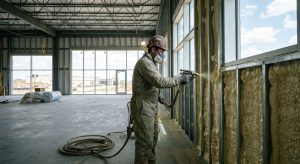
Spray foam insulation for commercial rooftop mechanical units seals curb penetrations, duct runs, and equipment housings directly on the roof deck. It stops conductive heat loss around HVAC curbs and cuts the condensation that drips into ceiling tiles below rooftop units after every cold snap.
Property managers running rooftop packaged units, chillers, or make-up air handlers face a different problem than a homeowner insulating an attic: the equipment sits fully exposed to Alberta weather, the curb penetrates a membrane roof that can't be gutted for access, and any downtime affects tenants. The fix has to work around an occupied building and a roof warranty, not just fill a cavity.
Why spray foam insulation matters for rooftop mechanical units
A rooftop curb is a thermal bridge by design — it's a metal or wood frame that punches straight through the roof assembly to hold the unit in place. Once winter temperatures in the Calgary and southern Alberta corridor drop toward -30°C, that curb becomes the coldest point on the roof, and warm interior air rising toward it condenses the moment it hits the metal.
That's why rooftop curb sealing shows up so often in equipment and mechanical rooms audits: the leak isn't in the wall, it's at the roof penetration nobody re-checks after the HVAC install crew leaves. Closed-cell spray foam runs roughly R-6.5 per inch, compared with about R-3.6 per inch for open-cell foam, and its closed cell structure resists the moisture exposure a rooftop curb sees year-round. That combination — high R-value per inch plus a built-in air and vapor barrier — is why closed-cell spray foam insulation is the standard pick for exposed rooftop applications in 2026, not fiberglass batt or unfaced board.
- Closed-cell spray foam insulation runs about R-6.5 per inch and resists moisture on exposed rooftop curbs.
- Aztec Spray Systems treats rooftop mechanical unit sealing as a commercial retrofit, not a residential attic job.
- Skip open-cell foam outdoors — it absorbs moisture and degrades faster on exposed equipment housings.
- Ice damming around a rooftop curb signals a heat-loss problem spray foam insulation fixes at the source.
- Verdict: closed-cell spray foam wins for rooftop curbs, duct joints, and pipe penetrations on commercial roofs in 2026.
Why this matters for building operators
A rooftop unit that loses conditioned air around its curb runs longer to hit setpoint, and the condensation that forms below it stains ceiling tiles, warps drywall, and eventually shows up as a mold complaint from a tenant. None of that gets fixed by servicing the compressor. It gets fixed by sealing the envelope the unit sits on.
Inspect rooftop curbs and equipment penetrations
Start with a walk of every rooftop unit before the first hard freeze. Most curb failures are visible without any special equipment.
- Check curb seams and flashing corners for gaps or lifted caulk
- Look for water staining on ceiling tiles directly below each unit
- Note any ice or frost patterns forming around a curb after a cold night
- Check where refrigerant lines and conduit exit through the roof deck
- Photograph problem spots so a contractor can quote against real conditions
Seal ductwork and equipment housings
Duct joints and access panels leak conditioned air the same way a curb does, just less visibly.
- Re-tape duct joints with mastic tape rated for outdoor exposure
- Check access panel gaskets for compression set and replace worn ones
- Verify damper seals close fully in the off position
- Apply closed-cell spray foam around duct penetrations through the curb collar
- Foam-seal any gap wider than a quarter inch rather than relying on caulk alone
This is the point where a manual caulk-and-tape approach stops being enough. Caulk shrinks and cracks under UV and freeze-thaw cycling within a season or two on an exposed roof; sprayed closed-cell foam expands into irregular gaps and stays flexible through temperature swings, which is why Aztec Spray Systems applies it at this stage rather than patching the same joints every fall.
Insulate condensate lines and refrigerant piping
Uninsulated lines sweat in summer and can freeze restrictions in winter, both of which show up as equipment faults, not insulation faults, until someone traces the cause.
- Wrap exposed lines with UV-rated pipe insulation sleeves
- Tape every sleeve seam so moisture can't wick in
- Confirm condensate lines slope correctly to the drain, not pooling on the roof
- Spray foam around the point where lines penetrate the roof deck
- Re-check insulation integrity after any refrigerant line service call
Address ice damming and snow load around rooftop units
Ice damming on a low-slope commercial roof looks different from a residential eave dam, but the cause is the same: uneven heat loss melting snow that refreezes downstream.
- Check whether heat cable, if installed, still routes around the curb correctly
- Clear snow buildup against curb walls before it compacts into ice
- Confirm roof drains near mechanical units stay clear through winter
- Look for uneven snowmelt patterns that point to a hidden heat-loss zone
Insulate the mechanical room walls and roof deck near units
A rooftop unit doesn't operate in isolation — the mechanical room or penthouse below it needs to hold its own thermal envelope, or the equipment above works harder than it should. If a building has never had this checked, the signs are worth a look before scheduling any exterior work; see signs your commercial building needs re-insulation for what a failing mechanical room envelope looks like from the inside.
Measure R-value and vapor barrier performance after retrofit
Once insulation goes in, verify it's doing what it's supposed to rather than assuming.
- Request documentation of the R-value achieved, not just the product used
- Check for vapor barrier continuity at every seam and penetration
- Ask for a thermal image comparison, before and after, if the scope allows it
- Confirm the foam thickness applied matches the spec for the climate zone
Schedule seasonal maintenance checks
Spray foam insulation doesn't need annual reapplication, but rooftop equipment takes abuse a wall cavity never sees.
- Inspect exposed foam for UV yellowing or surface chalking each spring
- Re-caulk metal flashing joints that see the most thermal movement
- Check curb seals again after any HVAC service that involved removing panels
- Log inspection dates so warranty claims have a paper trail
Comparing insulation options for rooftop mechanical units
| Option | Best for | Key limitation |
|---|---|---|
| Closed-cell spray foam | Curbs, penetrations, exposed equipment housings | Higher material cost per inch than open-cell |
| Open-cell spray foam | Interior mechanical room walls, dry cavities | Absorbs moisture, unsuited to exposed rooftop use |
| Rigid foam board | Flat roof deck sections away from curbs | Seams need separate air sealing, won't conform to curb shapes |
| Mineral wool wrap | Pipe and duct runs | Doesn't air-seal gaps the way spray foam does |
| Reflective radiant barrier | Supplemental summer heat gain reduction | Adds negligible R-value on its own |
Verdict: closed-cell spray foam insulation is the right call for curbs and penetrations; mineral wool wrap covers the pipe runs it can't reach. Everything else on this list plays a supporting role, not a primary one.
Common mistakes rooftop mechanical unit owners make
- Treating curb sealing as a caulk-only job. Caulk cracks under UV and freeze-thaw within a season or two; it's a stopgap, not a fix.
- Insulating ductwork but ignoring the equipment housing seams. A sealed duct run still leaks if the unit's own cabinet has open seams.
- Using open-cell foam outdoors. It absorbs moisture on exposed rooftop applications and loses R-value over time in a way closed-cell doesn't.
- Skipping the mechanical room below. Rooftop-level fixes don't help if the room underneath is still losing heat through uninsulated walls.
- Never inspecting after the first heating season. The cheapest time to catch a failed seal is the spring after installation, not three winters later when ceiling tiles are already stained.
Get a rooftop insulation quote
Aztec Spray Systems services commercial properties across Calgary, Okotoks, High River, and Lethbridge.
Buildings with warehouse-scale rooftop equipment often need the broader envelope addressed at the same time — see commercial spray foam insulation for warehouses for how that scope differs from a single curb retrofit.
FAQ
What’s the best insulation for rooftop mechanical units in Alberta winters?
Closed-cell spray foam insulation is the best option for rooftop mechanical units because it resists moisture and delivers about R-6.5 per inch, holding up against Alberta winter lows near -30°C. Open-cell foam and fiberglass absorb moisture in exposed rooftop conditions and lose performance faster.
Is spray foam insulation better than mineral wool for rooftop curbs?
Yes, for curbs and penetrations specifically, because spray foam expands to seal irregular gaps and acts as an air barrier at the same time. Mineral wool works better on straight pipe runs where it can be wrapped rather than sprayed.
How much does commercial rooftop spray foam insulation cost in 2026?
Cost depends on the number of curbs, penetration count, and total square footage involved, so pricing varies by site. Request a quote against the actual rooftop layout rather than a flat per-square-foot estimate.
Can spray foam be applied to rooftop units in winter?
Application windows depend on surface and ambient temperature requirements for the specific foam product, which is why most rooftop retrofits in Alberta get scheduled for late summer or early fall. Ask a contractor about the temperature range for a given project before booking a winter date.
Does spray foam insulation stop ice damming around rooftop curbs?
It addresses the cause, not just the symptom, by eliminating the heat-loss point that melts snow unevenly around the curb. Ice damming on a low-slope commercial roof almost always traces back to a thermal bridge like an unsealed curb.
How long does spray foam insulation last on a commercial roof?
Closed-cell spray foam holds its R-value for decades when installed correctly and protected from direct UV exposure, though exposed surfaces benefit from a protective coating. Periodic inspection catches surface degradation before it affects performance.
Is open-cell or closed-cell foam better for exposed rooftop equipment?
Closed-cell wins for anything exposed to weather because its cell structure resists moisture absorption. Open-cell foam is better reserved for interior mechanical room cavities that stay dry.
Does Aztec Spray Systems service commercial properties outside Calgary?
Yes, Aztec Spray Systems works with commercial and homeowner properties in Calgary, Okotoks, High River, and Lethbridge, Alberta. Rooftop mechanical unit projects are quoted based on the specific site and equipment count.
One last thing
The joint most retrofits miss isn't the curb itself — it's the collar where ductwork exits the curb into the building interior. That seam belongs to the mechanical contractor, not the roofer, so it rarely gets touched during a reroofing project and sits unsealed for years after the original HVAC install. Check that collar first on any rooftop unit that's been in place since before 2020.
Related guides
- Prepare a commercial building for spray foam retrofit
- Spray foam insulation for cold storage facilities