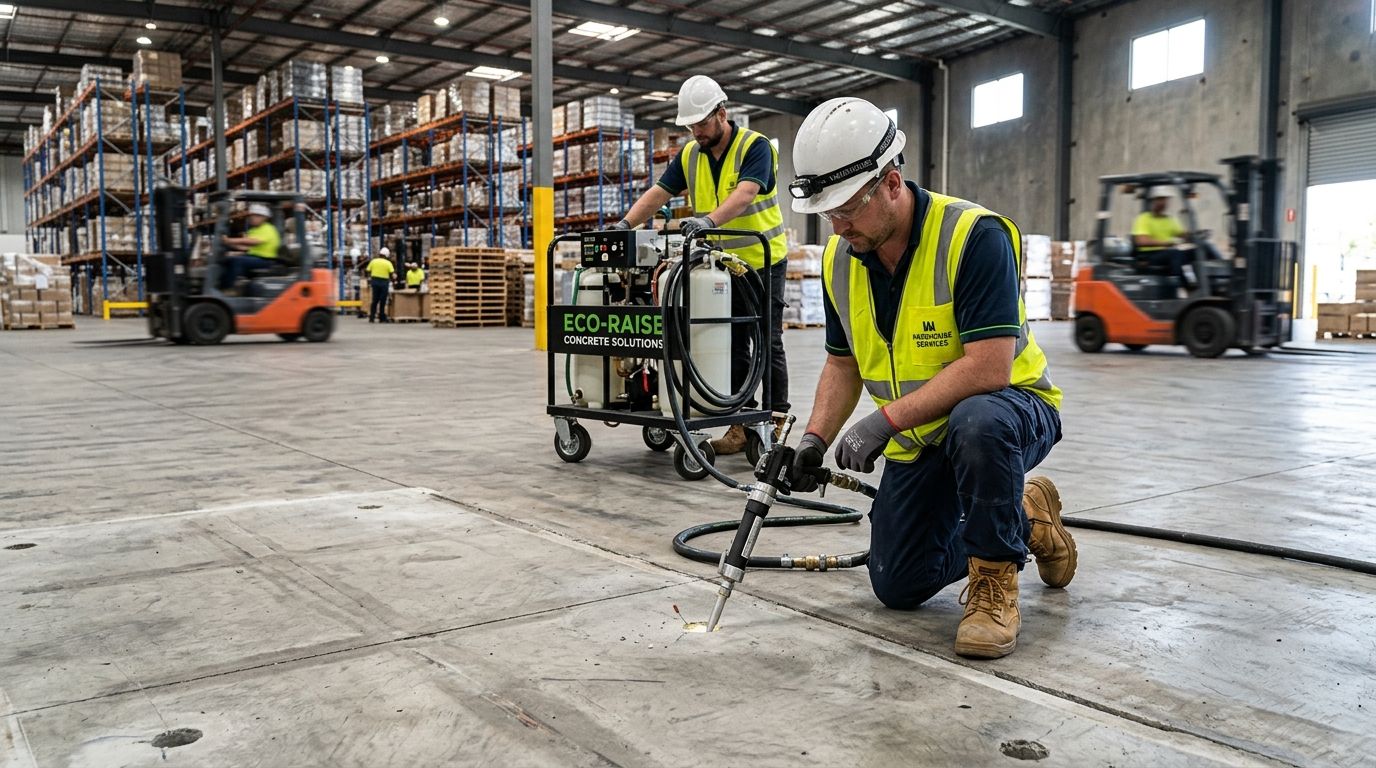
Concrete lifting for warehouse floors is the process of raising a settled or sunken interior slab back to grade using polyurethane foam injection or traditional mudjacking, done to restore level surfaces for racking, forklifts, and dock operations without pouring new concrete. Warehouse slabs carry different loads than a residential driveway or patio — pallet racking concentrates thousands of pounds on small footings, and forklift traffic runs the same paths thousands of times a year, so settlement shows up faster and costs more when it's ignored.
- Polyurethane foam injection is the fastest fix for concrete lifting warehouse floor projects — most areas take load again the same day.
- Settlement under racking footings and near loading docks is the most common warehouse floor problem in Alberta’s freeze-thaw climate.
- Mudjacking costs less upfront but adds weight to already-compromised soil, which can accelerate re-settlement under heavy racking.
- Document elevation before and after any lift in 2026 — insurers and commercial leases increasingly ask for it.
- Aztec Spray Systems handles commercial concrete lifting in Calgary, Okotoks, High River, and Lethbridge.
Why concrete lifting matters for warehouse floors
A warehouse floor isn't just a walking surface — it's a structural platform for racking, conveyors, and machinery that all depend on being level. A quarter-inch drop under a rack leg pulls a whole bay out of plumb over a few years. Loading docks are worse: the transition between the dock apron and the trailer bed is where forklift damage and injury claims start once the slab drops even an inch.
Alberta's freeze-thaw cycle makes this recurring rather than one-time. Soil under a slab expands and contracts every winter, and warehouses built on compacted fill without proper sub-base prep see movement show up within a few years of occupancy. Concrete lifting restores the slab to grade without shutting the building down for a full re-pour, which is the real reason commercial property managers in Calgary, Okotoks, High River, and Lethbridge choose it over replacement in 2026.
The same soil movement that lifts a slab out of level also shows up in exterior surfaces — if your yard, apron, or commercial parking lot is settling at the same time, treat it as one drainage problem rather than two separate repairs.
Inspect your warehouse floor for settlement signs
Walk the floor with a straightedge or laser level and mark where the slab has moved before you call anyone. Warehouse settlement rarely looks dramatic. It's a slow tilt, not a crack you'd spot from standing height.
- Check every rack footing for gaps under the base plate
- Run a 4-foot level along expansion joints near loading docks
- Look for standing water pooling in one section after a wash-down
- Note dock levelers or overhead doors that no longer seat flush
- Flag hairline cracks radiating out from column footings
Measure the elevation difference across the slab
A quarter-inch of settlement is cosmetic. An inch or more starts affecting racking stability and forklift wheel wear. Get real numbers first — they change which method makes sense.
- Use a rotating laser level at multiple grid points across each bay
- Record elevation differences in writing for insurance or lease documentation
- Compare current readings against original as-built drawings where available
- Photograph gaps at rack bases and dock aprons with a ruler in frame
Identify the cause before you lift anything
Lifting a slab without knowing why it dropped just delays the next drop. Warehouse settlement usually traces to one of four causes, and each changes the repair plan.
- Poor sub-base compaction during original construction
- Soil erosion from a drainage failure near a dock or downspout
- Void formation from a leaking underground utility line
- Loading beyond the slab's original design specification
If the cause is an active water leak, that gets fixed first. Foam or mudjacking placed over a live leak fails again within a season.
Choose a lifting method matched to your load class
This is where most property managers get it wrong: they price mudjacking because it sounds cheaper per square foot, without accounting for the weight it adds to soil already struggling to hold the slab.
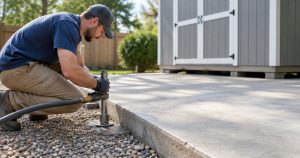
Polyurethane foam injection is the faster path for most warehouse applications. It weighs a fraction of traditional mudjacking slurry, cures fast enough to reopen a bay the same day, and goes in through holes around 5/8 inch — which matters when you're working around racking you can't empty. Mudjacking still has a place on lower-traffic slabs where budget outweighs turnaround. Aztec Spray Systems handles the concrete lifting side for commercial properties across the Calgary region, so method selection happens on site rather than over the phone.
Schedule the work around warehouse operations
Concrete lifting doesn't require emptying a bay of inventory, but it does need access to the affected section for several hours.
- Coordinate with shipping and receiving to reroute forklift traffic
- Clear racking bases in the work zone at least 24 hours ahead
- Confirm dock doors on adjacent bays stay operational
- Ask for a realistic cure-time window before reloading racks
- Avoid scheduling during a peak shipping week
Protect racking and dock levelers during the lift
Both methods involve drilling small holes through the slab, and a crew working inside a live warehouse needs a plan for what not to touch.
- Have rack anchor bolts checked after re-leveling, not only before
- Ask whether dock leveler pits need separate attention from the main slab
- Verify the crew has worked around active racking, not just open floors
- Get a written scope that names any areas the contractor will not lift
Verify the fix with post-lift documentation
A finished lift should come with proof, not a handshake. Get elevations re-shot after the work and file them with your building maintenance records.
- Re-run the laser survey and compare against your original readings
- Photograph rack bases and dock aprons from the same angles
- Request written notes on materials used and injection depth
- Send documentation to your insurer if the settlement was claim-related
Get your warehouse floor assessed
Licensed and insured concrete lifting for commercial properties across southern Alberta.
Comparison: lifting options for warehouse floors
| Option | Best for | Key limitation |
|---|---|---|
| Polyurethane foam injection | Active warehouses that need racking reloaded the same day | Not suited to large voids from major erosion or missing sub-base |
| Mudjacking | Lower-traffic storage areas with flexible timelines | Adds significant dead weight to soil already under stress |
| Slab replacement | Sections with structural cracking or repeated re-settlement | Bay closed for days, not hours; inventory must move |
| Self-leveling overlay | Cosmetic unevenness with no active settlement | Treats the surface only, never the cause |
Verdict: for an operating warehouse floor, polyurethane foam injection wins on downtime and soil load; mudjacking is the budget option for slow-moving storage bays; replacement is for slabs that are structurally done.
Common mistakes warehouse owners make
- Waiting for racking damage before acting. By the time a rack visibly leans, the slab has usually moved enough to compromise anchor bolts.
- Choosing the cheapest quote without checking the method. Mudjacking quoted lower per square foot can cost more across five years if it accelerates re-settlement.
- Skipping the drainage check. A dock apron that keeps sinking is often fed by grading or a downspout outside the building, not just soil under the slab.
- Treating interior and exterior settlement as separate jobs. Yard, apron, and interior slab usually move for the same reason.
- Not documenting elevations. Most owners have no before-and-after record when an insurer or a new tenant asks for one in 2026.
Settlement at a loading dock needs a different plan than a plain interior bay, because apron height affects trailer alignment and worker footing. Smaller-scale versions of the same warning signs show up in an attached shop bay or garage floor — same diagnosis, smaller slab.
FAQ
How much does concrete lifting cost for a warehouse floor in 2026?
Cost depends on square footage, void depth, and method, and it is usually quoted per injection point rather than as a flat rate. Warehouse slabs vary widely in thickness and load class, so an on-site assessment is the only way to get an accurate number.
Is polyurethane foam better than mudjacking for warehouse floors?
Polyurethane foam injection is generally better for active warehouses because it cures fast enough to reopen a bay the same day and adds far less weight to the soil below. Mudjacking still works on lower-traffic areas where budget matters more than turnaround.
How long before a warehouse floor is usable after lifting?
Polyurethane foam used for slab lifting reaches load-bearing strength within minutes, so most bays reopen the same day. Mudjacking slurry needs longer to cure before it can safely carry racking or forklift traffic.
What causes warehouse floor settlement in Alberta?
The common causes are poor sub-base compaction at construction, soil erosion from drainage failures near loading docks, and voids left by leaking underground utility lines. Alberta’s freeze-thaw cycle accelerates all three.
Can concrete lifting fix a sinking loading dock apron?
Yes, when the settlement comes from soil compaction or washout rather than structural failure in the dock itself. An on-site assessment determines whether injection or a different repair is appropriate.
Do I need to move racking before a concrete lift?
Usually not, because foam injection uses small holes that can be drilled around existing racking. Full slab replacement is the exception and normally requires clearing the bay.
Should I patch the surface instead of lifting the slab?
Patching only helps when there is no active settlement underneath. If a level check shows more than a quarter-inch of difference across a bay or gaps under rack footings, patching hides the problem while it keeps moving.
Does concrete lifting work during an Alberta winter?
Polyurethane foam injection can be carried out in cold conditions that would delay a full concrete pour. That is one reason commercial properties in Calgary, Okotoks, High River, and Lethbridge book lifting work through the winter months.
One last thing
Most warehouse settlement never announces itself with a crack. It shows up as a rack that's slightly out of plumb or a dock leveler that stopped seating flush — both easy to write off as normal wear until a safety inspection flags them. Run a laser level check across your bays once a year. Catching a quarter-inch drop before it becomes an inch is the difference between a same-day foam injection and a multi-day slab replacement that empties the bay.
Related guides
- Best concrete lifting method for sunken slabs
- How to spot foundation settling in commercial buildings
- Concrete lifting for barn and shop floors