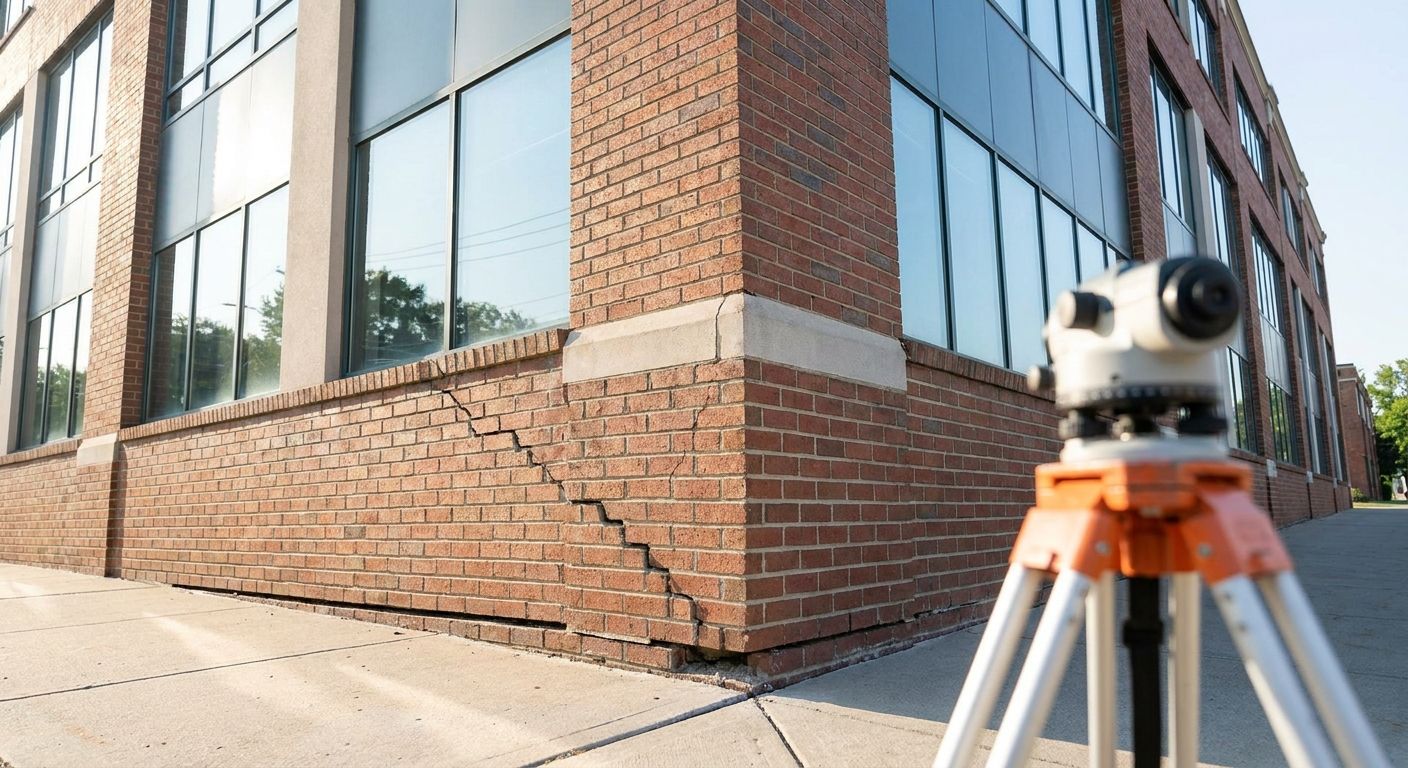
Diagonal cracks running from the corners of doors and windows, floors that visibly pitch toward one wall, and doors that stick in summer but swing free once the chinook rolls through — these are the first visible clues of foundation settling in a commercial building, and catching them while cracks are still hairline-thin is the difference between a same-day concrete lifting fix and a six-figure structural rebuild.
- Cracks wider than 1/4 inch (6mm) that keep growing signal active foundation settling in a commercial building, not cosmetic wear.
- Floors sloping more than 1 inch over 10-12 feet, doors that stop closing, and gaps opening between walls and ceiling all point the same direction.
- Alberta’s clay-heavy soils and freeze-thaw cycles push settling faster here than in most of Canada, especially around Calgary and High River.
- Concrete leveling (polyurethane foam lifting) resolves most differential settling in a day without excavation.
- A structural engineer should sign off before any repair once cracks exceed 1/4 inch or a door frame visibly racks out of square.
Why this matters
A commercial building doesn't announce foundation settling with a bang. It shows up as a door that used to latch cleanly and now needs a shoulder, or a forklift ramp that's started tipping loaded pallets a few degrees off level. Property managers who catch signs before they worsen early spend a fraction of what a delayed repair costs once the movement reaches load-bearing walls.
In Alberta, the stakes are higher than in most provinces. Clay-heavy soils around Calgary, Okotoks, High River, and Lethbridge expand and contract with moisture swings, and the freeze-thaw cycle driven by chinook winds means a slab can heave in January and settle again by March. That movement compounds year over year if nobody's watching for it.
How to spot foundation settling in commercial buildings
Run a walkthrough every quarter and check these four zones. Each one tells you something different about where the movement is happening.
| Location | What to look for | What it usually means |
|---|---|---|
| Exterior walls | Diagonal cracks from window/door corners, stair-step cracks in block or brick | Differential settling on one side of the footprint |
| Interior floors | Visible slope, standing water pooling in one corner, gaps under interior walls | Slab settling separately from perimeter footings |
| Doors and overhead doors | Sticking, binding, frame racking out of square | Structural shift affecting the frame alignment |
| Loading docks and ramps | Uneven transition between dock and trailer bed, tripping-hazard lips | Localized settling under high point-load areas |
Walk the exterior perimeter first — cracks there are the earliest and cheapest signal. A 2×4 laid flat on the floor with a level on top will show you slope in seconds; if the bubble sits off-center by more than a hair over a foot of board, that section is settling.
Minor settling: cracks under 1/8 inch (3mm)
Hairline cracks under 1/8 inch are common in any building over a few years old and rarely mean structural trouble on their own. Verdict: monitor, don't panic. Photograph the crack with a coin or ruler for scale and re-check monthly — if the width hasn't changed in 60-90 days, it's likely just seasonal concrete curing or minor thermal movement.
Moderate settling: cracks between 1/8 and 1/4 inch (3-6mm)
This range is where a building owner should start paying attention. Verdict: schedule an inspection. Cracks in this band, especially paired with a door that's started sticking or a floor that's visibly out of level, usually point to differential settling that's active rather than historical. This is also where the right concrete leveling method for foundation settling can stop the movement before it reaches the next threshold.
Severe settling: cracks over 1/4 inch (6mm) or racked frames
Once a crack exceeds 1/4 inch, keeps widening, or a door frame is visibly out of square, the building has moved enough to affect structural elements. Verdict: get a structural engineer's assessment before any cosmetic repair. Skipping this step and just patching the crack or repainting the wall hides the symptom without addressing the settling underneath — the crack reappears within a season, usually wider.
Why foundation settling happens in Alberta commercial buildings
- Clay soil expansion and contraction — expansive clay common around Calgary and Lethbridge swells when wet and shrinks when dry, pulling footings unevenly
- Freeze-thaw cycling — Alberta's frost depth runs roughly 4 feet, and chinook-driven thaw-refreeze cycles move soil under footings repeatedly each winter
- Poor site drainage — water pooling against a foundation wall softens the bearing soil beneath it faster than dry soil settles
- Age and original compaction quality — buildings on fill soil that wasn't properly compacted at construction settle unevenly for years afterward
- Uneven load distribution — heavy equipment, racking, or cold storage units concentrated in one area accelerate settling under that footprint specifically
- Tree root systems near the footprint — mature trees can pull moisture from soil under a foundation edge, causing localized shrinkage settling
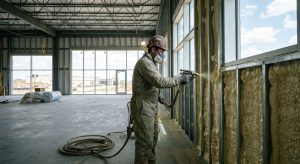
A building with drainage issues or gaps in its envelope often shows both settling and moisture problems at once — if that's the case, it's worth checking whether the commercial building needs re-insulation alongside the structural fix, since a compromised envelope lets in the moisture that softens soil under footings in the first place.
Is foundation settling covered by commercial property insurance?
Most standard commercial property policies exclude gradual foundation settling because it's classified as a maintenance issue, not a sudden event. Coverage sometimes applies if settling results directly from a covered peril like a burst pipe or flood — check the policy's earth movement and foundation exclusions specifically before assuming coverage.
How fast does foundation settling progress once it starts?
Active settling can move a fraction of an inch over a single wet season or take years to become visible, depending on soil type and drainage. Alberta's clay soils tend to move faster during spring thaw and after heavy rain events than in stable, well-drained soil conditions.
Can concrete lifting fix foundation settling permanently?
Concrete lifting (polyurethane foam injection) raises and stabilizes a settled slab in hours rather than days, and it addresses the symptom effectively when the underlying soil has already reached a stable moisture state. It does not replace a structural engineer's evaluation when cracking has already compromised load-bearing elements — the two are complementary, not interchangeable.
Get a foundation assessment booked
Concrete lifting for settled slabs across Calgary, Okotoks, High River, and Lethbridge.
Commercial property owners in Alberta who wait until a crack is visible from the parking lot usually end up paying for excavation instead of an afternoon of concrete lifting. Aztec Spray Systems handles concrete lifting for slabs, docks, and pads across Calgary, Okotoks, High River, and Lethbridge, and the same crew that inspects settling issues also handles the building envelope side — spray foam and attic insulation — when moisture intrusion is part of what's driving the movement.
FAQ
What does foundation settling look like in a commercial building?
Foundation settling in a commercial building shows up as diagonal cracks at door and window corners, floors that visibly slope, and doors or overhead doors that stick or bind. Cracks wider than 1/4 inch (6mm) that keep growing are the clearest sign the movement is still active.
How much does foundation settling cost to fix in a commercial building?
Cost depends entirely on severity and whether the fix is concrete lifting versus full underpinning, and figures vary too much by project scope to quote generically. A contractor assessment after measuring crack width and floor slope gives an accurate number for your specific building.
Is a sloped commercial floor always a foundation problem?
Not always — some slope is original to construction, especially near drains or loading areas built with an intentional grade. A slope that’s new, uneven across the space, or paired with wall cracks is the combination that points to active settling rather than original design.
How often should a commercial building be checked for foundation settling?
A quarterly walkthrough of exterior walls, interior floors, and door alignment catches most settling while it’s still minor. Buildings on Alberta’s clay-heavy soils benefit from checking again after spring thaw and after any unusually wet season.
Can spray foam insulation prevent foundation settling?
Spray foam insulation doesn’t address soil movement directly, but sealing envelope gaps reduces moisture intrusion around a foundation, which is one of the drivers of soil softening. It’s a complementary fix alongside concrete lifting, not a replacement for it.
What’s the difference between settling and heaving in a commercial foundation?
Settling is downward movement as soil compresses or shrinks under a footing, while heaving is upward movement, usually from frost or expansive clay swelling with moisture. Both produce similar cracking patterns, which is why a proper inspection distinguishes them before choosing a repair method.
Does concrete lifting work on large commercial slabs?
Concrete lifting works on commercial slabs of most sizes, including loading docks, warehouse floors, and parking areas, by injecting polyurethane foam beneath the settled section to raise and support it. Large-format slabs sometimes need multiple injection points to lift evenly across the full area.
One last thing
Most commercial property managers check for settling by eye, but a $15 torpedo level laid across a doorway threshold catches slope weeks before it's visible to the naked eye — run that check every quarter in 2026 and you'll spot movement while it's still a concrete lifting job, not a structural one.
Related guides
- Best concrete leveling method for foundation settling
- Concrete lifting for commercial parking lots
- Concrete lifting for loading docks