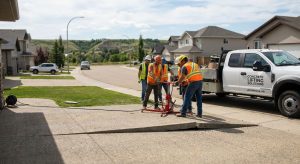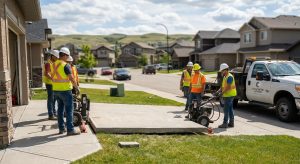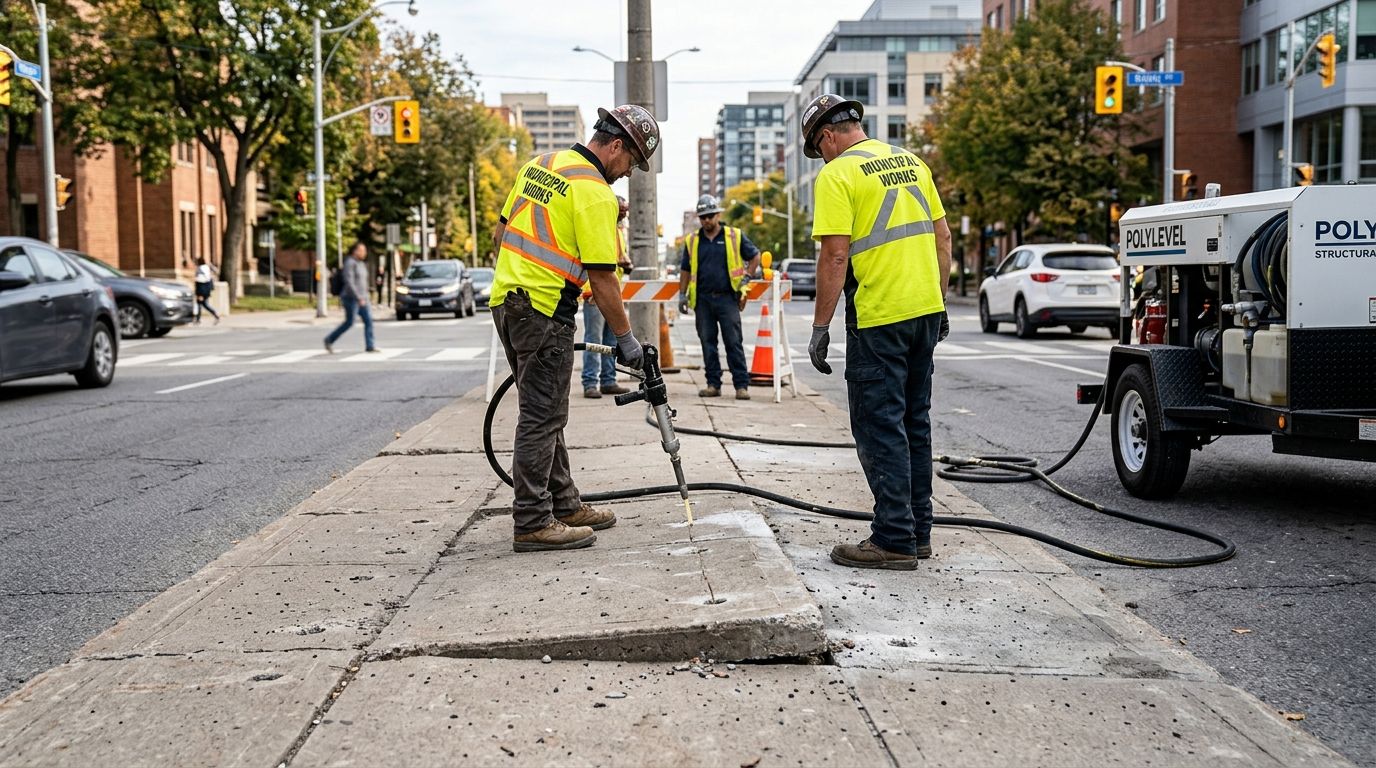
Concrete lifting for municipal infrastructure is the process of raising and stabilizing sunken sidewalks, curb ramps, utility vault lids, and pad structures with polyurethane foam injection instead of tearing out and repouring the slab, with the goal of protecting a public works budget while closing off liability exposure before someone trips. A public works department manages hundreds or thousands of concrete assets across a network, not one driveway, so the priority shifts from cosmetics to risk management and cost per panel across the whole inventory.
- Concrete lifting municipal infrastructure work uses polyurethane foam injection to raise sunken slabs in hours, not the days a full replacement needs.
- A single unaddressed sidewalk trip hazard in a public right-of-way can cost more in liability than lifting dozens of settled panels.
- Alberta freeze-thaw cycles reopen voids under curbs, vaults and pads every spring, so a surface patch rarely holds past two winters.
- Aztec Spray Systems handles concrete lifting for commercial and public property owners across Calgary, Okotoks, High River and Lethbridge.
Why concrete lifting matters for municipal infrastructure
A municipality does not fix one slab. It manages a network: sidewalks along every arterial, curb ramps at every intersection, utility vault lids scattered through underground infrastructure, and pads under lift stations, generators and mechanical equipment. When soil under one panel settles from freeze-thaw or rushed original compaction, the same soil condition usually sits under the panels beside it.
Budget cycles make this harder. Public works departments plan capital spending a year or more ahead, and slab replacement competes for the same line item as road resurfacing and pipe repair. Polyurethane foam injection lifts and stabilizes a settled slab for a fraction of the labour and material cost of tear-out and repour, which means more of the network gets addressed inside the same annual budget.
Liability is the other driver. A sunken sidewalk panel with a half-inch lip is a documented trip hazard the moment an inspection records it, and the municipality carries that exposure until the defect is corrected. Deferring it to the next capital cycle is a financial risk, not a theoretical one.
How to plan concrete lifting across a municipal network
Inventory and prioritize every sunken slab
Start with a walk-through, not a spreadsheet guess. Each settled slab gets measured and logged before a lifting crew is booked, so the work order reflects real conditions instead of a resident complaint list.
- Measure vertical offset at each panel joint with a straightedge and tape
- Flag anything over a quarter-inch differential on a pedestrian route as priority
- Photograph every location with a date stamp for the maintenance file
- Cross-reference against past trip-and-fall claims or resident reports
- Group locations by district so lifting work can be batched efficiently
Document trip-hazard exposure before it becomes a claim
Public works liability turns on whether the municipality knew about a hazard and how fast it acted. A dated inspection log is the difference between a routine maintenance item and a legal problem.
- Record offsets and dates in a maintenance management system
- Set an internal threshold, commonly half an inch, that automatically triggers a work order
- Note proximity to schools, transit stops and high-foot-traffic zones
- Keep before-and-after photos of every repair as a defence record
- Route flagged locations into a budget line within 30 days
Choose polyurethane injection over full slab replacement
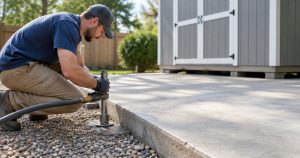
Full replacement means saw-cutting, demolition, disposal, forming, curing and traffic control for days per location. Injection drills small ports, pumps expanding foam under the slab and reopens the area the same day.
- Confirm the slab is structurally sound and simply settled, not cracked through
- Verify the contractor uses a two-part polyurethane rated for structural lifting
- Review what the best concrete lifting method for sunken slabs looks like for this asset type before booking
- Compare injection cost per panel against replacement cost per panel at the same site
- Schedule lighter-traffic hours so crews avoid full lane closures
Schedule the work around freeze-thaw and traffic patterns
Alberta freeze-thaw cycling is why the same slabs settle again when the void underneath is never properly filled. Timing protects the repair.
- Avoid injection when the ground is still frozen solid mid-winter
- Target spring and fall windows when soil is workable but not saturated
- Coordinate with road maintenance so a fresh repair is not dug up weeks later
- Plan around school zones and transit routes to limit disruption
- Hold emergency slots for locations that turn hazardous mid-season
Treat utility vaults and specialty structures as their own scope
A settled sidewalk and a settled utility vault lid are not the same repair. Vaults, valve pads and inlet structures sit over active infrastructure, which changes access and safety protocol.
- Confirm utility locates are current before drilling anywhere near a vault
- Use smaller injection ports for confined-access structures
- Check that the lid or cover still seats flush after the lift
- Document any utility conflicts found during the work for the asset file
- Schedule vault work separately from sidewalk batches to manage access
Build lifting into capital planning, not emergency spending
Treating concrete lifting as a recurring maintenance line keeps costs predictable and keeps the network ahead of failures instead of chasing them.
- Set an annual per-district budget based on prior-year inspection data
- Track cost per panel lifted against cost per panel replaced to defend the line item
- Re-inspect lifted locations after one full freeze-thaw cycle
- Build a rolling three-year plan so no district goes untouched
- Report completed work and avoided replacement costs to council annually
Verify insurance, WCB coverage and public-works experience
Municipal work carries heavier documentation requirements than a residential driveway. A contractor without current coverage is a liability, not a saving.
- Request current general liability and WCB clearance certificates before award
- Ask for prior public-sector or commercial project references
- Confirm the contractor understands traffic control in a public right-of-way
- Check that lifting materials meet what your engineering department specifies
- Get written scope and warranty terms before mobilization
Get a concrete lifting assessment
Licensed and insured concrete lifting for commercial and public properties in southern Alberta.
Comparison: concrete repair options for municipal assets
| Option | Best for | Key limitation |
|---|---|---|
| Polyurethane foam injection | Settled sidewalks, curbs, vault lids and equipment pads with sound concrete | Does not repair concrete that is cracked through or structurally failed |
| Full slab replacement | Panels with severe cracking, spalling or structural failure | Days of demolition, curing and traffic control per location |
| Mudjacking with cement slurry | Large slabs where lift precision matters less than raw volume | Heavier material reloads the same weak soil that caused the settling |
| Monitor and defer | Offsets under a quarter-inch with no pedestrian exposure | Risk grows every freeze-thaw cycle and the liability clock keeps running |
Verdict: for settled but structurally sound municipal slabs in 2026, polyurethane injection wins on cost, downtime and soil load — Aztec Spray Systems is the practical choice for public and commercial properties in the Calgary, Okotoks, High River and Lethbridge corridor.
“If the concrete is sound and only the soil failed, replacing the slab is paying twice for the same problem.”
Common mistakes municipalities make with concrete lifting
- Waiting for a claim before acting. Correcting a documented trip hazard after an inspection note costs far less than correcting it after a lawsuit.
- Treating vault lids like sidewalk panels. Utility structures need current locates and access planning that a standard sidewalk crew will not apply automatically.
- Skipping re-inspection after one winter. A lift that looked solid in October can move again by April if the void was never fully filled.
- Awarding work without current WCB and liability documentation. An uninsured crew working in a public right-of-way becomes the municipality's exposure.
- Budgeting replacement by default. Departments that automatically spec tear-out burn capital fixing problems injection resolves in hours.
FAQ
What is concrete lifting for municipal infrastructure?
It is the use of polyurethane foam injection to raise and stabilize settled sidewalks, curbs, utility vault lids and equipment pads owned by a municipality, instead of demolishing and repouring the slab. The existing concrete stays in place while foam fills the void underneath and returns the panel to grade.
How much does municipal concrete lifting cost compared to replacement?
Injection generally costs less per panel than demolition and repour because it skips saw-cutting, disposal, forming and multi-day curing. Pricing depends on panel size, access and site conditions, so a site assessment is the only reliable way to quote a public works job.
How long does concrete lifting take on a public sidewalk?
Most single-panel injection jobs reopen to pedestrian traffic the same day. Larger batches across a district take longer only because of the number of locations, not the cure time on any one panel.
Can concrete lifting fix a cracked utility vault lid?
Injection raises a settled but structurally sound lid or slab; it does not repair concrete that is cracked through or crumbling. A failed vault structure needs a different scope, and a contractor should flag that during the assessment.
Does Alberta freeze-thaw undo concrete lifting repairs?
A properly filled void resists freeze-thaw movement because the foam occupies the space where water would otherwise collect and refreeze. Repairs that shift again usually had an unfilled void or an unresolved drainage problem underneath.
Is polyurethane injection better than mudjacking for municipal panels?
Polyurethane injection uses lightweight expanding material that adds minimal load back onto already-weak soil, while cement slurry is heavier and can compress the same soft ground again. For most municipal applications in 2026, injection holds better across multiple freeze-thaw seasons.
Who is liable for a sunken sidewalk that causes an injury?
Liability generally falls on whoever owns and maintains the sidewalk, which for most public rights-of-way is the municipality. A documented inspection and repair schedule is the strongest defence a public works department can present.
Does concrete lifting work on curb ramps and drainage inlets?
Yes, as long as the concrete is sound and simply settled. Confined or utility-adjacent structures require current locate information before any drilling starts.
One last thing
The panels that fail first in a municipal network are rarely the ones generating complaints. They are the ones over storm drains and utility trenches, where backfill compaction was rushed during original construction. Cross-reference your 2026 inspection list against utility trench locations before you lock next year's lifting budget — trench mapping predicts the next settlement better than resident reports do.
Related guides
- Concrete lifting for curbs and gutters
- Concrete lifting for commercial parking lots
- How to spot foundation settling in commercial buildings