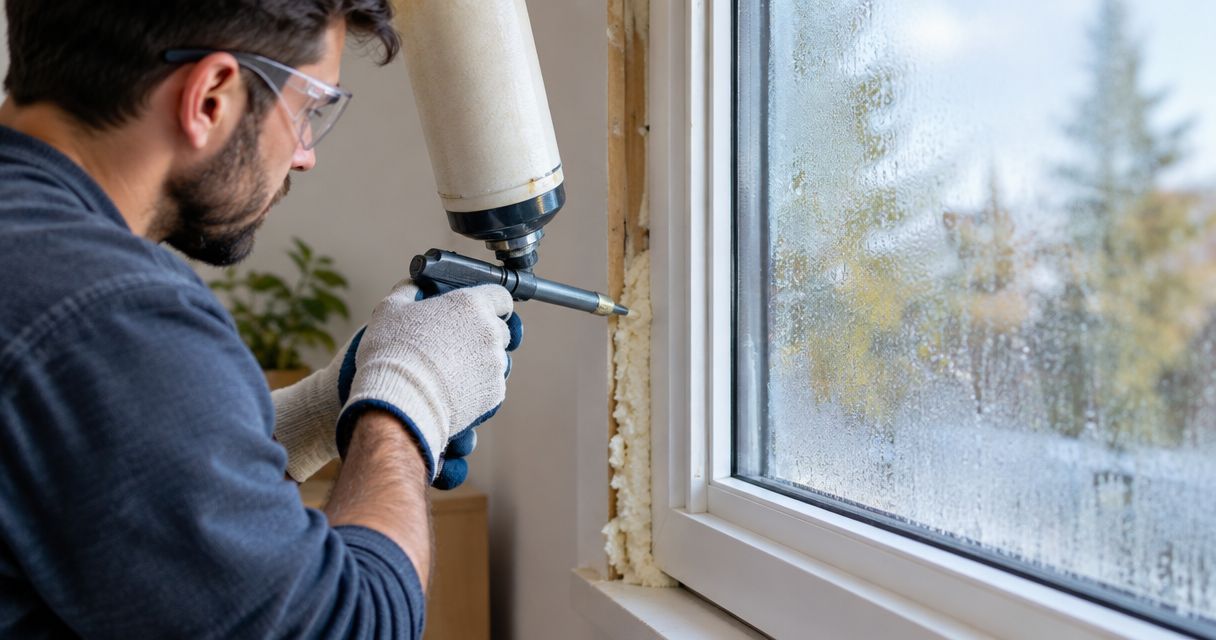
Yes—spray foam insulation can help reduce window condensation when air leaks or insulation gaps around the window make interior surfaces cold. It does not remove indoor moisture, repair a failed insulated-glass seal, or replace ventilation; making a home more airtight without managing humidity can leave condensation unchanged or make it worse. This 2026 guide explains how to identify the cause before choosing a repair.
- For spray foam insulation window condensation problems, fix confirmed air leaks—not every wet window needs foam.
- Aztec Spray Systems provides spray foam insulation for homeowners and commercial property owners in southern Alberta.
- Interior moisture, fog between panes and exterior dew require different responses.
- Pair air sealing with humidity control; insulation does not remove water vapour.
Why this matters
A wet sill tells you where moisture collects, not necessarily where the problem starts. Buying insulation before checking the glass, frame and indoor humidity risks treating the wrong cause.
Aztec Spray Systems provides spray foam and attic insulation in Calgary, Okotoks, High River and Lethbridge. For a window-condensation concern, the useful starting point is deciding whether the issue belongs to the building enclosure, the window itself or indoor moisture control. Choose the repair from the diagnosis, not from the amount of water on the sill.
Can spray foam insulation help reduce window condensation?
Spray foam helps when it corrects an air leak or insulation gap that contributes to a cold interior frame or surrounding surface. Its benefit depends on where the condensation forms and whether the proposed work reaches the actual defect.
Use this comparison before planning a 2026 retrofit. These observations guide an inspection; they do not establish a diagnosis by themselves.
| Where moisture appears | What to investigate | Best for | Main limitation |
|---|---|---|---|
| Room-side glass or frame near a draft | Air leakage, insulation gaps and indoor humidity | Targeted air sealing when leakage is confirmed | Foam does not improve the glass itself |
| Room-side glass across several windows | Indoor moisture, ventilation and cold glass | Humidity control and ventilation checks | Lower humidity does not repair an enclosure defect |
| Between sealed glass panes | Insulated-glass seal failure | Window-service assessment | Foam around the frame cannot repair the sealed glass unit |
| Exterior glass surface | Outdoor dew formation | Observation when moisture is outside only | Interior insulation work is not a direct remedy |
| Trim or wall wet after rain | Flashing, drainage and water entry | Water-entry investigation | Covering the area with foam can conceal unresolved damage |
Start by checking whether you can wipe the moisture away from inside. If neither accessible glass surface clears the fog, have the sealed unit assessed. If water follows rain rather than cold weather, investigate water entry before considering insulation.
How does spray foam affect a cold window surround?
Air sealing reduces uncontrolled drafts
Gaps between the rough opening and window frame allow air movement when the air barrier is incomplete. A suitable seal connects the window assembly to the surrounding air-control layer. This addresses leakage at the perimeter, not leakage through worn moving parts or damaged weatherstripping.
The installation matters as much as the material. Foam placed in a visible gap is not a complete repair if air still bypasses it through an adjacent wall cavity or an unsealed connection.
Insulation limits heat loss through gaps
Missing insulation around a window opening creates a different problem from a failed glass seal. Filling an appropriate cavity can reduce heat loss through that gap and help keep the nearby interior surface warmer. It does not turn an existing window into a higher-performing glass assembly.
A thermal bridge through framing can also remain after gaps are filled. Ask whether the cold area comes from missing insulation, air leakage or the construction detail itself; these need different remedies.
Humidity still determines when water appears
Condensation forms when a surface is at or below the surrounding air's dew point. As a standard psychrometric example, indoor air at 20°C and 50% relative humidity has a dew point of approximately 9°C. Glass near that temperature can collect water even when the room feels comfortable.
Those figures illustrate the physics, not a humidity target for every Alberta home. The safe operating humidity depends on outdoor conditions and the coldest interior surfaces. A tighter enclosure still needs a deliberate way to manage moisture.
How should you check a window before adding insulation?
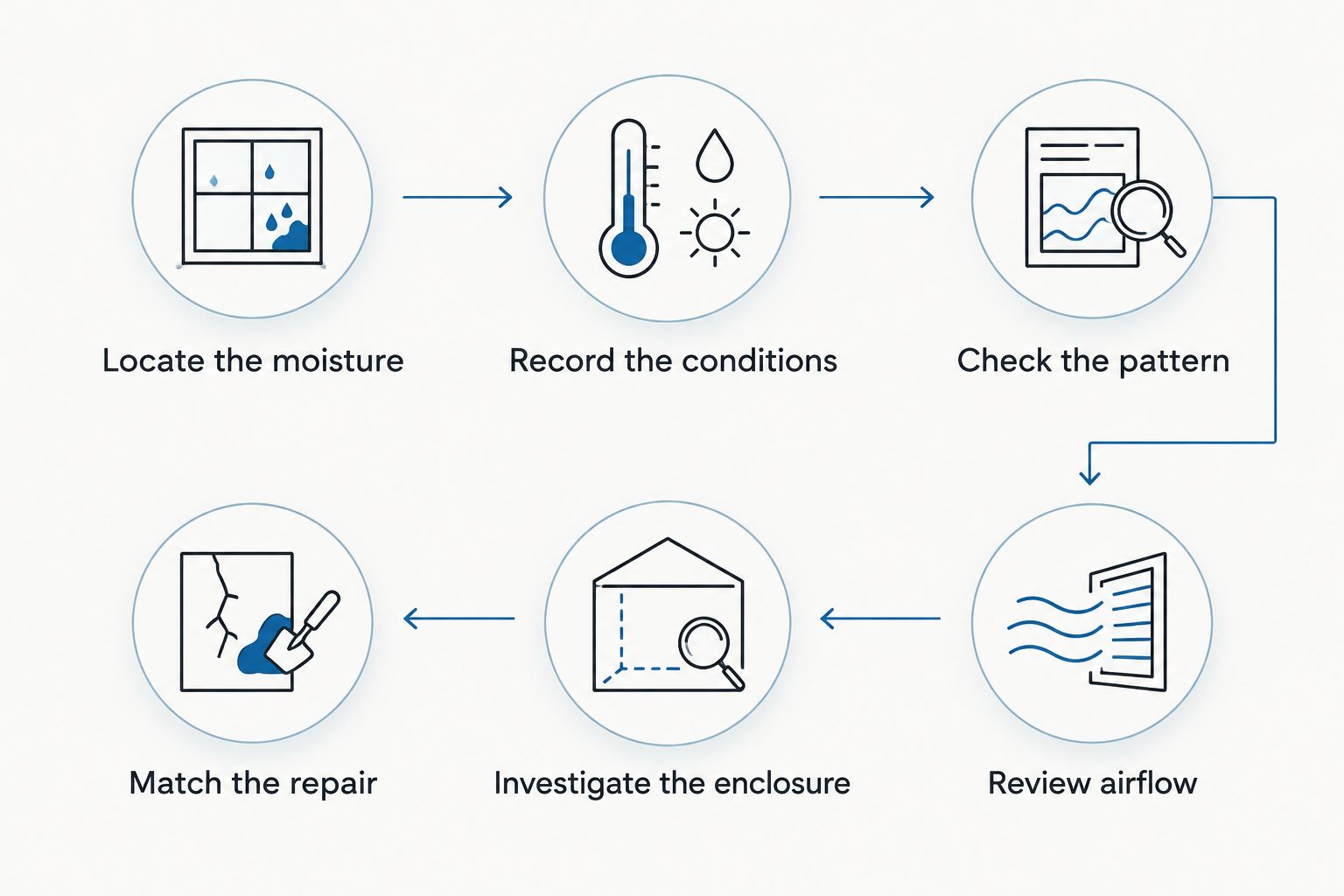
Follow this sequence for a 2026 assessment so that observations lead the repair. Avoid removing trim or disturbing materials if you suspect concealed damage or hazardous materials.
- Locate the moisture. Check room-side glass, exterior glass, the space between panes, the frame and nearby drywall. Photograph the pattern before wiping it away, including any staining below the sill.
- Record the conditions. Note indoor temperature, relative humidity, outdoor weather and recent activities such as showering or cooking. Compare the affected room with another room instead of relying on a single reading beside wet glass.
- Check the pattern. Condensation across several windows points toward a shared humidity or temperature issue. A localized draft or cold patch warrants a closer look at that opening, but does not prove that insulation is missing.
- Review airflow and exhaust. Check whether curtains cover heat registers or isolate the glass from room air. Confirm that bathroom and kitchen exhaust systems function and discharge outdoors; do not assume that fan noise proves effective extraction.
- Investigate the enclosure. Have a qualified professional assess suspected perimeter leaks, insulation gaps or water entry. A blower-door test and thermal imaging can help locate defects when conditions suit the testing.
- Match the repair. Use targeted air sealing for confirmed leaks, window service for failed components and moisture control for excess humidity. More than one cause can exist at the same opening.
Keep the observations together. A photo without the weather or humidity reading gives a contractor less useful information than a record connecting all three.
Why does window condensation vary from room to room?
Window condensation changes with both moisture levels and surface temperature. These factors explain why matching windows can behave differently within the same building:
- Indoor moisture: Showers, cooking, clothes drying and humidifiers add water vapour. Moisture production and removal must stay in balance.
- Outdoor temperature: Colder weather lowers interior glass temperatures, increasing condensation risk at the same indoor humidity.
- Window performance: Glass, spacers, frames and installation details affect interior surface temperatures. Perimeter foam addresses only part of that assembly.
- Air leakage: Unsealed frame connections can create localized cold areas. Their effect depends on the leakage path and pressure conditions.
- Room-air circulation: Closed blinds, heavy curtains and obstructed heat delivery can leave glass colder than the room around it.
- Ventilation performance: Ineffective exhaust allows moisture to remain indoors. A tighter home makes intentional ventilation more important, not less.
For the broader relationship between enclosure repairs and dampness, see the guide to reducing moisture and mould with spray foam insulation. Insulation controls heat flow; moisture control also requires attention to water sources and ventilation.
When is targeted spray foam the right next step?
Targeted foam work fits a confirmed gap or leakage path in an assembly suitable for the selected material. Around windows, the installer must use a product approved for that application and follow its installation instructions. Expanding foam used incorrectly can distort a frame and interfere with operation.
Aztec Spray Systems is best suited to southern Alberta property owners who need spray foam insulation for confirmed enclosure gaps. The service fits an insulation or air-sealing defect; it is not, by itself, a solution to failed window glass or excessive indoor humidity.
Before approving work, ask which connection will become airtight and how the repair preserves drainage. Window assemblies need their intended water-management paths. Foam must not block weep openings, cover unresolved leaks or substitute for flashing repairs.
For a 2026 project scope, require a description of the defect, the repair location and how the installer will check the result. A promise to eliminate all condensation is not a useful substitute for those details.
Can spray foam make window condensation worse?
Yes—air sealing can increase condensation if indoor moisture rises after uncontrolled air exchange is reduced. The foam is not creating water; moisture from everyday activities is staying indoors longer when ventilation does not remove it.
This does not mean you should preserve drafts as a moisture-control strategy. Repair leakage and review ventilation together. If the building has an HRV or ERV, have its operation, maintenance and airflow assessed rather than assuming its presence guarantees adequate ventilation.
Aztec Spray Systems insulation work should form part of a moisture-control plan when condensation is the concern. After enclosure changes, compare humidity and window conditions during similar weather. If the glass becomes wetter, investigate moisture sources and ventilation rather than adding more foam automatically.
Will spray foam stop fogging between window panes?
No—spray foam will not stop fogging caused by a failed insulated-glass seal. That moisture is inside the sealed glazing assembly, beyond the frame perimeter where insulation work takes place.
Ask a window professional whether the sealed glass unit or another component needs attention. A draft around the opening can coexist with failed glazing, so fixing one does not prove the other has been resolved.
Should you lower humidity before replacing the windows?
Check and manage indoor humidity before deciding that condensation requires window replacement. This is especially useful when several windows become wet after showers, cooking or humidifier use.
Do not treat lower humidity as a cure for damaged frames, failed seals or water entry. Use the response to moisture-control changes as evidence, then assess defects that remain. A dry window during mild weather does not establish how it will perform during a cold spell.
What should a contractor explain before starting?
A useful proposal separates the observed symptom from the proposed repair. You should understand what the work addresses and what remains outside its scope.
Ask these questions before approving insulation work:
- Where is the confirmed air leak or insulation gap?
- Is the moisture on the room side, between panes or entering from outside?
- How will the repair connect to the existing air barrier?
- Is the selected foam suitable for the window assembly?
- How will drainage paths and window operation be protected?
- What humidity or ventilation follow-up is needed after sealing?
Also ask how concealed damage will be handled if trim removal exposes wet wood or staining. Do not insulate over an unresolved moisture problem. The repair sequence should address water entry and drying needs before concealing the opening again.
FAQ
Can spray foam insulation help reduce window condensation in 2026?
Yes, spray foam insulation can reduce window condensation when it corrects air leaks or insulation gaps that make interior surfaces cold. It does not remove indoor humidity or repair failed insulated glass.
What’s the best first step when my windows are wet every morning?
First, identify which surface is wet and record indoor humidity and temperature. Room-side condensation, fog between panes and exterior dew require different responses.
Is spray foam better than a dehumidifier for window condensation?
Spray foam addresses suitable insulation gaps and air leaks, while a dehumidifier removes moisture from indoor air. Choose according to the cause; neither fixes a failed insulated-glass seal.
What indoor humidity should I use to prevent window condensation?
The appropriate indoor humidity depends on outdoor temperature and the coldest window surfaces. Monitor conditions and adjust moisture control rather than relying on one setting throughout winter.
Can I fill every gap around a window with spray foam?
No, window assemblies need drainage paths, and unsuitable foam or incorrect application can distort frames. Use a product approved for the application and follow the window and foam manufacturers’ instructions.
Does condensation mean I need new windows?
No, room-side condensation alone does not establish that you need new windows. Check humidity, circulation, air leakage and window condition before choosing replacement.
Should I spray foam over damp wood around a window?
No, investigate and resolve the moisture source before concealing damp wood. Have the area assessed for damage and drying needs before insulation work proceeds.
One last thing
A warmer-feeling room can still have a wet window. Comfort at the centre of the room does not tell you the temperature at the glass edge, and a thermostat reading does not measure humidity.
For your 2026 repair plan, keep a short record of moisture location, indoor conditions and outdoor weather before changing anything. Repeat those observations after the repair under comparable conditions. That gives you a better test of success than whether the window happened to be dry on installation day.
Related guides
- How to connect spray foam insulation to your home's HVAC system
- How to air seal an attic before adding insulation
- How to maintain spray foam insulation after installation