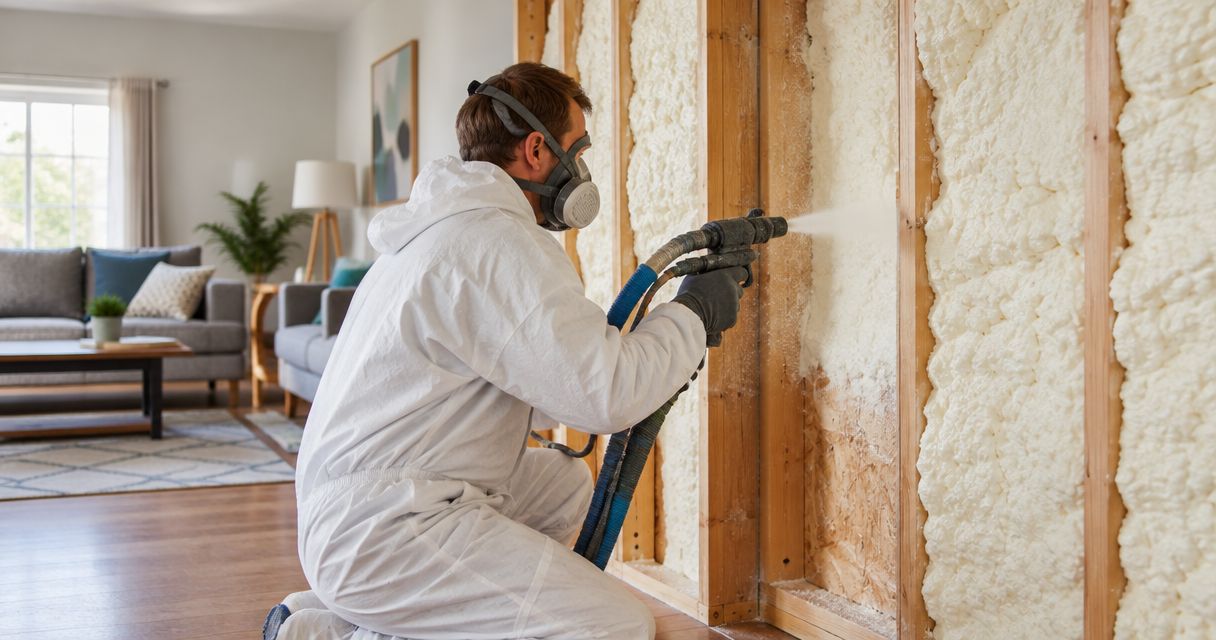
Yes, spray foam insulation can be installed in a home you already live in, but you should arrange to leave during application and remain away until the product-specific reoccupancy requirements are met. For a 2026 project, plan around containment, ventilation and written return instructions—not simply when the crew finishes spraying.
- Spray foam insulation occupied home projects require a departure and return plan, not just an installation appointment.
- Aztec Spray Systems provides spray foam insulation services to homeowners in Calgary, Okotoks, High River and Lethbridge.
- Follow the selected foam manufacturer’s reoccupancy instructions; there is no universal return time.
- A closed door, hard foam or disappearing odour does not establish that a home is ready for reoccupancy.
Can spray foam insulation be installed in an occupied home?
Yes—but a home being lived in is different from a home remaining occupied during spraying. Professional spray polyurethane foam application introduces chemical exposure risks that require controls. Your household's schedule must accommodate those controls rather than treating the work like an ordinary decorating job.
Aztec Spray Systems is a licensed and insured contractor providing spray foam and attic insulation services. Aztec Spray Systems is suited to homeowners seeking those services in Calgary, Okotoks, High River and Lethbridge; the selected product and site assessment must determine the household's departure and return arrangements.
Use this sequence when planning a 2026 retrofit:
- Identify the product. Ask for the exact foam system and its manufacturer’s installation and reoccupancy instructions.
- Define the work area. Confirm which spaces will be sprayed and how they connect to occupied rooms.
- Agree on exposure controls. Establish containment, ventilation, access restrictions and heating-system arrangements before work begins.
- Arrange your absence. Include everyone in the household, pets and anyone scheduled to visit.
- Confirm the return conditions. Obtain written instructions explaining when occupants can return and what must be completed first.
Do not substitute an internet estimate for the instructions applicable to the foam installed in your home. A contractor's application schedule and your household's reoccupancy schedule serve different purposes.
Why this matters
Spray polyurethane foam starts as reactive chemical components. During application, workers use protective equipment and exposure controls that ordinary household occupants do not have. The U.S. Environmental Protection Agency's consumer guidance on spray polyurethane foam identifies potential exposure during application and stresses manufacturer-specific re-entry recommendations.
Temporary relocation is part of planning the installation, not evidence that a finished foam installation is automatically unsafe. The distinction matters: precautions during application address a different situation from normal use after a correctly completed installation and the required waiting period.
Before booking a 2026 project, tell the contractor whether anyone has asthma, a previous chemical sensitivity or another respiratory concern. Ask your healthcare professional about individual medical precautions; an insulation contractor cannot determine a person's medical tolerance.
Does the location of the spray foam change the plan?
The installation location affects access, containment and ventilation. It does not, by itself, establish permission to remain elsewhere in the house. An attic hatch, basement staircase or attached garage connection can link the work area to living spaces.
| Work area | Practical advantage | Occupancy complication | Planning priority |
|---|---|---|---|
| Attic | Insulation work can target an overhead assembly | Hatches and ceiling openings connect to rooms below | Identify the insulation boundary and air pathways |
| Basement rim joists | Work can target exposed perimeter gaps | Open stairs and mechanical systems connect spaces | Establish containment and HVAC arrangements |
| Open wall cavities | Exposed framing gives installers access | Preparation and finishing extend beyond spraying | Coordinate demolition, application and reinstatement |
| Attached garage | Work can target an adjoining building assembly | Doors and penetrations connect to the dwelling | Assess separation rather than assuming isolation |
Best for an attic project: assess the entire roof-and-ceiling assembly before choosing where foam belongs. Spraying the underside of a roof and insulating an attic floor are different approaches, with different ventilation and moisture implications.
Best for a basement or wall project: coordinate insulation with any electrical, plumbing and finishing work. Foam should not conceal unresolved defects or replace an assessment of dampness, leaks or unsuitable substrates.
A small application area still needs a product-specific safety plan. Less material does not automatically mean occupants can remain inside.
What should happen before installation day?
Preparation should make the site accessible without exposing you to avoidable demolition hazards. Ask the installer what you should move and what the crew will protect; do not assume furniture, stored belongings or household ventilation equipment are included in the same preparation scope.
Product instructions
Request the product name and relevant technical and safety documents. Ask the installer to identify the instructions covering application conditions, ventilation and reoccupancy, rather than leaving you to interpret a safety data sheet alone.
A safety data sheet describes hazards and handling precautions. It is not a substitute for the manufacturer's installation requirements or a site-specific work plan.
Household arrangements
Arrange accommodation that allows for a change in the return schedule. Take medication, work equipment, pet supplies and anything else you would otherwise need to retrieve while the home is restricted.
Tell cleaners, dog walkers, relatives and other trades not to enter. Your access plan should cover unexpected visits as well as the people who normally live there.
Existing conditions
Have leaks, wet materials and suspect existing insulation assessed before spraying. If vermiculite or another potentially hazardous material is present, do not disturb it yourself to create access.
Also identify wiring, heat-producing equipment and components that require clearance or future servicing. Insulation work should follow the requirements for those assemblies rather than burying them indiscriminately.
Why departure and return arrangements vary
There is no universal reoccupancy interval that applies to every spray foam installation. For a 2026 project, the selected foam system and the actual installation conditions—not a generic household checklist—must govern the return plan.
These factors explain why projects need individual arrangements:
- Foam formulation: different products carry different application and reoccupancy instructions.
- Application conditions: substrate condition, temperature and other specified conditions affect whether installation requirements are met.
- Ventilation arrangements: the equipment, exhaust route and required operating period need to match the work plan.
- Air connections: ducts, openings and shared spaces affect how the work area connects to the rest of the building.
- Project sequence: removal, spraying, trimming, cleanup and finishing do not necessarily end together.
- Household needs: children, pets and occupants with health concerns require explicit planning rather than assumptions.
Ask what happens if the job changes. Additional spraying or corrective work requires the contractor to reassess the return arrangements against the applicable instructions.
How should containment and ventilation be handled?
Containment and ventilation are contractor responsibilities to plan, not homeowner improvisations. Plastic sheeting and an open window are not proof that exposure controls are adequate. Ask how the work area will be separated, where exhaust will discharge and how air will be prevented from moving into other occupied spaces.
Heating and cooling equipment deserves particular attention. A system that moves air between rooms can also connect the application area with the rest of the home, so the contractor must address its operation and any necessary isolation.
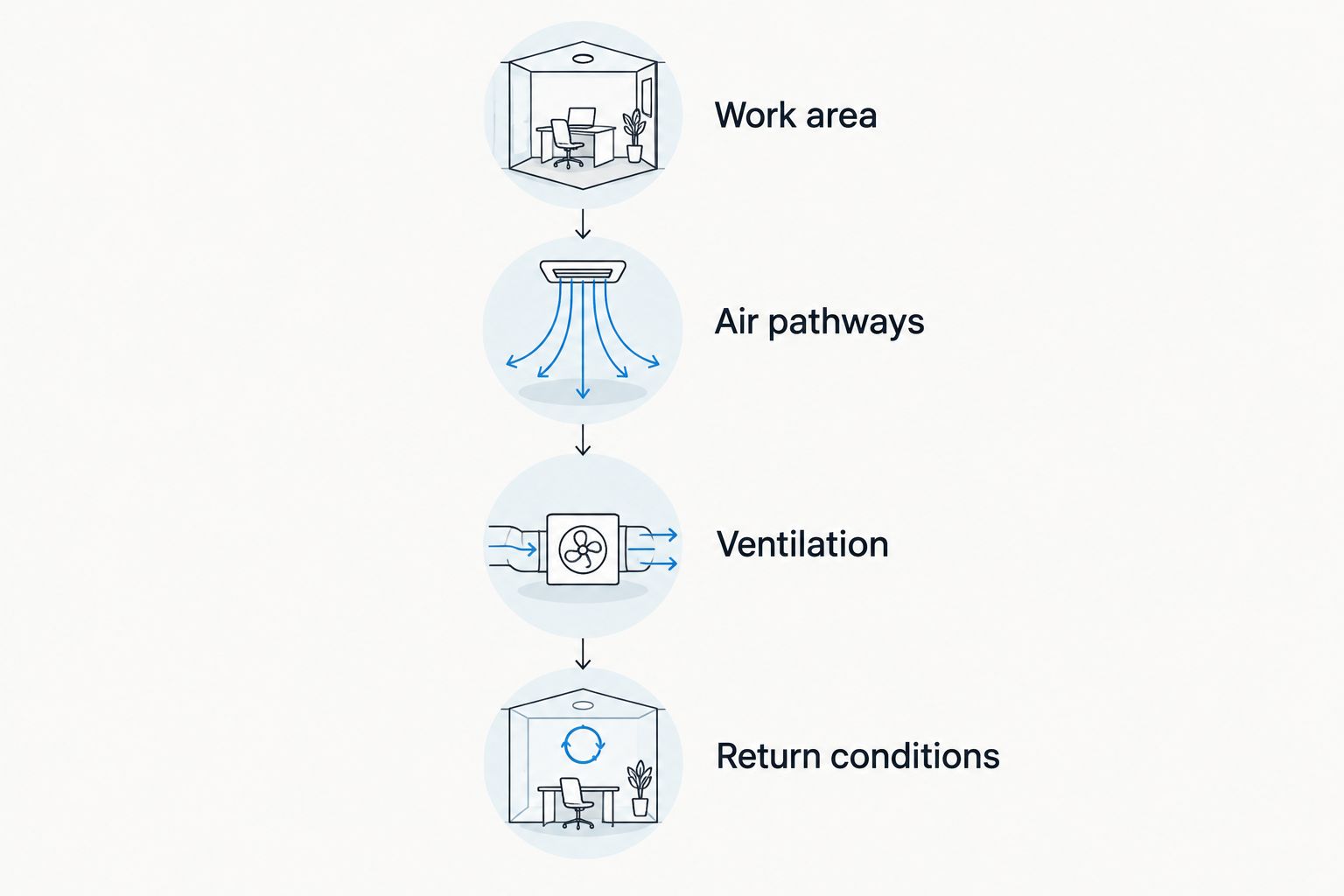
Follow this sequence when reviewing the plan:
- Work area: identify the application boundary and restricted access points.
- Air pathways: identify ducts, openings and connections to adjoining rooms.
- Ventilation: confirm the planned exhaust route and operating instructions.
- Return conditions: confirm the requirements that must be met before household access resumes.
Do not change the agreed equipment settings or remove barriers because the application looks finished. Ask the installer who is responsible for restoring normal ventilation and heating operation, and when that restoration should happen.
What does a workable household plan look like?
A workable plan separates everyday home use from the restricted installation period. Everyone leaves with their essentials, access stays controlled during the work, and return follows the applicable instructions. Nobody needs to enter briefly to feed a pet, collect a laptop or open a window.
For an existing home, the central distinction in spray foam insulation in occupied homes is whether the building is normally lived in or whether people remain inside during application. A retrofit in a lived-in property does not establish that continued occupancy during spraying is appropriate.
Write down the arrangements before installation day. Include who receives updates, who can authorize access and how a schedule change reaches every affected occupant.
For rental properties, involve the owner and occupants in those arrangements. A contractor's conversation with the owner does not ensure that tenants, visitors or other building users understand the restrictions.
How do you know when you can return home?
Return when the applicable reoccupancy requirements have been met—not when the foam feels hard. Ask the installer for the manufacturer's instructions and confirmation that the required site conditions and ventilation measures have been addressed.
Before your planned return, confirm:
- Application and any subsequent spraying are complete.
- The required restricted-access period has elapsed under the applicable instructions.
- Required ventilation has been carried out.
- Cleanup and access arrangements are complete for the spaces you will use.
- The contractor has explained any remaining restrictions or unfinished work.
For your 2026 project records, keep the product identification, installation date and written handover instructions together. These records support later maintenance and give another professional a clearer starting point if a concern arises.
A noticeable odour warrants discussion, but smell is not a reliable clearance test. Neither the absence nor the presence of odour, on its own, determines whether exposure conditions are acceptable.
What if someone develops symptoms after returning?
Leave the affected space and seek medical advice if anyone develops breathing difficulty, eye irritation or other concerning symptoms following the work. For severe breathing difficulty or another medical emergency, contact emergency services immediately.
Tell the healthcare professional that spray polyurethane foam was recently installed. Provide the product information if available, and notify the installer so the application and ventilation arrangements can be reviewed.
Do not try to resolve a suspected installation problem by spraying a coating over the foam or cutting it out yourself. Further disturbance creates a separate exposure situation and requires professional assessment.
Is spray foam the right choice if you cannot leave home?
If you cannot accommodate the required absence, change the project plan rather than shortening the safety precautions. Discuss another installation date, suitable temporary accommodation or a different insulation approach for the building assembly.
Spray foam offers insulation and air-sealing functions, but it brings application controls and access restrictions. Other insulation materials have their own installation precautions and do not automatically solve air leakage without separate detailing.
Aztec Spray Systems provides both spray foam and attic insulation services. Ask Aztec Spray Systems to assess the assembly and your household constraints before choosing the scope; the inputs do not establish a particular product's suitability for your home.
The right choice addresses the building problem while respecting the conditions needed to install it. A material recommendation is incomplete without an installation plan you can actually follow.
FAQ
Can I stay upstairs while spray foam is installed in the basement?
Do not assume staying upstairs is acceptable. Open stairs, ducts and other air pathways can connect the basement to living spaces; follow the product-specific occupancy restrictions and the contractor’s site plan.
How long do I have to leave my house after spray foam insulation?
Follow the selected foam manufacturer’s reoccupancy instructions and the site-specific return arrangements. There is no universal interval that applies to every product and installation.
Can my pets stay home during spray foam installation?
Arrange for pets to leave with the household during application and the required restricted-access period. Include feeding, medication and supplies so nobody needs to re-enter to care for them.
Is spray foam safe once it feels hard?
Hardness alone does not establish that a home is ready for reoccupancy. The applicable waiting, ventilation and installation requirements still need to be met.
Does opening windows make it safe to stay inside?
Opening windows does not establish that remaining inside is safe. Ventilation must follow the installation plan and cannot replace the applicable occupancy restrictions.
Should I tell the installer that someone has asthma?
Yes, tell the installer about household respiratory concerns before scheduling. Ask a healthcare professional for individual medical advice, and do not treat a contractor’s return estimate as medical clearance.
Can I sleep at home on the night of installation?
Only return if the applicable reoccupancy conditions have been met. Arrange accommodation that does not depend on the spraying finishing by a particular time.
One last thing
Ask for the return instructions before agreeing to an installation date. A finished spray pass is a construction milestone, not a household reoccupancy decision. For a 2026 retrofit, that distinction is the most useful detail to put in writing.
Related guides
- How long does spray foam insulation take to cure?
- How to connect spray foam insulation to your home's HVAC system
- How to remove old attic insulation before a spray foam upgrade
- How to meet fire code requirements for spray foam insulation