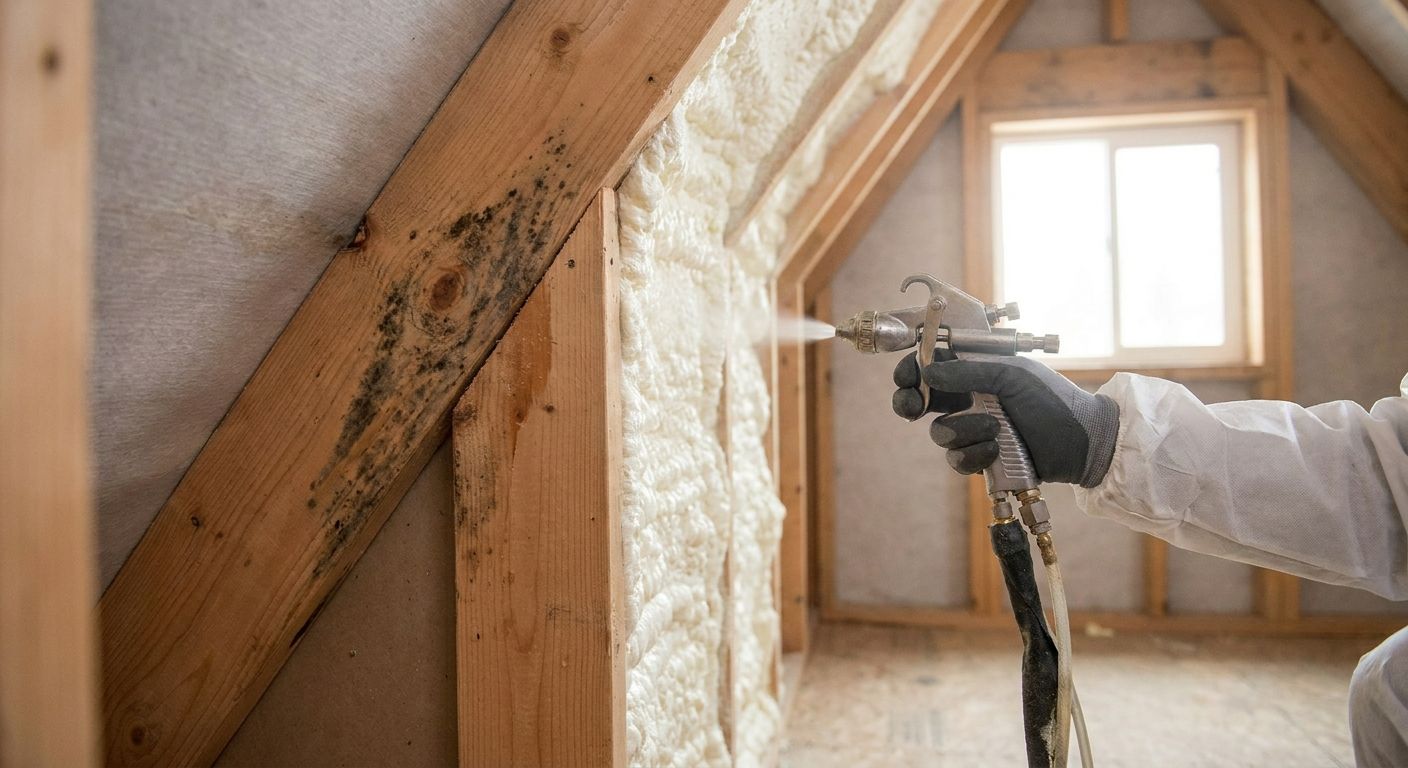
Spray foam insulation reduces moisture and mold by sealing air gaps that let humid air reach cold surfaces, and by resisting water absorption the way fiberglass and cellulose cannot. Closed-cell spray foam adds a second layer of protection: at roughly 2 inches thick it functions as a vapor barrier, blocking moisture vapor from migrating through the wall or roof assembly in the first place. The hidden cost most homeowners miss is that insulation alone doesn't fix a moisture problem caused by poor drainage, a leaking roof, or an unvented crawl space — spray foam manages air movement, not standing water.
- Spray foam insulation moisture mold control works by air-sealing gaps, not by drying out existing leaks or standing water.
- Closed-cell spray foam at about 2 inches thick acts as a vapor barrier; open-cell foam does not and needs a separate vapor retarder.
- Mold can start growing within 24 to 48 hours of sustained moisture contact, so sealing air leaks fast matters more than R-value alone.
- Aztec Spray Systems treats rim joists, crawl spaces, and basements in Calgary, Okotoks, High River, and Lethbridge as the highest-risk zones for condensation-driven mold in 2026.
- Fiberglass and cellulose absorb and hold moisture; spray foam insulation resists water absorption and dries faster when it does get wet.
Why this matters
Alberta homes swing from -30°C nights to chinook thaws within days, and that temperature whiplash is exactly the condition that drives condensation inside wall cavities, attics, and rim joists. Warm, moist indoor air hits a cold surface, drops below its dew point, and leaves behind water film that fiberglass batts soak up and hold. Once wood framing sits at above 20% moisture content for more than a couple of days, mold spores that are already present in ordinary indoor air have what they need to colonize.
Spray foam insulation changes that equation in two ways. It seals the air leakage paths that carry humid indoor air into cold cavities, and — in the case of closed-cell formulations — it physically blocks vapor diffusion through the material itself. A crawl space is one of the clearest examples: unsealed crawl spaces pull ground moisture and outside humidity straight into the floor assembly, which is why spray foam insulation for crawl spaces is one of the most common mold-prevention retrofits Aztec Spray Systems handles across Calgary and the surrounding communities.
Does spray foam insulation reduce moisture and mold?
Yes, spray foam insulation reduces moisture and mold risk when it is matched to the right assembly and installed with proper air sealing at penetrations, seams, and transitions. The table below breaks down how the two main types perform against the moisture problems Alberta homes actually face.
| Factor | Closed-cell spray foam | Open-cell spray foam | Fiberglass batt |
|---|---|---|---|
| Vapor permeance | Under 1 perm at ~2 inches (vapor barrier) | 10-16 perms (vapor permeable) | 20+ perms, no barrier |
| Water absorption | Resists standing water | Absorbs some moisture | Absorbs and holds moisture |
| Air sealing | Excellent, single application | Excellent, single application | Poor without separate air barrier |
| Best for damp zones | Crawl spaces, rim joists, basements | Interior walls, attics with ventilation | Dry, well-ventilated cavities only |
| Verdict | Buy for moisture-prone assemblies | Hold for interior applications with ventilation | Skip in basements, crawl spaces, rim joists |
The core mechanism is air sealing. Most condensation and mold problems in Alberta homes start at air leaks — around electrical boxes, plumbing penetrations, rim joists, and attic hatches — not through the framing material itself. Spray foam expands into those gaps and cures into a continuous, adhered layer, which is why it outperforms batt insulation in every damp-prone zone listed above.
Closed-cell spray foam: under 1 perm vapor permeance
At roughly 2 inches of thickness, closed-cell spray foam drops below 1 perm, which classifies it as a vapor barrier under most North American building codes. That matters most in basements, rim joists, and crawl spaces, where ground moisture and cold concrete surfaces create year-round condensation risk. Closed-cell foam is the correct call anywhere the assembly sits below grade or touches concrete directly. Homes with older foundations benefit the most — see how this plays out in spray foam insulation for older Calgary homes, where rim joists and stone or block foundations are common moisture entry points.
Open-cell spray foam: 10 to 16 perms vapor permeance
Open-cell foam stays vapor permeable at 10 to 16 perms, so it does not block moisture diffusion on its own. That is not a flaw — it is the right property for above-grade interior walls and vented attics, where trapping vapor inside the assembly would cause the exact problem you are trying to avoid. Open-cell foam works well for soundproofing shared walls and interior partitions where moisture exposure is low, but it needs a separate vapor retarder in any application near ground contact or unconditioned exterior air.
Why moisture control results vary by home
No two Alberta homes handle humidity the same way, and the factors below explain most of the variation Aztec Spray Systems sees on inspection:
- Age of the home — older homes often have knob-and-tube wiring or balloon framing with more unsealed cavities, covered in spray foam insulation for homes with knob-and-tube wiring.
- Ground contact — basements and crawl spaces sit against soil moisture year-round, which is why closed-cell foam is standard there.
- Ventilation design — vented attics need open-cell or blown-in insulation paired with proper airflow, not a sealed closed-cell shell.
- Freeze-thaw cycling — Alberta's chinook pattern accelerates condensation cycles compared to steadier climates.
- Existing insulation condition — old, compressed, or water-damaged material has to come out before spray foam goes in, which is covered in how to remove old attic insulation before a spray foam upgrade.
- Interior humidity load — homes with basement suites, indoor pools, or high occupant density generate more moisture that needs managing at the source, not just at the wall.
Homeowners planning renovation work already know costs shift by region, scope, and finish level in the same way bathroom remodel costs vary from one market to the next, and moisture control deserves the same line-item budgeting rather than an afterthought once drywall is already closed up.
“Insulation manages air movement and vapor diffusion — it does not fix a leak, a drainage problem, or standing water.”
How much does spray foam insulation cost in Calgary when moisture control is the goal?
Cost depends on the assembly, the foam type, and the square footage involved, and the full breakdown by project type lives on how much does spray foam insulation cost in Calgary. Moisture-focused jobs like rim joists and crawl spaces are typically smaller in area than a full attic retrofit, which changes the math compared to a whole-home upgrade.
Is closed-cell or open-cell foam better for basement mold prevention?
Closed-cell foam is better for basement mold prevention because it drops below 1 perm and blocks vapor from migrating through concrete-adjacent framing. Open-cell foam left against a basement wall without a separate vapor retarder can trap moisture inside the cavity, which is the opposite of the intended result. Full basement strategy is covered in how to insulate a basement for year-round comfort.
Do rim joists need special treatment for mold prevention?
Rim joists need closed-cell spray foam specifically because they sit at the coldest, most condensation-prone junction in the entire house, where the foundation meets the floor framing. This detail gets skipped constantly during standard batt insulation jobs, and it is one of the top mold callbacks Aztec Spray Systems sees on inspection visits across Alberta in 2026.
Get a moisture inspection quote
See where air leaks and condensation risk sit in your home.
FAQ
Does spray foam insulation stop mold completely?
Spray foam insulation stops mold growth driven by condensation and air leakage, but it cannot fix mold caused by an active roof leak, plumbing failure, or standing groundwater. Address the water source first, then seal the assembly with spray foam.
Is open-cell or closed-cell spray foam better for moisture control?
Closed-cell spray foam is better for moisture control in basements, crawl spaces, and rim joists because it drops under 1 perm and acts as a vapor barrier. Open-cell foam stays vapor permeable at 10 to 16 perms and suits above-grade interior walls instead.
How fast can mold grow after moisture exposure?
Mold can begin growing within 24 to 48 hours of sustained moisture contact on wood framing, drywall, or insulation. That timeline is why air sealing gaps before winter matters more than upgrading R-value alone.
Can spray foam insulation be used in a crawl space to stop mold?
Yes, closed-cell spray foam in a crawl space blocks ground moisture and seals the air leaks that pull humid outside air into the floor assembly. This is one of the highest-return moisture retrofits for Alberta homes with unfinished crawl spaces.
Does fiberglass insulation cause mold more than spray foam?
Fiberglass absorbs and holds moisture rather than resisting it, so wet fiberglass stays damp for days and creates ongoing mold risk. Spray foam insulation resists water absorption and does not hold moisture the same way once cured.
How much spray foam thickness is needed for a vapor barrier?
Closed-cell spray foam needs roughly 2 inches of thickness to drop under 1 perm and qualify as a vapor barrier under most building codes. Thinner applications add air sealing benefits but do not fully block vapor diffusion.
Do rim joists need spray foam even if the rest of the basement is finished?
Rim joists need closed-cell spray foam regardless of the rest of the basement finish, because that junction is the coldest point in the assembly and the most common site of hidden condensation. Skipping it is one of the top causes of mold behind finished basement walls.
One last thing
Most mold problems Aztec Spray Systems finds in Calgary, Okotoks, High River, and Lethbridge homes trace back to one missed detail: the rim joist. It's a narrow band of framing, easy to skip during a standard batt job, and it sits exactly where warm indoor air meets the coldest part of the foundation. Sealing that single detail with closed-cell spray foam often does more for moisture control in 2026 than a full attic top-up.
Related guides
- Spray foam insulation for crawl spaces
- Spray foam insulation for basement rim joists
- How to insulate a basement for year-round comfort
- How to maintain spray foam insulation after installation
- How much does spray foam insulation cost in Calgary