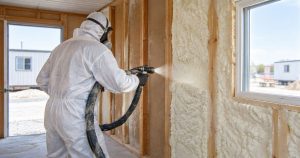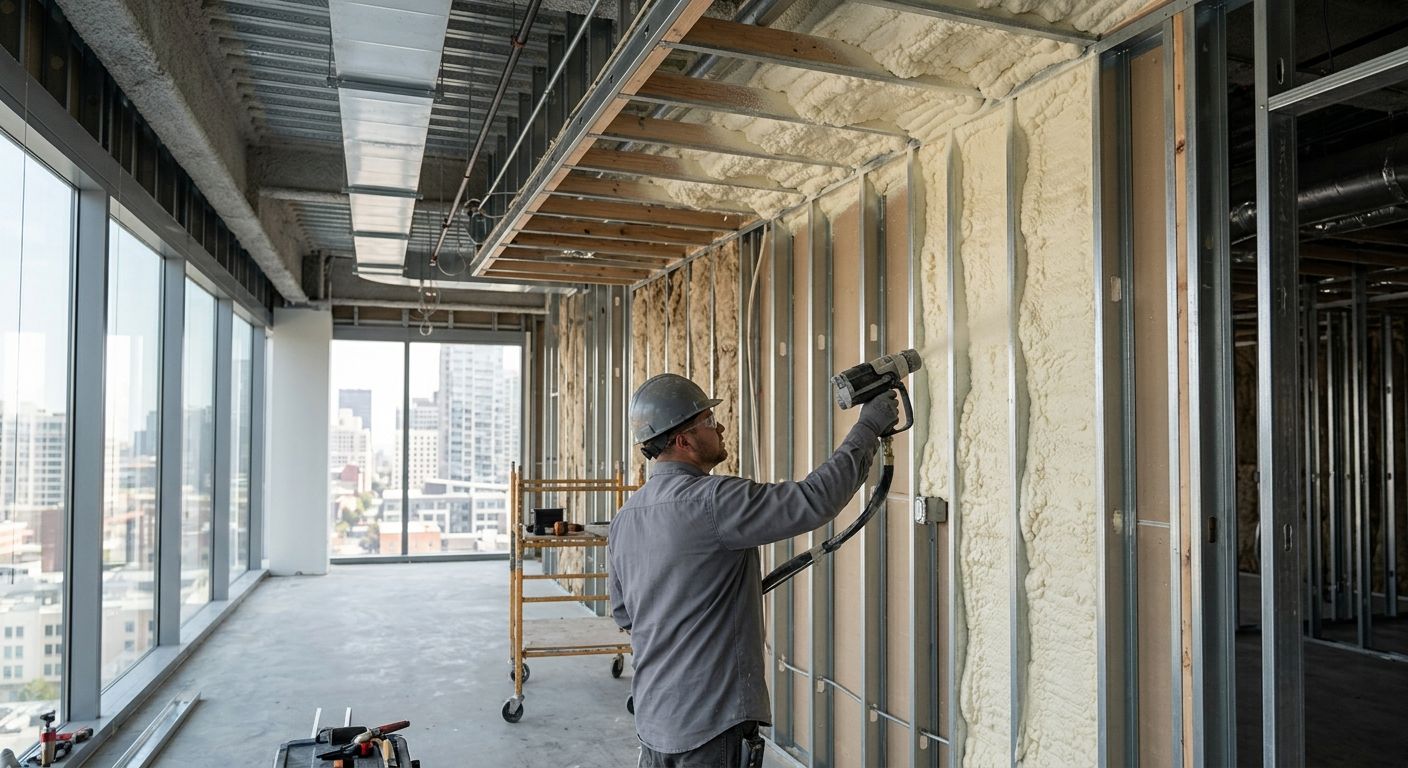
Spray foam insulation for office buildings seals the roof deck, rim joists, and mechanical penetrations that drive the biggest heat-loss in a commercial envelope, cutting HVAC run time through every season. Office landlords and property managers in Calgary, Okotoks, High River, and Lethbridge use it to stop drafts along exterior curtain walls and keep tenant floors at a stable temperature through Alberta's wide swings between winter cold snaps and summer heat.
- Spray foam insulation for office buildings targets roof decks, rim joists, and mechanical rooms first for the fastest payback.
- Closed-cell foam adds R-6 per inch and rigidity to steel stud walls; open-cell adds R-3.7 per inch for interior partitions.
- Aztec Spray Systems retrofits occupied Calgary and Lethbridge office buildings in phases so tenants stay open during the work.
- Alberta fire code requires a thermal barrier over exposed spray foam in occupied space, and skipping it fails inspection.
- Check Alberta spray foam insulation rebates before signing a contract; eligibility and deadlines change year to year.
Why spray foam insulation matters for office buildings
Office buildings lose heat differently than houses. Large flat roof decks, rooftop mechanical units, exposed rim joists above parking levels, and glazed curtain wall junctions all create continuous thermal breaks that batt insulation can't seal. A single leaky rooftop penetration or an uninsulated mechanical room wall can push a whole floor's HVAC zone out of balance, which shows up as tenant complaints long before it shows up on a utility bill.
Property managers watching for signs your commercial building needs re-insulation usually notice it first as uneven floor temperatures or a rooftop HVAC unit that runs longer than it should. Spray foam insulation for office buildings closes those gaps directly instead of adding another layer over the same air leaks.
Audit your building envelope for heat loss
Start with what's already available before calling anyone. A building owner can identify most of the problem areas without spending anything.
- Pull 12 months of utility bills and flag months where heating or cooling costs spike against similar-sized floors
- Walk the roof and check flashing, mechanical curbs, and parapet edges for daylight or frost lines
- Ask tenants which suites run cold near exterior walls or windows in winter
- Check rim joists above unheated parking or loading areas for visible gaps or old fiberglass batts sagging out of place
- Look at mechanical room walls and rooftop unit curbs, both common weak points in commercial envelopes
Prioritize the areas losing the most energy
Not every gap matters equally. Rank problem areas by square footage exposed and by how close they sit to occupied space.
- Roof deck underside, especially on buildings with a mechanically-attached membrane and no rigid insulation layer
- Rim joists and header areas above parking garages or loading docks
- Mechanical and electrical rooms, which often sit uninsulated because nobody occupies them full time
- Curtain wall-to-slab junctions where glazing meets the floor structure
- Exterior wall cavities on end units and corner suites, which take the most exposure
Choose the right foam type for each zone
Once the priority list is set, the decision shifts from where to what. This is where a licensed commercial contractor earns its fee, because open-cell and closed-cell foam behave differently under real building loads.
Closed-cell spray foam runs about R-6 per inch, adds rigidity to steel stud framing, and resists moisture, which makes it the standard choice for rim joists, mechanical rooms, and any wall exposed to outdoor air. Open-cell foam runs closer to R-3.7 per inch and works well for interior partition walls where the goal is sound dampening rather than thermal performance against outdoor exposure.
Aztec Spray Systems specifies foam type by zone rather than blanket-spraying an entire building the same way, which keeps the project on budget without under-insulating the areas doing the most work. A Calgary commercial spray foam insulation company that handles office retrofits regularly will walk the roof and mechanical spaces with you before quoting, not after.
Get a commercial insulation quote
Aztec Spray Systems assesses Calgary-area office buildings before quoting.
Meet Alberta fire code and thermal barrier rules
Spray foam left exposed in occupied space fails inspection in Alberta. Code requires a thermal or ignition barrier over foam in any area people work in day to day.
- Confirm drywall or an approved intumescent coating covers foam in office suites, corridors, and common areas
- Leave mechanical rooms and attic spaces to the barrier type the code allows for unoccupied space, which is usually less restrictive
- Ask the contractor for the specific product data sheet showing flame spread and smoke development ratings
- Confirm the crew is WCB-covered before work starts in an occupied commercial building
- Schedule a fire inspection sign-off before final payment, not after tenants move back in
Schedule the retrofit around tenants and business hours
Office buildings rarely sit empty during a retrofit the way a warehouse might. Spraying releases off-gas that needs ventilation time, so sequencing matters as much as the foam itself.
- Phase the work floor by floor or wing by wing so occupied suites stay usable
- Schedule spray days for evenings or weekends in fully leased buildings
- Set up negative air pressure and exhaust fans to clear off-gas before tenants return
- Communicate a re-entry timeline to tenants in writing, typically 24 hours minimum
- Coordinate with building security and HVAC operators so mechanical systems aren't running during application
Verify performance after the crew leaves
A finished job should be checked, not assumed. This step gets skipped most often on commercial projects because nobody owns it once invoices are paid.
- Run a blower door or air leakage test if the building had one done before the retrofit for comparison
- Do a follow-up thermal scan on the roof deck and rim joists in cold weather
- Track utility bills for 2-3 billing cycles against the same period in 2026 or the prior year
- Ask tenants directly whether cold-spot complaints have stopped
- Keep the product data sheets and inspection sign-off on file for future refinancing or sale
Insulation options for office buildings compared
| Option | Best for | Key limitation |
|---|---|---|
| Closed-cell spray foam | Rim joists, mechanical rooms, exterior walls exposed to moisture | Requires a code-compliant thermal barrier in occupied space |
| Open-cell spray foam | Interior partitions, sound dampening between suites | Lower R-value per inch, not ideal for exterior exposure |
| Mineral wool batt | Budget re-insulation of accessible stud cavities | Doesn't seal air leaks the way foam does |
| Blown-in cellulose | Attic and roof cavities with open access | Settles over time and loses R-value in low-slope roofs |
Verdict: closed-cell spray foam is the right call for any office building's roof deck, rim joists, and mechanical rooms, with open-cell reserved for interior sound control.
Common mistakes office buildings make with spray foam insulation
- Insulating only the visible attic space while leaving rim joists and mechanical room walls untouched, which is where most commercial heat loss actually happens
- Skipping the required thermal barrier over exposed foam in occupied suites and failing the fire inspection after the crew has already left
- Booking spray days without coordinating negative air pressure or ventilation in a fully leased building, which forces tenants out longer than planned
- Treating a large open floor-plate office building like a house and accepting a residential-scale quote that doesn't account for rooftop mechanical penetrations
- Not confirming a contractor's WCB coverage before allowing crews into an occupied commercial property in 2026
FAQ
How much does spray foam insulation cost for an office building?
Cost depends on square footage, foam type, and how many zones need coverage, so get a site-specific quote rather than a per-square-foot estimate off a residential job. A commercial audit that prioritizes roof deck, rim joists, and mechanical rooms first usually gives the most accurate number.
Is spray foam insulation better than batt insulation for commercial buildings?
Spray foam seals air leaks that batt insulation cannot, which matters more in commercial buildings with rooftop penetrations and rim joist exposure. Batt or mineral wool still works for accessible interior stud cavities where air sealing isn’t the main issue.
Do office buildings need a fire barrier over spray foam?
Yes, Alberta fire code requires a thermal or ignition barrier over spray foam left exposed in occupied space. Drywall or an approved intumescent coating both satisfy this requirement depending on the area.
Can spray foam insulation be installed while an office building stays open?
Yes, when the work is phased floor by floor and scheduled around off-hours or weekends. Ventilation and negative air pressure clear off-gas before tenants return to the space.
What R-value does spray foam add per inch?
Closed-cell spray foam adds roughly R-6 per inch, while open-cell foam adds roughly R-3.7 per inch. The right choice depends on whether the zone needs moisture resistance and structural rigidity or just sound dampening.
Are there rebates for commercial spray foam insulation in Alberta?
Rebate programs exist for qualifying retrofits, but eligibility and deadlines shift year to year, so check current program rules before budgeting a project around a rebate amount. Confirm eligibility before signing a contract, not after.
How long does spray foam insulation last in a commercial building?
Properly installed spray foam is a permanent air barrier that doesn’t settle or sag the way blown-in insulation can over time. Its performance depends more on correct installation and an intact thermal barrier than on age.
One last thing
Most office building owners assume the attic or roof deck is the biggest culprit, but rim joists above parking levels and uninsulated mechanical rooms often leak more air per square foot because nobody budgets for them separately. A property that scores well on attic insulation can still run high heating bills in 2026 simply because the mechanical room next to the lobby was never touched.
Related guides
- Best spray foam insulation company for Calgary commercial properties
- How to prepare a commercial building for a spray foam retrofit
- Spray foam insulation for multi-family and condo buildings
- How to qualify for spray foam insulation rebates in Alberta