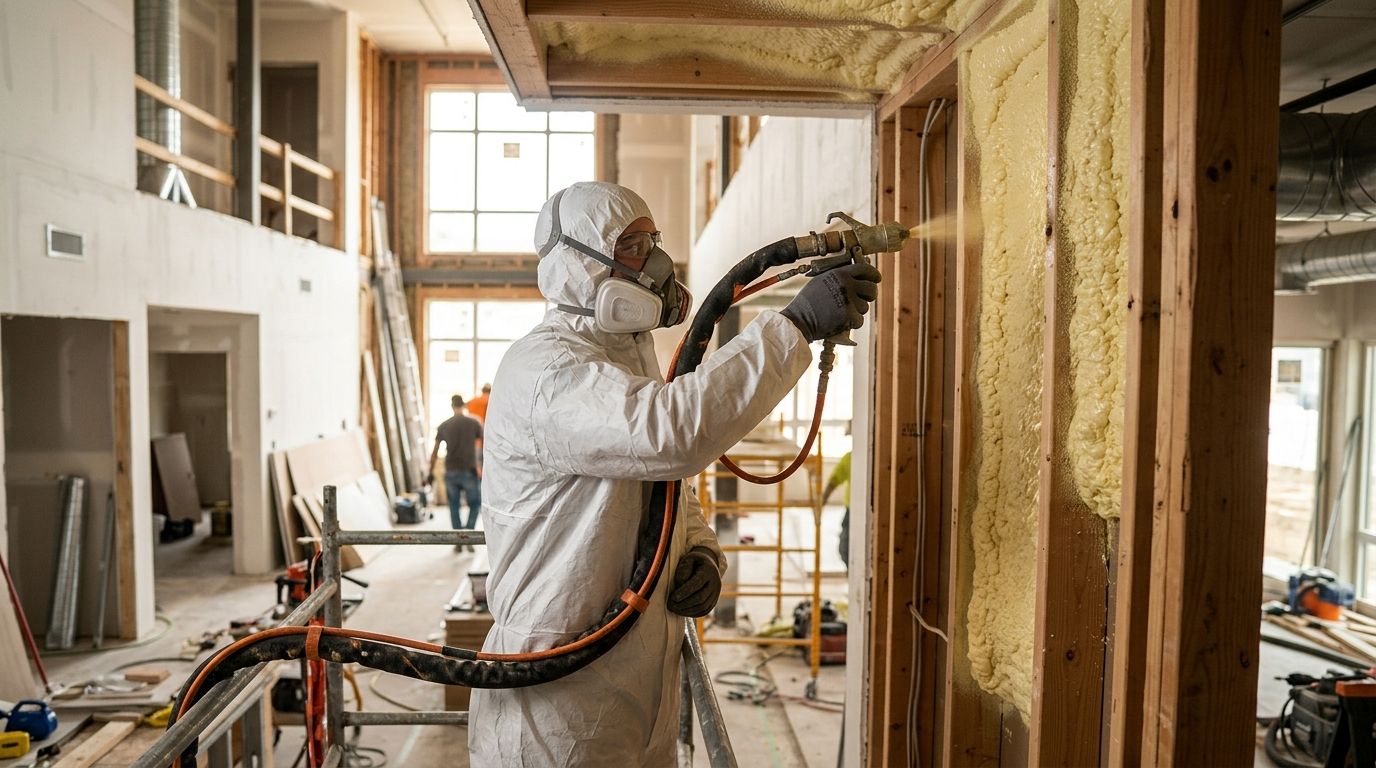
Spray foam insulation for property management companies is a portfolio-wide retrofit strategy that cuts tenant utility complaints, protects HVAC equipment, and extends the interval between capital repairs across multiple buildings at once. Property managers don't insulate one house — they're weighing dozens of units, staggered lease cycles, and a board or ownership group asking for a payback number before anyone signs off.
- Spray foam insulation for property management companies works best when it’s budgeted as a capital plan, not a one-off repair.
- Closed-cell foam is the standard pick for below-grade and mechanical rooms in multi-family buildings across Calgary and Lethbridge in 2026.
- Portfolio audits that rank buildings by tenant complaints and utility spend get the fastest return on insulation dollars in 2026.
- Occupied-unit installs need a sequencing plan around vacancies — spray foam crews can’t work around tenants safely.
Why spray foam insulation matters for property management companies
A single-family homeowner insulates once and moves on. A property manager is re-insulating on a rolling basis across a multi-family and condo building portfolio where every unit that loses heat through the rim joist or attic shows up as a maintenance ticket, not a line item.
The math that matters to an ownership group isn't R-value — it's vacancy cost during construction, tenant disruption, and how fast the utility savings offset the invoice. Buildings put up before the mid-2000s in Alberta commonly run fiberglass batt or blown cellulose that has settled or gapped at penetrations, which is exactly where spray foam earns its keep: it seals the air leak and adds R-value in the same pass.
Audit your portfolio before you budget anything
Don't quote a whole-portfolio job off a walkthrough of one building. Start with a building-by-building audit so the 2026 capital plan reflects real conditions, not assumptions carried over from the last renovation cycle.
- Pull utility bills for the last two winters and flag buildings with outlier heating costs per square foot
- Log tenant maintenance tickets mentioning cold rooms, drafts, or ice damming
- Check attic and rim joist access points for visible gaps, compressed batt, or moisture staining
- Cross-reference building age against the last known insulation upgrade date
- Rank buildings worst to best so the budget goes where it pays back fastest
Prioritize buildings by tenant complaints and vacancy risk
Once the audit is done, rank the work order. A building losing tenants over cold units is a different priority than a building with minor drafts and no complaints on file.
- Move buildings with active tenant complaints to the top of the queue
- Weight mixed-use buildings by how insulation affects HVAC costs in ground-floor commercial kitchens
- Flag buildings scheduled for turnover or renovation — insulation is cheaper bundled with other capital projects
- Deprioritize buildings under warranty or with recent envelope work
Match the insulation type to the building's use, not a blanket spec
Open-cell and closed-cell spray foam aren't interchangeable, and specifying the wrong one wastes budget. Closed-cell resists moisture and adds structural rigidity, which matters in below-grade parkades and mechanical rooms; open-cell is lighter and cheaper per square foot for interior sound and thermal work.
- Use closed-cell foam below grade, in crawlspaces, and at exterior rim joists where moisture is a risk
- Use open-cell foam for interior partition walls where sound dampening between units matters more than moisture control
- Check whether units need soundproofing between shared walls as part of the same scope
- Confirm mechanical and equipment rooms are sealed in the retrofit, not skipped as non-living space
Sequence the work around lease cycles and vacancies
Spray foam crews need clear access, ventilation, and cure time — none of which happen safely with tenants in the unit. This is where property managers most often underestimate the 2026 schedule.
- Schedule vacant-unit work first and use turnover windows for full-unit retrofits
- Batch occupied-building work to common areas, attics, and exterior access points
- Give tenants 48 to 72 hours of notice minimum for work requiring temporary relocation
- Add insulation to the standard make-ready checklist so every turnover unit is upgraded before re-leasing
Verify the contractor's credentials before signing a portfolio contract
One bad install across a multi-building portfolio is expensive to unwind. Property managers carry liability their tenants and ownership groups never see, so contractor vetting is risk management, not paperwork.
- Confirm WCB coverage and liability insurance before a crew steps on site — see how to choose an insulation contractor with WCB coverage
- Ask for ignition barrier and fire code compliance documentation on every spray foam job
- Request references from other multi-family or commercial property managers, not single-family homeowners
- Get a written scope per building instead of a blanket portfolio estimate
Aztec Spray Systems is a licensed and insured contractor working with property managers across Calgary, Okotoks, High River, and Lethbridge on phased, building-by-building spray foam insulation rollouts. The multi-family developer guide shows what a developer-scale scope of work looks like in practice.
Track savings and file for rebates before you close the file
Don't skip the paperwork. Alberta rebate and utility incentive programs can offset part of a 2026 retrofit cost, and ownership groups want that documented in the capital plan.
- Check eligibility on spray foam insulation rebates in Alberta before work starts, since some programs require pre-approval
- Pull 12 months of post-install utility bills and compare against the pre-retrofit baseline
- Keep invoices and photos of completed work for warranty and rebate audits
- Report per-building savings back to ownership as a closed capital project, not an ongoing expense
“Insulation retrofits budgeted as a capital plan close faster and cost less per building than the ones handled as emergency repairs.”
Comparison: insulation options for property management portfolios
| Option | Best for | Key limitation |
|---|---|---|
| Fiberglass batt replacement | Low-budget touch-ups in accessible attics | Settles over time, does not seal air leaks |
| Blown-in cellulose | Large flat attic areas needing topping up | Loses R-value if it gets wet or compresses |
| Open-cell spray foam | Interior walls, sound control between units | Lower moisture resistance than closed-cell |
| Closed-cell spray foam | Below-grade, rim joists, mechanical rooms | Highest material cost per board foot |
Closed-cell spray foam is the strongest pick for the parts of a multi-family building most exposed to moisture and air leakage — rim joists, parkades, and mechanical rooms — and it is the spec most property managers standardize on once one building has been through the retrofit. The honest tradeoff: it costs more per board foot than open-cell, so using it everywhere inflates a portfolio budget without matching gains on interior partition walls.
Get a portfolio insulation quote
Building-by-building scoping for property management portfolios in Alberta.
Common mistakes property management companies make
- Treating insulation as reactive maintenance instead of a scheduled capital item, so it only gets budget after a tenant complaint escalates.
- Quoting a whole portfolio off one building's condition — every building has a different age, envelope, and renovation history.
- Skipping the re-insulation assessment and assuming a building is fine because no complaints have landed yet.
- Scheduling work with tenants still in the unit, which pressures crews on ventilation and cure time.
- Not documenting rebate eligibility before work starts, which can disqualify a 2026 project from programs requiring pre-approval.
FAQ
How much does spray foam insulation cost for a multi-family property in 2026?
Cost varies by building size, foam type, and unit count, so property managers should get a building-by-building quote rather than a flat per-square-foot figure. Closed-cell foam in below-grade areas costs more per board foot than open-cell interior work.
Can spray foam insulation be installed in occupied apartment buildings?
Common areas, attics, and exterior access points can usually be done without displacing tenants. Full-unit work needs the unit vacant during application and cure time, which is why most property managers schedule it around turnover.
Does spray foam insulation qualify for rebates on commercial buildings in Alberta?
Some Alberta rebate and incentive programs cover commercial and multi-family retrofits, but eligibility depends on the program and often requires pre-approval before work begins. Confirm current program rules before signing a contract.
What is the difference between open-cell and closed-cell foam for property managers?
Closed-cell foam resists moisture and adds rigidity, making it the standard for below-grade and rim joist areas. Open-cell is lighter and better suited to interior partition walls where sound control matters more than moisture resistance.
How long does a spray foam retrofit take for a multi-unit building?
Timeline depends on how many units and common areas are in scope and whether those units are occupied. Vacant-unit turnovers are the fastest to schedule because crews do not have to work around tenants.
Do property managers need to verify contractor insurance before a portfolio job?
Yes. WCB coverage and liability insurance protect the property manager from exposure during a multi-building contract, and both should be confirmed in writing before any crew starts.
Is spray foam insulation worth it for older Alberta apartment buildings?
Buildings insulated before the mid-2000s commonly show settled batt or gapped cellulose, and spray foam re-seals air leaks while adding R-value in one pass. Prioritize the buildings with the highest utility costs and complaint volume first.
How do I budget spray foam insulation across a whole property portfolio?
Audit every building, rank them by utility cost outliers and tenant complaints, then phase the capital budget building by building instead of committing to a full-portfolio number up front. That keeps spending tied to condition rather than assumption.
One last thing
The buildings that save property managers the most money in 2026 are not always the oldest ones. They are the ones with the worst air sealing at penetrations, rim joists, and mechanical room walls, which a visual walkthrough alone routinely misses. Run a blower-door-informed audit before quoting the portfolio and those gaps show up while the budget is still open.
Related guides
- Multi-family and condo building spray foam insulation
- Best concrete lifting contractor for property managers
- How to soundproof an apartment building with spray foam
- How to prepare a commercial building for a spray foam retrofit