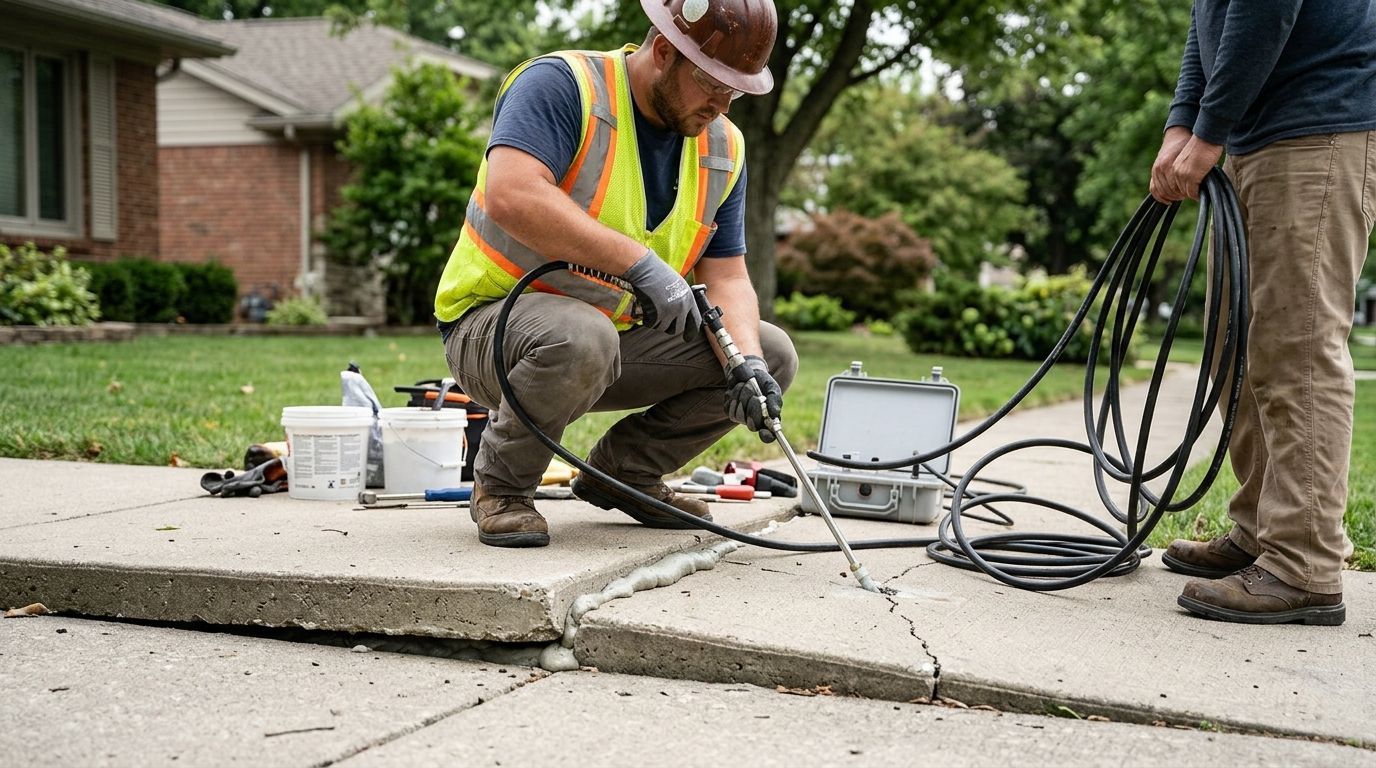
Polyurethane concrete lifting raises a sunken slab by injecting expanding structural foam underneath it through dime-sized holes, filling the void left by eroded or compacted soil until the slab floats back to level. The foam sets within about 15 minutes and the surface is ready to walk or drive on the same day. The hidden catch most homeowners miss: lifting only works if the soil underneath can still support the slab once it's raised — severe erosion or a broken drain line under the concrete needs fixing first, or the lift won't hold.
- Polyurethane concrete lifting injects expanding foam through 5/8-inch holes to raise a settled slab in about 15 minutes.
- Aztec Spray Systems uses polyurethane over mudjacking because the foam weighs roughly 2 lbs per cubic foot versus 100+ lbs for slurry.
- Lift accuracy runs within about 1/8 inch, and slabs are walkable or drivable the same day.
- Results vary with soil type, void size, and how much the slab has settled before treatment.
Why this matters
Calgary, Okotoks, High River, and Lethbridge all sit on soil that shrinks and swells with freeze-thaw cycles and expansive clay content. That movement is the reason driveways, garage slabs, and patios settle unevenly within a decade or two of being poured, long before the concrete itself has worn out. Replacing a slab means demolition, disposal, forms, and a multi-day cure — concrete lifting for Calgary homes and driveways restores the same slab in hours instead.
Understanding how the injection process actually works matters before you sign a quote in 2026, because pricing and warranty terms hinge on how much void space needs filling and how deep the foam has to travel. A contractor who can't explain the mechanics in plain terms usually can't diagnose the underlying soil problem either.
How does concrete lifting work?
The process follows the same sequence on a driveway, a garage floor, or a patio slab. Here's what happens from arrival to cleanup:
- Assessment — the technician checks elevation differences across the slab with a level or laser, and probes for the size of the void underneath.
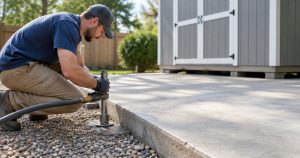
- Drilling — small holes, typically 5/8 inch across, are drilled through the concrete at the low points, spaced a few feet apart.
- Injection — a two-part polyurethane resin is pumped through the holes; the chemical reaction starts the moment the components mix.
- Expansion — the liquid foam expands 20 to 30 times its original volume within seconds, filling the void and pressing upward against the slab.
- Lift and monitor — the crew watches elevation in real time and stops injecting the instant the slab reaches grade, working hole by hole until the surface is level.
- Patch and cure — the holes get capped with a matching concrete patch, and the foam finishes curing within about 15 minutes, so the area handles foot or vehicle traffic the same day.
Polyurethane vs mudjacking: which lifts concrete better
Mudjacking is the older method — pumping a cement-and-soil slurry under the slab through much larger holes. Polyurethane injection replaced it in most markets because the material is lighter and the holes are smaller.
| Factor | Polyurethane injection | Mudjacking |
|---|---|---|
| Hole size | 5/8 inch | 1.5–2 inches |
| Material weight | ~2 lbs/cu ft | 100+ lbs/cu ft |
| Cure time | ~15 minutes | 24–48 hours |
| Re-settling risk | Low — foam adds almost no load | Higher — slurry weight can compact soft soil further |
| Best for | Driveways, garage floors, patios needing fast turnaround | Rarely recommended for residential work in 2026 |
Verdict: polyurethane injection is the better choice for most Alberta homeowners in 2026 because the lightweight foam doesn't reintroduce the weight that caused the settling in the first place, and the same-day cure means a driveway or garage floor isn't out of service for a weekend.
“Polyurethane foam weighs about 2 lbs per cubic foot, which is why it lifts a slab without adding the load that compacted the soil in the first place.”
Why concrete lifting results vary
Not every slab lifts the same way, and a contractor should walk you through which of these apply before quoting the job:
- Soil type — sandy or silty soils under Calgary-area slabs erode differently than the clay-heavy soil common near Okotoks and High River.
- Void size — a slab that dropped 3 inches needs more injection points and more material than one that dipped half an inch.
- Slab thickness — thicker commercial-grade concrete distributes lift pressure differently than a standard 4-inch residential pour.
- Moisture content — saturated soil under a slab after spring runoff affects how the resin expands and sets.
- Access and layout — a slab poured tight against a foundation wall or a utility line limits where holes can be drilled.
- Underlying cause — a lift addresses settling, but a broken weeping tile or a downspout dumping water under the slab needs separate repair or the settling returns.
Homeowners usually notice uneven concrete on a garage floor before they connect it to a lifting fix — the warning signs are covered in how to tell if your garage floor needs concrete lifting.
Get a concrete lifting assessment
Aztec Spray Systems evaluates settling and quotes the lift in a single visit.
How long does polyurethane foam take to cure after injection?
Polyurethane foam reaches initial cure in about 15 minutes, which is why a crew can lift, patch, and reopen the area to traffic in the same visit. Chemical cure continues briefly after that, but the slab is structurally supported well before the crew packs up.
Can polyurethane concrete lifting fix a cracked garage floor?
Polyurethane concrete lifting fixes uneven or sunken sections of a garage floor, but it does not repair existing surface cracks — those need a separate patch or sealant. If settling caused the cracking, lifting the slab back to grade stops the crack from widening further.
How long does a polyurethane concrete lift last in Alberta?
A polyurethane concrete lift holds for years because cured foam doesn't compress or wash out the way the original soil did. Longevity still depends on whether the drainage problem behind the settling gets addressed — the early warning patterns are in how to identify foundation settling before it worsens.
FAQ
How does concrete lifting work?
Concrete lifting works by injecting expanding polyurethane foam through small drilled holes underneath a sunken slab, filling the void until the slab rises back to grade. The foam cures in about 15 minutes, so the slab is usable the same day.
What’s the best method for lifting a sunken driveway?
Polyurethane injection is the best method for most driveways in 2026 because it uses 5/8-inch holes and doesn’t add the heavy load that mudjacking slurry does. It also cures fast enough to reopen the driveway to vehicle traffic the same day.
Is polyurethane concrete lifting better than mudjacking?
Polyurethane concrete lifting is generally better than mudjacking because the foam weighs roughly 2 lbs per cubic foot versus 100-plus pounds for slurry, reducing the chance the slab re-settles under the weight of its own repair. It also cures in about 15 minutes compared to 24 to 48 hours.
How much does polyurethane concrete lifting cost?
Cost depends on how much void space needs filling and how many injection points the slab requires, so it varies with slab size and settling severity. Get a site-specific quote rather than relying on a flat estimate.
Can concrete lifting fix a garage floor that has sunk near the door?
Concrete lifting can raise a garage floor section that has sunk near the door, provided the soil underneath still supports the slab once it is lifted. A technician checks for voids and drainage issues before injecting foam.
How long does it take to lift a concrete slab?
Most residential concrete lifting jobs finish in a few hours, including drilling, injection, and patching, because the foam cures in about 15 minutes. Larger slabs and deeper voids take longer to fill evenly.
Does concrete lifting work on patios and pool decks?
Concrete lifting works on patios and pool decks the same way it works on driveways: foam injected through small holes raises the settled section back to level. Uneven pool deck edges are a common candidate for this repair.
Will a lifted slab sink again?
A lifted slab holds long-term in most cases because cured polyurethane foam doesn’t compress the way soil does, but it can settle again if the original drainage problem is left unfixed. Redirecting water away from the slab protects the lift.
One last thing
The detail that surprises most homeowners: the foam expands 20 to 30 times its liquid volume within seconds of injection, which is why a crew fills a large void with a small amount of material pumped through a 5/8-inch hole. That expansion ratio is also why over-injecting is the most common failure on DIY kits — a slab overshoots level fast once the reaction starts. A trained crew watches elevation in real time and stops the moment the slab reaches grade, which in 2026 is still the difference between a level driveway and one that tips the wrong way.
Related guides
- Concrete lifting for patios and pool decks
- Concrete lifting for garage floors
- Concrete lifting for interior basement floors