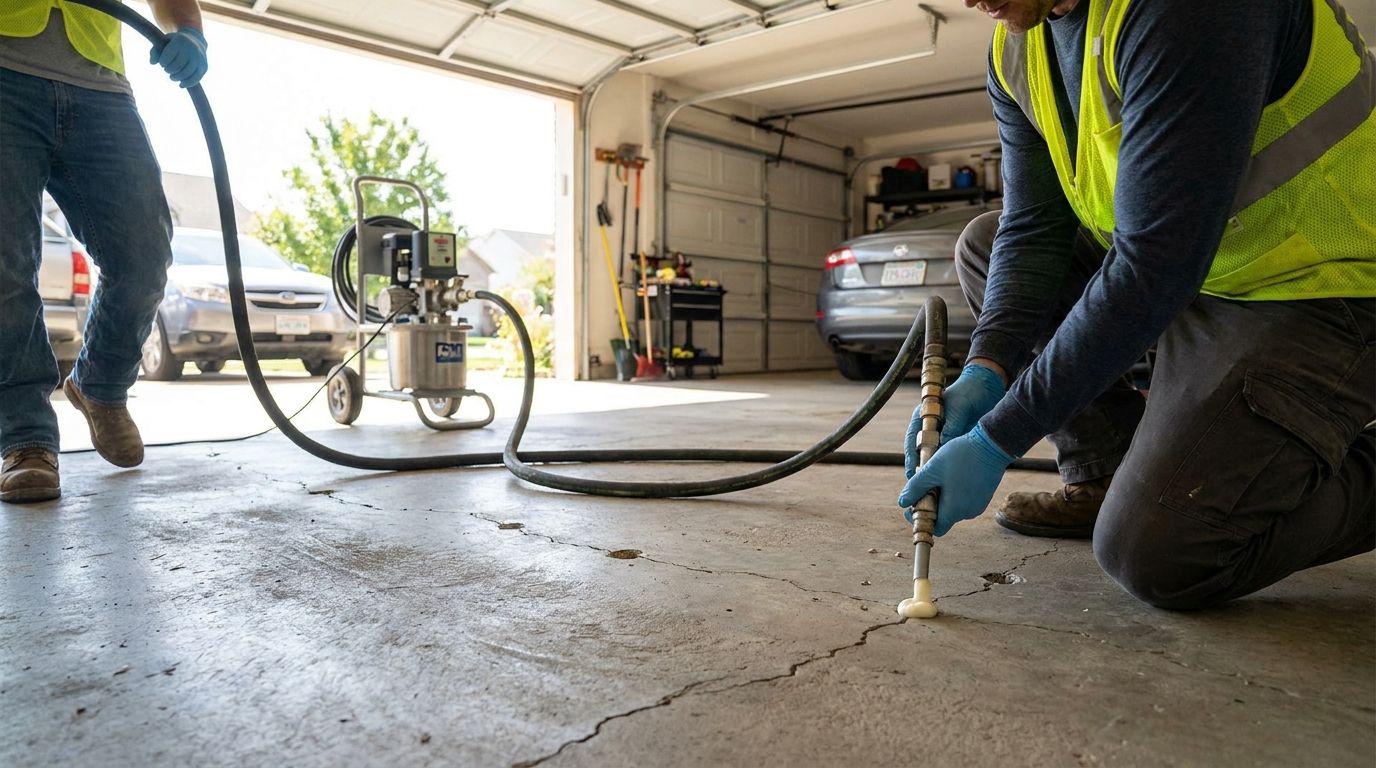
A sunken garage floor slab isn't just cosmetic — it traps water against the foundation, cracks under vehicle weight, and gets worse every freeze-thaw cycle Alberta throws at it. This guide breaks down what actually works to fix it, what to skip, and which method holds up through a Calgary winter.
- Polyurethane foam lifting is the buy for garage floors in 2026 — it cures in 15 to 30 minutes and adds almost no weight to the slab.
- Mudjacking is a skip for most garages: the mud slurry mix runs 100+ lbs per cubic foot and needs 24 to 48 hours before you can park on it.
- Slab replacement is a consider, only when the concrete itself is cracked through, not just settled.
- Any lift job on a garage floor should be paired with a look at the garage walls and ceiling, since heat loss and moisture often travel together.
- Concrete lifting garage floor work in Calgary, Okotoks, High River, and Lethbridge deals with the same enemy: repeated freeze-thaw movement in the soil.
Why this matters
A garage slab that's dropped even half an inch at one corner is a symptom, not the problem. The soil underneath has lost density, shifted, or washed out, and it will keep moving until something fills that void and lifts the slab back to level.
Alberta's freeze-thaw pattern makes this worse than in milder climates. Soil expands when it freezes, contracts when it thaws, and repeats that cycle dozens of times a winter — each cycle pulls a little more support out from under the slab. Ignoring it means a trip hazard at the garage door threshold turns into a crack that lets water and cold air straight into the slab edge.
Aztec Spray Systems handles concrete lifting alongside spray foam insulation work across Calgary, Okotoks, High River, and Lethbridge, which matters because a sinking garage floor and a poorly insulated garage often show up on the same property.
Who this is for
This is for homeowners in southern Alberta with a garage floor that's cracked, sunken at one edge, or pulling away from the foundation wall — usually visible as a gap where the slab meets the house, or a puddle that collects in the same spot after every rain. It's also for anyone who's been quoted a full slab tear-out and wants to know if there's a faster, less invasive fix first.
What to look for in concrete lifting for a garage floor
Cure time before you can park
A garage floor that's out of commission for two days is a real cost, not just an inconvenience — you lose the bay, and in winter you lose covered parking during the coldest stretch of the year. Cure time is the single biggest differentiator between lifting methods, and it's worth asking about before anything else.
Weight added to the existing slab
Whatever gets pumped under the slab becomes part of its foundation. A material that weighs a fraction of what the original soil weighed won't recreate the same settling problem five years later, while a heavy slurry mix can.
How the crew handles the injection points
Lifting requires drilling small holes through the slab to inject material underneath. The size and pattern of those holes — and how they're patched afterward — determines whether you end up with a floor that looks untouched or one with a grid of visible dots.
Whether it's reversible or repeatable
Soil under a garage floor in Alberta doesn't stop moving just because you've lifted it once. A method that can be reinjected at the same access points years later is worth more than one that requires starting from scratch.
Structural fit for a vehicle load
A garage floor carries concentrated point loads from tires, not evenly distributed foot traffic. The lifting material needs enough compressive strength to hold that load without recompressing over time.
Moisture behavior underneath the slab
Some fill materials absorb water and lose density over time; others are closed-cell and stay stable. In a climate with a high water table after spring melt, that difference decides whether the fix lasts one winter or fifteen.
Top picks for concrete lifting garage floor jobs
Polyurethane foam lifting — the safe pick
One spec that matters: polyurethane foam weighs roughly 2 to 4 lbs per cubic foot once cured, compared to a mud slurry mix at 100+ lbs per cubic foot. That weight difference is why foam doesn't recreate the settling problem it was hired to fix.
Cure time runs 15 to 30 minutes in most cases, which means the garage bay is back in service the same day. It's closed-cell, so it resists moisture absorption through Alberta's spring thaw. Verdict: Buy — for the majority of sunken garage slabs, this is the method that solves the problem without a multi-day shutdown.
Mudjacking / mortar slurry — the old-school pick
Mudjacking has been around for decades and uses a cement, soil, and water slurry pumped under the slab. It's heavier than the foam alternative and needs 24 to 48 hours to cure before any vehicle weight goes back on it.
The holes it requires are also larger than foam injection points, typically 1 to 2 inches across. Verdict: Skip for garage floors specifically — the added weight under the slab and the longer downtime make it a worse fit than foam for a space that needs to hold a vehicle.
Full slab replacement — the last resort
When the concrete itself has cracked through, not just settled, lifting won't fix it — the slab is broken, not just displaced. Replacement means demolition, new forms, new pour, and a cure period measured in days before full load-bearing strength.
Verdict: Consider — only when a visual inspection shows the concrete is structurally compromised, not just uneven.
Void fill without a full lift — the patch job
This addresses a gap or void under the slab without actually raising it back to level. It stops water intrusion but leaves the trip hazard and the uneven surface in place.
Verdict: Skip if the goal is a level, drivable garage floor — this is a stopgap, not a fix.
Get your garage floor assessed
Concrete lifting and spray foam service across Calgary, Okotoks, High River, and Lethbridge.
What to avoid
- Self-leveling compound poured over the top. It fills the visible dip but does nothing about the void underneath — the slab will keep dropping and the compound cracks along with it.
- A quote that skips the injection point pattern. If a contractor can't tell you how many holes and where, you can't compare that bid against another one honestly.
- Any crew that treats a garage floor the same as a sidewalk slab. Vehicle load is concentrated and repetitive; a method fine for a walkway can underperform under a parked truck.
While the floor's being addressed, it's worth a second look at the garage envelope itself — sunken slabs and poor insulation often share the same root cause of moisture and temperature swings, and garage wall and ceiling spray foam insulation is a natural pairing with a lift job since both projects mean the space is already out of daily use.
Verdict comparison
| Method | Cure Time | Weight Added | Reversible/Repeatable | Verdict |
|---|---|---|---|---|
| Polyurethane foam lifting | 15-30 min | 2-4 lbs/ft3 | Yes, same access points | Buy |
| Mudjacking / slurry | 24-48 hrs | 100+ lbs/ft3 | Limited | Skip |
| Full slab replacement | Days | N/A (new pour) | N/A | Consider |
| Void fill only | Same day | Minimal | No | Skip |
FAQ
What’s the best method for concrete lifting on a garage floor?
Polyurethane foam lifting is the best fit for most garage floors in 2026 because it cures in 15 to 30 minutes and adds only 2 to 4 lbs per cubic foot to the slab. Mudjacking works too but adds far more weight and needs a 24 to 48 hour cure before vehicle traffic.
Is concrete lifting better than replacing the garage slab?
Lifting is better when the concrete is intact but has settled or sunk, since it costs less downtime and doesn’t require demolition. Replacement only makes sense when the slab itself is cracked through, not just uneven.
How much does concrete lifting for a garage floor cost?
Cost depends on slab size, how far it needs to lift, and soil conditions under the garage, so it varies property to property. Request a site assessment for an exact number rather than relying on a per-square-foot estimate.
How long does polyurethane foam concrete lifting last?
Polyurethane foam is closed-cell and resists moisture absorption, which means it holds its density better than mud slurry through repeated freeze-thaw cycles. It’s also repeatable at the same injection points if the soil shifts again years later.
Can you drive on a garage floor right after it’s lifted?
With polyurethane foam, yes — most jobs cure in 15 to 30 minutes and the bay is back in service the same day. Mudjacking requires waiting 24 to 48 hours before any vehicle weight goes back on the slab.
Does concrete lifting work on a cracked garage floor?
It works if the crack is a surface crack tied to settling, but not if the slab is structurally broken through. A visual inspection of the crack pattern determines whether lifting or replacement is the right call.
Why does my garage floor keep sinking in Alberta?
Alberta’s freeze-thaw cycle expands and contracts the soil under the slab dozens of times each winter, gradually washing out support. That’s why garage floors in Calgary, Okotoks, High River, and Lethbridge see repeated settling more than in milder climates.
Is mudjacking or polyurethane foam better for a garage floor?
Polyurethane foam wins for garage floors because it’s lighter, cures faster, and resists moisture better through Alberta winters. Mudjacking is an older, heavier method that takes longer to cure and can settle again sooner under vehicle load.
One last thing
The freeze-thaw cycle that caused the sinking in the first place doesn't stop after the lift job is done — it's why a repeatable method matters more than a one-time fix in this climate. A slab that's been lifted with polyurethane foam can be reinjected at the same access points if the soil shifts again, which isn't true of a mudjacked or self-leveling repair.
If the garage is getting attention this year anyway, checking insulation at the same time avoids paying for access twice — see the cost breakdown for spray foam insulation in Calgary for what that adds to a combined project.