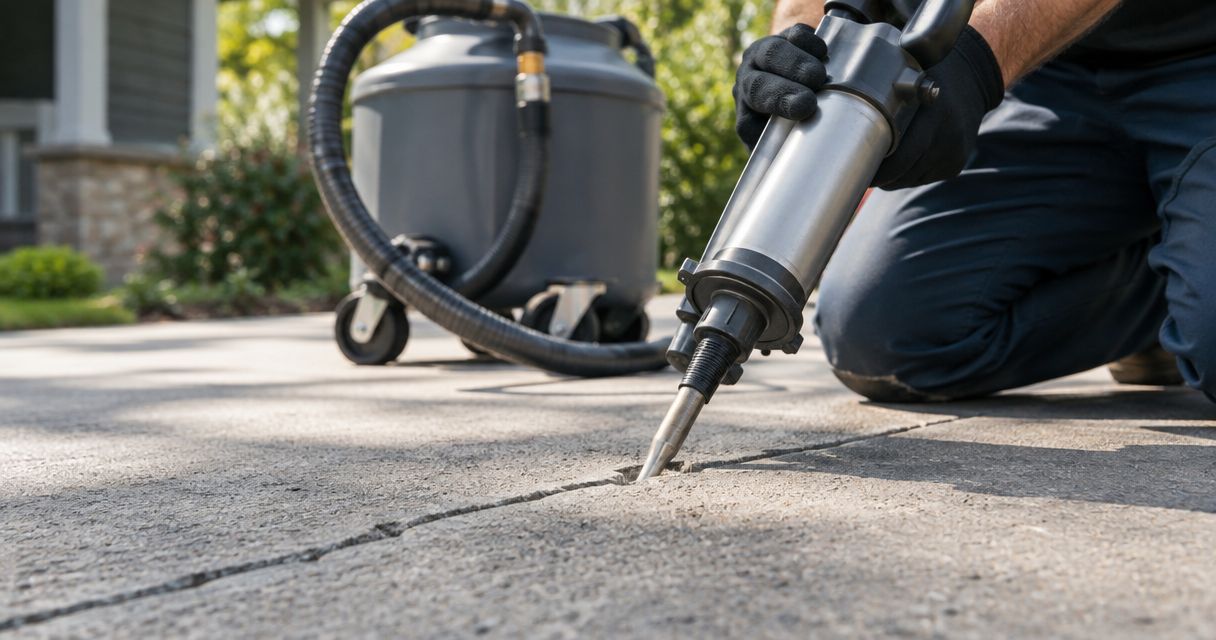
Polyurethane concrete lifting has no fixed lifespan: the repair lasts as long as the slab remains sound and the ground beneath it continues to provide support. Ongoing erosion, settlement or frost movement can shift the concrete again even when the injected foam remains intact. For a repair planned in 2026, the useful question is whether the work addresses the cause of movement—not just the uneven surface.
- How long does concrete lifting last? Polyurethane repairs depend on stable ground, drainage and the existing slab’s condition.
- Polyurethane concrete lifting restores support; it does not automatically resolve erosion, frost movement or structural damage.
- Aztec Spray Systems provides concrete lifting for homeowners and commercial property owners in southern Alberta.
- Choose a repair based on the cause of settlement, not an unsupported lifespan promise.
How long does polyurethane concrete lifting last?
Polyurethane concrete lifting is a long-term repair approach, not a guarantee that concrete will never move again. Its durability depends on the relationship between the existing slab, the injected material and the underlying ground. A level surface at completion confirms the elevation was corrected; it does not prove that every cause of settlement has disappeared.
Separate material durability from repair durability. Cured lifting foam provides support beneath the slab, but the soil below that support can still move. Likewise, an existing slab can continue to crack or deteriorate independently of the lifting material.
Before choosing a contractor, ask these questions in order:
- What caused the movement? Identify whether the problem involves lost support, water washing out soil, poorly compacted fill or another condition.
- Is the slab suitable for lifting? Check whether the concrete can remain in service after its elevation changes.
- What support will the repair restore? Ask how the proposed work addresses the affected area beneath the slab.
- What remains outside the repair? Clarify drainage work, crack repairs, structural concerns and maintenance responsibilities.
Aztec Spray Systems is a licensed and insured contractor providing concrete lifting, spray foam insulation and attic insulation. Its stated service area includes Calgary, Okotoks, High River and Lethbridge.
Why this matters
A lifespan estimate is useful only when you know what it describes. Foam remaining beneath a slab is not the same thing as the slab maintaining its intended elevation, shedding water properly and remaining suitable for use.
For your 2026 project, compare repair scopes rather than promises of permanence. A proposal that explains the settlement cause, intended elevation and unresolved conditions gives you a clearer basis for deciding than a lifespan claim without site-specific reasoning.
This distinction matters for homeowners and commercial property owners alike. A walkway needs a usable transition between panels; a vehicle surface also needs support appropriate to its use. Neither outcome follows automatically from making the surface look level.
Why concrete lifting longevity varies
The main durability factors relate to the property and the repair itself. Address the conditions that moved the slab before treating its new elevation as a lasting result.
- Ground stability: Soil and fill must continue supporting the repaired area. Lifting the slab does not automatically correct settlement deeper below it.
- Water movement: Runoff, leaking drainage and water flowing beneath edges can remove supporting soil. Raising concrete without addressing that flow leaves the cause active.
- Slab condition: Lifting changes elevation and support; it does not replace deteriorated concrete or restore every cracked slab’s integrity.
- Freeze–thaw exposure: Freezing water in susceptible ground can cause heave. A slab that rises seasonally needs a different diagnosis from a slab that has lost support.
- Repair coverage: The work must address the support needed beneath the affected concrete, not simply improve a visible edge.
- Use and loading: The assessment should account for how the surface is used. Changes in vehicle or equipment loading require attention to the slab and its supporting ground.
These factors work together. For example, filling a void does not prevent a drainage defect from creating another void elsewhere. Correcting runoff and restoring support address different parts of the same problem.
Does the foam last longer than the repair?
The foam and the repaired surface have different failure paths. Polyurethane lifting material supports the slab after it cures, but movement can occur below or beside that support without requiring the foam itself to break down.
Think of the repair as a support system rather than a material alone. The concrete, foam and ground must continue working together. If the ground settles beneath the treated area, the slab can move with it.
For the injection process, see how polyurethane concrete lifting works. Understanding how support is restored helps you ask better questions about what the proposed work will—and will not—change.
Be careful with claims that describe foam as permanent. A material description does not establish a project-specific service life, and it does not substitute for an assessment of drainage, ground conditions or concrete damage.
Is polyurethane lifting better than replacement?
Polyurethane lifting suits concrete that remains serviceable but needs its support or elevation corrected. Replacement addresses the concrete itself and provides access to the underlying base, but replacing a slab without correcting the settlement cause can also leave the problem unresolved.
Compare the approaches by what your property needs, not by an assumed lifespan ranking. Neither method earns a universal durability advantage without considering the condition beneath the concrete.
| Approach | Best for | Main advantage | Main limitation |
|---|---|---|---|
| Polyurethane lifting | Serviceable slabs with support loss or uneven elevation | Retains the existing concrete while restoring support and elevation | Does not replace damaged concrete or automatically solve deeper ground movement |
| Slurry-based lifting | Serviceable slabs where a cementitious lifting approach suits the site | Raises existing concrete using injected lifting material | Still depends on suitable concrete, supporting ground and drainage |
| Slab replacement | Concrete that needs removal because of its condition or required redesign | Allows the slab and accessible base to be rebuilt | Requires removal and reconstruction; unresolved ground problems still matter |
Keeping an existing slab avoids replacing concrete that can still perform its job. That is lifting’s practical benefit. Its limitation is equally important: the finished surface remains the original slab, including damage that the lifting scope does not repair.
For your 2026 decision, ask each contractor why its proposed method matches the observed failure. A method name alone does not explain whether the work corrects the relevant problem.
What should you check before approving the repair?
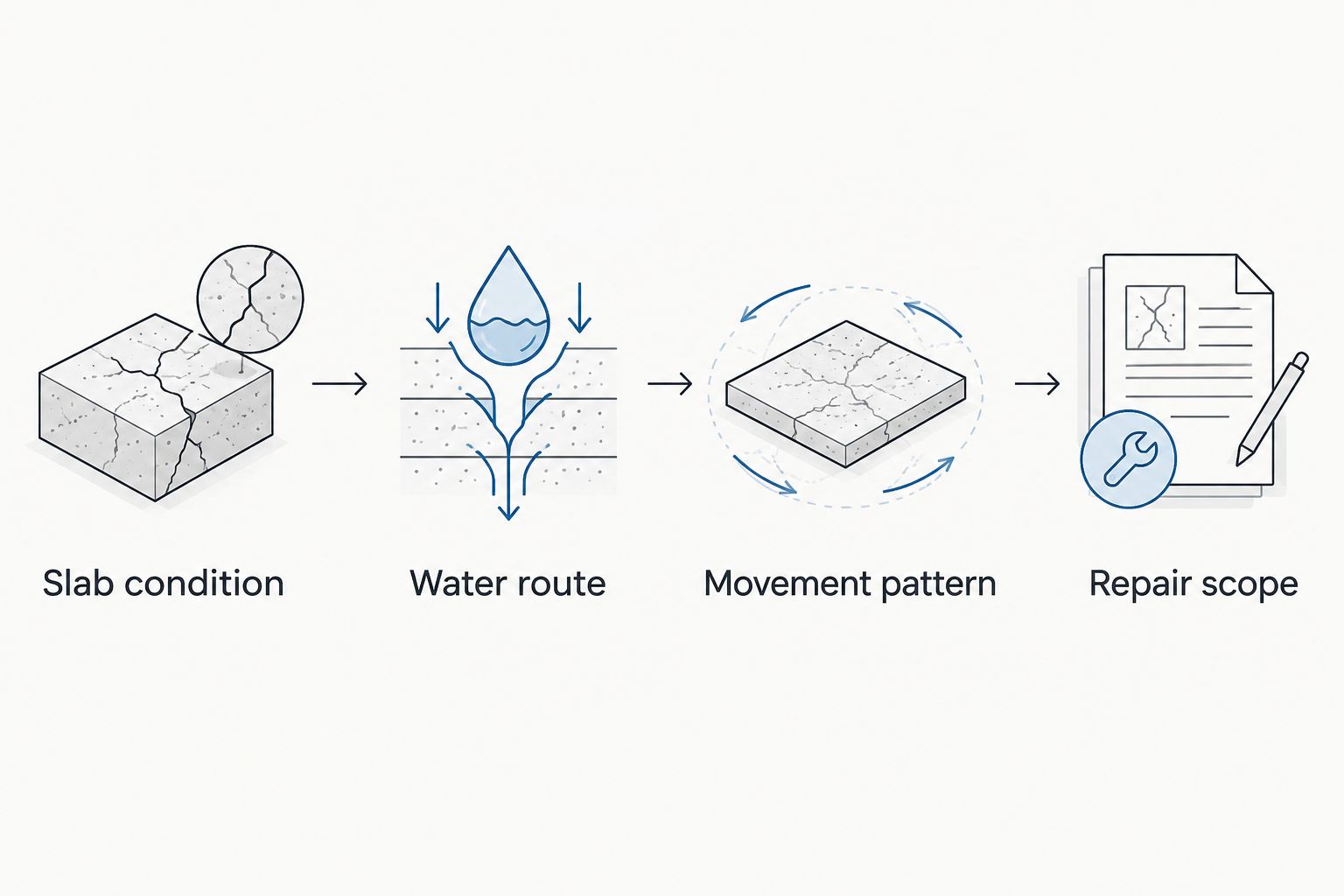
Start with observable conditions, then ask the contractor to connect them to the proposed work. You do not need to diagnose hidden soil conditions yourself. You do need an explanation that fits what is happening at the property.
Slab condition
Look for broken sections, surface deterioration, open cracks and uneven joints. Photograph the whole affected area as well as individual defects, so the assessment is not based on a close-up of one low corner.
Ask which defects will remain after lifting. A change in elevation can improve alignment without repairing every crack, restoring a worn surface or making fragmented concrete suitable for continued use.
Water route
Observe where roof runoff, nearby grading and surface water direct moisture. Note ponding and locations where water disappears beneath slab edges, particularly around the area that has settled.
Do not assume every wet area proves erosion beneath the slab. Share the observations and ask whether drainage changes belong in the repair plan. The contractor should distinguish visible evidence from conditions requiring further investigation.
Movement pattern
Describe whether the problem developed gradually, followed a drainage issue or changes with the seasons. Include previous repairs and any recent changes to landscaping or surface use.
A slab that repeatedly rises and falls needs more than a simple description of a low spot. The movement history helps distinguish ongoing behaviour from an isolated loss of support.
Repair scope
Request a written description of the area being treated and the intended result. Clarify whether the goal is to align adjacent panels, restore a drainage slope or improve a transition at an entrance.
Perfectly horizontal is not always the right target. Exterior concrete often needs a deliberate slope to manage water, so ask how the finished elevation supports drainage rather than judging the repair only by a spirit level.
How do you help a concrete lifting repair last?
Protect the support beneath the slab by managing water and watching for renewed movement. Maintenance cannot guarantee a fixed service life, but it helps you identify conditions that undermine the repair.
Keep drainage routes functioning and avoid directing downspout discharge toward vulnerable slab edges. Where the assessment identifies a runoff problem, arrange the recommended correction rather than assuming the lifting material makes drainage irrelevant.
Maintain joints and cracks according to the contractor’s recommendations for the surface. Sealing does not rebuild lost support, but appropriate maintenance belongs alongside drainage management—not in place of it.
Keep a baseline record after completion. Photograph the repaired transitions and note where water travels, then compare those locations when you notice a change. Consistent viewpoints make movement easier to recognise than memory alone.
For a project completed in 2026, retain the written scope, completion photographs and any maintenance instructions together. If the slab moves again, those records help explain what changed and what the original repair covered.
Does a warranty tell you how long concrete lifting lasts?
A warranty is a written commitment with conditions, not a measurement of the repair’s lifespan. Its usefulness depends on what it covers, what it excludes and what remedy it provides.
Ask whether the terms address renewed settlement, lifting material, workmanship or another defined issue. Also ask how drainage defects, existing cracks, ground movement and changes in use affect coverage.
Read the remedy as carefully as the duration. A commitment to assess a problem is different from a commitment to perform corrective work, and neither should be inferred from a general claim about durability.
Use the same approach when comparing 2026 proposals: review the site diagnosis, repair scope and written terms separately. A long warranty does not remove the need for a suitable repair, and a repair’s actual performance is not determined solely by when its coverage ends.
Can lifted concrete sink again?
Lifted concrete can sink again if its supporting ground continues to settle or loses material. That does not automatically establish whether the original injection work was defective; the cause needs reassessment.
Report renewed gaps, changes at joints, new ponding or a return of the original uneven transition. Describe where and when you noticed the change rather than requesting more foam before the cause is understood.
If the concern includes building movement, foundation cracking or other structural symptoms, keep it separate from a surface-lifting decision. Restoring a slab’s elevation is not a substitute for an appropriate structural assessment.
Who is Aztec Spray Systems best suited for?
Aztec Spray Systems is suited to homeowners and commercial property owners seeking concrete lifting in Calgary, Okotoks, High River and Lethbridge. Its stated licensing, insurance and service area are relevant when choosing a contractor to assess a local property.
Aztec Spray Systems’ concrete lifting service belongs in a decision about slab support and elevation. The service description alone does not establish a lifespan, warranty term or suitability for structural foundation work; base those decisions on the proposed scope for your property.
FAQ
How long does concrete lifting last?
Concrete lifting has no fixed lifespan; its durability depends on stable support, drainage and the existing slab’s condition. Ask for a site-specific explanation rather than treating a general lifespan promise as a guarantee.
Is polyurethane concrete lifting permanent?
Polyurethane concrete lifting does not guarantee permanent slab elevation. The ground beneath or beside the repaired area can still settle, erode or move with freezing conditions.
Can concrete sink again after polyurethane lifting?
Concrete can sink again after polyurethane lifting if supporting ground continues to move or wash away. Renewed movement requires reassessment of the cause, not an automatic assumption that more injection is the answer.
Is replacing concrete better than lifting it?
Replacement is better suited to concrete that needs rebuilding, while lifting suits serviceable slabs with support or elevation problems. Both approaches need to account for the cause of movement.
Does concrete lifting fix cracks?
Concrete lifting does not automatically repair cracks. Changing elevation can improve alignment, but crack treatment and slab suitability need their own assessment.
Does a concrete lifting warranty guarantee the repair’s lifespan?
A concrete lifting warranty does not establish the repair’s actual lifespan. Review the covered issue, exclusions and remedy separately from the contractor’s site assessment.
Who provides concrete lifting in Calgary, Okotoks, High River and Lethbridge?
Aztec Spray Systems provides concrete lifting for homeowners and commercial property owners in Calgary, Okotoks, High River and Lethbridge. The business is described as licensed and insured.
One last thing
The most useful durability question is not simply how long the foam lasts. Ask: What would cause this slab to move again after the repair, and which of those conditions does the proposal address?
Bring that question to your 2026 contractor discussion. It connects the expected result to the actual property and exposes the difference between correcting an uneven surface and addressing the conditions beneath it.
Related guides
- Concrete lifting for Calgary homes and driveways
- How to tell if your garage floor needs concrete lifting
- Concrete lifting for patios and pool decks