Yes, concrete lifting can be done in winter in Alberta when the slab, supporting ground, and lifting material meet the conditions required for the work. Frozen ground, frost heave, and unsuitable application temperatures can make an outdoor repair inappropriate even on a mild day. For a 2026 winter project, arrange a site assessment before treating a warmer forecast as permission to proceed.
- Can concrete lifting be done in winter? Yes, when ground conditions and material requirements permit it.
- Frozen ground and frost heave need assessment before an Alberta slab is lifted.
- A heated garage does not prove the ground beneath its floor is unfrozen.
- Aztec Spray Systems provides concrete lifting in southern Alberta; confirm winter project suitability directly.
Can concrete lifting be done in winter in Alberta?
Yes—but the condition beneath the concrete matters more than the month. A contractor needs to establish whether the slab has settled, whether frost has temporarily raised adjoining concrete, and whether the proposed lifting material can be installed under the actual site conditions.
Aztec Spray Systems is a licensed and insured contractor providing concrete lifting to homeowners and commercial property owners in Calgary, Okotoks, High River, and Lethbridge. Ask about the suitability of your particular slab rather than assuming that every outdoor surface qualifies for winter work.
Use this comparison to frame the assessment. These are decision routes, not promises that a particular property is ready for repair.
| Decision route | Best for | Main benefit | Main limitation |
|---|---|---|---|
| Assess for winter lifting | A settled slab with verifiable ground conditions and suitable material requirements | Establishes whether repair can proceed during winter | Cold, frost, or uncertain support can prevent the work |
| Monitor until thaw | Outdoor concrete with suspected seasonal frost movement | Allows the slab to be reassessed without frozen-ground effects | The uneven surface still needs interim safety management |
| Investigate beyond lifting | Broken slabs, recurring movement, or suspected structural problems | Addresses whether lifting is the right repair at all | Assessment can identify work outside a lifting contractor's scope |
The best route follows the diagnosis. Do not lift one slab simply because the slab beside it appears higher in winter. The higher slab could be the part that has moved.
Why this matters
An uneven walkway creates an immediate access problem, but the visible height difference does not explain its cause. Settlement is downward movement; frost heave is upward movement associated with freezing conditions in susceptible ground. They require different reasoning.
If a frost-heaved section is used as the reference level, lifting adjacent concrete to match it can leave the repaired area incorrectly positioned after thaw. That is why identifying the stable reference matters before discussing the lift itself.
For your 2026 repair plan, separate two decisions: how to manage the uneven surface now, and when to carry out a lasting correction. Restricting access or directing pedestrians to another route addresses exposure to the hazard without assuming the slab is ready for lifting.
Outdoor driveways and sidewalks: assess the ground first
Outdoor slabs are exposed to changing weather, snow cover, meltwater, and freezing conditions. A dry-looking driveway can still have frozen support beneath it. Surface appearance alone cannot establish whether the repair is suitable.
Water freezes at approximately 0°C, or 32°F, under ordinary atmospheric conditions. Those figures explain the freezing point of water; they are not universal concrete-lifting installation limits. The lifting material's technical requirements and the ground condition still need to be checked separately.
A useful outdoor assessment considers the following:
- Movement history: Did the uneven joint exist before winter, or appear during freezing weather?
- Reference level: Is the apparently higher section stable, or has it heaved?
- Ground condition: Is the support frozen, thawed, wet, or uncertain?
- Drainage: Where does water travel, and where does it collect?
- Slab condition: Is the concrete sufficiently intact for the proposed repair?
Photographs from warmer weather help establish whether a height difference is persistent. They support the assessment but do not replace inspection beneath or around the slab.
Heated garage floors: indoor air is not the whole test
A heated garage offers a more controlled working environment than an exposed driveway. It does not establish the temperature or condition of the ground beneath the entire floor, particularly near doors and exterior edges.
Best for winter assessment: an accessible indoor slab with a known history of settlement. The advantage is shelter from direct weather; the limitation is that heating the room does not verify the slab's support conditions.
Tell the contractor how the garage is heated, whether it remains heated continuously, and where movement occurs. Also identify drains, utilities, and any known in-floor heating before drilling is considered.
If you are planning a 2026 garage repair, distinguish a floor problem from a door problem. An uneven floor, a moving threshold, and a poorly adjusted overhead door can produce similar complaints about gaps, but they do not establish the same repair need.
Why winter concrete-lifting suitability varies
Winter suitability depends on several conditions working together. No single air-temperature reading answers the question.
- Ground freezing: Frozen support complicates assessment of the slab's position and what will happen after thaw.
- Seasonal movement: Frost heave can make stable neighbouring concrete appear sunken.
- Material requirements: Application conditions depend on the specific lifting system and its technical documentation.
- Water movement: Drainage problems and meltwater need attention alongside any proposed elevation correction.
- Access and visibility: Snow and ice can hide joints, cracks, edges, and the full extent of the uneven surface.
- Repair scope: A settled, intact slab presents a different problem from extensively broken concrete or suspected structural movement.
These factors explain why two nearby properties can receive different recommendations. A sheltered floor and an exposed walkway do not share identical conditions just because they have the same postal code.
How should you assess a winter lifting project?
For a 2026 winter enquiry, prepare evidence that helps the contractor distinguish persistent settlement from seasonal movement. Keep the information practical. You do not need to diagnose the soil yourself.
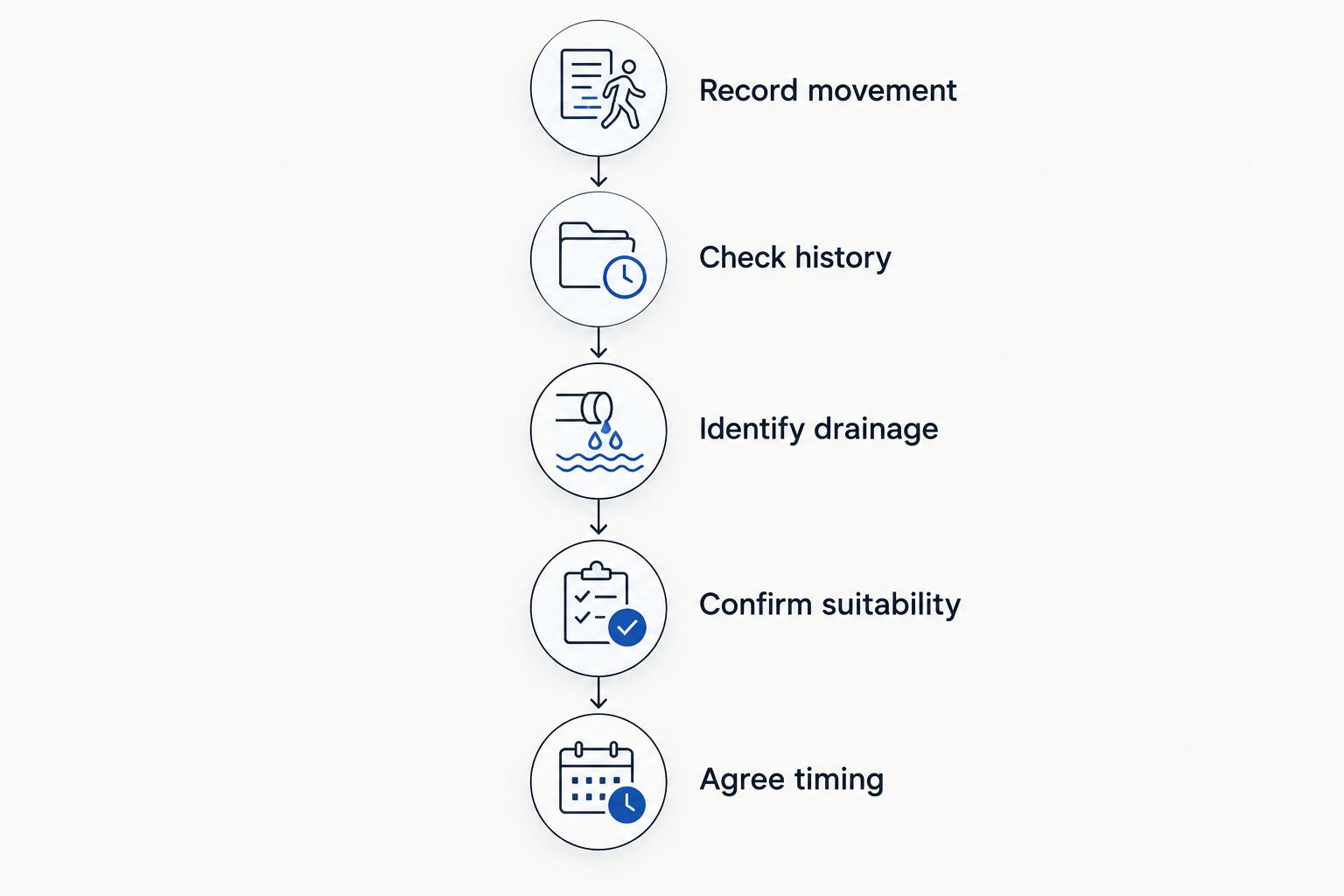
- Record movement. Photograph the uneven joint, surrounding slabs, nearby walls, and drainage features. Add the date and note whether the surface was snow-covered or recently thawed.
- Check history. Find older photographs or maintenance records. Note whether the unevenness changes between winter and warmer weather.
- Identify drainage. Describe ponding, downspout discharge, and water entering the area. Do not assume lifting alone will correct every water source.
- Confirm suitability. Ask the contractor how ground conditions, slab integrity, and material requirements will be checked before work begins.
- Agree timing. Establish whether the recommendation is to proceed, reassess after thaw, or investigate a different repair.
The sequence matters: gather observations before choosing a repair date. A request to “make the slabs level” leaves out the essential question of which elevation is correct.
Once suitability is established, ask how the proposed repair changes the slab's support and elevation. The guide to how polyurethane concrete lifting works explains the process; it does not replace a winter site assessment.
Can you lift concrete during an Alberta Chinook?
A Chinook does not automatically make concrete lifting suitable. Warmer air and melting surface snow do not prove that the supporting ground has thawed or that seasonal movement has ended.
Treat a mild spell as an opportunity for assessment, not evidence of readiness. Ask what has been verified beneath the slab and whether the proposed material meets its application requirements under the measured conditions.
For an outdoor repair during winter 2026, a forecast is only part of the picture. Recent weather, current ground conditions, water movement, and slab history all belong in the decision.
Should you wait until spring to lift a sunken driveway?
Wait for reassessment after thaw when frost movement or frozen support prevents a reliable repair decision. Waiting is not the same as ignoring the problem: document the surface, manage access, and arrange the follow-up assessment.
Spring itself is not a guarantee of suitable conditions. Thawing ground and meltwater can change the site, so the contractor still needs to confirm the support and drainage before lifting.
Best for uncertain outdoor movement: reassessment after thaw. The benefit is a clearer view of the slab without frozen-ground effects; the drawback is that you must manage the uneven surface in the meantime.
What should you ask a concrete-lifting contractor before booking?
Ask for the reason behind the timing recommendation, not simply the earliest appointment. A useful discussion connects the observed defect to the proposed repair.
Bring these questions to the assessment:
- What indicates settlement rather than frost heave?
- Which surface or benchmark will establish the correct finished elevation?
- How will you check the ground and slab conditions?
- Which material requirements govern whether work can proceed?
- What drainage issue needs correction alongside the lift?
- What conditions would require postponement or a different repair?
Aztec Spray Systems is a concrete-lifting option for homeowners and commercial property owners in its stated southern Alberta service areas. Its licensed and insured contractor status is relevant when selecting a provider; winter suitability still requires a property-specific decision.
A clear recommendation should explain both the intended correction and its limits. Lifting a settled slab does not, by itself, establish that a foundation-wall problem, failed drain, or continuing ground movement has been resolved.
Discuss your uneven concrete
Describe the slab, seasonal changes, and drainage concerns before deciding when to repair.
FAQ
Can concrete lifting be done in winter in Alberta?
Yes, concrete lifting can be done in winter when the supporting ground, slab, and lifting material meet the conditions required for the work. Frozen support or suspected frost heave can make postponement the appropriate decision.
What temperature is too cold for concrete lifting?
There is no universal air-temperature limit that applies to every concrete-lifting system and site. The contractor needs to check the specific material requirements as well as the slab and supporting ground conditions.
Does a warm winter day mean my driveway is ready to lift?
No, a warm winter day does not prove that the ground beneath a driveway has thawed. Surface warmth and clear concrete are not substitutes for checking support conditions.
Can concrete lifting fix frost heave?
Concrete lifting is not a direct correction for frost heave because frost heave raises concrete rather than lowering it. The contractor must distinguish a raised section from a genuinely settled neighbouring slab before selecting a repair.
Can a heated garage floor be lifted in winter?
A heated garage floor can be considered for winter lifting when its slab, support, and material application conditions are suitable. Indoor heating alone does not verify the condition of the ground beneath the floor.
Should I ignore an uneven walkway until spring?
No, manage access to an uneven walkway even if permanent repair must wait. Document the defect and arrange reassessment when ground conditions allow a reliable diagnosis.
Does Aztec Spray Systems provide concrete lifting in southern Alberta?
Aztec Spray Systems provides concrete lifting for homeowners and commercial property owners in Calgary, Okotoks, High River, and Lethbridge. Ask directly whether your specific winter project is suitable for assessment and repair.
One last thing
The slab that looks low is not always the slab that moved. Winter frost can raise the neighbouring section and create a misleading reference point.
Before approving a 2026 winter lift, ask the contractor to identify the stable reference elevation and explain how seasonal movement was considered. That question gets closer to the repair decision than asking whether the equipment can operate in cold weather.
Related guides
- Concrete lifting for Calgary homes and driveways
- Concrete lifting for garage floors
- Can you drive on a driveway right after concrete lifting?