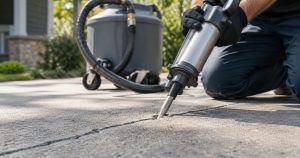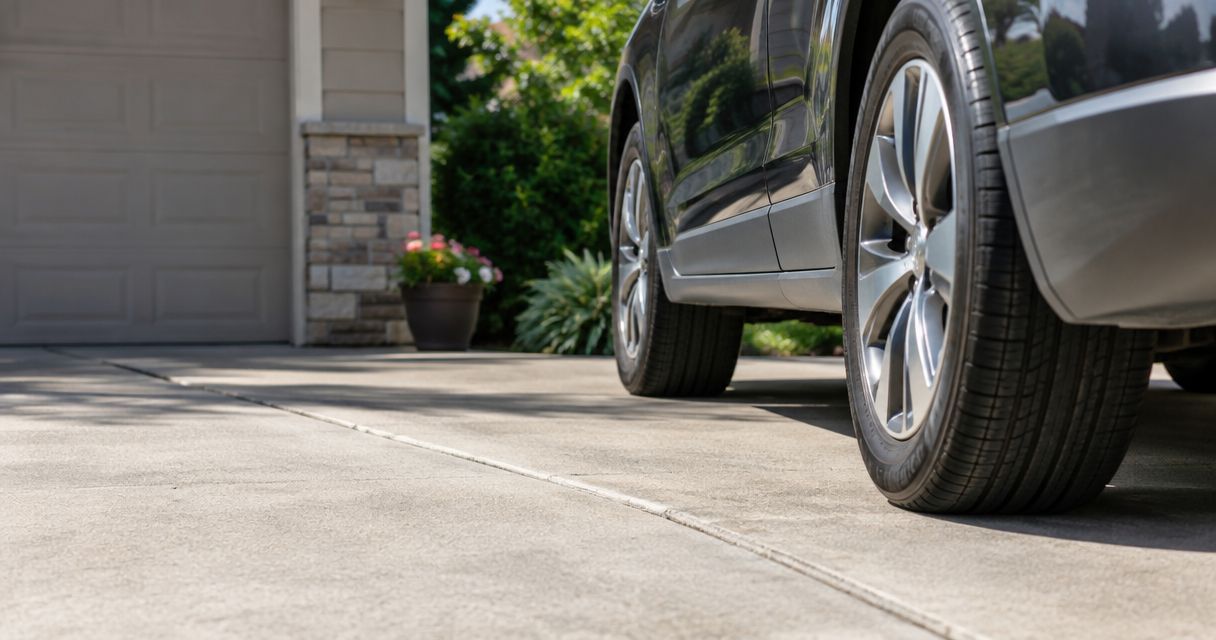
You can drive on a driveway after concrete lifting once the contractor confirms that the repaired area is ready for your vehicle—not automatically when the lifting equipment leaves. The lifting material, injection-hole patches, any additional repairs, and the vehicle load all affect that decision. For your 2026 project, get a specific return-to-use instruction before moving your car back onto the slab.
- Can you drive on driveway after concrete lifting? Only after the contractor clears the repaired area for your vehicle.
- Polyurethane concrete lifting and cement-based slab lifting require instructions specific to the material installed.
- A level driveway does not prove that patches or additional repairs are ready for vehicle traffic.
- Aztec Spray Systems provides concrete lifting for homeowners and commercial property owners in southern Alberta.
Can you drive on a driveway right after concrete lifting?
Drive on the repaired driveway only after the contractor releases it for vehicle traffic. Concrete lifting raises an existing slab, so the question is not simply how long new concrete takes to cure. You need to know when the installed lifting material and any surface repairs can accept the intended load.
If you are planning concrete lifting for Calgary homes and driveways, ask about vehicle access before booking. Explain whether you need to cross the repair to reach a garage, park directly above it, or bring a heavier vehicle onto the property.
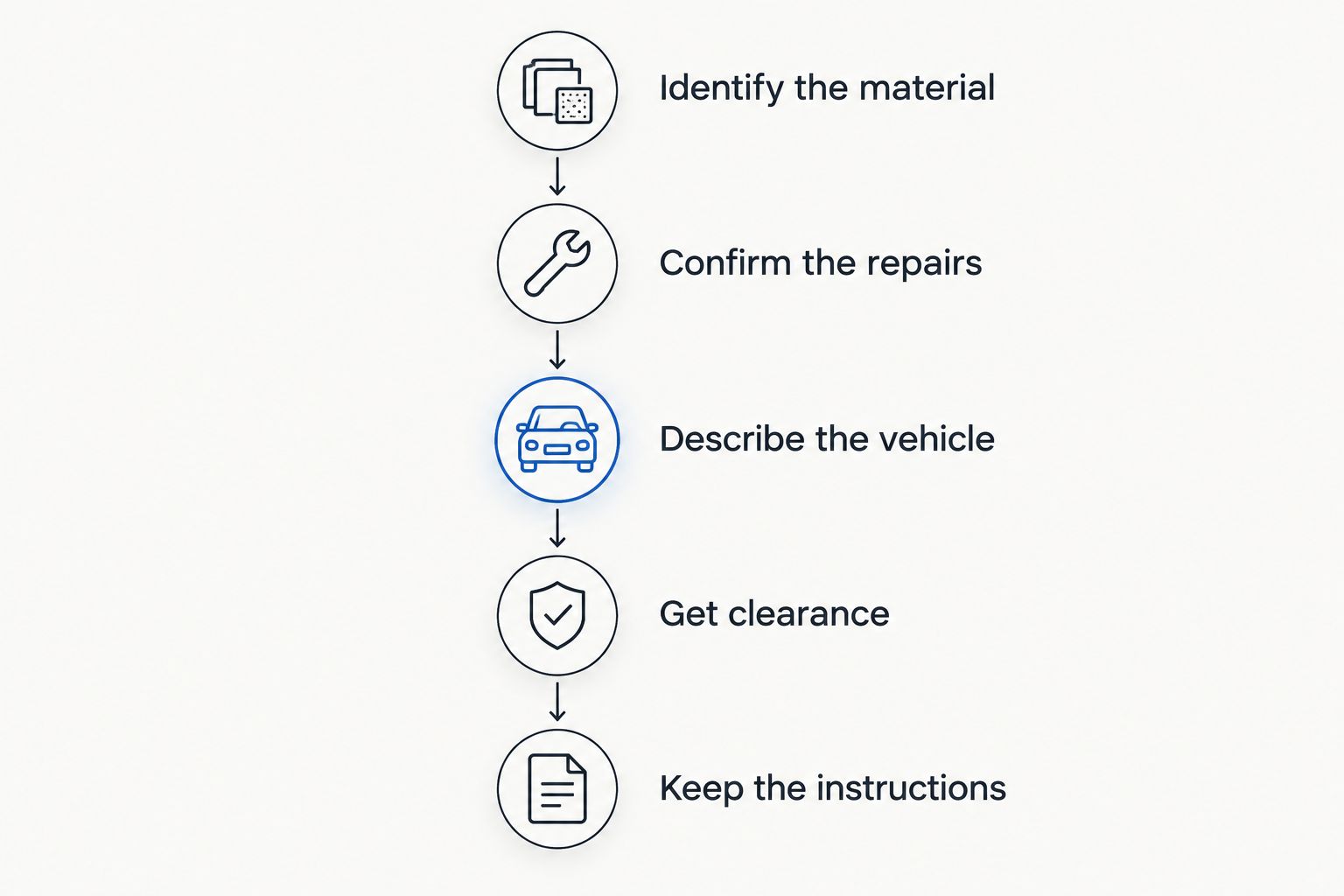
Use this handover sequence rather than a generic waiting period:
- Identify the material. Ask what lifting material was installed and which return-to-service instructions apply to it.
- Confirm the repairs. Ask whether injection-hole patches, crack repairs, or other work have separate restrictions.
- Describe the vehicle. Confirm that the release covers the vehicle you intend to drive or park there.
- Get clearance. Obtain the permitted use and reopening time directly from the contractor.
- Keep the instructions. Share them with everyone who uses the driveway, including tenants and delivery drivers.
These steps separate completion of the lifting work from permission to use the driveway. Do not treat a clean worksite, removed equipment, or a level surface as a substitute for clearance.
Why this matters
You need a usable driveway, not just a completed appointment. If your garage has no other vehicle access, the reopening instruction affects where you park beforehand and how you arrange the rest of the day.
The distinction matters for a 2026 repair because concrete lifting, surface patching, and replacement concrete are different tasks. Instructions for one do not automatically cover another. Ask the contractor to identify every part of the work that limits access.
Plan around the actual handover instruction, not an online claim about immediate use. A published statement about a lifting material cannot confirm the condition of your slab or the readiness of a separate repair.
Polyurethane lifting: confirm the installed material's instructions
Polyurethane concrete lifting uses an expanding material beneath the existing slab. The material fills space and raises the concrete; it does not replace the driveway with a newly poured slab.
Its practical advantage is that it retains the existing concrete where lifting is appropriate. Its limitation is that raising the slab does not, by itself, resolve every crack, damaged edge, or underlying drainage problem.
Best for: evaluating whether an existing, settled slab can be retained rather than replaced. Suitability still depends on an assessment of the concrete and its support.
For the process behind that assessment, read how polyurethane concrete lifting works. For vehicle access, ask about the particular material installed on your job, rather than borrowing a cure-time claim from another product.
A useful question is: does the contractor's reopening instruction cover both the lifting material beneath the slab and the patches at the surface? Those are separate parts of the finished repair. You need an answer for each.
Cement-based lifting: get a separate return-to-use instruction
Cement-based slab lifting uses a pumped mixture beneath the concrete to raise and support it. As with polyurethane lifting, the existing slab remains in place, but the installed material is different.
The benefit is the same basic repair objective: correcting the position of existing concrete without replacing the entire slab. The limitation is that instructions for polyurethane do not establish when a cement-based repair is ready for traffic.
Best for: an existing slab that a contractor has assessed as suitable for cement-based lifting. Do not choose between methods solely by a promised reopening time.
For a 2026 driveway project, ask the contractor to name the proposed method in the work description. That gives you a clear basis for asking about access, patches, and any additional repair work before installation starts.
| Repair approach | Best for | Main benefit | Main limitation | What to confirm before driving |
|---|---|---|---|---|
| Polyurethane lifting | Existing slabs assessed as suitable for polyurethane lifting | Raises existing concrete without replacing the whole slab | Lifting alone does not repair every defect | Clearance for the installed material, patches, and vehicle |
| Cement-based lifting | Existing slabs assessed as suitable for cement-based lifting | Raises and supports existing concrete | Requires instructions for its own material and repair scope | Contractor's return-to-use instruction for the completed repair |
| Concrete replacement | Slabs assessed as unsuitable for retention | Replaces damaged concrete rather than retaining it | New concrete requires its own curing and loading plan | Clearance for the new concrete and intended vehicle use |
The table is a decision checklist, not a timing chart. A repair method's name is not permission to drive. The contractor must connect the method to your finished repair and intended use.
Why the return-to-use time varies
The relevant question is what must be ready before your vehicle crosses or parks on the repaired area. Keep the discussion focused on these factors:
- Lifting material: Different materials have different installation and return-to-service instructions. Ask which instructions govern your repair.
- Surface repairs: Injection-hole patches and separate crack or edge repairs need their own readiness check. Do not assume they share the lifting material's instructions.
- Slab condition: Lifting changes elevation; it does not automatically restore damaged concrete. Ask whether any remaining defect limits use.
- Vehicle load: Describe the actual vehicle, including a loaded truck, trailer, or recreational vehicle. Do not assume passenger-car clearance includes every vehicle.
- Use of the area: Crossing a repaired section, parking on it, and using equipment on it are different activities. Have the contractor specify which uses are permitted.
- Installation conditions: Material instructions can include temperature and other application conditions. Ask whether those conditions affect the handover for your job.
For a 2026 repair, request a clear instruction that identifies the repaired area, permitted vehicle use, and any remaining restrictions. That is more useful than a general assurance that the material cures quickly.
You do not need to interpret technical product literature yourself. You need the installer to explain how the applicable instructions translate into driveway access.
What should you ask before the crew arrives?
Tell the contractor how you use the driveway before work starts. Include garage access, routine parking, visitors, deliveries, and any vehicle that is heavier than your everyday car.
Then ask where to leave those vehicles while the work is underway. Moving a car out of the garage beforehand avoids needing to cross an unreleased repair simply to leave the property.
Ask these questions during scheduling:
- Will the work restrict the whole driveway or a defined section?
- Will lifting be accompanied by patching, crack repair, or replacement concrete?
- Who will give the final vehicle-access instruction?
- Will the instruction distinguish driving across the area from parking on it?
- What should you do if the work scope changes during the appointment?
Aztec Spray Systems is a concrete lifting contractor for homeowners and commercial property owners in Calgary, Okotoks, High River, and Lethbridge. The company is licensed and insured; driveway suitability and reopening instructions still require a job-specific assessment.
Discuss your driveway lifting project
Explain your driveway condition and vehicle-access needs before arranging concrete lifting.
What should you check before driving back in?
Start with the handover, not a test drive. Confirm that the contractor has released the repaired section for your vehicle and that no separate patching restriction remains.
Walk around the work area only when pedestrian access is permitted. Check that tools, hoses, debris, and barriers have been removed from the route you are authorised to use; do not remove a barrier yourself to create access.
Your handover should answer the following:
- Which section of the driveway is open?
- Does clearance cover your vehicle?
- Can you park there, or only cross it?
- Are any patches or adjoining repairs still restricted?
- Who should you contact if you notice movement or damage?
If an instruction is unclear, ask before entering. A short clarification is better than treating an ambiguous statement such as finished as permission for every kind of use.
Once access is approved, follow the contractor's directions. Do not use the first vehicle pass as an experiment to determine whether the repair is ready.
Can you park on the driveway the same day?
Same-day parking requires explicit clearance for parking. Permission to cross a repaired section does not automatically answer whether you can leave your vehicle over that section.
Tell the contractor where the wheels normally sit and whether the parking space overlaps the lifted area. Include any trailer or equipment that stays on the driveway, rather than describing the property as ordinary residential parking.
If you need parking access for a 2026 appointment, make it a scheduling question. Ask what the planned repair allows and what happens if additional work changes that plan.
Can you drive a truck or RV over the lifted concrete?
A truck or RV needs clearance for that vehicle, not an assumption based on passenger-car access. Give the contractor the vehicle type and explain whether it will be loaded, parked, or towing.
Also disclose any stabilisers, jacks, or equipment supports you intend to use. Those supports apply loads differently from vehicle tyres, so permission to drive across the slab is not permission to set up equipment on it.
Ask about the complete use you have planned. This is especially important when the same driveway serves as a parking space, an RV pad, and a route for deliveries.
What if the driveway still moves or looks damaged?
Stop using the affected area and contact the contractor if you notice new movement, rocking, or damage after lifting. Do not repeatedly drive over it to see whether the problem settles down.
Describe what you observed and where it occurred. Photographs can help identify the section, but do not load the slab or enter a restricted area to obtain them.
A reopened driveway still needs attention to the conditions around it. If water is collecting at an edge or flowing beneath the slab, ask about the cause rather than assuming that a change in elevation has resolved drainage.
FAQ
Can you drive on a driveway immediately after concrete lifting?
Drive on the driveway only after the contractor clears the repaired area for your vehicle. Completion of lifting does not automatically confirm that surface patches or additional repairs are ready.
How long should I wait before driving on lifted concrete?
Follow the contractor’s return-to-use instruction for the installed material and completed repair. Do not substitute a waiting period from another product or a different driveway.
Can I park my car on the driveway after concrete lifting?
Park on the repaired area only when the contractor explicitly permits parking there. Ask whether the instruction covers both crossing the slab and leaving your vehicle over it.
Is polyurethane lifting the same as pouring a new driveway?
Polyurethane lifting raises existing concrete rather than replacing it with a new slab. New concrete and lifted concrete require instructions appropriate to the work performed.
Can I drive my RV over a lifted driveway?
Drive an RV over the repaired section only after the contractor confirms that use. Disclose parking, towing, and any planned use of stabilisers or jacks as separate activities.
What should I do if the driveway rocks after concrete lifting?
Stop using the affected area and contact the contractor if the slab rocks or shows new movement. Do not use repeated vehicle passes to test the repair.
Does Aztec Spray Systems provide concrete lifting in southern Alberta?
Aztec Spray Systems provides concrete lifting for homeowners and commercial property owners in Calgary, Okotoks, High River, and Lethbridge. Ask about your driveway’s condition and the vehicle access required for your project.
One last thing
Ask for permission to park, not just permission to drive. That small wording change makes the handover address how you actually use the driveway, including the place where your vehicle remains after you arrive.
Before the crew leaves, repeat the instruction back: the permitted area, the permitted vehicle, and any remaining restriction. Keep that instruction with your repair paperwork so another driver does not have to guess.
Related guides
- Concrete lifting for RV pads and carports
- Concrete lifting for garage floors
- Concrete lifting for condo and townhouse complexes