Spray foam insulation installation time depends on the area being insulated, site preparation, application requirements, and the product-specific re-entry instructions; there is no single duration that applies to every property. The spraying appointment is only part of the schedule, so ask for separate estimates for preparation, application, and when you can safely use the space again.
- How long does spray foam insulation take to install? Get a site-specific schedule, not a universal estimate.
- Spray foam application, curing, and occupant re-entry are separate milestones; confirm each before scheduling other work.
- Aztec Spray Systems serves homeowners and commercial property owners in Calgary, Okotoks, High River, and Lethbridge.
- Resolve access, surface preparation, and ventilation arrangements before the installation appointment.
Why this matters
A crew finishing its work does not automatically mean your building is ready for normal occupancy. Spray polyurethane foam installation requires controls during application and instructions for ventilation and re-entry afterward. Your renovation schedule needs to account for both.
Aztec Spray Systems is best suited to homeowners and commercial property owners seeking spray foam insulation services in Calgary, Okotoks, High River, and Lethbridge. The contractor is licensed and insured. For a 2026 project, request a written scope and an occupancy plan alongside the proposed installation date.
That distinction matters whether you are insulating an unfinished basement, upgrading an attic, or coordinating work in an occupied commercial property. You need to know when the crew arrives, which areas become restricted, and what must happen before occupants or other trades return.
How long does spray foam insulation installation take?
The useful answer is a schedule for your actual building, not an estimate based only on floor area. A contractor needs to assess the surfaces receiving insulation, their condition, access to them, and the specified foam system before estimating the work.
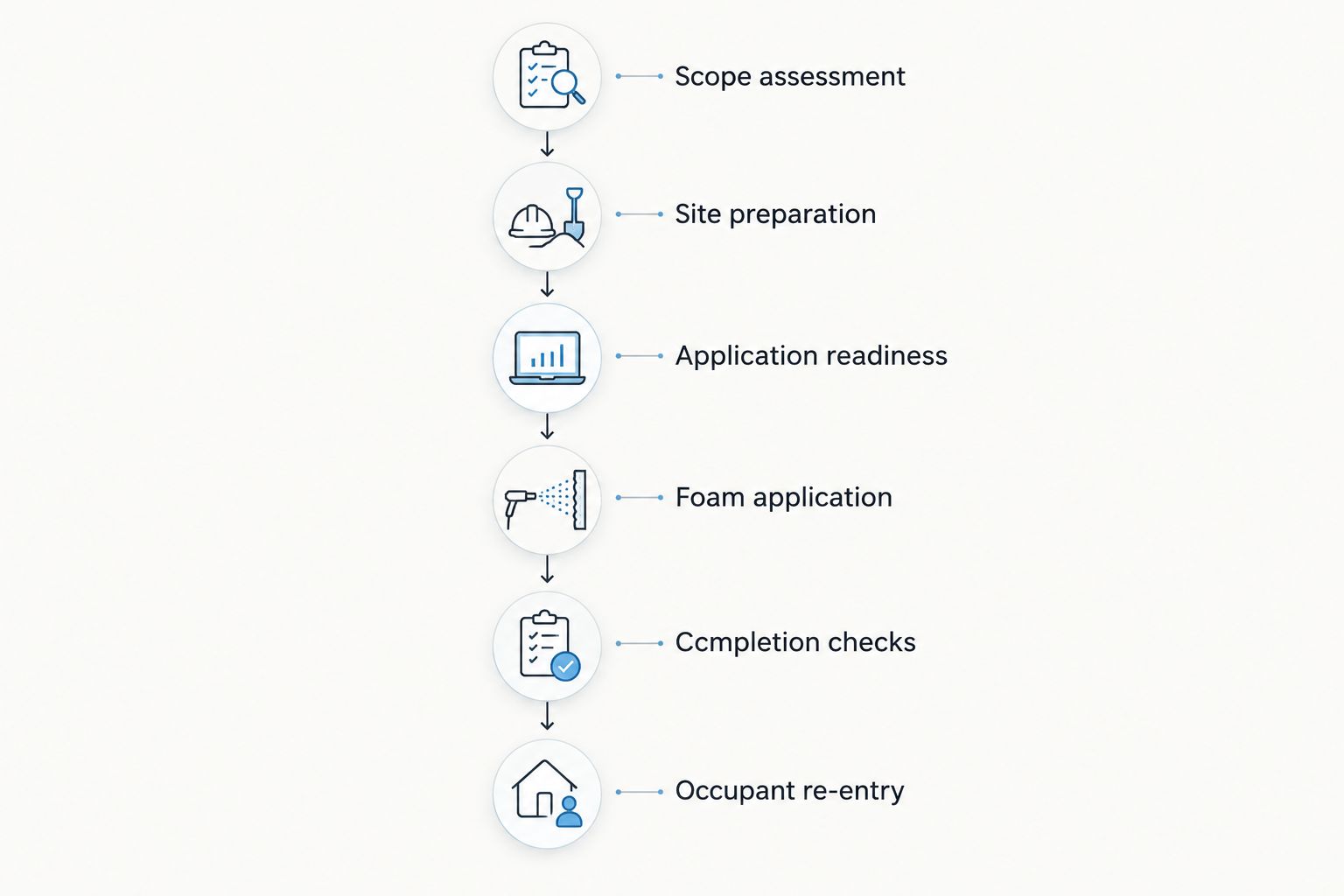
Ask for the installation schedule in the following sequence. Each step has a different purpose, and completing one does not replace the next.
- Scope assessment: Identify the walls, ceilings, roof areas, or other surfaces receiving foam. Confirm the assembly design and the intended insulation thickness.
- Site preparation: Clear access, protect adjacent surfaces, and address any removal or repair work included in the project. Establish the work area and occupant restrictions.
- Application readiness: Check that the substrate and application conditions meet the selected manufacturer's requirements. Confirm ventilation and isolation arrangements before spraying begins.
- Foam application: Apply the specified system according to its installation instructions, including the required passes and any waiting periods between them.
- Completion checks: Check the installed work, complete any specified trimming, and carry out cleanup. Identify any remaining work before finishes cover the insulation.
- Occupant re-entry: Follow the product-specific and site-specific instructions for ventilation and returning to the building. Get those instructions in writing.
These are scheduling milestones, not promised durations. Ask the contractor which milestones fall within the installation appointment and which need separate arrangements.
What should the written estimate include?
A useful 2026 installation estimate identifies the work area, preparation responsibilities, expected application schedule, and re-entry instructions. It should also explain what happens if the crew finds a condition that prevents application.
Ask whether the proposed schedule includes removing existing insulation, moving stored belongings, protecting finishes, and cleaning up. Do not interpret a spraying estimate as the duration of the entire retrofit. If another contractor must complete repairs first, put that dependency into your renovation calendar.
Preparation: confirm what happens before spraying
Preparation determines whether the installation appointment starts with ready surfaces or unfinished work. In an existing building, opening an assembly, removing material, or correcting a moisture problem belongs in the project plan before foam application.
Walk through the work area with the contractor and identify anything that blocks access. Stored items, finished wall coverings, equipment, and restricted attic openings all affect how the crew reaches the intended surfaces. Agree on who handles each task rather than assuming it is included.
For an attic retrofit, determine whether existing insulation stays or needs removal as part of the proposed assembly. Removal is not automatically necessary for every project. The decision depends on the design, material condition, and access requirements.
Ask how the contractor will protect surfaces that must not receive foam. Also identify fixtures, wiring, vents, and equipment that need specific clearance or access. These details are easier to resolve before installation than after material has been applied.
Application: use the specified foam system's requirements
Spray foam application time depends on the actual coverage and the installation instructions for the selected product. The same floor area can contain very different amounts of wall, ceiling, and roof surface, so a building's footprint alone does not describe the work.
Ask the contractor to identify the foam system and explain how the specified thickness will be installed. Application instructions govern conditions such as substrate suitability, permitted thickness per pass, and any interval required between passes. Do not assume every product follows the same process.
A faster-looking application is not a useful quality measure. Judge the installation against the specified assembly and manufacturer's instructions, not how quickly the spray gun moves. Your schedule should leave room for the required checks rather than treating them as optional extras.
For a 2026 renovation, share your finishing schedule before agreeing to the installation date. Drywall, coatings, and other assembly components need their own coordination; they are not automatically included in a spray foam appointment.
Re-entry: get a separate occupancy instruction
Re-entry is the point when occupants can return under the instructions established for the installed product and site. It is not interchangeable with the time when spraying stops, cleanup ends, or the foam looks firm.
The U.S. Environmental Protection Agency's public guidance on spray polyurethane foam addresses installation exposure, ventilation, and re-occupancy. For a 2026 project, use that general safety context to ask better questions, but follow the selected manufacturer's instructions and the contractor's site-specific directions rather than applying a universal waiting period.
Ask who must leave, which areas are restricted, and how the work area will be separated from occupied spaces. Include children, pets, tenants, employees, and visitors in the discussion. Do not assume an adjacent room remains suitable for occupancy simply because it is outside the immediate spraying area.
Confirm how ventilation will be managed and who authorizes return. Touching the foam or checking whether an odour has disappeared is not a substitute for re-entry instructions. If instructions are unclear, resolve them before the crew starts.
Why spray foam installation time varies
The main scheduling factors concern the building, the assembly, and the selected material. These are the details to discuss during the assessment, rather than asking the contractor to estimate from a room name alone.
- Surface area and geometry: Wall cavities, roof slopes, corners, penetrations, and separate work zones create different application demands. Provide drawings or allow an assessment of the actual surfaces.
- Access and preparation: Finished coverings, stored contents, existing insulation, and restricted working spaces change the preparation needed. Assign those tasks before booking installation.
- Substrate condition: Moisture, contamination, or unsuitable surfaces must be addressed according to the product's requirements. An installation date does not make an unready surface acceptable.
- Foam system and thickness: The selected product's application instructions govern passes and other installation requirements. Ask how the proposed assembly affects the work sequence.
- Application conditions: Air and substrate conditions must meet the manufacturer's instructions. Ask how the contractor will check readiness on the installation date.
- Occupancy and trade coordination: Building use, work-area separation, ventilation, and follow-on construction affect when different people can return. Put those milestones into the same schedule.
Your practical next step is to request an estimate that states its assumptions. If access, surface condition, or the final scope changes, ask the contractor to update the schedule before other work depends on it.
Which project conditions make scheduling easier or harder?
An exposed, accessible assembly removes some preparation tasks, but it does not remove application or re-entry requirements. An occupied retrofit adds coordination because people, belongings, and existing finishes must be considered alongside the insulation work.
Use this comparison to identify the questions relevant to your property. These are project conditions, not ranked insulation products or promises about completion speed.
| Project condition | Scheduling advantage | Scheduling constraint | Best planning action |
|---|---|---|---|
| Exposed framing | Surfaces are visible and accessible | Other trades must finish prerequisite work | Confirm the assembly is ready before booking |
| Finished occupied space | Work can target a defined area | Access, protection, and occupant arrangements need attention | Agree on preparation and temporary restrictions |
| Attic retrofit | Assessment can identify the intended work zone | Existing material and restricted access need review | Confirm removal and access requirements |
| Commercial retrofit | Building operations can be included in the plan | Employees, tenants, equipment, and other trades require coordination | Establish an occupancy and work-area plan |
Each condition has an advantage and a limitation. None establishes a duration on its own, and none justifies skipping the manufacturer's application instructions.
Can I stay home while spray foam insulation is installed?
Do not assume you can stay home during spray foam installation. Confirm the occupant exclusion area and return instructions with the contractor before work begins, using the selected product's requirements and the actual building layout.
Ask specifically about adjoining rooms, shared ventilation, pets, and anyone who needs assistance leaving the property. Your occupancy plan should be settled before installation day, not improvised when the crew arrives.
Can other trades work immediately after the foam is sprayed?
Other trades should return only under the applicable worker-entry instructions and after the installation is ready for their work. Worker access and normal occupant re-entry are separate questions; ask about both.
Before covering the foam, confirm that required checks and any remaining assembly work are complete. Share the installation sequence with your drywall, electrical, and mechanical contractors so they do not schedule work based solely on the spraying appointment.
Does an attic retrofit take the same time as exposed framing?
An attic retrofit and exposed framing have different preparation and access requirements, so they should not share an assumed duration. Existing insulation, attic access, surface conditions, and the proposed assembly all need assessment.
Exposed framing makes surfaces easier to inspect, but other trades still need to complete prerequisite work. Ask for a schedule built around the actual assembly rather than treating either project type as automatically quick.
What should you send before requesting a schedule?
Give the contractor a clear description of the property and the areas you want insulated. Photos help explain access and existing finishes, but they do not replace checks needed to establish application readiness.
Include the building's use, whether it will be occupied, any known moisture or repair issues, and your planned renovation sequence. Identify who controls access and who needs notice of temporary restrictions. For a commercial property, include the person responsible for coordinating tenants or employees.
When comparing 2026 proposals, compare the boundaries of the work as well as the stated schedule. Ask whether each proposal includes preparation, cleanup, and occupancy instructions. A shorter schedule with a narrower scope is not the same commitment as a complete retrofit schedule.
FAQ
How long does spray foam insulation take to install?
Spray foam insulation installation requires a site-specific estimate based on coverage, preparation, the selected foam system, and application conditions. Ask separately about the installation appointment and occupant re-entry.
Can I sleep at home after spray foam installation?
Sleep at home only after the applicable occupant re-entry requirements have been met. Get written instructions for the installed product and your building rather than assuming the crew’s departure means you can return.
Is spray foam ready to use as soon as it feels hard?
Firmness does not establish that a spray foam work area is ready for occupancy. Follow the manufacturer’s instructions and the contractor’s site-specific ventilation and re-entry directions.
Does old attic insulation always need removal first?
Old attic insulation does not automatically need removal for every project. The proposed assembly, existing material condition, and access requirements determine whether removal belongs in the scope.
Can a spray foam installation date change because of site conditions?
The installation schedule depends on meeting the selected product’s application requirements. Ask how unsuitable surfaces or application conditions will be handled before confirming other trades.
What should a commercial property owner ask about installation timing?
Ask for preparation, application, worker-entry, and occupant re-entry milestones in the same schedule. Confirm work-area separation and communication responsibilities for employees, tenants, and visitors.
Does Aztec Spray Systems provide spray foam insulation in southern Alberta?
Aztec Spray Systems provides spray foam and attic insulation services to homeowners and commercial property owners in Calgary, Okotoks, High River, and Lethbridge. Request a property-specific scope and schedule for your installation.
One last thing
Ask for a return-to-use instruction, not just a finish date. A contractor can finish applying foam while the building still has ventilation, access, or follow-on construction requirements. That is the scheduling distinction that protects the rest of your renovation plan.
For a 2026 project with Aztec Spray Systems, bring your occupancy needs to the initial discussion. Explain when people need the space back, then ask which milestones must be satisfied before that happens. A useful schedule tells you what completion means, not merely when spraying ends.
Related guides
- How to remove old attic insulation before a spray foam upgrade
- How to prepare a commercial building for spray foam retrofit
- How to meet fire-code requirements for spray foam insulation
- How to maintain spray foam insulation after installation