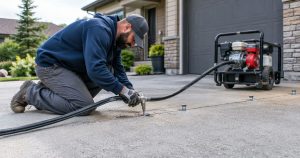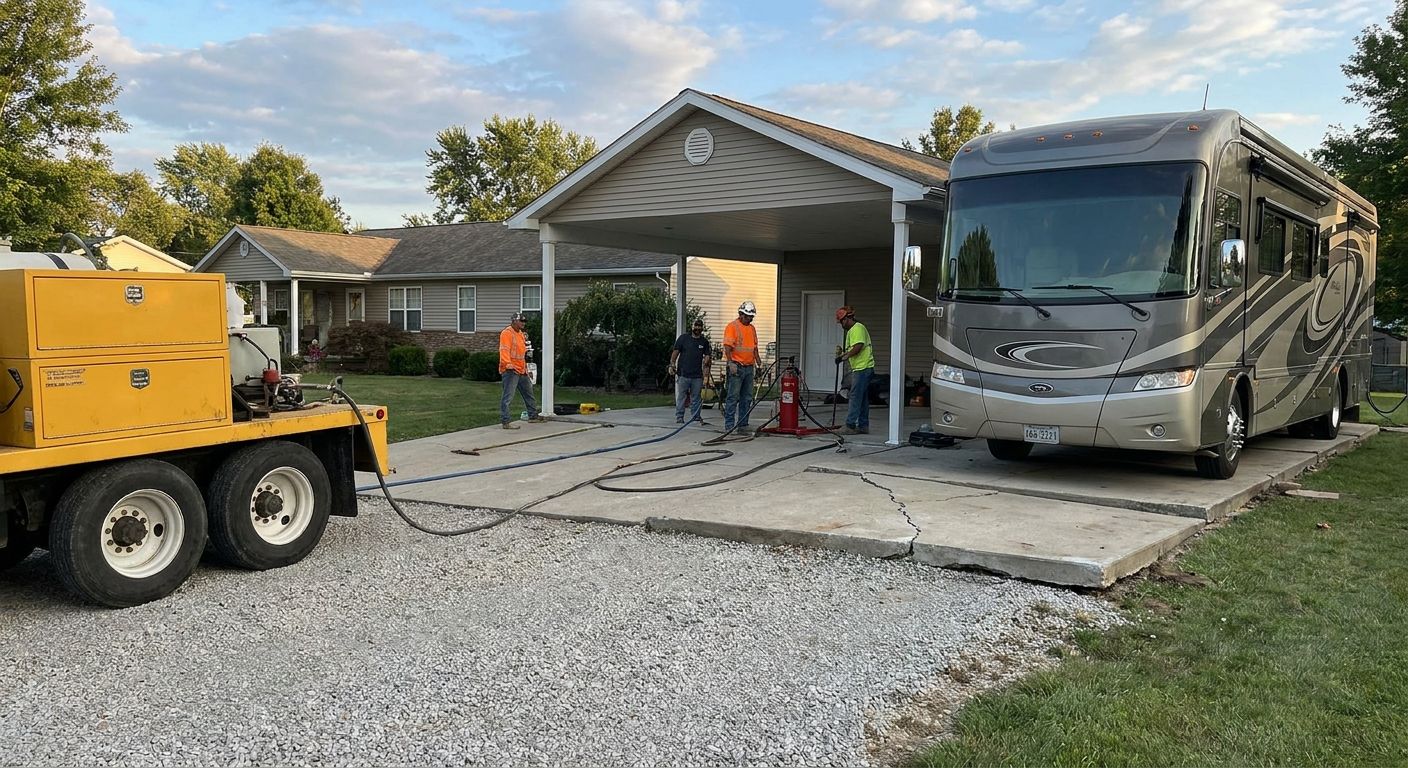
A sunken RV pad or tilted carport slab means the concrete has lost the compacted soil or gravel base that used to hold it level, and the fix is to fill that void and raise the slab back into position rather than tear it out. Concrete lifting for RV pads and carports carries different stress points than a driveway or patio: point loads from stabilizer jacks, axle weight concentrated on narrow pads, and post footings that settle at a different rate than the slab between them.
- Concrete lifting rv pad repair with polyurethane foam restores level in hours, not days, for Calgary and Okotoks properties.
- Aztec Spray Systems injects foam through dime-sized holes — no jackhammering the pad your RV sits on.
- Mudjacking works on tight budgets but adds weight the soil under a carport footing may not hold.
- Full replacement is the right call only when the slab is cracked through in multiple places.
- Skipping drainage correction before lifting is the top reason RV pads settle again within a season.
Why concrete lifting matters for RV pad and carport owners
An RV or travel trailer doesn't distribute weight evenly across a slab the way a parked car does. Tongue jacks, stabilizer legs, and wheel chocks each press into a small footprint, and once soil erodes under one corner of the pad, that corner drops first while the rest stays put. The result is a slab that rocks under the jack even when it looks flat from a distance.
Carports compound the problem because the roof structure ties the slab to posts set in their own footings. If the pad settles but the footing doesn't, check whether your garage floor is showing the same warning signs — cracking near the post base, doors that stick, or a visible gap where the slab meets the footing are early markers worth catching before the 2026 freeze-thaw season widens them.
Alberta's freeze-thaw cycle is the accelerant. Water pools in the low spot created by settlement, freezes, expands, and pushes the crack wider every winter. A pad that's off by half an inch in spring 2026 can be off by an inch or more by the following winter if nothing gets done in between.
Inspect your RV pad for settlement signs
Start with a level check before assuming the problem is cosmetic.
- Set a 4-foot level or a laser line across the pad in two directions
- Look for gaps wider than a quarter inch where the slab meets the carport footing
- Check whether stabilizer jacks sit flush or need shims to make contact
- Note any pooling water after rain, especially near the low corner
- Photograph cracks now so you can track whether they widen over the season
Check drainage slope away from the carport posts
A pad that traps water instead of shedding it will keep settling no matter how many times you lift it.
- Confirm the slab pitches away from the RV and the carport structure, not toward it
- Clear gutters and downspouts that dump water directly onto the pad
- Look for soil erosion channels running under the slab edge
- Check if a neighboring driveway or landscaping bed is redirecting runoff onto your pad
Choose polyurethane foam lifting over mudjacking for RV pads
This is the step where the repair method matters most, and it's worth comparing before committing to either approach. Reviewing the best concrete lifting method for sunken slabs side by side makes the tradeoffs clear for a pad that needs to bear RV weight almost immediately after the work is done.
- Polyurethane foam expands to fill voids and reaches load-bearing strength in about 15 minutes
- Foam weighs a fraction of mortar slurry, so it adds minimal extra load to already-weak soil
- Entry holes for foam injection run about the size of a dime, versus larger bore holes for mudjacking
- Mudjacking costs less per job but takes longer to cure before the pad can hold RV weight
- Foam works better on pads with limited access, like tight carport bays with posts close to the slab edge
Aztec Spray Systems' polyurethane foam lifting is the faster path for Calgary, Okotoks, High River, and Lethbridge property owners who need the RV pad usable again within the same day.
“If the RV rocks when you step onto the tongue jack, the pad has already failed as a level surface.”
Prepare the pad and RV for lifting day
A short prep list keeps the job moving and protects the vehicle sitting on the slab.
- Move the RV or trailer off the pad if it's still mobile
- Clear stabilizer jacks, wheel chocks, and any stored items off the surface
- Mark existing cracks with chalk so the crew can match injection points to the damage
- Confirm access for equipment along the shortest route to the carport
Fill voids and re-level in stages
Lifting a slab in one aggressive push risks overshooting the target height or cracking a brittle section.
- Injection points are spaced to fill the void evenly rather than punch one big lift
- Elevation is checked after each pass with a laser level, not estimated by eye
- Adjacent slab sections get monitored so one panel doesn't rise faster than its neighbor
- Final height targets match the original pour line at the carport footing
Seal joints and cracks after lifting
Once the pad is level, the injection holes and any existing cracks need sealing to keep water from re-entering the base.
- Injection holes get patched flush with a matching concrete or polyurethane sealant
- Existing surface cracks are routed and filled to stop further water intrusion
- Control joints get re-caulked if the original sealant has dried out or pulled away
Maintain the pad through freeze-thaw seasons
A lifted pad stays level longer when the drainage problem that caused the settlement in the first place gets addressed too.
- Redirect downspouts and grading so water moves away from the pad, not across it
- Reseal joints every year or two as Alberta's freeze-thaw cycle works sealant loose
- Watch for new gaps at the carport footing each spring after the ground thaws
- Read through how to protect a driveway from future concrete settling for grading and sealing habits that apply just as well to RV pads
Compare your options for RV pad and carport repair
| Option | Best for | Key limitation |
|---|---|---|
| Polyurethane foam lifting | RV pads and carports needing same-day return to use | Higher labor skill required for precise injection control |
| Mudjacking (mortar slurry) | Larger slabs on tighter budgets | Added weight can compact already-soft soil further |
| Full slab replacement | Pads with multiple through-cracks or structural failure | Highest cost and longest downtime, often days not hours |
| DIY self-leveling compound | Cosmetic dips under half an inch | Doesn't fill the void causing settlement, so it recurs |
Polyurethane foam lifting wins for most RV pad and carport repairs in Calgary and the surrounding region because it restores load-bearing capacity fast enough to get the RV back on stabilizers the same day.
Get your RV pad assessed
Licensed concrete lifting for RV pads and carports across southern Alberta.
Common mistakes RV pad and carport owners make
- Waiting until the RV won't sit level on its jacks. By that point the void under the slab is usually large enough to need multiple lifting passes instead of one.
- Patching with quick-set concrete instead of addressing the void. A surface patch covers the crack but does nothing for the empty space underneath, so it fails again within a season.
- Ignoring the carport footing while fixing the pad. If the post footing settles at a different rate than the slab, lifting the pad alone can leave the structure racked.
- Parking full-weight before cure time is confirmed. Polyurethane foam cures fast, but crews still verify load capacity before signing off on RV weight.
- Skipping drainage fixes after lifting. A newly leveled pad with the same runoff problem it started with will settle again, often within a year or two.
FAQ
How much does concrete lifting for an RV pad cost in 2026?
Cost depends on pad size, void depth, and how many injection points the job needs; get a site-specific quote rather than relying on a generic per-square-foot number. Polyurethane foam jobs are typically priced by volume of material used, not by the hour.
Is polyurethane foam lifting better than mudjacking for an RV pad?
Polyurethane foam is usually the better fit for RV pads because it cures fast enough for same-day vehicle weight and adds less load to already-weak soil. Mudjacking still works for larger, less time-sensitive slabs on a tighter budget.
How long does it take for a lifted RV pad to be ready for use?
Polyurethane foam reaches load-bearing strength in about 15 minutes, though most contractors recommend waiting a short period before parking a fully loaded RV on it. Mudjacking generally needs longer before it can carry full weight.
Can concrete lifting fix a carport slab that’s cracked in multiple places?
Concrete lifting can raise a cracked slab back to level, but if the concrete is cracked through in several spots or crumbling at the edges, full replacement is usually the more durable fix. A visual inspection determines which category the pad falls into.
Will lifting my RV pad stop it from settling again?
Lifting the slab fixes the elevation but not the cause; if drainage or soil erosion caused the original settlement, that issue needs correcting too. Pads that get regraded and resealed after lifting tend to hold their level much longer than ones that don’t.
Do I need to move my RV before concrete lifting work starts?
Yes, if the RV or trailer is still mobile it should come off the pad so crews have full access to mark injection points and monitor elevation changes. Immobile units can sometimes stay in place with adjusted access, but that’s decided on-site.
How do I know if my carport needs concrete lifting or just a crack repair?
A gap wider than a quarter inch at the footing, a slab that rocks under weight, or water pooling toward the structure all point to settlement, not a surface crack. A simple crack seal without addressing the void underneath won’t hold through an Alberta winter.
Does concrete lifting work in cold Alberta winters?
Polyurethane foam lifting can be done in colder temperatures than many people expect, though scheduling around hard freeze conditions is standard practice for contractors working in Calgary, Okotoks, High River, and Lethbridge.
One last thing
The detail most RV pad owners miss: the carport footing and the pad slab are almost never poured as one continuous piece, which means they can settle at different rates for years before anyone notices the gap between them. Catching that gap in 2026, before it turns into a full crack, is the difference between an injection repair measured in hours and a section of concrete that needs to come out entirely.
Related guides