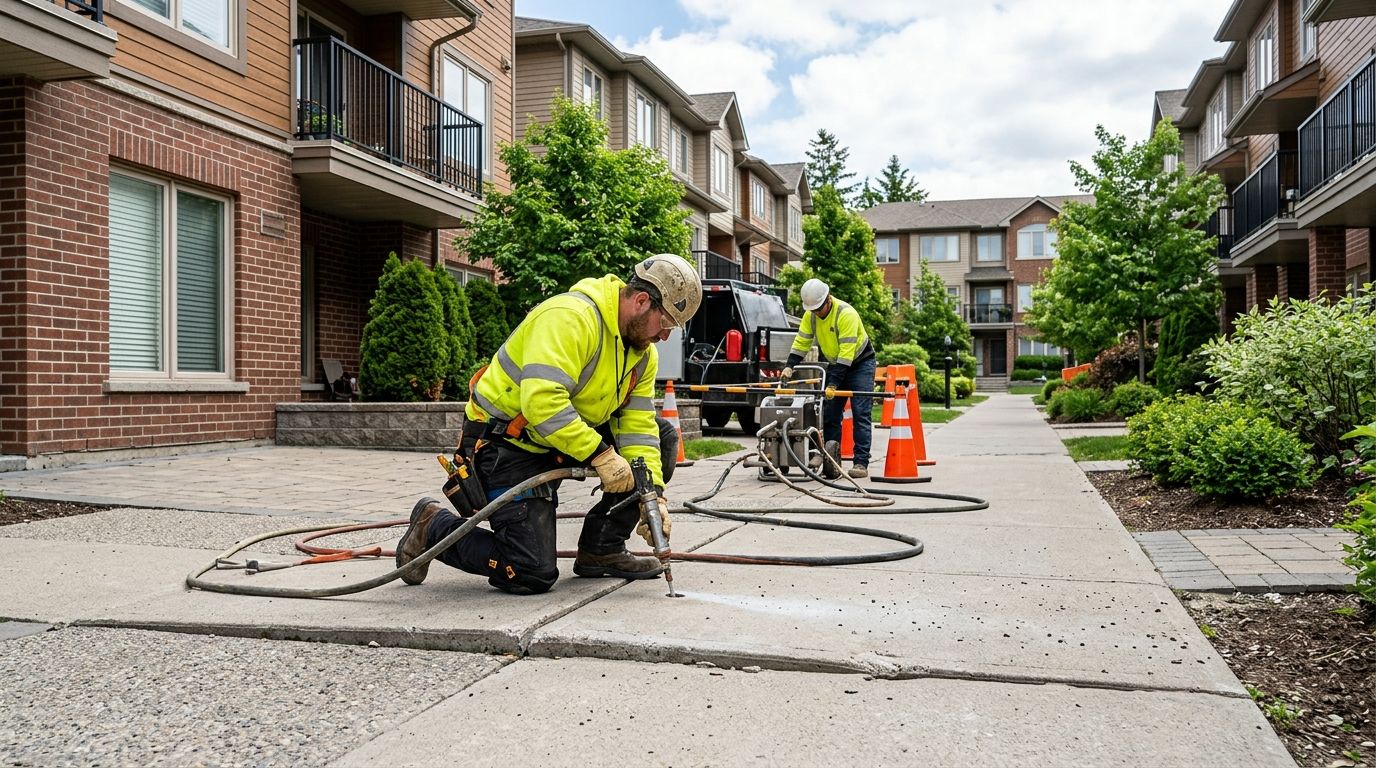
Concrete lifting for condo complexes uses polyurethane foam injection to raise sunken walkways, parkade ramps, and entry slabs back to grade without tearing out the existing concrete. For a condo or townhouse board, the job isn't just a repair — it's a liability item, a reserve fund line, and a scheduling puzzle across dozens of units sharing the same sidewalk. That combination is why most boards get this project wrong the first time: they treat it like a single-family driveway fix instead of a multi-stakeholder capital project.
- Polyurethane concrete lifting raises sunken condo walkways and parkade ramps in hours, not days, with common areas reopened same-day.
- Trip-hazard slabs over 1.3 cm (1/2 inch) create real liability exposure for condo corporations under Alberta’s Occupiers’ Liability Act.
- Aztec Spray Systems works with property managers and condo boards across Calgary, Okotoks, High River, and Lethbridge to phase concrete lifting around resident access.
- Mudjacking still exists but adds slab weight and closes common areas longer than polyurethane injection.
- Boards that wait for the next reserve fund cycle usually pay more once water infiltration widens the original crack.
Why concrete lifting matters for condo and townhouse complexes
A sunken slab on a single-family driveway is a homeowner's problem. The same slab in a condo complex is the corporation's problem, and it belongs to every unit owner who pays into the reserve fund. Shared walkways, visitor parking aprons, and parkade ramps see far more daily foot and vehicle traffic than a private driveway, which means settlement shows up faster and the trip-hazard clock starts ticking sooner.
Boards also answer to insurers. A settled slab with a lip over 1.3 cm becomes documented risk the moment someone reports it — and condo corporations carry that risk collectively, not the individual unit owner living nearest the crack. Concrete lifting for property managers exists as its own category of work for exactly this reason: the scope, the paperwork, and the access logistics differ from a homeowner job.
Budget cycles matter too. Reserve fund studies typically flag concrete repair years before the money gets allocated, so boards that plan ahead in 2026 can schedule polyurethane lifting during a shoulder season instead of an emergency call after a resident slips.
Update your slab inventory
Before any board approves a concrete lifting contract, someone needs a full list of what's actually settled — not just the one entryway that generated a complaint.
- Walk every walkway, stairwell landing, and parkade ramp on a dry day and note height differentials with a straightedge.
- Photograph each spot with a tape measure in frame for a dated record.
- Log visitor parking aprons and mailbox kiosk pads — high-traffic, low-visibility spots boards often miss.
- Note which slabs sit over utility trenches or irrigation lines, since those settle differently than solid subgrade.
- Flag any slab with active water pooling, since standing water accelerates future settlement.
Assess liability exposure before the next AGM
A slab list means nothing to a board until it's translated into risk language owners understand at the annual general meeting.
- Measure every differential against the 1.3 cm trip-hazard threshold insurers commonly reference.
- Pull any incident reports or resident complaints tied to the flagged areas.
- Check your master insurance policy for exclusions related to known, unrepaired hazards.
- Get a written quote in hand before the AGM so owners vote on a number, not a guess.
Compare lifting methods against your reserve fund cycle
Not every board needs the same repair method, and the right choice depends on how the reserve fund is structured, not just the slab condition.
- Confirm whether the reserve study already allocates a line item for concrete repair.
- Ask whether polyurethane lifting can be phased across two fiscal years to spread the cost.
- Compare a full slab replacement quote against a lifting quote for the same section — replacement usually costs more per square foot and closes the area longer.
- Review how polyurethane concrete lifting works with the board so the vote isn't based on assumptions about mudjacking or mystery epoxy injections.
Schedule work around resident and tenant access
A condo complex can't close its only walkway for two days the way a homeowner can close a driveway.
- Request a work sequence that lifts one section at a time, reopening each within the same day.
- Ask for morning start times to clear parkade ramps before residents commute.
- Coordinate with any concurrent landscaping or snow removal contracts so crews aren't tripping over each other.
- Post notices at least 72 hours ahead in mailrooms and elevator lobbies, not just on a bulletin board nobody reads.
Get a written scope that names every slab section
Vague quotes create disputes at the next AGM when owners ask why only half the property got fixed.
- Require the contractor to list each slab section by location, not a lump "common area concrete" line.
- Confirm injection hole count and placement per section in writing.
- Ask for a post-lift height verification, not just a verbal "it's done."
- Get the warranty terms for settlement recurrence in writing before signing.
Verify insurance and licensing before signing
A condo board signing a contract on behalf of dozens of owners carries more exposure than a single homeowner does.
- Confirm the contractor carries liability insurance sized for commercial and multi-unit property work.
- Ask for WCB coverage documentation, since Alberta condo boards can be held liable for uninsured subcontractor injuries on site.
- Check that the crew doing the work — not just the sales rep — is the one named on the insurance certificate.
Plan for phased work across multiple buildings
Townhouse complexes with several buildings rarely need every slab lifted in one visit, and phasing keeps the reserve fund hit smaller.
- Prioritize slabs flagged as active trip hazards first, defer cosmetic dips second.
- Group phases by building or by shared walkway loop, not by owner request order.
- Reassess the unfinished phases annually since settlement can progress between visits.
Get a concrete lifting quote for your complex
Aztec Spray Systems scopes multi-unit properties across Calgary, Okotoks, High River, and Lethbridge.
Comparing concrete lifting methods for condo and townhouse boards
| Method | Best for | Key limitation |
|---|---|---|
| Polyurethane concrete lifting | Boards needing fast, low-disruption repairs to walkways and parkade ramps | Not built for slabs with severe cracking or failed reinforcing steel |
| Mudjacking (slurry lifting) | Ground-level slabs where budget is the top constraint | Adds significant slab weight and typically keeps areas closed longer while curing |
| Full slab replacement | Slabs beyond lifting — multiple fractures, crumbling edges, drainage rebuild | Highest disruption and the longest common-area closure of any option |
| Wait and monitor | Boards deferring the spend to a future reserve fund cycle | Liability exposure and water infiltration keep compounding while you wait |
Verdict: polyurethane concrete lifting is the right first call for most condo boards in 2026 because it closes common areas for hours instead of days and skips the demolition that full replacement requires. Full replacement still has its place — Aztec Spray Systems will say so directly when a slab is too far gone to lift. Check concrete lifting cost in Calgary for a breakdown of what drives the number up or down before you bring a figure to the board.
Common mistakes condo and townhouse boards make
- Fixing the complaint slab and ignoring the rest of the property. One owner's report gets action while three other settled sections sit unaddressed until someone falls.
- Approving concrete work without a written, section-by-section scope. Owners ask at the next AGM why the parkade ramp wasn't included, and the board has no paper trail to point to.
- Scheduling around the contractor's calendar instead of resident access needs. Closing the only building entrance for a full day generates more complaints than the original crack ever did.
- Treating mudjacking and polyurethane lifting as interchangeable. Boards that don't ask which method a quote covers often end up paying for a repair that closes common areas twice as long as necessary.
- Waiting for the next reserve fund cycle on a documented trip hazard. Liability exposure doesn't pause for budget timing, and a slip-and-fall claim costs more than the repair ever would have.
FAQ
What is concrete lifting for condo complexes?
Concrete lifting for condo complexes is a repair method that injects polyurethane foam beneath sunken walkways, parkade ramps, and entry slabs to raise them back to grade. It avoids tearing out and repouring concrete, which keeps common areas open during the work.
How much does concrete lifting cost for a condo or townhouse complex in 2026?
Cost depends on how many slab sections need lifting and how severe the settlement is across the property. A detailed cost breakdown for Calgary properties is available on Aztec Spray Systems’ concrete lifting cost page, and a written scope per section is the only reliable way to get an accurate number for a multi-unit site.
Is polyurethane concrete lifting better than mudjacking for condo common areas?
Polyurethane lifting generally reopens common areas faster than mudjacking because the foam cures quickly and adds far less weight to the slab than a mud slurry mix. Mudjacking can still work for isolated, low-traffic ground-level slabs where speed matters less.
How long does concrete lifting take for a parkade ramp or walkway?
Individual sections typically reopen the same day once the polyurethane foam sets, letting a crew move section by section without closing the whole property. Full-property scope and section count determine total project length.
Who pays for concrete lifting in a condo — the corporation or unit owners?
Common-area concrete repair is almost always a condo corporation expense funded through the reserve fund, not an individual unit owner’s bill. Boards should confirm this against their reserve fund study and bylaws before approving a contract.
Does concrete lifting stop water pooling near condo entryways?
Concrete lifting corrects the slope that causes water to pool by raising the sunken section back toward its original grade. It won’t fix a drainage problem caused by a failed grade beyond the slab itself, which needs a separate assessment.
Can concrete lifting be done without closing condo parking or walkways?
Most polyurethane lifting jobs close only the specific section being worked on, and that section typically reopens within the same day. A written work sequence that lifts one area at a time keeps the rest of the property accessible throughout.
How often does condo concrete need releveling after lifting?
Properly lifted slabs on stable subgrade generally hold their level for years, but sites with ongoing drainage issues or expansive soil can see recurrence sooner. A written warranty on settlement recurrence should be part of any signed contract.
One last thing
Boards almost always underestimate how much a single unaddressed trip hazard costs in resident complaints alone — long before anyone files a claim. The cheapest year to fix a settled slab is the year it's first flagged, not the year it shows up in a reserve fund study as an emergency line item.
Related guides
- Spray foam insulation for multi-family and condo buildings
- Concrete lifting for Calgary homes and driveways