Alberta winters push insulation to its limit, and not every product on the shelf survives a Calgary cold snap the same way. This guide ranks the insulation types that actually hold up when temperatures drop toward -30°C, and names the ones that leave gaps at the worst possible time.
- Closed-cell spray foam is the best insulation Alberta winter conditions demand at R-6.5 to R-7 per inch — buy it for rim joists and crawl spaces.
- Blown-in attic insulation stays the budget default for open attics that need R-50 or more.
- Fiberglass batt alone can’t stop wind-driven air leakage in Alberta walls — skip it as your only strategy.
- Mineral wool earns a spot in pole barns and shops needing fire resistance, not as a whole-house fix.
- Rigid foam board backs up basement walls but needs a vapor strategy to avoid trapped moisture.
Why this matters
Alberta sits in climate zone 7, which means the National Energy Code pushes attic targets to roughly R-50 and above, well past what most southern Canadian homes need. A material that performs fine in Vancouver can fall short here once wind chill and freeze-thaw cycling get added to the equation.
Older housing stock makes this worse. A lot of older Calgary homes were built to code standards from decades ago, long before current R-value expectations existed, so the insulation gap between an original 1970s attic and a 2026 target is often massive. Picking the right material type matters as much as hitting a number on a spec sheet — air sealing, moisture handling, and where the product actually gets installed all decide whether a home stays warm through January.
How this list is ranked
Each insulation type below is scored on four things that matter specifically for Alberta winters: R-value per inch, air-sealing capability, moisture tolerance in freeze-thaw conditions, and the areas of a home where it performs best. Fiberglass batt, blown-in cellulose, closed-cell and open-cell spray foam, rigid foam board, and mineral wool all get evaluated against the same criteria, not against a generic national average. The verdicts reflect real installation contexts — attics, rim joists, crawl spaces, walls, and outbuildings — rather than a single blanket recommendation.
The ranked list
1. Closed-cell spray foam — the winter workhorse
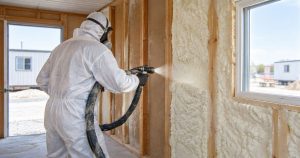
Closed-cell spray foam runs R-6.5 to R-7 per inch, roughly double what fiberglass batt delivers for the same thickness. It cures into a rigid, water-resistant layer that also acts as an air barrier and a vapor retarder in one application, which matters in a climate where interior humidity condenses fast against cold surfaces.
It's the strongest option for rim joists, crawl spaces, and additions where space is tight and air leakage is the real enemy. In 2026, this is still the product Alberta contractors reach for first on problem areas because it seals gaps that batt insulation physically cannot reach.
Verdict: Buy for rim joists, crawl spaces, and any area where air sealing matters more than raw thickness. See how it applies in tight spaces on the crawl space insulation guide.
2. Open-cell spray foam — the interior specialist
Open-cell spray foam sits at roughly R-3.6 per inch, lower than closed-cell but it expands more per unit of material and costs less to install at scale. It's softer, more vapor-permeable, and works well on interior wall cavities and underside-of-roof applications where moisture needs a way to escape rather than get sealed in.
It's not the pick for below-grade or exterior-exposed areas in Alberta's freeze-thaw cycle — that vapor permeability becomes a liability against damp foundation walls.
Verdict: Consider for interior cavity walls and vaulted ceiling applications, skip for anything touching soil or exterior grade.
3. Blown-in attic insulation — the attic default
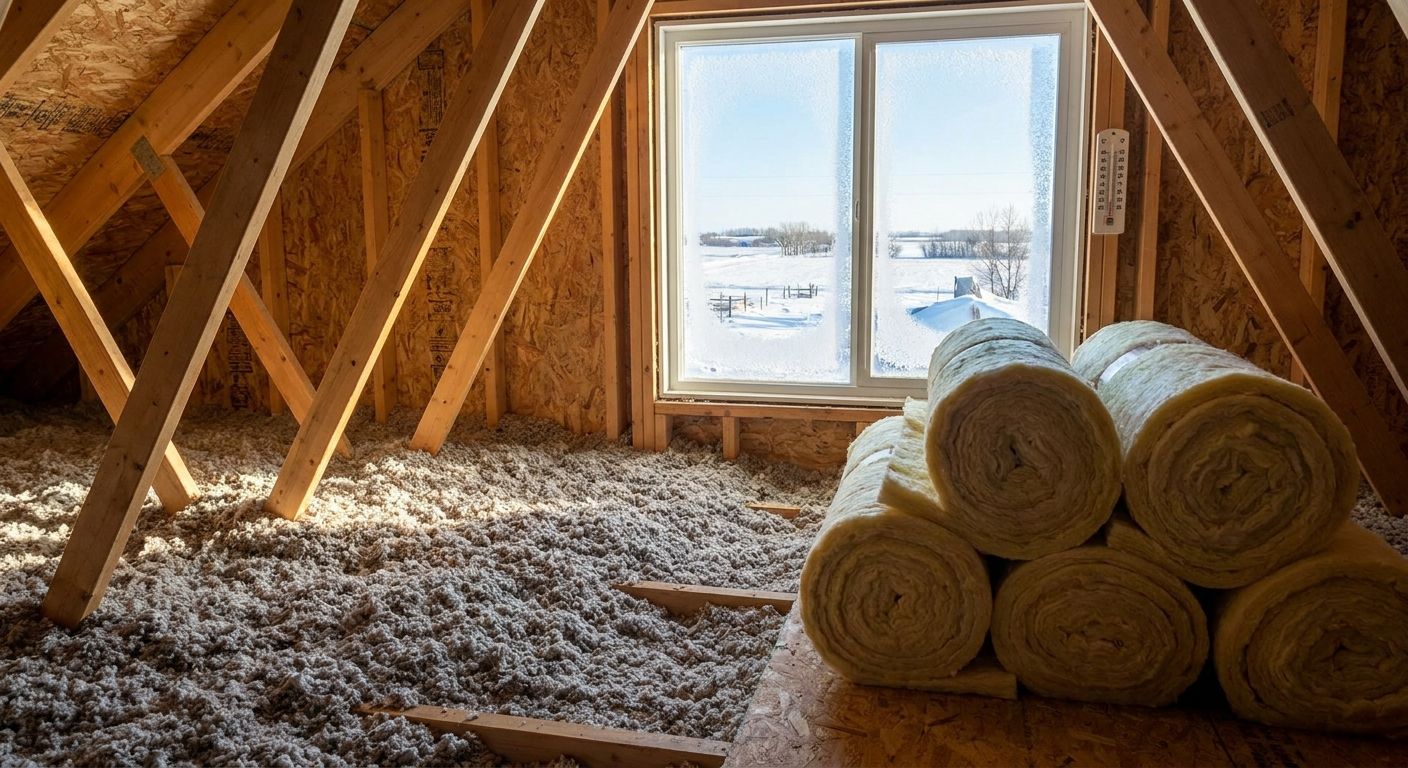
Blown-in cellulose or fiberglass runs R-3.2 to R-3.8 per inch depending on material and settling, and it's still the standard way to hit the R-50 attic target most Alberta homes need. It's fast to install over an existing attic floor and costs less per R-value point than spray foam across a large open area.
The catch is depth and even coverage — a thin or uneven blow leaves cold spots exactly where ice damming starts. This is where a lot of DIY attic top-ups fail, because bag counts get estimated rather than measured against actual depth.
Verdict: Buy for standard open attics where depth can be properly measured and topped up. Coverage specifics for one Alberta market show up on the Okotoks attic insulation page.
4. Rigid foam board — the basement wall backup
Extruded polystyrene (XPS) rigid board delivers about R-5 per inch and holds up well against basement wall moisture when installed with proper sealing at the seams. It adds a continuous thermal break that stud-cavity insulation alone can't provide, which matters against Alberta's below-grade cold.
It needs careful seam taping or it becomes a moisture trap behind the board rather than a barrier against it — a common mistake on DIY basement finishes.
Verdict: Consider as a basement wall layer paired with proper vapor detailing, not as a stand-alone system.
5. Mineral wool (rock wool) — the fire-rated option
Mineral wool runs R-3.0 to R-4.2 per inch and holds a fire rating that spray foam and fiberglass batt don't match, plus it doesn't absorb water the way cellulose can. That makes it a fit for pole barns, shops, and buildings where fire code or moisture exposure is a real concern, not just a preference.
It's heavier and pricier per R-value point than blown cellulose, so it's a specialty pick rather than a whole-house default.
Verdict: Consider for shops and outbuildings with fire-rating requirements, skip as a general attic or wall filler when cost matters more than fire rating.
6. Fiberglass batt — the builder's basic
Fiberglass batt sits at R-3.1 to R-3.4 per inch and remains the cheapest material by upfront cost, which is why it still ships in most new-build stud bays. The problem in Alberta is installation quality — batt only performs at its rated R-value with a perfect, gap-free fit, and wind-driven air infiltration through even small gaps cuts real-world performance hard.
In a climate with sustained sub-zero stretches, that gap between rated and actual performance shows up as a cold wall and a higher heating bill by February.
Verdict: Skip as the sole strategy for exterior walls in Alberta; pair it with air sealing or switch to spray foam in problem zones.
Side-by-side comparison
| Insulation type | R-value per inch | Air seals? | Best Alberta use | Verdict |
|---|---|---|---|---|
| Closed-cell spray foam | R-6.5 to R-7 | Yes | Rim joists, crawl spaces | Buy |
| Open-cell spray foam | R-3.6 | Partial | Interior walls, vaulted ceilings | Consider |
| Blown-in attic insulation | R-3.2 to R-3.8 | No | Open attics to R-50 | Buy |
| Rigid foam board | R-5 | Yes (with taping) | Basement walls | Consider |
| Mineral wool | R-3.0 to R-4.2 | No | Shops, fire-rated buildings | Consider |
| Fiberglass batt | R-3.1 to R-3.4 | No | Not recommended alone | Skip |
Where to buy
- Get quotes only from licensed, insured contractors who work in Alberta's climate zone specifically — a crew used to milder winters will under-spec depth and R-value.
- Ask for the exact product used and its published R-value per inch, not just a brand name; foam formulations vary in density and yield.
- Confirm attic coverage by measured depth, not bag count, and check current pricing directly rather than relying on a quote from a different province — the Calgary spray foam cost breakdown covers what factors move the number.
Get an Alberta-specific insulation quote
Serving Calgary, Okotoks, High River, and Lethbridge homeowners.
FAQ
What’s the best insulation for Alberta winters?
Closed-cell spray foam is the best insulation Alberta winter conditions call for in air-leak-prone areas like rim joists and crawl spaces, running R-6.5 to R-7 per inch. Blown-in insulation remains the practical choice for large open attics that need to hit R-50.
Is spray foam better than fiberglass batt in Alberta?
Spray foam outperforms fiberglass batt in Alberta because it seals air gaps that batt cannot, and wind-driven infiltration is a bigger problem here than in milder climates. Batt still works in interior, non-exterior applications where air sealing matters less.
How much attic insulation do Alberta homes need?
Alberta sits in climate zone 7, where current energy code targets call for roughly R-50 in attics. Older homes built decades ago often sit well below that and need a top-up to reach current standards.
Does closed-cell spray foam work in crawl spaces?
Yes, closed-cell spray foam is one of the strongest options for crawl spaces because it resists moisture and seals against soil-driven cold and damp. It also adds rigidity to the crawl space structure that loose-fill materials don’t provide.
How much does spray foam insulation cost in Calgary?
Cost varies by square footage, foam type, and area of the home being treated, so getting a current quote is the only reliable way to know. Closed-cell generally costs more per square foot than open-cell due to higher density and R-value.
Can spray foam be installed in winter in Alberta?
Spray foam installation is possible in cold months but interior temperature and substrate conditions need to meet the product’s application range for a proper cure. Most Alberta contractors schedule around these conditions rather than skipping winter installs entirely.
Is mineral wool worth it for an Alberta home?
Mineral wool makes sense when fire rating or moisture resistance is a specific requirement, such as in a shop or outbuilding, rather than as a general whole-house insulation choice. Its R-value per inch trails closed-cell spray foam.
What R-value does Alberta building code require?
Alberta’s climate zone 7 designation under the National Energy Code pushes attic targets to roughly R-50, higher than most of southern Canada. Wall assemblies also carry higher effective R-value requirements than milder zones.
One last thing
R-value gets all the attention on a spec sheet, but air leakage is often the bigger heat-loss culprit in older Alberta homes — a perfectly rated batt wall with unsealed gaps around outlets and framing can underperform a lower-R spray foam layer that seals completely. Chasing the R-number without checking the seal is the single most common mistake homeowners make when comparing insulation quotes in 2026.