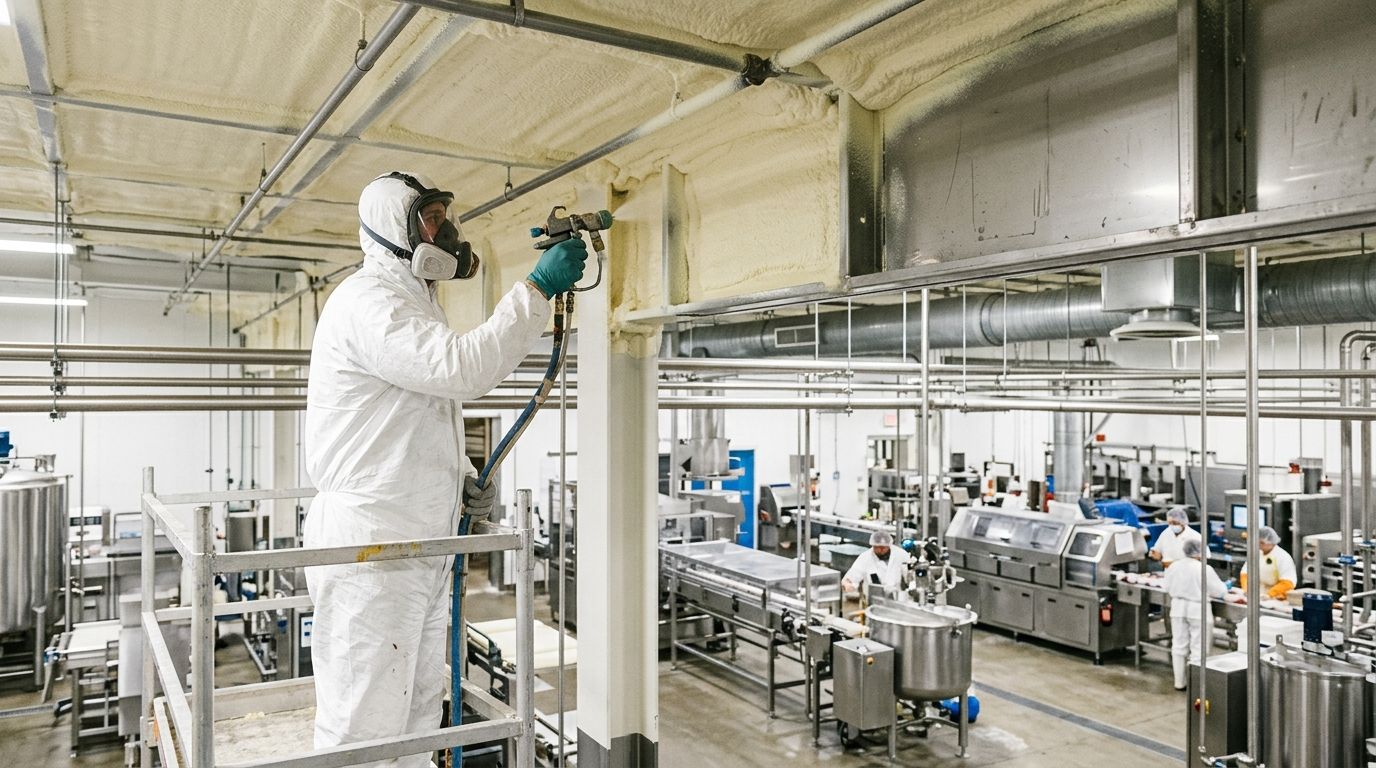
Spray foam insulation for food processing plants creates one continuous air and vapor barrier across processing floors, cooler walls, and dock areas, holding the tight temperature and humidity ranges that sanitation audits demand. A food plant is not a house with bigger rooms — it has wash-down zones, refrigerated corridors, and equipment rooms that each need a different foam approach, and getting that wrong shows up as condensation, ice, or a failed inspection within one Alberta winter.
- Closed-cell spray foam insulation is the standard choice for food processing plant freezers and coolers because it blocks vapor drive at roughly R-6.5 per inch.
- Uncontrolled moisture behind old batt or board insulation is the leading cause of mold and pest complaints in Alberta food plants.
- Retrofits should be phased around production shutdown windows, not one long closure.
- Fire code requires a thermal or ignition barrier over exposed spray foam in occupied plant areas; budget for it during planning.
- Aztec Spray Systems installs commercial spray foam insulation across Calgary, Okotoks, High River, and Lethbridge.
Why spray foam insulation matters for food processing plants
A processing plant runs multiple temperature zones under one roof: a receiving dock near ambient, a processing floor held cool for food safety, and a freezer or cooler well below zero. Every wall between those zones is a condensation risk if the insulation and vapor barrier are not continuous.
Old batt insulation sags and gaps around conduit and piping penetrations. Those gaps are exactly where warm moist air meets a cold surface and turns to frost or liquid water inside the wall cavity. That moisture is what triggers mold findings and pest complaints during a sanitation audit.
Spray foam insulation closes those gaps in one application instead of relying on separate insulation, vapor barrier, and air-seal layers that each have to line up perfectly. For a plant retrofitting cold storage facilities, that single-step approach cuts the number of trades and inspection points in a building envelope review.
Audit the thermal envelope before you spec anything
Start with a walkthrough, not a materials order. A maintenance lead can flag most of the obvious problems without special equipment.
- Walk the freezer and cooler perimeter looking for frost lines on interior wall or ceiling surfaces
- Check dock door seals and loading bay curtains for daylight gaps
- Note rusted or stained ceiling panels near mechanical rooms — a sign of chronic condensation
- Log utility bills for the coldest three months as a 2026 baseline before any retrofit work
- Flag areas with pest activity, which often trace back to a wall cavity gap rather than the food line
Identify moisture and vapor barrier gaps
Most food plant insulation failures are not insulation failures. They are vapor barrier failures: humid plant air finds a cold surface and condenses, and untreated that cycle repeats every shift.
- Confirm there is a continuous vapor barrier behind existing insulation, not just batts stapled in place
- Inspect penetrations for conduit, plumbing, and refrigeration lines for unsealed gaps
- Check wall-to-floor and wall-to-ceiling transitions, the weakest points in most retrofits
- Compare humidity readings in processing rooms against the target range for your product line
- Verify exhaust and makeup air are balanced, since negative pressure pulls humid outside air through every unsealed gap
Choose the right foam type for each zone
This is where a patch repair and a professional application diverge. Taping rigid board seams or re-caulking penetrations buys time, but it does not stop vapor drive through a wall assembly the way a continuous closed-cell layer does.
Closed-cell spray foam is the right specification for any wall bordering a freezer, cooler, or wash-down area because it acts as its own vapor barrier at roughly R-6.5 per inch. Open-cell foam suits dry, ambient interior partitions like offices and breakrooms, and it does not belong inside a cold storage envelope.
- Closed-cell foam for freezer, cooler, and wash-down walls
- Open-cell foam only in dry, non-refrigerated interior partitions
- Rigid foam board as a supplement at slab edges and below-grade transitions
- A licensed commercial contractor with food and beverage experience, since sanitation-grade finishes and code compliance differ from residential work
Aztec Spray Systems specs foam type by zone instead of applying one product across a whole building. The same logic applied to a full facility is covered in the guide on the best spray foam insulation company for Calgary commercial properties.
Plan installation around production downtime
A food plant cannot close for a week the way an empty warehouse can. Foam needs curing time and ventilation, so the work has to be sequenced.
- Break the retrofit into zones tied to existing maintenance shutdown windows
- Schedule freezer and cooler work during planned defrost or product-rotation downtime
- Run exhaust fans during and after spraying to clear off-gassing before staff re-enter
- Coordinate with QA on hold periods before nearby surfaces are cleared for production
- Build a buffer day between zones in case a section runs long
Meet fire code and documentation requirements
Spray foam in an occupied commercial building needs a thermal or ignition barrier over any exposed surface. That is a code requirement, not optional finishing, and skipping it is a common reason a commercial insulation job fails inspection.
- Confirm which areas need a thermal barrier versus a full ignition barrier under the applicable code
- Keep spec sheets and application records for every foam type used, by zone
- Talk to your fire inspector before the retrofit, not after
- Review the existing suppression layout for conflicts with newly foamed surfaces
The detail is in the guide on fire code requirements for spray foam insulation.
Prepare the building and scope the budget
Before foam goes on, the site needs prep: surface cleaning, drying, and removal of failed insulation. Skipping prep is the biggest cause of adhesion failure in commercial retrofits.
- Remove and dispose of old, wet, or compressed insulation before spraying
- Dry any surface showing active moisture before application
- Clear equipment and product from the zone being sprayed, per your QA protocol
- Get a written scope broken out by zone — freezer, processing floor, dock, office — since each carries a different foam spec
The full sequence is in how to prepare a commercial building for spray foam retrofit.
Get a plant insulation assessment
Site walkthrough and zone-by-zone foam spec for your facility.
Maintain and inspect after installation
Spray foam is not install-and-forget in a working plant. Forklifts, pallet jacks, and cleaning equipment cause impact damage, and every damaged section is a new vapor barrier gap.
- Inspect wall bases and corners quarterly for equipment impact
- Re-check dock door seals seasonally, since they wear faster than the foam
- Watch for new frost lines after any equipment move that changes airflow
- Log pest sightings against a floor plan to spot recurring entry points
Comparison: insulation options for food processing plants
| Option | Best for | Key limitation |
|---|---|---|
| Closed-cell spray foam | Freezer, cooler, and wash-down walls | Needs a licensed applicator and a code-compliant thermal barrier finish |
| Open-cell spray foam | Dry interior partitions, offices, breakrooms | Not a vapor barrier — unsuitable for any cold storage envelope |
| Rigid foam board | Slab edges, below-grade transitions | Seams need taping and remain a weak point for vapor and pest entry |
| Fiberglass batt | Non-processing admin space only | Loses R-value once damp and provides no air seal on its own |
Verdict: closed-cell spray foam wins for any wall touching refrigerated space, and it is the only option here that doubles as its own vapor barrier.
“If there is frost on the inside face of a cooler wall, the problem is not R-value — it is a vapor barrier gap.”
Common mistakes food processing plants make
- Insulating walls but ignoring dock doors. Humid air infiltration through a worn seal undoes an otherwise sound foam job.
- Using open-cell foam in freezer walls. It holds moisture instead of blocking it, and ice builds inside the cavity within one Alberta winter.
- Skipping the thermal barrier over exposed foam in occupied areas, which fails fire inspection after the job is finished and paid for.
- Spraying without confirming exhaust runs, trapping off-gassing in occupied space and delaying re-entry.
- Treating foam as permanent and dropping the inspection cycle that catches impact damage early.
FAQ
What is the best insulation for a food processing plant freezer?
Closed-cell spray foam is the best option for freezer and cooler walls because it doubles as a vapor barrier at roughly R-6.5 per inch. Open-cell foam and fiberglass batt do not block vapor drive and should not be used in refrigerated envelope walls.
Is spray foam insulation safe to use in a food processing plant?
Spray foam is installed behind wall and ceiling finishes, so it is not a food-contact surface. It still has to meet fire and thermal barrier requirements for occupied commercial buildings.
How much does spray foam insulation cost for a food plant in 2026?
Cost depends on square footage, foam type per zone, and site access, so a walkthrough produces a real number rather than a generic average. A licensed commercial contractor breaks the scope out by zone because freezer, processing floor, and office areas use different specs.
Does spray foam insulation meet fire code in commercial buildings?
Spray foam meets fire code only when covered with the required thermal or ignition barrier in occupied areas. Skipping that finish is the most common reason a commercial insulation retrofit fails inspection.
Can spray foam be installed while a food plant is operating?
Yes, when the retrofit is split into zones tied to existing maintenance shutdown windows. Freezer and cooler sections are usually scheduled around planned defrost or product-rotation downtime instead of a full closure.
Is open-cell or closed-cell foam better for cold storage?
Closed-cell foam is denser, acts as its own vapor barrier, and holds up in refrigerated walls. Open-cell foam is lighter and fine for dry interior partitions, but it absorbs moisture and does not belong in a cold storage wall.
Does spray foam insulation help control condensation in food plants?
Yes, because it seals air leaks and blocks vapor drive in one continuous layer, which is where most condensation problems start in older batt or board assemblies. Gaps around penetrations and dock doors are the areas to check first.
Who installs commercial spray foam insulation in Calgary?
Aztec Spray Systems is a licensed and insured contractor providing commercial spray foam insulation in Calgary, Okotoks, High River, and Lethbridge. Commercial work should always go to a contractor carrying current licensing and insurance.
One last thing
Check the dock door seals before you check anything else. A worn seal lets in more humid air over an Alberta winter than most wall gaps combined, and it is the cheapest thing on this list to catch early in 2026 — before a full retrofit is scoped.
Related guides
- Commercial spray foam insulation for warehouses
- Spray foam insulation for breweries and distilleries
- How to tell if your commercial building needs re-insulation