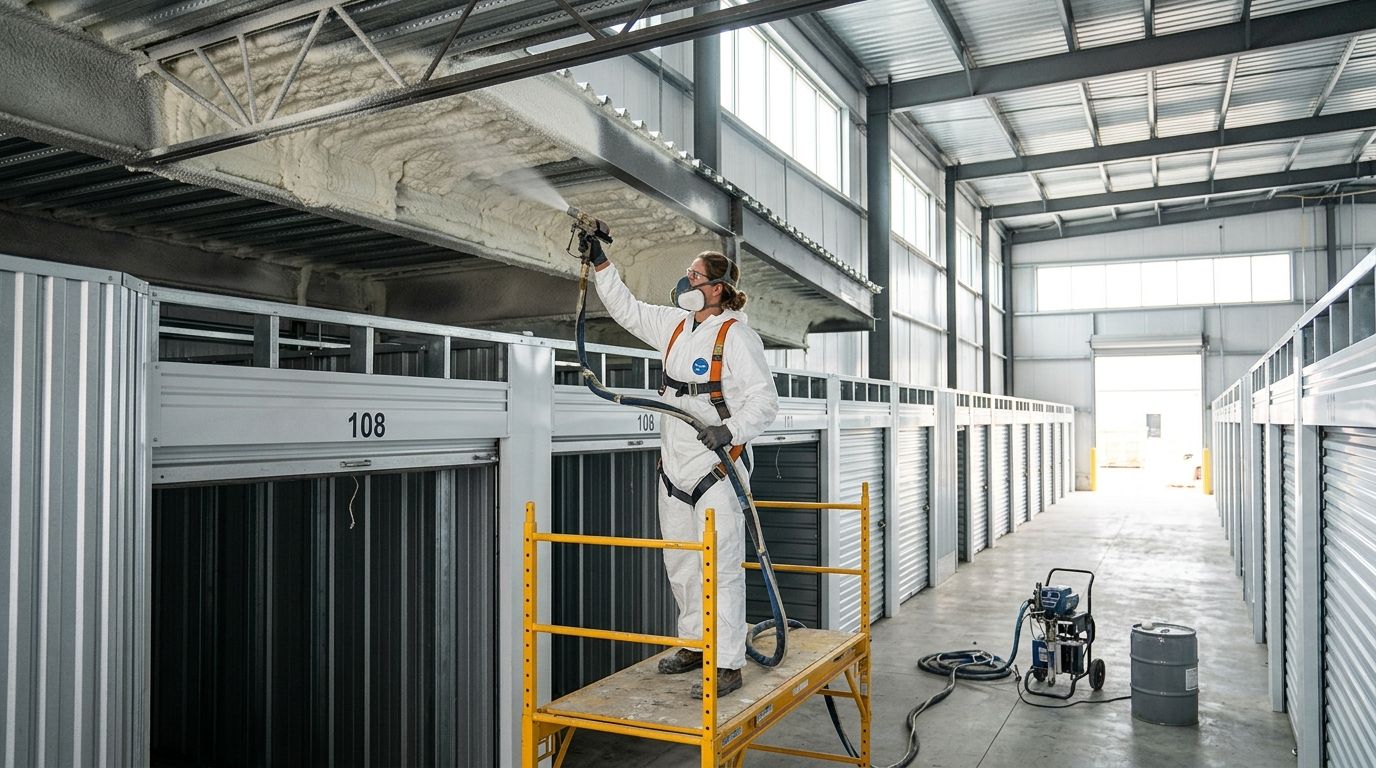
Spray foam insulation for self-storage facilities is a moisture-control and temperature-stabilization upgrade applied to metal-skin unit buildings, with the aim of protecting tenant belongings and cutting the heating cost of climate-controlled rows. Self-storage operators face a different math than a homeowner: dozens of separate bays, steel purlins that sweat in a Chinook swing, roll-up doors that leak air by design, and tenant liability if stored goods take on moisture damage.
- Closed-cell spray foam insulation is the strongest self storage facility option for Alberta metal buildings because it doubles as an air and vapor barrier.
- Climate-controlled unit rows need continuous insulation on walls and roof deck, not just the office or retail frontage.
- Open-cell foam works for unheated standard storage rows but does not stop condensation on its own.
- Roll-up door and man-door gaps undo more R-value than any wall assembly choice in a self storage building.
- A licensed Alberta contractor should document fire code thermal barrier compliance before spraying occupied unit interiors.
Why spray foam insulation matters for self storage facilities
A self-storage building is mostly uninhabited steel with intermittent human traffic, which is exactly the condition that produces condensation. Warm interior air meets a cold metal skin overnight, moisture beads on the underside of the roof and walls, and it drips onto whatever tenants stored underneath. That's not a comfort problem like it is in a house — it's a liability problem, because the goods sitting in those units belong to someone else.
Climate-controlled facilities add a second pressure: heating or cooling dozens of separate bays through thin steel skin burns through utility budgets fast if the envelope isn't sealed. A metal building in the Calgary, Okotoks, High River or Lethbridge corridor sees swings that can hit -30°C in January and +25°C by July, and every uninsulated seam is a spot where that swing shows up inside the unit. Spray foam insulation for a self storage facility addresses both problems at once: it stops the sweating and it slows the heat transfer that drives the utility bill.
Step-by-step: insulating a self storage facility the right way
Audit your building envelope for condensation risk
Start with a walk-through before spending a dollar on foam. Most operators already have the evidence sitting in their units.
- Check the underside of the metal roof deck for rust streaks or dark staining along the purlins
- Look for water spots on stored goods directly below roof seams
- Inspect demising walls between climate-controlled and unheated rows for temperature-driven moisture
- Check overhead door thresholds for ice buildup in winter months
- Pull humidity logs if the facility already runs climate control
Measure your current R-value and identify gaps
Most older storage buildings have no insulation at all, or a thin batt layer stapled to purlins with no air seal behind it.
- Identify what's currently installed: bare metal, batt, rigid board, or nothing
- Measure cavity depth at wall girts to know what thickness is achievable
- Flag uninsulated header steel and roll-up door frames
- Note gaps around electrical conduit, sprinkler penetrations, and HVAC line sets
- Check whether demising walls between unit rows are insulated at all — most aren't
Seal roll-up doors, man-doors and dock levelers first
This is the free step every operator skips, and it's the one with the fastest payback. A wall assembly rated at R-20 does almost nothing if the roll-up door track leaks air on three sides.
- Weatherstrip roll-up door tracks and bottom seals
- Add foam gasketing where the door frame meets the wall panel
- Replace bare steel man-doors with insulated units at exterior access points
- Seal dock leveler pits and edges if the facility handles freight
- Caulk or foam-seal wall panel seams at the base plate
Choose the right foam type for heated vs. unheated rows
Not every bay in a self storage building needs the same treatment, and mixing foam types by row is standard practice for mixed-use facilities.
- Closed-cell spray foam (roughly R-6.5 per inch) for climate-controlled rows — it's rigid, adds structural stiffening to metal panels, and doubles as a vapor barrier
- Open-cell spray foam (roughly R-3.5 per inch) for unheated standard storage rows where vapor control matters less and sound dampening between units matters more
- Closed-cell at demising walls between a heated and unheated section, regardless of which foam is used elsewhere
- A hybrid layout — closed-cell on the exterior shell, open-cell on interior partition walls — for facilities running mixed climate zones
Hire a licensed, insured contractor for the spray application
Once the building's condensation risks and foam type are mapped out, the application itself is not a DIY job — spray foam requires trained applicators and proper ventilation during cure. Aztec Spray Systems works with commercial property owners across Calgary, Okotoks, High River and Lethbridge on projects like this, and self storage buildings share the same metal-shell condensation problems as the cold storage facilities and commercial warehouses the crew insulates regularly.
- Confirm the contractor carries current WCB coverage for commercial job sites
- Ask for documentation of certified spray foam applicator training
- Request a per-row or per-bay breakdown rather than one lump quote
- Verify liability coverage that accounts for tenant-occupied buildings
- Ask how the crew handles occupied units during application — foam curing requires the space to be vacated for a set period
Get a quote for your storage facility
Talk through foam type, row-by-row pricing, and scheduling around tenant access.
Confirm fire code and thermal barrier compliance
Spray foam exposed inside an occupied storage unit is a fire code issue, not an afterthought. Alberta Building Code requires a thermal barrier — typically drywall or an intumescent coating — over exposed foam in most occupied spaces.
- Check whether unit interiors count as "occupied" under the applicable code section for the building's use class
- Install a 15-minute-rated thermal barrier over any exposed foam accessible to tenants
- Keep smoke detector and sprinkler head clearances intact around new foam
- Get written documentation of the thermal barrier installation for insurance records
Maintain moisture control after installation
Insulation is not a one-time fix if the building's other systems change — a new HVAC unit or a roof repair can shift the moisture balance.
- Run a humidity data logger in at least one climate-controlled row for the first winter
- Re-inspect door seals every fall before the freeze-thaw cycle starts
- Watch for condensation reappearing at any penetration the crew didn't reach
- Schedule an annual walk-through, especially after any roof work
Comparison: insulation options for self storage buildings
| Option | Best for | Key limitation |
|---|---|---|
| Closed-cell spray foam | Climate-controlled rows, metal building condensation control | Costs more per bay than batt or open-cell |
| Open-cell spray foam | Unheated standard rows, sound dampening between units | No vapor barrier on its own |
| Rigid foam board | Retrofit over existing metal liner panels | Seams need taping; doesn't seal irregular penetrations |
| Fiberglass batt | Budget unheated storage with low condensation risk | Loses R-value when damp, no air seal |
Verdict: closed-cell spray foam is the correct call for any climate-controlled self storage row in an Alberta winter — it's the only option on this list that seals air movement and blocks vapor in the same pass. Open-cell is fine for unheated bays where the goal is sound and mild temperature buffering, not condensation control.
Common mistakes self storage operators make
- Insulating the roof deck and skipping demising walls between climate-controlled and unheated sections, so heat migrates between rows and the HVAC never catches up
- Using batt insulation in a metal building with no vapor barrier, which traps moisture behind the steel skin where nobody sees it until the panels rust
- Skipping door seals entirely — a single loose roll-up door track can offset the R-value gained from an entire wall assembly
- Foaming over an active roof leak instead of fixing it first, which seals moisture inside the foam layer permanently
- Treating fire code thermal barrier as optional in tenant-accessible units, which creates an insurance and inspection problem down the line
FAQ
What’s the best insulation for a self storage facility in Alberta?
Closed-cell spray foam is the best option for climate-controlled self storage rows in 2026 because it seals air leaks and blocks vapor in the same application. Unheated standard rows can use open-cell foam or rigid board at lower cost.
Is spray foam insulation worth it for unheated storage units?
Yes, if condensation is damaging stored goods — open-cell foam reduces temperature swings and cuts the moisture that beads on metal walls overnight. It’s a lower priority than climate-controlled rows where utility costs are also in play.
How much does spray foam insulation cost for a self storage facility?
Cost depends on building size, foam type, and how many rows need coverage, so a per-bay quote from a licensed contractor is the only reliable number. Ask for a row-by-row breakdown rather than a single lump figure.
Does spray foam insulation stop metal building condensation?
Closed-cell spray foam stops condensation by sealing the air gap between warm interior air and the cold metal skin, which is where sweating starts. Open-cell foam reduces it but doesn’t fully block vapor movement on its own.
Do self storage buildings need a vapor barrier?
Any climate-controlled row in an Alberta winter needs vapor control, and closed-cell spray foam provides that without a separate poly sheet. Unheated rows have lower vapor barrier priority but still benefit from a sealed envelope.
Can spray foam insulation reduce heating costs in climate-controlled storage?
Yes — sealing air leaks at roll-up doors and wall seams reduces how hard the HVAC system works to hold temperature in each row. The building envelope, not just the equipment, drives most of the utility cost in a metal storage facility.
Is open-cell or closed-cell foam better for self storage units?
Closed-cell is better for climate-controlled rows because it adds vapor control and rigidity to metal panels. Open-cell works for unheated standard rows where sound dampening between units matters more than vapor control.
Does insulating a self-storage facility affect fire code compliance?
Yes — exposed spray foam in tenant-accessible units typically requires a thermal barrier under Alberta Building Code. A licensed contractor should document that barrier installation as part of the job, not as an add-on.
One last thing
The detail most self storage operators miss is that the roof deck, not the walls, drives most of the condensation complaints in a metal building — steel purlins conduct heat straight through, and warm interior air condenses on the cold steel above the units. Foaming the walls without addressing the roof deck fixes half the problem and leaves the other half dripping onto tenant belongings through the next Alberta winter.
Related guides
- Heated RV and boat storage garages
- Best spray foam insulation company for Calgary commercial properties
- Spray foam insulation for metal buildings