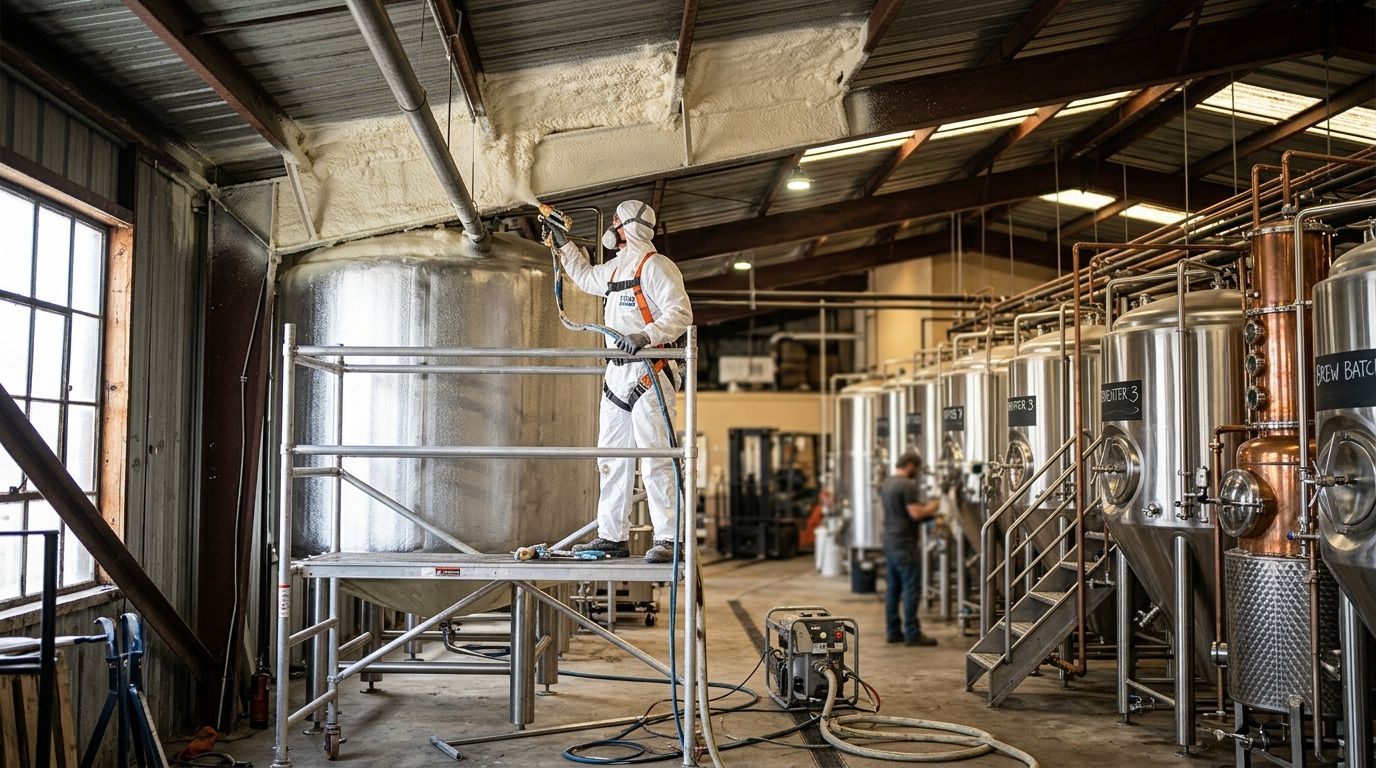
Spray foam insulation for breweries and distilleries is a closed-cell application that seals fermentation rooms, cold storage, and production floors against temperature swings and moisture, with the aim of holding consistent brewing temperatures and cutting HVAC load. Breweries and distilleries need tighter humidity control and stricter fire-code compliance than a typical commercial building, because fermentation tanks throw off heat and vapor that standard batt insulation can't manage in a Calgary or Lethbridge winter.
- Closed-cell spray foam insulation is the standard pick for brewery and distillery fermentation rooms and cold storage across Alberta.
- Closed-cell foam runs R-6 to R-6.5 per inch, holding fermentation temperature steadier than fiberglass batt in unheated production bays.
- Vapor barrier performance matters as much as R-value once brewhouse humidity runs past 60 percent for extended brew cycles.
- National Building Code fire provisions require a thermal barrier over exposed spray foam in occupied production spaces before a 2026 sign-off.
Why spray foam insulation matters for breweries and distilleries
A fermentation cellar wants to sit in a narrow band, usually well below room temperature, for weeks at a stretch. A brewhouse next door runs hot and wet from mashing and boiling. Put those two zones in the same building envelope and you get condensation, mold risk on cold surfaces, and a chiller working overtime to fight heat bleeding through uninsulated block or metal panel walls.
Closed-cell spray foam insulation solves that because it's also a vapor barrier at roughly 1.5 to 2 inches of thickness, not just an R-value filler. For a walk-in cooler or a space handled the same way as cold storage facilities, that combination of air-seal and vapor control matters more than raw thickness. Metal-clad production buildings in particular lose the fight against thermal bridging without a continuous foam layer, since steel studs and girts conduct cold straight through fiberglass batt.
Energy cost is the second driver. A distillery running a still and a chiller simultaneously pays for that mismatch on every utility bill, and 2026 electricity and gas rates in Alberta make an uninsulated production floor an expensive line item month after month.
Map your temperature-critical zones first
Before any foam goes on a wall, walk the building and separate it into thermal zones. Fermentation cellars, brewhouses, packaging lines, and mechanical rooms all have different temperature and humidity targets, and insulating them identically wastes money in the wrong places.
- Mark fermentation and cold rooms that need year-round cooling
- Mark hot zones around kettles, mash tuns, and stills
- Note any shared walls between hot and cold zones — these are your highest-risk condensation points
- Flag mechanical rooms, loading docks, and packaging areas as separate zones
- Photograph existing insulation gaps, exposed studs, and roof penetrations for the contractor walkthrough
Choose closed-cell foam for cold rooms and fermentation cellars
Open-cell foam is cheaper and better for sound damping, but it absorbs moisture and isn't a vapor barrier on its own. That disqualifies it for any wall touching a cold room or fermentation cellar in a brewery.
- Specify closed-cell foam at 2 lb density for cold-facing walls and ceilings
- Target 2 to 3 inches of thickness on exterior walls in cellars and walk-ins
- Use closed-cell foam on roof decks above production floors to stop convective heat gain
- Reserve open-cell foam for interior partition walls where sound control matters more than vapor control
- Confirm the foam system carries a commercial fire rating suited to occupied production space
Air-seal walls, ceilings, and penetrations around brewing equipment
Glycol lines, conduit, drains, and duct penetrations puncture almost every wall in a working brewery. Each one is a potential air leak that undermines the insulation around it, no matter how good the foam job is elsewhere.
- Seal every conduit and pipe penetration with foam before drywall or panel goes back up
- Foam around dock doors and overhead doors where metal buildings lose the most air
- Treat the top plate and roof-to-wall junction as a priority — this is where most metal buildings leak heat
- Check floor-to-wall junctions in cellars where slab meets foundation wall
- Re-inspect penetrations added after equipment installs; new lines often go unsealed
Control vapor and humidity around brewhouse and cellar walls
Brewhouses generate steam during mashing and boiling, and that moisture travels through the building looking for a cold surface to condense on. Left unmanaged, it shows up as mold on cellar ceilings or rust on structural steel within a season or two.
- Run closed-cell foam continuously across any wall shared between a hot brewhouse and a cold cellar, the same approach used for wine cellars and cold rooms
- Avoid gaps at wall-ceiling junctions where warm, humid air can bypass the vapor barrier
- Add supplemental dehumidification in packaging areas if humidity still tracks above 60 percent after insulation work
- Inspect for condensation on cold pipes and tanks monthly during the first year after retrofit
Insulate loading docks, mechanical rooms, and walk-in coolers
Loading docks and mechanical rooms get skipped constantly because they're not production space, but an uninsulated dock door bleeds cold air into a packaging line every time a truck backs in.
- Foam the header and jamb around every dock door, not just the door panel itself
- Insulate mechanical room walls separately from production space to protect compressors and controls from temperature swings
- Treat walk-in cooler and freezer walls as their own zone with dedicated vapor barrier detailing
- Check rooftop mechanical curbs for the same air-sealing brewhouses need at wall penetrations
Meet fire code and food-safety requirements before sign-off
Spray foam in an occupied commercial building isn't a DIY-and-forget job. Alberta building code, aligned with the National Building Code of Canada, requires a thermal barrier — typically drywall or an intumescent coating — over exposed spray foam in any occupied space, and a brewery production floor counts.
- Confirm the insulation contractor covers exposed foam per fire code requirements before final inspection
- Keep foam away from direct contact with hot equipment surfaces per manufacturer clearance specs
- Document the installation for your food-safety and building inspector records
- Ask about product formulations with low off-gassing near food-contact and packaging areas
Get a brewery insulation quote
Licensed, insured spray foam contractor serving Calgary, Okotoks, High River, and Lethbridge.
Comparison of insulation options for breweries and distilleries
| Option | Best for | Key limitation |
|---|---|---|
| Closed-cell spray foam | Cold rooms, fermentation cellars, walls between hot and cold zones | Higher upfront labor cost than batt |
| Open-cell spray foam | Interior partition walls, sound control between packaging and office space | Absorbs moisture; not suited to cold-facing walls |
| Rigid foam board (XPS/polyiso) | Flat roof decks, slab perimeters | Joints need taping; doesn't self-seal irregular framing |
| Fiberglass batt | Low-humidity office or admin areas only | No vapor barrier; performs poorly against condensation |
Verdict: closed-cell spray foam insulation wins for any wall or ceiling touching a fermentation cellar, cold room, or shared hot-cold zone in a brewery or distillery — fiberglass batt is a skip in those zones every time.
Common mistakes breweries and distilleries make
- Insulating the production floor but ignoring the loading dock — cold air still floods in every delivery
- Treating the whole building as one thermal zone — a fermentation cellar and a brewhouse need different R-values and different vapor strategies, not the same batt insulation applied evenly
- Skipping the thermal barrier over exposed foam — this fails inspection and creates a fire-code violation in occupied space
- Adding equipment after insulation without resealing new penetrations — every new glycol line or conduit run is a fresh air leak if it isn't foamed
- Choosing open-cell foam for cold storage to save money — it isn't a vapor barrier and invites condensation and mold within a season
FAQ
What’s the best spray foam insulation for a brewery fermentation room?
Closed-cell spray foam at 2 lb density is the best choice for brewery fermentation rooms because it acts as both insulation and vapor barrier at 2 to 3 inches of thickness. Open-cell foam absorbs moisture and isn’t suited to cold-facing walls in a fermentation cellar.
Is spray foam insulation better than fiberglass batt for a distillery?
Spray foam insulation outperforms fiberglass batt in a distillery because it seals air leaks and blocks vapor, while batt insulation does neither. Distilleries running stills and chillers in the same building need the air-seal that only spray foam provides.
Does spray foam insulation need a fire-rated cover in a brewery?
Yes, exposed spray foam in an occupied brewery production space requires a thermal barrier such as drywall or an intumescent coating under the National Building Code of Canada. Building inspectors check for this before signing off on a 2026 commercial insulation retrofit.
How much spray foam thickness does a brewery cold room need?
A brewery cold room typically needs 2 to 3 inches of closed-cell spray foam to hit an effective vapor barrier and hold R-13 or better on exterior walls. Roof decks above cold rooms often need more thickness than side walls due to greater heat gain.
Can spray foam insulation reduce energy costs for a distillery chiller?
Spray foam insulation reduces the load on a distillery chiller by cutting the heat transfer through walls shared with hot brewhouse zones. Less heat bleeding into a cold room means the chiller cycles less often, which shows up directly on 2026 utility bills.
Is spray foam insulation safe near food and beverage production?
Spray foam insulation is safe near food and beverage production once fully cured and covered with a proper thermal barrier per code. Ask the contractor about product formulations with low off-gassing for areas near packaging and food-contact zones.
One last thing
The wall most breweries forget is the one between the brewhouse and the cellar — it's the single highest-risk surface in the building for condensation, because it's the only wall in the facility that has to fight heat on one side and cold on the other at the same time. Insulate that wall first if the budget forces you to phase the project.
Related guides
- Commercial spray foam insulation for warehouses
- Spray foam insulation for equipment and mechanical rooms