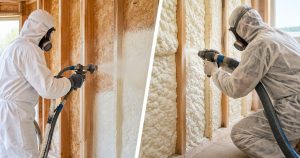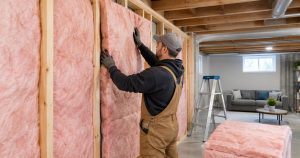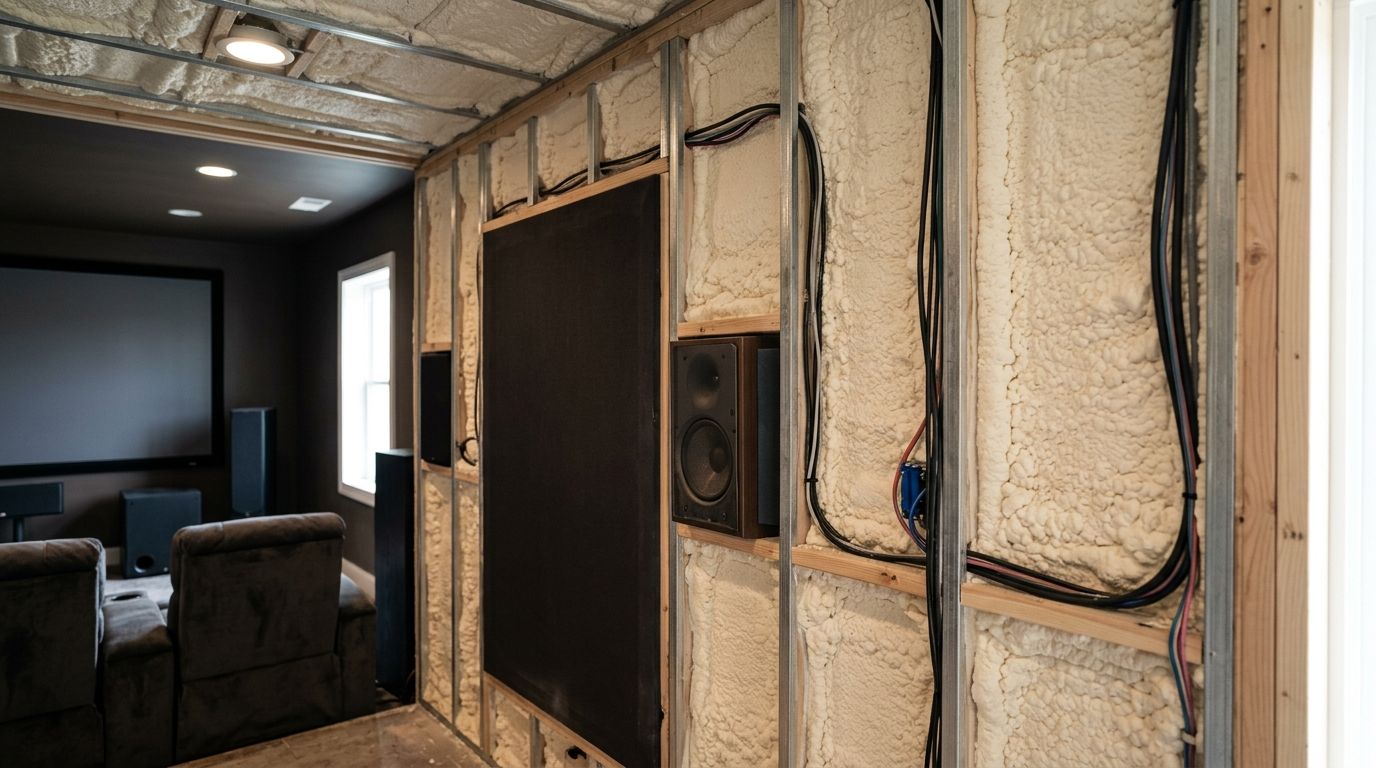
Home theater spray foam insulation is the acoustic and thermal upgrade that turns a converted basement, bonus room, or garage-adjacent space into a room that actually holds sound and temperature the way a dedicated media room should. Standard batt insulation leaves gaps around wiring, ductwork, and electrical boxes that let bass leak into bedrooms and let temperature swings stress AV equipment — spray foam closes those gaps in one continuous seal.
- Spray foam insulation home theater upgrades cut sound transfer through shared walls better than batts because foam seals gaps batts can’t reach.
- Closed-cell spray foam runs roughly R-6.5 to R-7 per inch versus R-3.5 for open-cell, which matters for rooms over garages or in basements.
- Aztec Spray Systems serves Calgary, Okotoks, High River, and Lethbridge homeowners converting rooms into media spaces.
- Bonus rooms above garages and basement theaters have different insulation priorities — floor cavities versus shared walls.
- Sealing electrical boxes and duct penetrations before foam goes in prevents the most common sound-leak complaint in 2026 theater conversions.
Why spray foam insulation matters for home theaters
A media room fails for two reasons: sound escapes into the rest of the house, or the room itself runs hot in summer and cold in winter because it sits over a garage or against an uninsulated basement wall. Both problems trace back to air gaps, not insulation type alone. Batt insulation compresses around joists, wiring, and can lights, leaving channels where sound and air move freely.
Spray foam expands into those same gaps and cures solid, which is why homeowners converting basements, bonus rooms, and garage-adjacent spaces in Calgary, Okotoks, High River, and Lethbridge increasingly ask about it specifically for theater rooms rather than whole-home retrofits. The room's function — isolated sound, stable temperature for electronics — is a narrower, more demanding job than a typical bedroom.
Test your room's current sound and thermal leaks
Before any material goes in, find out where the room is actually losing sound and temperature. This step is free and takes under an hour.
- Run a subwoofer test track at moderate volume and walk the perimeter of adjoining rooms listening for leak points
- Feel around electrical outlets, light switches, and can lights for airflow with your hand
- Check the door — a hollow-core door with no weatherstripping undoes hours of wall work
- Look at HVAC duct boots and returns for daylight gaps around the frame
- Note any shared wall with a bedroom, since that's the wall that generates the most complaints
Choose open-cell or closed-cell foam for the room's job
Open-cell and closed-cell spray foam behave differently for sound dampening and thermal performance, and the choice depends on whether the room sits over a garage, in a basement, or against an exterior wall.
- Open-cell foam expands more and fills irregular stud cavities well, which helps with sound absorption in interior partition walls
- Closed-cell foam delivers roughly R-6.5 to R-7 per inch versus about R-3.5 for open-cell, making it the better call for rooms over unheated garages or below-grade basement walls
- Mixed applications are common — closed-cell on exterior-facing assemblies, open-cell on interior partition walls for sound
- A contractor should specify which foam goes where before spraying starts, not decide on site
Seal the shared wall first — it's the highest-complaint area
The wall between a theater and a bedroom or living room carries more low-frequency bass than any other surface in the room. Batt insulation alone rarely stops it because sound travels through the framing itself, not just the air gaps.
- Foam-fill the entire stud cavity, not just the visible gaps around outlets
- Treat electrical boxes with acoustic putty pads before foam goes in, since foam alone won't seal a box designed to be removable
- Address the top and bottom plates where walls meet floor and ceiling framing — sound bridges through wood-to-wood contact points foam can't reach
- For a full walkthrough of assembly options, see spray foam insulation for soundproofing shared walls
Handle bonus rooms above garages differently than basements
A media room built above a garage has a completely different thermal problem than one built in a basement. The floor cavity over the garage is exposed to unconditioned space on all six sides, which means summer heat and winter cold both hit the room from below.
- Foam the floor cavity between the garage ceiling and the room's subfloor, not just the exterior walls
- Seal rim joists and the transition point where the bonus room meets the main house structure
- Check for existing batt insulation that has sagged or compressed over time before adding foam over it
- Homeowners planning this exact conversion should review how to insulate a bonus room above the garage before scheduling work
Match R-value to Alberta's climate, not a generic recommendation
Alberta winters push exterior-facing theater room assemblies harder than interior rooms in milder climates. A media room against an uninsulated exterior wall in Calgary needs a different R-value target than the same room built in a basement with earth on the other side of the wall.
- Confirm which walls in the room face unconditioned space versus conditioned interior rooms
- Use closed-cell foam at higher R-value on any wall or ceiling facing outside air or an unheated garage
- Verify the assembly meets current Alberta Building Code minimums, not just what feels warm enough by hand
- The full breakdown is in how to choose the right spray foam R-value for your attic, which applies the same logic to ceiling assemblies in a media room
Address cathedral or vaulted ceilings if the room has one
Some home theaters, especially those built into converted lofts or additions, have vaulted or cathedral ceilings with no attic space above for traditional venting. These assemblies need a different foam approach than a flat ceiling.
- Closed-cell foam applied directly to the roof deck creates an unvented, conditioned assembly appropriate for these ceiling types
- Confirm ventilation strategy with the contractor before spraying — an unvented cathedral assembly done wrong traps moisture
- Review spray foam insulation for cathedral and vaulted ceilings if your theater room has this ceiling type
Get quotes before committing to a foam type
Costs vary by room size, ceiling height, and how much of the existing insulation needs removing before spray foam goes in. Get a site visit rather than a phone estimate for a theater conversion — access around ductwork and framing changes the labor time significantly.
- Ask whether the quote includes removal of existing batt insulation or vapor barrier
- Confirm whether electrical boxes and can lights are treated separately or included in the base quote
- Get the R-value and foam type specified in writing, not just square footage covered
- General cost ranges for the Calgary market are covered in how much does spray foam insulation cost in Calgary
Get a theater room insulation quote
Licensed, insured spray foam contractor serving Calgary, Okotoks, High River, and Lethbridge.
Comparing insulation options for a home theater room
| Option | Best for | R-value per inch | Key limitation |
|---|---|---|---|
| Closed-cell spray foam | Rooms over garages, exterior walls, basements | ~R-6.5–7 | Higher labor time to apply, requires trained crew |
| Open-cell spray foam | Interior partition walls, sound dampening | ~R-3.5 | Lower R-value per inch, not ideal on exterior-facing walls alone |
| Mineral wool batts | Budget-conscious interior partition walls | ~R-3.7–4.3 | Doesn't seal gaps around outlets and framing the way foam does |
| Rigid foam board (XPS) | Supplemental ceiling or rim joist boost | ~R-5 | Requires taped seams to perform as an air barrier; foam alone doesn't seal penetrations |
Verdict: for a home theater or media room in the Calgary area, closed-cell spray foam on exterior-facing assemblies paired with open-cell on interior partition walls handles both the thermal and acoustic job better than any single-material approach — batts alone are a skip for this specific use case.
Common mistakes homeowners make with theater room insulation
- Insulating the walls but ignoring the door. A solid-core door with a proper sweep matters as much as the wall assembly behind it.
- Treating a bonus-room-over-garage floor like a normal interior floor. It's an exterior-facing assembly and needs foam, not carpet padding, as the thermal barrier.
- Skipping electrical box treatment. Foam around a box, not inside a properly sealed box, still leaves a sound and air path.
- Assuming more foam automatically means more soundproofing. Assembly design — double stud walls, resilient channel, mass — matters more than foam thickness alone for low-frequency bass.
- Not checking existing wiring for knob-and-tube before spraying. Older Calgary and Lethbridge homes sometimes still have it, and it changes what a contractor can safely foam around.
Why this matters
A theater room that leaks sound gets used less — the whole point of the room fails quietly over a year of complaints from the next room. A theater room over a garage that runs 15 degrees colder in January than the rest of the house stresses AV equipment and makes the space uncomfortable exactly when families want to use it most. Spray foam insulation solves both problems in the same pass, which is why it outperforms batt-only retrofits for this specific room type.
FAQ
What’s the best insulation for a home theater or media room?
Closed-cell spray foam on exterior-facing walls and ceilings, paired with open-cell spray foam on interior partition walls, handles both thermal control and sound dampening better than batt insulation alone. This matters most for rooms above garages or against basement walls in Calgary’s climate.
Is spray foam better than batt insulation for soundproofing a media room?
Yes, because spray foam seals gaps around electrical boxes, wiring, and framing that batts leave open. Sound and air both travel through those gaps, so an unsealed batt wall leaks bass even at a high R-value.
How much does spray foam insulation cost for a home theater room in Calgary?
Cost depends on room size, ceiling type, and whether existing insulation needs removal first. A site visit gives an accurate number faster than a phone estimate for theater conversions.
Do I need to insulate the floor if my media room is above a garage?
Yes. A bonus room above a garage is exposed to unconditioned space on the floor side, so the floor cavity needs the same attention as exterior walls. Skipping it leaves the room cold in winter regardless of how well the walls are done.
What R-value do I need for a home theater ceiling in Alberta?
The target depends on whether the ceiling faces an attic, a cathedral assembly, or conditioned space above. Alberta Building Code sets minimums, and closed-cell foam typically reaches those targets with less material thickness than batts.
Can spray foam fix an existing home theater that already has echo or sound leakage?
In many cases yes, if the walls can be opened or accessed from an adjacent space like a garage or unfinished basement. A contractor needs to assess access before quoting the work.
Does spray foam insulation affect a new home warranty for a theater room addition?
It can, depending on the builder’s terms and how the insulation is installed. Check warranty terms before scheduling foam work on a newly built addition.
One last thing
The detail most homeowners skip: treat the door and its frame with the same seriousness as the walls. A theater room with foam-sealed walls but a hollow-core door and no sweep still leaks the majority of its sound through that one gap — it's the cheapest fix in the whole project and the most commonly ignored.
Related guides
- Spray foam insulation for basement suite conversions
- How to insulate a home office for energy efficiency
- Spray foam insulation for garage walls and ceilings
- How to reduce moisture and mold with spray foam insulation