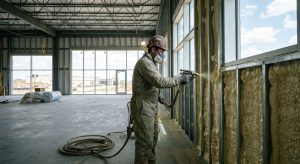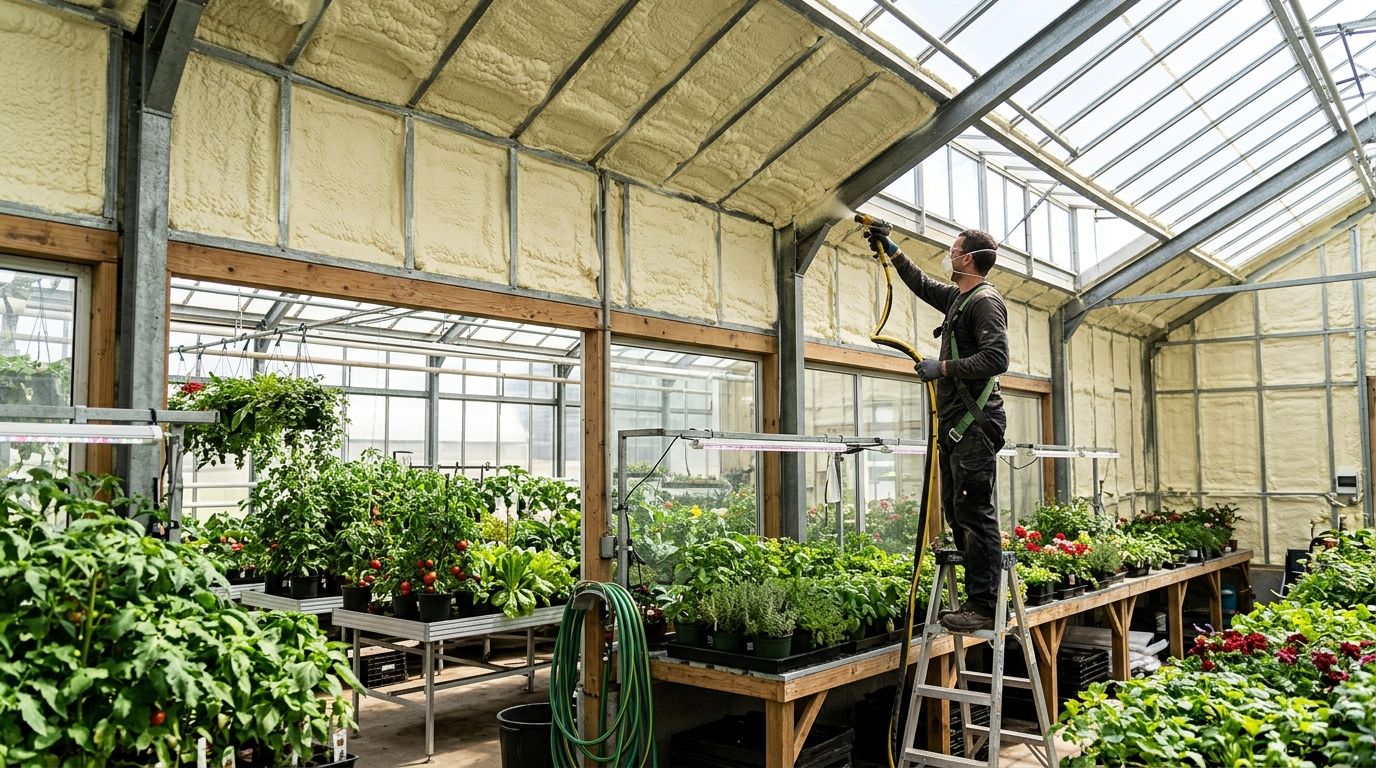
Spray foam insulation greenhouse and grow room projects solve two problems fiberglass batts can't touch: Alberta's -20°C winter swings and the condensation that builds up inside a humid growing structure. Closed-cell spray foam is the right call for most Calgary-area grow rooms and hard-sided greenhouses because it insulates and vapor-seals in one pass. A poly-film hoop house needs a different approach entirely, and that distinction changes the whole plan.
- Spray foam insulation greenhouse projects need closed-cell foam to handle Alberta humidity and sub-zero winters.
- Aztec Spray Systems recommends 2 inches minimum of closed-cell foam on north-facing grow room walls.
- Open-cell foam costs less per board foot but still needs a separate vapor barrier in humid grow rooms.
- Plan for a 24-hour cure and ventilation window before moving plants back into a freshly foamed space.
Why spray foam insulation matters for greenhouse and grow room operators
A grow room runs hot and humid on the inside while the shell sits against a Calgary winter on the outside. That temperature and moisture gap is exactly where fiberglass batt insulation fails: water vapor moves through the batt, hits the cold sheathing, condenses, and you get soaked insulation and mold inside the wall by February.
Closed-cell spray foam closes that gap because it's a vapor retarder at roughly 2 inches thickness and an air seal at the same time. For a year-round grow operation running supplemental heat, that combination cuts the heating load and keeps the moisture and mold control problem from ever starting inside the framing.
Greenhouses built on poly film or twin-wall polycarbonate are a different animal. You're not foaming the glazing itself, but the knee walls, foundation, endwalls, and any attached headhouse or equipment room benefit from the same closed-cell treatment a shop or barn gets.
The spray foam insulation greenhouse and grow room how-to
Assess your structure type before you call anyone
A poly hoop house, a hard-sided glass greenhouse, and a converted pole barn used as a grow room each need a different spray foam plan. Get this right before pricing anything.
- Poly or twin-wall glazing panels don't get foamed directly — insulate the knee wall, north wall, and foundation instead
- Hard-sided greenhouses with solid walls can take full closed-cell coverage on non-glazed surfaces
- Converted barns or shops used as grow rooms foam like any other agricultural building
- Attached headhouses, equipment rooms, and loading areas get treated as separate zones with their own R-value targets
Prep the structure before spray day
Spray foam needs a clean, dry substrate to bond and cure properly, and grow spaces often carry more organic debris and humidity than a typical garage or attic.
- Clear plant debris, soil residue, and standing water from wall cavities and sill plates
- Fix any active roof or window leaks before the crew arrives — foam over wet framing traps the moisture instead of solving it
- Confirm electrical, irrigation lines, and heating equipment are marked or capped so the crew can spray around them
- Review the same prep list used for barn and agricultural building jobs, since grow rooms carry similar humidity and airflow issues
- Schedule the job for a stretch with no rain in the forecast if the structure is open to weather during prep
Choose closed-cell over open-cell for humidity control
Open-cell foam runs cheaper per board foot and insulates fine in a dry attic, but a grow room running 60-80% relative humidity needs the vapor control closed-cell provides.
- Closed-cell foam at 2 inches acts as its own vapor barrier — no separate poly sheet needed
- Open-cell foam is vapor-open and requires a taped vapor barrier layer added afterward in humid spaces
- Closed-cell adds structural rigidity to thin-walled outbuildings, which matters on converted pole barns
- Open-cell is the better choice only for dry, low-humidity storage rooms attached to the grow space
Insulate the right zones, not the whole envelope
Greenhouses waste money insulating glazing that needs to transmit light. Target the parts of the structure doing the actual thermal work.
- North-facing walls and any wall with no light requirement — foam these first and heaviest
- Foundation perimeter and rim joists, where cold ground transfer pulls heat out of root zones
- Roof or ceiling above any hard-sided section, especially over a headhouse or equipment room
- Doors, vents, and equipment penetrations, where air leakage undoes R-value gains everywhere else
Plan ventilation and vapor management around the foam
A sealed grow room needs mechanical ventilation planned alongside the foam job, not after it. Closed-cell foam stops air leakage, and a grow room without a leaky envelope needs a real air exchange strategy.
- Size exhaust fans and intake vents for the crop's humidity output, not the old leaky-building baseline
- Add a dehumidifier where crop density pushes humidity past what ventilation alone can clear
- Keep any combustion heater vented to the outside — a sealed envelope traps combustion byproducts fast
- Recheck CO2 supplementation rates once the room is sealed tighter than before
Budget for the R-value your crop actually needs
A cold-tolerant crop overwintering at low light doesn't need the same R-value as a heated grow room running lights and irrigation year-round in 2026.
- Match wall and foundation R-value to your minimum interior temperature target, not a generic number
- Closed-cell foam at 2 inches delivers roughly R-12 to R-14 — enough for most three-season grow rooms
- Full four-season operations in Calgary or Lethbridge typically need 3-4 inches on exposed walls
- Get a written scope breaking out thickness by wall, not a single blended quote for the whole structure
Check rebates and code compliance before you book
Spray foam over an occupied grow space still falls under the same building code rules as any other structure, and skipping this step causes rework later.
- Confirm whether an ignition or thermal barrier is required if the space is occupied for extended periods
- Check current Alberta spray foam rebates before signing a contract — funding programs shift year to year
- Ask whether a permit applies to the specific structure type before work starts
- Confirm the contractor carries WCB coverage and liability insurance for agricultural and outbuilding work
Maintain the foam after installation
Spray foam in a grow room takes more abuse than an attic — irrigation splash, chemical exposure, and equipment vibration all add up over a growing season.
- Inspect foam near irrigation lines annually for staining that signals a slow leak
- Keep foam surfaces clear of direct fertilizer or chemical contact where possible
- Patch any mechanical damage from equipment or racking before it exposes bare framing
- Recheck sealant around penetrations added after the original install — vents, conduit, new equipment
Comparing insulation options for greenhouses and grow rooms
| Option | Best for | Key limitation |
|---|---|---|
| Closed-cell spray foam | Year-round grow rooms, humid environments | Higher material cost per board foot than open-cell |
| Open-cell spray foam | Dry storage rooms attached to the grow space | Needs a separate vapor barrier in humid air |
| Rigid foam board | Foundation perimeter, retrofit on a budget | Seams need taping or they leak air |
| Fiberglass batt | Low-humidity, low-stakes storage areas only | Absorbs moisture and loses R-value when wet |
| Double-poly film (greenhouse glazing) | Light-transmitting walls and roofs | Zero structural insulation value — not a wall substitute |
Closed-cell spray foam is the clear winner for any grow room or greenhouse running heat and humidity control year-round — buy it. Fiberglass batt is a skip for anything above a dry tool shed.
Get a greenhouse insulation quote
Scope closed-cell foam for your grow room before the next cold snap hits.
Common mistakes greenhouse and grow room operators make
- Foaming over active condensation without drying the framing first, which seals the moisture in permanently
- Insulating south-facing glazing walls instead of putting the budget into the north wall and foundation where it actually pays off
- Skipping the ventilation redesign after sealing the envelope tighter, then fighting humidity spikes all season
- Treating a pole barn conversion like a standard shop job instead of checking it against the same prep steps used for pole barn and shop spray foam work, which shares the same agricultural-building humidity risks
- Ignoring reoccupancy timing and moving plants back into the space before the foam finishes curing and off-gassing
FAQ
What’s the best spray foam insulation for a greenhouse?
Closed-cell spray foam is the best choice for greenhouse walls, foundations, and headhouses because it insulates and vapor-seals in one layer. Poly or twin-wall glazing panels don’t get foamed directly since they need to transmit light.
Is spray foam insulation safe for grow rooms with plants?
Spray foam cures within about 24 hours, and the space needs ventilation during that window before plants move back in. After cure, the foam is inert and doesn’t off-gas into the growing environment.
How much R-value does a grow room need in Alberta?
A three-season grow room typically needs R-12 to R-14, achieved with about 2 inches of closed-cell foam. A four-season operation running heat through Calgary or Lethbridge winters usually needs 3-4 inches on exposed walls.
Can you spray foam a poly greenhouse directly?
No, poly film and twin-wall polycarbonate glazing stay uninsulated since they need to pass light. Spray foam goes on the knee walls, north wall, foundation, and any attached hard-sided rooms instead.
Does spray foam insulation stop condensation in a greenhouse?
Closed-cell spray foam acts as a vapor retarder at around 2 inches thick, which stops the wall-cavity condensation that fiberglass batt allows. It won’t stop condensation on glazing surfaces, which needs ventilation or a dehumidifier instead.
Is open-cell or closed-cell foam better for a grow room?
Closed-cell foam is better for any grow room running above roughly 60% relative humidity, since it doesn’t need a separate vapor barrier layer. Open-cell foam works fine in dry, low-humidity storage rooms attached to the grow space.
Do spray foam rebates in Alberta cover greenhouse or grow room projects?
Rebate eligibility depends on the specific program and structure type, and terms change year to year. Check current Alberta spray foam rebate details before signing a contract for a 2026 project.
One last thing
The detail growers miss most: a sealed, closed-cell-foamed grow room needs more planned ventilation than the leaky structure it replaced, not less. Insulating the shell without resizing the exhaust fan just trades a heating problem for a humidity problem.
Related guides
- Spray foam insulation for horse barns and equestrian facilities
- Spray foam insulation for metal buildings
- Spray foam insulation for commercial rooftop mechanical units
- Best insulation type for Alberta winters