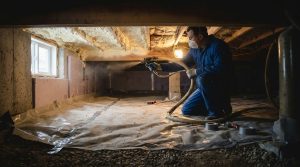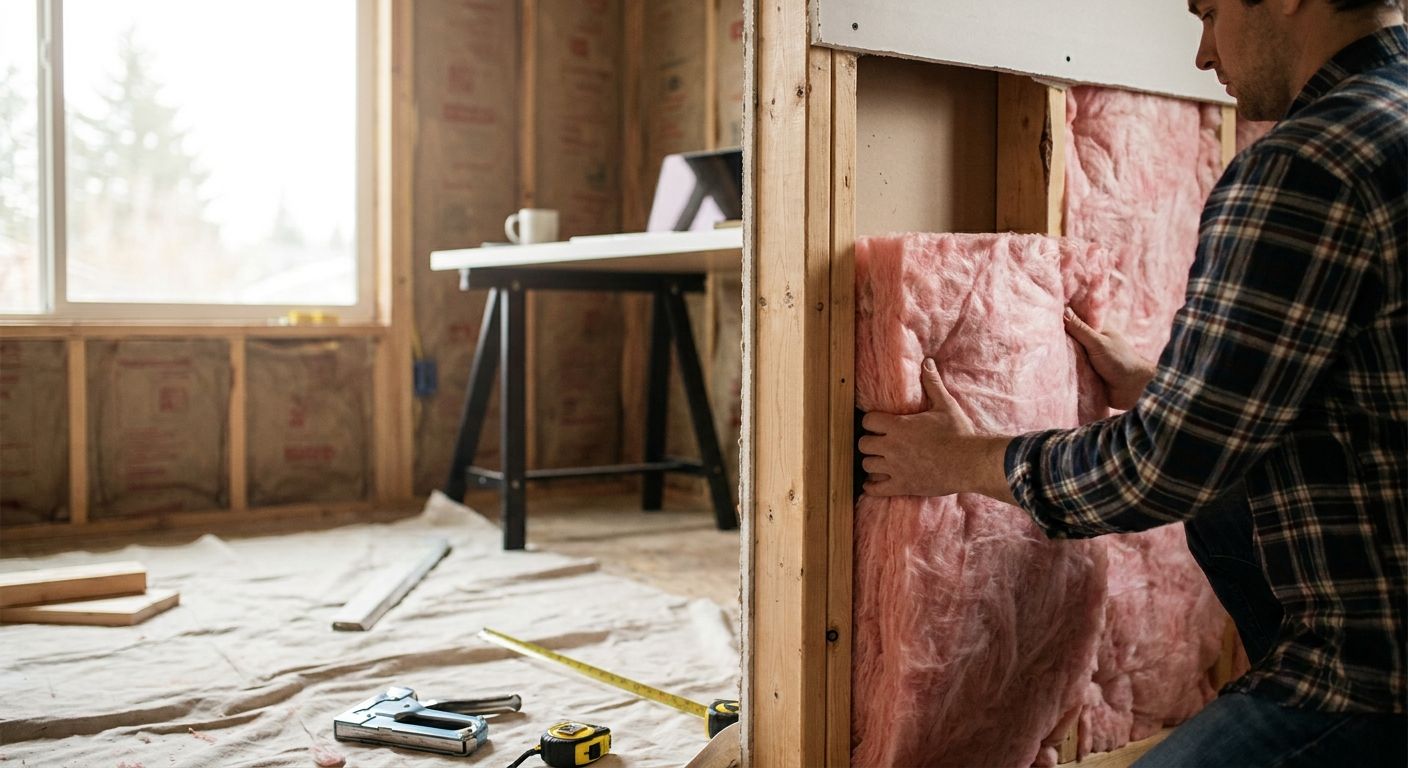
Insulating a home office for energy efficiency in 2026 means treating the room as its own thermal zone, not an afterthought of the rest of the house: closed-cell spray foam or dense-pack insulation in the walls and ceiling, air sealing around outlets and window frames, and an R-value matched to where the room actually sits. The location most homeowners get wrong is a home office above an unheated garage, where a joist bay without continuous spray foam bleeds heat through the floor no matter how well the walls are done.
- Insulate a home office for energy efficiency by targeting the ceiling, floor, and air leaks first, not just the walls.
- A garage-converted office needs continuous spray foam in the floor joist bay, not just batts between studs.
- Detached workshop offices in Alberta’s climate zone lose the most heat through an under-insulated ceiling.
- Aztec Spray Systems treats each room type differently because a basement office and a bonus room over a garage fail in different spots.
Why this matters
A home office runs a space heater or a second monitor bay ten hours a day, five days a week, in a room that was often never designed to hold heat. Alberta winters push outdoor temperatures well below -20°C for weeks at a time, and a poorly insulated office forces the furnace to work overtime just to keep one room comfortable. Spray foam insulation closes the air gaps that batt insulation leaves behind, which matters more in a home office than almost anywhere else in the house because the room is occupied, heated, and often has more electrical penetrations than a bedroom or living room.
How do you insulate a home office for energy efficiency?
- Identify the room's exposure — is it over a garage, in a basement, in a detached structure, or a bonus room tucked under the roofline?
- Air seal first — outlets, window frames, and any duct penetrations leak more heat than a bare wall ever will.
- Match the insulation type to the cavity — closed-cell spray foam performs best in tight joist bays and rim joists where batts can't seal edge-to-edge.
- Hit the right R-value for the climate zone — Alberta's climate zone 7A calls for higher targets than most of the U.S. building code.
- Check the door and window seals — a well-insulated wall next to a leaky exterior door still loses heat fast.
| Home office location | Typical weak point | Recommended approach | Best for |
|---|---|---|---|
| Above attached garage | Floor/ceiling joist bay | Continuous closed-cell spray foam in the joists | Rooms with cold floors year-round |
| Basement | Foundation wall, rim joist | Spray foam on foundation walls and rim joist | Year-round comfort, moisture control |
| Detached workshop/shed office | Ceiling and wall cavities | Higher-R spray foam plus air sealing at the roofline | Backyard offices, studios |
| Bonus room over garage | Kneewalls and sloped ceiling | Spray foam in kneewall cavities and roof deck | Rooms with awkward roof angles |
Home office above an attached garage: R-30 floor minimum
If the office sits directly over a garage, the floor is the weak point, not the walls. Closed-cell spray foam runs roughly R-6.5 per inch, so a joist bay filled to about 4-5 inches gets you into the R-30 range that a garage-adjacent floor needs in an Alberta winter. Batt insulation in this cavity almost always leaves gaps at the rim joist, which is exactly where the bonus room above a garage tends to feel drafty even when the walls test fine.
Verdict: for a garage-topped office in 2026, spray foam in the floor cavity is the first dollar spent, not the last.
Detached workshop or backyard office: R-49 ceiling, R-20 walls
A detached office or converted workshop or hobby space needs to hit ceiling and wall targets closer to Alberta's prescriptive path for climate zone 7A — roughly R-49 at the ceiling and R-20 in the walls. These structures are usually built with thinner framing than a house, so spray foam's higher R-value per inch matters more here than in a standard stud wall. There is no shared heat from adjacent rooms to fall back on, which is why the ceiling target is the highest of any office type.
Basement home office: continuous foam on foundation walls
A basement office fights two problems at once: heat loss through the foundation and moisture creeping in from the soil side. Spray foam applied continuously to the foundation wall, rather than batts stapled between furring strips, closes both problems in a single pass and removes the cold spots that form wherever a batt doesn't sit flush. The rim joist is the single leakiest square footage in most Calgary basements, and it takes under an inch of closed-cell foam to fix.
Why insulation needs vary for a home office
- Room location — garage, basement, bonus room, and detached structures each fail at different points.
- Existing cavity depth — a 2×4 wall can't hit the same R-value as a 2×6 wall without a denser product.
- Air leakage around penetrations — outlets, pot lights, and duct runs leak more than most homeowners expect.
- Heat load in the room — space heaters, extra monitors, and equipment change how much insulation actually pays off.
- Climate zone — Alberta's zone 7A calls for higher R-values than milder Canadian regions.
- Existing insulation condition — older batts settle and compress over 15-20 years, losing effective R-value even when they look intact.
Get your home office assessed
Aztec Spray Systems checks the ceiling, floor, and walls before quoting a fix.
Does a home office need its own heating and cooling?
A home office doesn't need a separate HVAC zone, but it does need the envelope sealed well enough that the existing system can hold temperature without running constantly. The fix is almost always insulation and air sealing, not a bigger furnace. A room that loses heat through an uninsulated garage floor or a leaky rim joist stays cold no matter how far the thermostat is pushed.
Is spray foam better than fiberglass for a home office?
Spray foam outperforms fiberglass batts in home office applications because it air seals as it insulates, while batts only insulate and leave gaps at every seam. Fiberglass costs less up front — that is the honest trade-off. In a garage-converted or detached office, though, those gaps show up as cold spots and drafts inside the first winter, and the cheaper install gets redone.
How much can insulating a home office lower energy bills?
Insulating a home office lowers the load on whatever system heats and cools it, because the room stops leaking conditioned air through the ceiling, floor, or foundation wall. The exact savings depend on the current insulation condition and how many hours a day the room is occupied and heated, which is why an on-site assessment beats a generic estimate. Alberta homeowners upgrading in 2026 should also check which rebate programs their scope of work qualifies for before booking the job.
“A home office can test at the right R-value on paper and still feel drafty, because air moves through outlets and pot lights faster than it moves through insulation.”
FAQ
What’s the best insulation for a home office over a garage?
Closed-cell spray foam applied continuously in the floor joist bay is the best option for a home office over a garage. It seals the rim joist edges that batt insulation typically misses.
Is spray foam insulation worth it for a small home office?
Spray foam is worth it for a small home office when the room sits over a garage, in a basement, or in a detached structure. Those locations lose the most heat through gaps that batts cannot seal.
How much does it cost to insulate a home office in Calgary?
Cost depends on the room’s size, current insulation condition, and whether it is a garage conversion, basement space, or detached structure. An on-site quote from a licensed Alberta contractor gives the accurate number.
Can I insulate a home office without opening the walls?
Spray foam is applied to open cavities during a renovation, and other methods exist for closed walls. Results depend on the wall’s current condition and available access points.
Does insulating a home office help with soundproofing too?
Spray foam reduces sound transfer through walls and ceilings as a side effect of sealing air gaps. That matters when the office shares a wall with a bedroom or living space.
What R-value does a home office need in Alberta?
Alberta’s climate zone 7A prescriptive targets run roughly R-49 at the ceiling and R-20 at the walls for a detached or above-garage office in 2026. A floor over an unheated garage should reach about R-30.
Is a bonus room over a garage harder to insulate than a basement office?
A bonus room over a garage is harder because it involves kneewalls, a sloped ceiling, and a cold floor cavity. A basement office mainly needs the foundation wall and rim joist addressed.
How long does it take to insulate a home office with spray foam?
A single-room spray foam job is typically completed in one working day once the cavities are open and prepped. Larger scopes covering a garage ceiling plus walls take longer.
One last thing
The part of a home office that loses the most heat usually isn't the wall at all — it's the electrical boxes, pot lights, and duct penetrations that punch through an otherwise well-insulated cavity. A room can hit the right R-value on paper and still feel drafty in January 2026 because air moves through those small gaps faster than it moves through the insulation. Seal the penetrations before you argue about R-values, and the room gets comfortable for a fraction of what a full re-insulation costs.
Related guides
- Best insulation type for Alberta winters
- Spray foam insulation for Canada Greener Homes Grant projects
- How to reduce energy bills with attic insulation