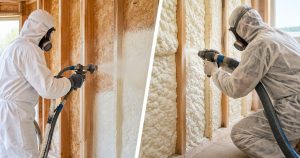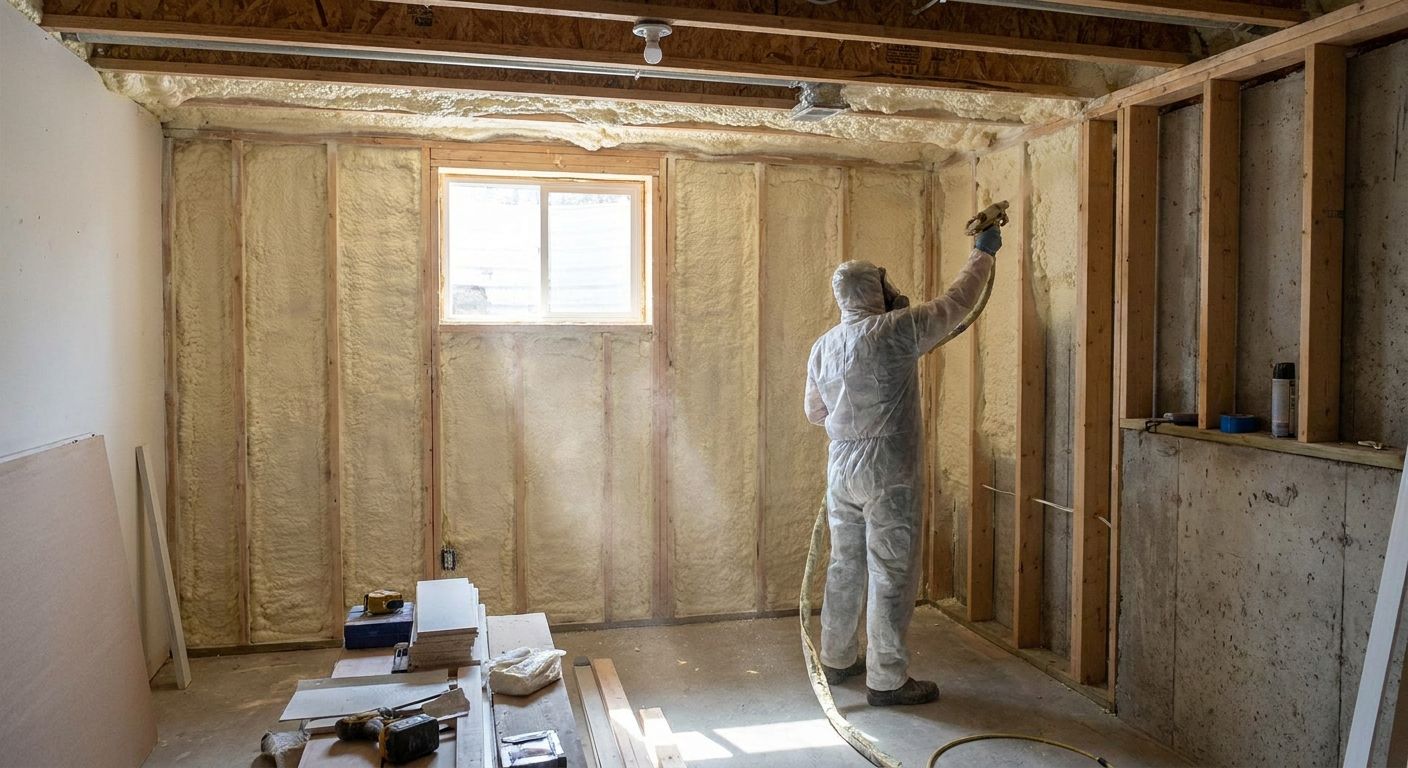
Converting a basement into a legal secondary suite in Calgary, Okotoks, High River, or Lethbridge means the insulation has to do three jobs at once: hold heat, block sound between floors, and meet fire-separation rules for rental units. Spray foam insulation is the material most contractors reach for on these projects because it handles all three where fibreglass batts fall short.
- Closed-cell spray foam at 2 inches on below-grade walls delivers roughly R-13, enough for most Alberta basement suite assemblies.
- Rim joists are the single most-skipped air-leak point in basement suite conversions in 2026 — seal them first.
- Open-cell foam on demising walls adds sound dampening between suite and main floor; closed-cell alone does not.
- Pre-1980 Calgary basements need moisture assessment before foam goes on the wall — skip this and you trap water, not heat.
- DIY foam board and caulk is a Skip for legal suite conversions; inspectors flag gaps at electrical and plumbing penetrations.
Why this matters
A basement suite that fails its final inspection over insulation or fire separation costs more to fix after drywall is up than before. Municipalities across southern Alberta are seeing more secondary suite applications in 2026 as homeowners look to offset mortgage costs, and inspectors are checking rim joist sealing and thermal barriers more closely than they did five years ago. Getting the spray foam insulation for basement rim joists detail right the first time avoids a re-inspection.
Who this is for
This guide is for Calgary, Okotoks, High River, and Lethbridge homeowners turning an existing basement into a rentable legal suite — not a casual rec room upgrade. If you're pulling permits, adding a separate entrance, and need the space to pass fire-separation and thermal-envelope requirements, spray foam insulation is worth the higher upfront cost over batts. If you just want a warmer basement for family use with no rental income involved, a lighter-touch approach may suit you better — see how to insulate a basement for year-round comfort for that scenario.
What to look for in spray foam insulation for a basement suite conversion
R-value at the below-grade wall
Below-grade concrete walls lose heat year-round in Alberta's climate, not just in winter. Closed-cell spray foam runs about R-6.5 per inch, so 2 inches gets you close to R-13 — enough thermal performance for most basement suite assemblies without eating too much floor space in a room that's already tight on square footage.
Rim joist and band joist sealing
The rim joist is where the foundation meets the floor framing, and it's the leakiest spot in most basements built before 2010. Batts compress and gap here; spray foam fills irregular cavities completely and stops the draft that makes basement suites feel cold no matter how high you set the thermostat.
Vapor and moisture control
Closed-cell foam acts as its own vapor retarder, which matters against a concrete wall that can wick ground moisture. Open-cell foam doesn't block moisture the same way, so pairing the wrong foam type with a damp foundation traps water inside the wall assembly instead of keeping it out.
Sound dampening between suite and main floor
A legal secondary suite means two households sharing one structure, and noise complaints are the fastest way a good tenant relationship goes bad. Open-cell foam in the joist bay between floors absorbs airborne sound far better than an empty cavity or a thin batt, even though it doesn't add much R-value there.
Fire separation and code compliance
Most municipalities require a rated thermal and fire barrier over exposed spray foam in habitable space — drywall almost always satisfies this, but the inspector will check it. Skipping the barrier to save a step is the fastest way to fail a secondary suite inspection in 2026.
Cure time before move-in
Spray foam off-gasses during application and needs proper cure and ventilation time before the space is livable. Rushing move-in before cure is complete is a common source of complaints on rental conversions, and it's avoidable with basic scheduling.
Top picks for basement suite spray foam
Closed-cell foam on below-grade concrete walls — the safe pick. At 2 inches deep you're looking at roughly R-13 with a built-in air and vapor seal against the concrete. This is the default choice for basement suite walls across Calgary and Lethbridge in 2026. Buy.
Rim joist sealing with closed-cell foam — the most-skipped fix. Contractors report this as the detail DIY conversions miss most often, and it's a small linear footage compared to full wall coverage. See the full breakdown at spray foam insulation for basement rim joists. Buy.
Open-cell foam on the demising ceiling — the sound dampening pick. Lower R-value per inch at R-3.6, but the acoustic benefit between suite and main floor is the real reason to spec it here rather than a batt. Consider.
Retrofit foam for older Calgary basements — the wildcard. Homes built before 1980 often have uneven stone or block foundations where spray foam's ability to fill irregular gaps beats rigid board by a wide margin. Details specific to these builds are covered in spray foam insulation for older Calgary homes. Consider, pending a moisture check first.
DIY foam board and caulk at penetrations — the corner-cutter. It looks like a budget shortcut on paper, but inspectors routinely flag gapped seams around electrical boxes and plumbing stacks on suite conversions. Skip.
What to avoid
- Skipping the moisture assessment on an older foundation. Foam that traps existing dampness against a stone or block wall causes more damage than no insulation at all.
- Using open-cell foam alone on exterior-facing basement walls. It insulates but doesn't manage vapor the way closed-cell does against concrete.
- Treating rim joists as an afterthought. Full wall coverage with an unsealed rim joist still leaves a cold, drafty suite and a likely inspection flag.
Get a basement suite insulation quote
Licensed spray foam contractor serving Calgary, Okotoks, High River, and Lethbridge.
Verdict comparison
| Criteria | Closed-cell (walls) | Open-cell (ceiling) | Fibreglass batt |
|---|---|---|---|
| R-value | ~R-6.5/inch | ~R-3.6/inch | ~R-3.2/inch |
| Vapor control | Yes, built-in | No | No |
| Sound dampening | Moderate | Strong | Weak |
| Rim joist fit | Excellent | Good | Poor |
| Verdict | Buy | Consider | Skip for suites |
Actual installed cost varies by square footage and wall condition — current Calgary pricing is broken down at how much does spray foam insulation cost in Calgary.
FAQ
What’s the best spray foam insulation for a basement suite conversion?
Closed-cell spray foam on below-grade walls is the standard choice for basement suite conversions because it insulates and manages moisture in one layer. Open-cell foam is often added on the ceiling between suite and main floor for sound dampening.
Is spray foam better than batt insulation for a legal secondary suite?
Yes, for legal secondary suites spray foam outperforms batts on air sealing, rim joist coverage, and moisture control against concrete. Batts compress and gap around framing irregularities that spray foam fills completely.
How much does spray foam insulation cost for a basement suite in Calgary?
Cost depends on square footage, wall condition, and foam type, and varies project to project. Current Calgary pricing ranges are covered in detail on the dedicated cost guide.
Do I need spray foam on the rim joists for a basement suite?
Yes, rim joists are the most common air-leak point in basement conversions and inspectors check them closely on secondary suite applications. Skipping this detail is the top reason basements feel cold even after wall insulation is done.
How long does spray foam need to cure before move-in?
Spray foam needs proper off-gas and cure time with ventilation before the space is safe to occupy. Scheduling this into the conversion timeline avoids delays and complaints once tenants move in.
Can spray foam insulation help with sound between a basement suite and the main floor?
Open-cell spray foam in the ceiling joist bay reduces airborne sound transfer between floors better than an empty cavity or thin batt. It contributes little R-value there, so it’s typically paired with a fire-rated drywall barrier.
Is spray foam insulation safe for older Calgary basements?
Spray foam works well on older, uneven foundations because it fills irregular gaps that rigid board can’t, but a moisture check should happen first. Trapping existing dampness against an old stone or block wall causes more harm than leaving it uninsulated.
Does spray foam insulation meet fire code for basement suites?
Exposed spray foam in habitable space generally needs a rated thermal and fire barrier such as drywall to meet code. This detail gets checked at inspection, so it should be planned into the build from the start.
One last thing
The detail that trips up more basement suite conversions than any other isn't the wall insulation — it's the rim joist. Homeowners spend on premium closed-cell foam for the walls and then leave the band joist gapped, and the suite still feels drafty in a Calgary February. Seal that strip first, before anything else goes in.
Related guides