Semi-detached homes, duplexes, and row houses across Calgary, Okotoks, High River, and Lethbridge share one structural weakness: a party wall that was framed for fire separation, not for privacy from your neighbor's TV at midnight. Spray foam insulation won't turn that wall into a recording studio, but the right product and installation approach cuts airborne noise more than most homeowners expect.
- Open-cell spray foam outperforms closed-cell for soundproofing shared wall insulation because its softer cell structure absorbs airborne sound instead of transmitting it.
- A bare 2×4 party wall with drywall on both sides rates around STC 33; open-cell foam plus an air seal typically pushes that into the high 30s.
- Aztec Spray Systems recommends open-cell foam for duplex and semi-detached party walls in Calgary and Lethbridge homes built before 2000 – Buy.
- Closed-cell foam is the wrong call for pure sound control; its rigid, dense structure conducts vibration rather than dampening it – Skip for this use case.
- Full soundproofing needs foam plus decoupling (resilient channel or mass-loaded vinyl) – foam alone gets you partway, not all the way.
Why this matters
A shared wall problem is different from an attic or crawl space problem. You're not chasing heat loss, you're chasing airborne sound – footsteps, voices, bass through drywall – and most Alberta builders never designed party walls with acoustics in mind. Building code in Alberta focuses party wall assemblies on fire separation, not sound transmission class (STC), which is why so many 1970s and 1980s duplexes in Calgary and Lethbridge have paper-thin acoustic performance even though the wall passes fire inspection.
Spray foam changes two things at once: it seals air gaps that carry sound the way a straw carries a whisper, and depending on which foam you pick, it either absorbs vibration or does almost nothing for it. Getting that choice wrong means paying for a full wall opening and getting the same noise complaints six months later.
Who this is for
This guide is for owners of semi-detached homes, duplexes, townhomes, and row houses in Calgary, Okotoks, High River, and Lethbridge dealing with a specific, named noise problem through a shared wall – not general whole-home comfort. If your neighbor's dog, TV, or stairwell traffic is audible through drywall, you're the target reader. Owners planning a home addition or renovation that will create a new party wall condition should read this before framing goes up, since it's far cheaper to spec the right foam once than to retrofit later.
What to look for in soundproofing shared wall insulation
Cell structure: open-cell vs. closed-cell
Open-cell spray foam has a soft, sponge-like structure at roughly 0.5 lb/ft3 density that absorbs sound energy as it passes through. Closed-cell foam is rigid and dense, built for structural strength and moisture resistance, and that rigidity actually transmits vibration more efficiently than a loose fiberglass batt would. For a wall where sound control is the goal, density works against you.
R-value isn't the metric that matters here
Closed-cell foam runs about R-6 to R-6.5 per inch and open-cell runs about R-3.6 to R-3.8 per inch, and homeowners chasing thermal performance default to closed-cell out of habit. On an interior party wall between two conditioned spaces, thermal R-value is close to irrelevant – the temperature on both sides is roughly the same. Optimizing for R-value here is solving the wrong problem.
Air sealing at penetrations
Electrical boxes, plumbing stacks, and HVAC penetrations through a shared wall are the biggest sound leaks in the assembly, often worse than the wall cavity itself. A contractor who only sprays the open cavity and ignores box penetrations leaves the flanking paths wide open.
Fire separation compliance
Any work on a duplex or semi-detached party wall in Alberta has to preserve the existing fire-rated assembly. Spray foam applied without maintaining the rated drywall layer and firestopping at penetrations can void the fire separation, which matters for insurance and resale even if nobody notices it acoustically.
Decoupling potential
Foam alone reduces flanking noise but doesn't stop structure-borne sound traveling through shared studs. If the wall shares framing members between units, foam should be paired with resilient channel or a double-stud approach where a full renovation allows it.
Installer experience with occupied, finished walls
Most shared-wall soundproofing jobs happen in a finished home, not new construction, which means small-cavity injection or partial wall opening rather than a wide-open stud bay. That's a different skill set than attic or new-build spraying, and it shows in the finish quality around drywall patches.
“On a party wall, the wrong foam with the right R-value still fails the neighbor test.”
Top picks for shared-wall soundproofing
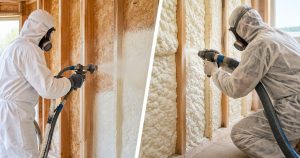
Open-cell retrofit foam – the acoustic specialist. Density around 0.5 lb/ft3 lets it flex and absorb mid-frequency sound (voices, TV dialogue) far better than rigid alternatives. This is the standard recommendation for spray foam insulation for older Calgary homes with original 2×4 party walls and no existing cavity insulation. Verdict: Buy.
Closed-cell foam in new party wall framing – the wildcard. In a brand-new duplex build or a home addition and renovation creating a fresh party wall, closed-cell's rigidity is less of a liability because the assembly can be engineered from scratch with resilient channel already planned in. On its own, without decoupling, it still underperforms open-cell acoustically. Verdict: Consider, only if decoupling hardware is part of the design.
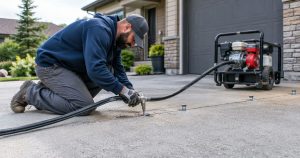
Injection foam into finished, closed cavities – the safe pick for occupied homes. Small-hole injection avoids demolishing drywall on either side of the wall, which matters when a neighbor's unit is occupied and you can't access their side. It fills the cavity without opening the wall to full studs. Verdict: Buy for retrofits where drywall removal isn't an option.
Foam sprayed against an attached garage shared wall. Homes where the garage backs onto a bedroom or living space see the same airborne-noise pattern as a duplex party wall, and the fix is nearly identical: spray foam insulation for garage walls and ceilings with open-cell foam plus sealed penetrations at the shared header. Verdict: Buy for garage-adjacent noise complaints.
DIY canned foam kits – the shortcut that isn't. Store-bought expanding foam cans can't match the density consistency or cavity fill rate of a professional rig, and gaps left behind become the flanking path that undoes the whole job. Verdict: Skip.
What to avoid
- Foaming only the cavity and skipping electrical boxes and plumbing penetrations. These are the leading flanking-noise culprits and the most commonly skipped step by inexperienced crews.
- Choosing closed-cell foam because a salesperson quotes a higher R-value. R-value sells easier than acoustic performance, but on an interior party wall it's the wrong sales pitch.
- Assuming foam alone hits soundproofing-grade results. Foam reduces airborne noise; it does not stop structure-borne vibration through shared framing without decoupling.
Verdict comparison
| Approach | Sound Improvement | R-Value per Inch | Best For | Verdict |
|---|---|---|---|---|
| Open-cell retrofit foam | Strong airborne absorption | R-3.6 to R-3.8 | Existing duplex/semi party walls | Buy |
| Closed-cell foam (no decoupling) | Weak, transmits vibration | R-6 to R-6.5 | Not recommended alone | Skip |
| Closed-cell + resilient channel | Strong, engineered | R-6 to R-6.5 | New builds/additions | Consider |
| Injection foam (closed cavity) | Moderate to strong | Varies by fill density | Occupied, finished homes | Buy |
| DIY canned foam | Minimal, inconsistent | Not rated for cavity fill | Nobody | Skip |
Get a shared-wall insulation quote
Aztec Spray Systems assesses party walls across Calgary, Okotoks, and Lethbridge.
FAQ
What’s the best insulation for soundproofing a shared wall?
Open-cell spray foam is the best insulation for soundproofing a shared wall in 2026 because its soft cell structure absorbs airborne sound rather than transmitting it. Closed-cell foam, despite a higher R-value, is denser and conducts more vibration.
Does spray foam insulation block sound between duplex units?
Spray foam reduces airborne sound between duplex units by sealing air gaps and absorbing vibration in the cavity, but it doesn’t fully block structure-borne noise traveling through shared framing. Pairing foam with resilient channel gets closer to full soundproofing.
Is open-cell or closed-cell spray foam better for noise reduction?
Open-cell spray foam is better for noise reduction because its lower density (around 0.5 lb/ft3) flexes and absorbs sound energy. Closed-cell foam is built for structural rigidity and moisture resistance, which works against acoustic performance on an interior wall.
How much does it cost to soundproof a shared wall in Calgary?
Cost depends on cavity access, wall length, and whether drywall needs to come down, and it varies by project scope. A detailed breakdown for typical Calgary jobs is available on the spray foam insulation cost page.
Can spray foam be added to an existing shared wall without removing drywall?
Yes, injection foam can be added through small drilled holes into a closed cavity without removing drywall on either side. This is the standard approach for occupied duplex and semi-detached homes where the neighboring unit isn’t accessible.
Does spray foam meet Alberta’s fire code for party walls?
Spray foam itself doesn’t replace the fire-rated drywall assembly required on Alberta party walls, and any wall opening has to restore that rating during patch-back. A licensed contractor accounts for firestopping at every penetration before closing the wall.
What STC rating do I need for a quiet shared wall?
A bare 2×4 wall with drywall on both sides typically rates around STC 33, and most homeowners aiming for real quiet target the high 30s to low 40s. Reaching that range usually needs insulation plus a decoupling method, not insulation alone.
How long does spray foam insulation take to install in a shared wall?
A single party wall section, whether sprayed through opened drywall or injected through small holes, is typically a same-day job for a licensed crew. Larger additions or full-height party walls in new construction take longer depending on square footage.
One last thing
The detail most homeowners miss: the loudest flanking path in a shared wall is almost never the drywall itself – it's the electrical outlet boxes mounted back-to-back on either side of the party wall, a common builder shortcut in older Calgary and Lethbridge duplexes. Sealing and offsetting those boxes during the foam job does more for perceived quiet than another inch of cavity fill.
Related guides
- Best spray foam insulation contractor for Calgary homeowners
- How much does spray foam insulation cost in Calgary