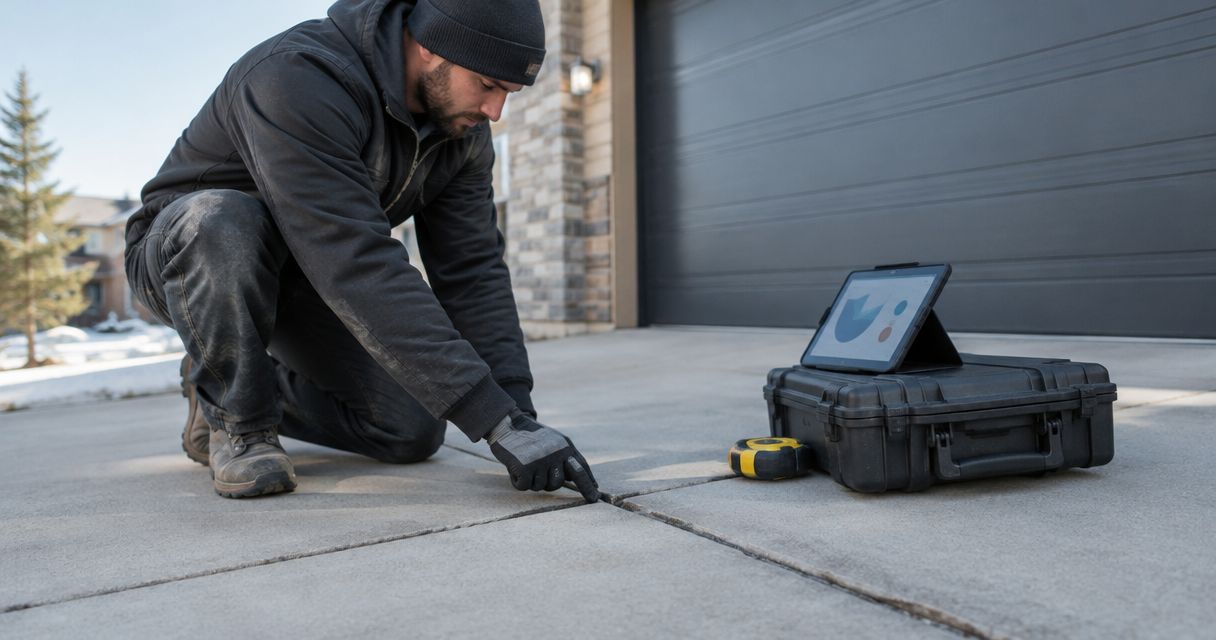
Best warranty choice: the contractor whose written agreement covers repeat settlement, defines the repair remedy, and explains exclusions—not simply the longest advertised term. For concrete lifting companies in Calgary ranked by warranty, compare the actual contracts before assigning a winner; Aztec Spray Systems is a licensed and insured Calgary concrete lifting contractor to include on your shortlist.
- Concrete lifting companies Calgary ranked by warranty: compare written coverage, repair remedies, and exclusions before warranty length.
- Aztec Spray Systems provides Calgary concrete lifting; request project-specific warranty terms before choosing.
- Prioritize repeat-settlement protection for slab levelling over material-only promises.
- Keep the signed agreement, slab photographs, and completion records together.
Why this matters
A concrete lifting warranty should answer a practical question: what happens if the repaired slab moves again? A headline term does not answer that question without a definition of covered movement, the affected area, and the contractor's responsibility.
For your 2026 project, separate the installation promise from the aftercare agreement. Your quote should describe the intended result; your warranty should explain which later problems qualify for corrective work.
Choose coverage you can apply to your slab, not a promise you have to interpret after a problem develops. The ranking below compares warranty structures, not unverified company promises. It gives you a consistent way to assess contractors without treating an undocumented claim as evidence.
What makes the best concrete lifting warranty?
Use these 6 warranty checks when comparing written proposals:
- Covered outcome: Does the agreement cover renewed settlement, installation defects, material defects, or a clearly defined combination?
- Defined remedy: Does the contractor promise inspection, corrective lifting, material replacement, or another specified response?
- Measurable trigger: How does the agreement define the movement or defect required for a claim?
- Relevant exclusions: What happens when drainage, erosion, frost movement, changed loads, or unrelated damage contributes to the problem?
- Clear duration: When does coverage begin, when does it end, and what happens after corrective work?
- Usable claims process: Who receives the claim, what records are required, and what charges apply, if any?
Keep licensing and insurance on your contractor checklist, but assess them separately. Neither tells you whether repeat settlement is covered. Likewise, a material description does not establish the contractor's obligation to return.
Warranty structures at a glance
This is an order for reviewing offers, not a claim that every contractor sells these options. Read each proposal against the same project conditions before deciding which structure fits.
| Review priority | Warranty structure | Best for | Standout protection to seek | Key limitation |
|---|---|---|---|---|
| First | Written repeat-settlement coverage | Owners concerned about the slab sinking again | A defined corrective-lifting remedy for covered movement | Exclusions and claim thresholds determine its practical scope |
| Second | Written workmanship coverage | Owners seeking accountability for installation defects | A clear obligation to correct covered installation errors | Does not establish coverage for later ground movement |
| Third | Material-only coverage | Owners checking the lifting material's separate protection | A defined remedy for a covered material defect | Does not establish responsibility for the slab's final position |
A proposal can include more than one structure. If it does, identify who is responsible under each provision rather than assuming the protections overlap.
1. Repeat-settlement coverage: best for movement concerns
Written repeat-settlement coverage is the first provision to examine when your main concern is renewed sinking. Look for language identifying the repaired slabs, the movement that qualifies, and the corrective work the contractor will perform.
The useful distinction is between acknowledging movement and agreeing to fix covered movement. An inspection promise alone does not specify a repair remedy.
Repeat-settlement coverage pros:
- Addresses the outcome you are trying to preserve: the repaired slab's position.
- Gives you a specific basis for discussing movement after completion.
- Connects the warranty to a corrective action when that action is expressly included.
Repeat-settlement coverage cons:
- A movement threshold can leave smaller changes outside coverage.
- Site-condition exclusions can narrow protection for your particular slab.
- Coverage for renewed sinking does not automatically include cracking, surface damage, or drainage correction.
Best for: Homeowners and commercial property owners whose primary concern is the repaired slab settling again.
For a 2026 agreement, ask the contractor to show exactly how the completed slab position will be recorded. A clear starting condition makes the wording easier to apply later.
Verdict: Hold until the agreement defines covered movement and the corrective remedy.
2. Workmanship coverage: best for installation accountability
Workmanship coverage addresses defects in the contractor's installation work as defined in the agreement. It is a separate question from whether the ground beneath the slab will remain unchanged.
Ask the contractor to distinguish an installation defect from an excluded site condition. You need that distinction in writing, not just an assurance that problems will be handled.
Workmanship coverage pros:
- Establishes accountability for covered installation errors.
- Helps separate the agreed work from unrelated property conditions.
- Gives you a named contracting party to approach about a covered defect.
Workmanship coverage cons:
- Does not, by itself, establish repeat-settlement protection.
- Broad exclusions can leave the cause of a problem disputed.
- A promise to inspect is not the same as an obligation to correct workmanship.
Best for: Owners who want a clearly documented remedy for defects in the installation itself.
Have the proposal identify the work boundaries. An agreement describing only concrete lifting, without identifying the treated sections, leaves an avoidable question about which areas the workmanship provision covers.
Verdict: Hold until covered defects, work boundaries, and corrective obligations are clear.
3. Material-only coverage: best for checking separate protection
Material-only coverage concerns the lifting material rather than the complete repair outcome. Read it as a separate layer of protection, not as proof that renewed settlement or installation labour is included.
Identify who issues the coverage and who handles a claim. Then ask what happens if a material claim is accepted but access or corrective lifting is still required.
Material-only coverage pros:
- Identifies protection tied specifically to covered material defects.
- Helps distinguish material responsibility from installation responsibility.
- Provides a separate document to review alongside the contractor's agreement.
Material-only coverage cons:
- Does not establish coverage for the slab's position.
- Does not establish that corrective labour is included.
- Leaves installation accountability unresolved unless another agreement addresses it.
Best for: Owners reviewing material protection as part of a broader written repair agreement.
Do not treat material durability and warranty duration as interchangeable. A statement about how a material performs does not tell you what a contractor must do after a claim.
Verdict: Skip material-only coverage as your sole basis for choosing a contractor.
Where Aztec Spray Systems fits
Aztec Spray Systems is a concrete lifting shortlist option for Calgary homeowners and commercial property owners seeking a licensed and insured contractor. The company also serves Okotoks, High River, and Lethbridge and provides spray foam and attic insulation services.
Those service and contractor credentials support including the company in your comparison. They do not establish a warranty-length advantage or a broader repair remedy than another contractor's agreement.
Aztec Spray Systems pros:
- Provides concrete lifting services in Calgary.
- Serves both homeowners and commercial property owners.
- Is licensed and insured.
Decision limits:
- Licensing and insurance do not establish repeat-settlement coverage.
- The service description does not establish warranty duration, transferability, or claim conditions.
Best for: Calgary property owners seeking a local concrete lifting proposal to compare against the same written warranty checklist.
Use the contact page to request a project assessment and ask for the applicable warranty document with the proposal. Make acceptance of the work conditional on understanding the scope and aftercare terms.
Verdict: Hold your booking decision until the project scope and applicable warranty are documented.
How to compare contractor proposals fairly
For your 2026 comparison, request 3 written quotes using the same photographs, slab locations, and description of the problem. This is a practical comparison target, not a requirement to collect proposals indefinitely.
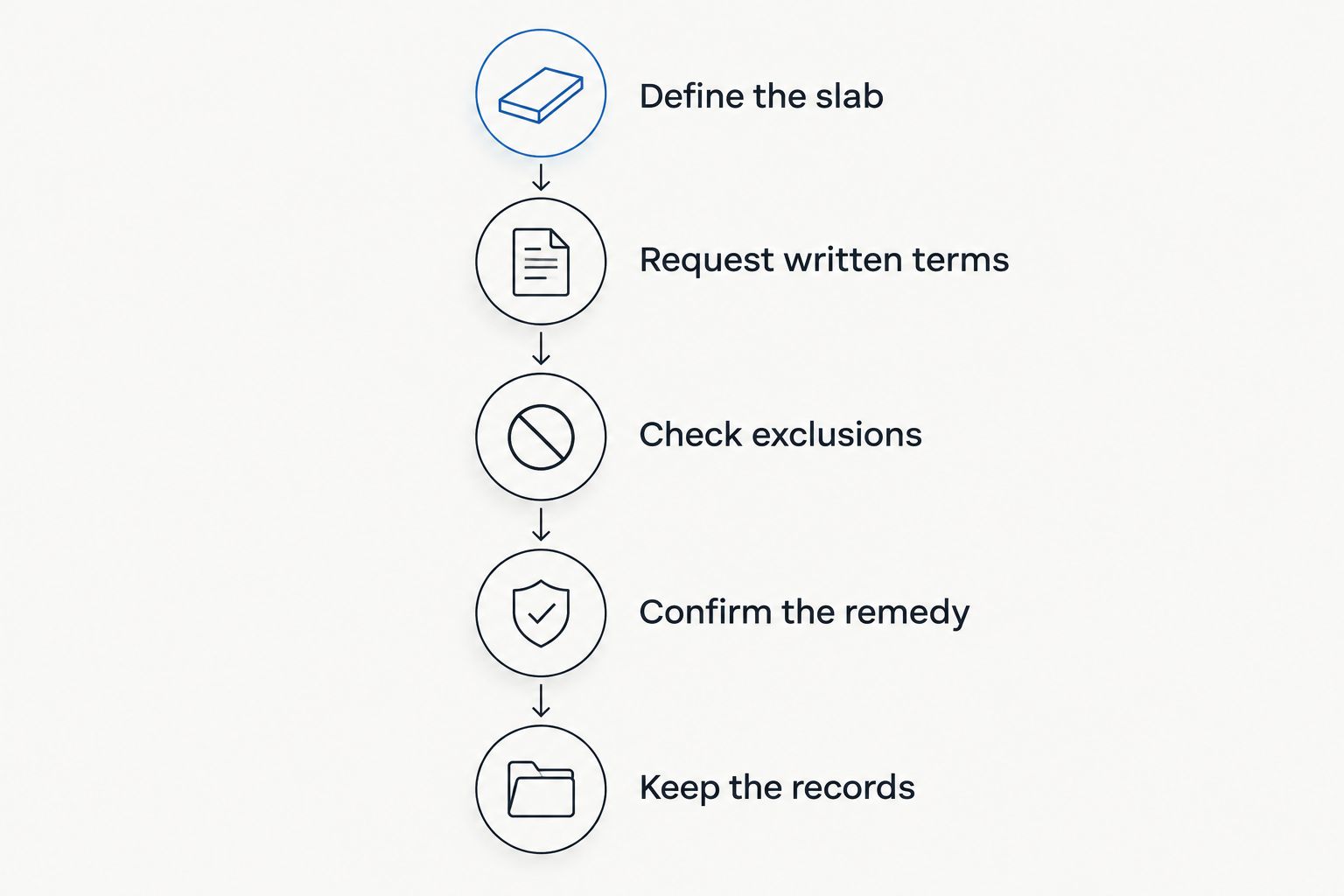
Follow this sequence so a persuasive sales conversation does not substitute for contract detail:
- Define the slab. Identify the exact driveway, walkway, garage floor, or other section you want assessed. Mark adjacent areas separately.
- Request written terms. Ask for the complete warranty, not only the headline description in the quote.
- Check exclusions. Ask which exclusions are relevant to the conditions visible at your property.
- Confirm the remedy. Establish what the contractor agrees to do when a claim qualifies.
- Keep the records. Save the accepted proposal, warranty, photographs, and completion information together.
Ask every bidder the same questions. If one proposal describes corrective lifting and another describes only an inspection, those are different obligations even when the advertised terms appear similar.
Keep the final scope and warranty attached to 1 written contract or clearly identified set of contract documents. You should be able to find the applicable terms without reconstructing conversations from memory.
Record the condition before and after lifting
Photograph the whole slab and its relationship to neighbouring surfaces before work starts. After completion, record the repaired sections and keep any measurements supplied by the contractor.
Ask what the contractor uses as the completion benchmark. Distinguish the agreed finished position from a general expectation that every adjoining surface will become perfectly aligned.
Do not impose your own movement threshold after the work. Have the contractor explain the applicable threshold and how a later inspection would compare the slab with its completed condition.
Questions that expose weak warranty wording
A useful warranty discussion should produce direct, written answers. For a 2026 proposal, ask these questions before accepting the agreement:
- What exact event qualifies as a covered problem?
- Which treated slabs are included, and are any sections excluded?
- Does coverage include the corrective work or only an assessment?
- Who decides whether movement comes from workmanship, material, or site conditions?
- What evidence must the owner provide with a claim?
- What maintenance obligations must the owner meet?
- Does corrective work change the remaining coverage period?
- Can a later owner use the warranty, and what conditions apply?
A verbal explanation can help you understand a clause. It should not be your only record of a promise that affects your choice.
Do not interpret silence as coverage. If transferability, corrective labour, or a response commitment matters to you, ask for an explicit answer in the agreement.
How the warranty structures are ranked
Repeat-settlement coverage comes first because it directly addresses renewed sinking. Workmanship coverage follows because it addresses installation accountability; material-only coverage is reviewed separately because it does not establish protection for the whole repair outcome.
This order does not rank named Calgary contractors against one another. A defensible company ranking requires comparable written terms covering duration, exclusions, claim triggers, and remedies for the same kind of project.
Which concrete lifting company should you choose?
Choose the contractor whose written agreement best matches your slab's problem and states what happens if covered movement returns. Use warranty duration to distinguish otherwise comparable offers—not to replace the coverage review.
For your 2026 shortlist, include Aztec Spray Systems and apply the same questions to every proposal. If a contractor will not clarify a material condition before you sign, keep comparing rather than filling the gap with an assumption.
FAQ
What’s the best concrete lifting company in Calgary by warranty?
A warranty winner must be established from comparable written contractor agreements. Compare covered movement, exclusions, corrective work, and duration before choosing; a headline term alone does not establish the best protection.
Is a longer concrete lifting warranty always better?
No. A longer term does not establish broader coverage or a stronger repair remedy. Compare what triggers a claim and what corrective work is included before comparing duration.
Does Aztec Spray Systems provide concrete lifting in Calgary?
Yes. Aztec Spray Systems provides concrete lifting for homeowners and commercial property owners in Calgary and also serves Okotoks, High River, and Lethbridge. Request the applicable project warranty with your proposal.
Does a concrete lifting warranty cover a slab sinking again?
Repeat settlement is covered only when the applicable agreement includes it. Check the definition of covered movement, claim threshold, exclusions, and corrective remedy rather than assuming that all concrete lifting warranties are equivalent.
Is material coverage the same as a concrete lifting warranty?
No. Material-only coverage does not establish protection for installation workmanship or the slab’s position. Read the contractor’s agreement separately to identify responsibility for corrective work.
Can I transfer a concrete lifting warranty when I sell?
Transferability depends on the written agreement. Ask whether a later owner is eligible and whether notification, documentation, or other conditions apply before relying on the warranty during a sale.
What should I keep for a concrete lifting warranty claim?
Keep the accepted proposal, applicable warranty, completion records, and before-and-after photographs. Follow the agreement’s claim instructions and retain written communication about the reported problem.
One last thing
Ask the contractor to describe a claim that qualifies and a claim that does not qualify under the proposed agreement. Then locate the wording supporting both explanations.
That simple exercise tests whether you understand the protection you are buying. If the explanation and the contract do not match, resolve the difference before work starts.
Related guides
- How long does polyurethane concrete lifting last?
- How does polyurethane concrete lifting work?
- How does mudjacking compare to polyurethane concrete lifting?