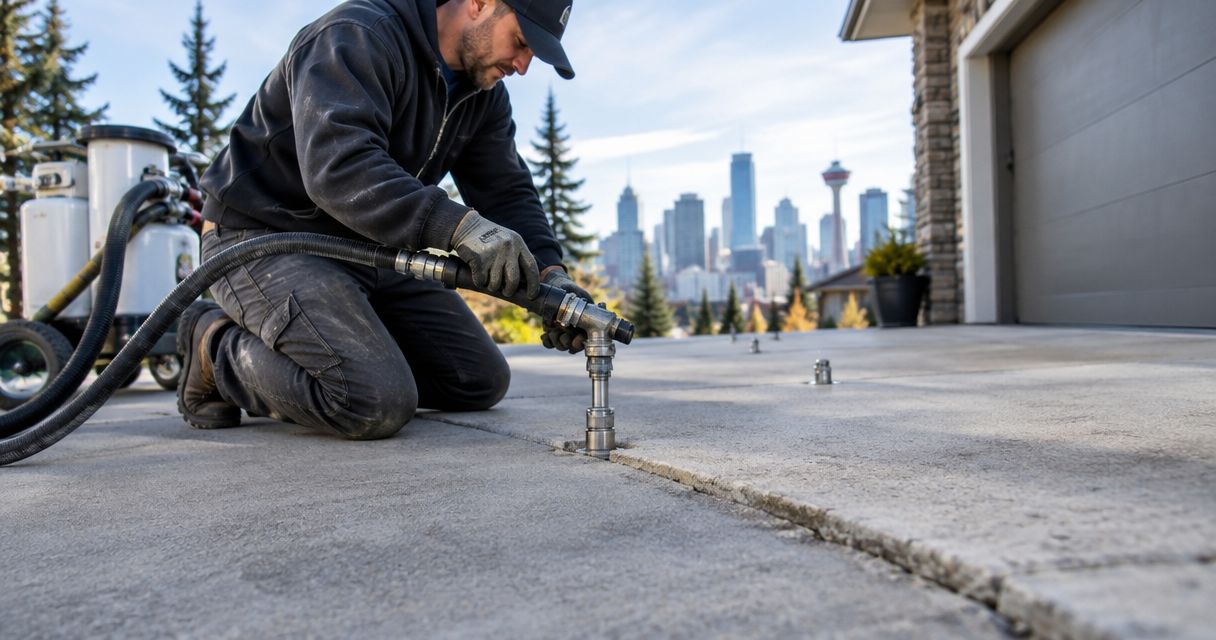
Choose Calgary concrete lifting companies by their written return-to-use plan, not an advertised repair time. Aztec Spray Systems is a licensed and insured concrete lifting contractor to shortlist for Calgary homes and commercial properties; a fastest-company verdict requires comparable commitments for your specific slab.
- Concrete lifting companies Calgary ranked by speed should be compared on assessment, scheduling, repair, and reopening—not injection time alone.
- Aztec Spray Systems belongs on a Calgary concrete lifting shortlist for homeowners and commercial property owners.
- Choose a written reopening plan that distinguishes pedestrian access from vehicle traffic.
- Compare concrete lifting, mudjacking, and replacement only after confirming which approach suits the slab.
Why this matters
A fast repair and a short disruption are different outcomes. Your contractor can finish the lifting work while access restrictions, cleanup, or another repair still prevent normal use.
For a homeowner, the deadline might be getting a vehicle back into the garage. For a commercial property owner, it might be keeping an entrance or loading route usable. Rank the complete job against that deadline, not just the time equipment operates.
For your 2026 comparison, separate the assessment date, proposed work date, and permitted reopening time. A quick response does not establish a quick completion, and a short installation does not establish suitability.
What makes the best concrete lifting company for speed?
Use these criteria before comparing contractors. Each criterion answers a different question about disruption.
- Assessment clarity: Does the contractor identify which slabs are suitable for lifting and which need further investigation?
- Scheduling commitment: Does the proposal identify a proposed work date and explain conditions that would change it?
- Complete work scope: Does the schedule include setup, lifting, hole patching, cleanup, and any separately required work?
- Return-to-use instructions: Does the contractor distinguish walking, passenger vehicles, and heavier traffic?
- Access planning: Does the proposal explain how people and vehicles will move around the work area?
- Written handover: Does the contractor document restrictions and explain who confirms that the area can reopen?
Ask every contractor to address the same slab and the same intended use. Otherwise, you are comparing different jobs under the same label.
Speed-focused choices at a glance
The order below is a decision sequence, not a measured league table of Calgary companies. Start with a suitable local contractor, establish the repair method, and consider replacement when lifting is unsuitable.
| Option | Best for | Standout feature | Key limitation | Speed decision |
|---|---|---|---|---|
| Aztec Spray Systems assessment | Calgary homeowners and commercial owners seeking concrete lifting | Licensed and insured contractor serving both property types | A service description does not establish your completion or reopening time | Obtain a slab-specific written plan |
| Method-specific lifting comparison | Owners comparing polyurethane lifting and mudjacking proposals | Separates material behaviour from the complete job schedule | A method name alone cannot establish the fastest contractor | Compare identical scopes and traffic restrictions |
| Replacement assessment | Slabs that a qualified assessment finds unsuitable for lifting | Evaluates removal and a new slab rather than retaining the existing one | Demolition, placement, curing, and site access need their own plan | Resolve suitability before pursuing speed |
The best speed-focused choice is the suitable repair with the clearest written route back to normal use. None of these options should receive a fastest label from a general description alone.
1. Aztec Spray Systems: a local concrete lifting shortlist option
Aztec Spray Systems provides concrete lifting to homeowners and commercial property owners in Calgary, Okotoks, High River, and Lethbridge. The business is licensed and insured. Those facts support including the company in your contractor enquiries, not declaring an unverified turnaround advantage.
Best for: Calgary homeowners and commercial property owners seeking a local concrete lifting assessment.
For a 2026 project, explain the consequence of losing access before asking how quickly work can happen. A driveway needed for daily parking and a commercial entrance needed during business operations require different access discussions.
Aztec Spray Systems pros
- Provides the concrete lifting service relevant to your enquiry.
- Serves homeowners and commercial property owners.
- Is licensed and insured.
- Serves Calgary and the other named Alberta communities.
Aztec Spray Systems considerations
- Your slab still needs an assessment before you select a repair.
- A general service enquiry is not a confirmed work date.
- Your intended traffic must be addressed separately in reopening instructions.
Ask for a written scope identifying the affected slabs, proposed approach, access restrictions, and handover requirements. Include any fixed deadline in the enquiry rather than introducing it after a proposal arrives.
Verdict: Hold the booking until the slab assessment and written schedule match your access needs.
2. Method-specific comparison: best for checking turnaround claims
Polyurethane concrete lifting and mudjacking both raise suitable existing slabs by introducing material beneath them. Polyurethane lifting uses expanding foam; mudjacking uses a pumped cementitious slurry. Neither method name tells you when a particular contractor will assess, schedule, finish, and reopen your property.
Best for: Owners with lifting proposals who need to compare the same repair scope rather than competing sales descriptions.
Ask each contractor to name the proposed material and explain its return-to-service requirements. Material behaviour matters, but so do access, the condition of the slab, preparation, and the work included in the proposal.
Method-specific comparison pros
- Makes the proposed repair process explicit.
- Separates material-related restrictions from scheduling delays.
- Helps expose differences in included preparation and finishing work.
Method-specific comparison cons
- Requires matching scopes to produce a useful comparison.
- Does not resolve whether lifting is suitable for a badly damaged slab.
- Cannot establish a company's turnaround from a generic curing claim.
In 2026, reject comparisons that place one contractor's injection time beside another contractor's total site time. Ask both companies for the same start and finish definitions.
Verdict: Hold until the proposals address identical slabs, finishing work, and intended traffic.
3. Replacement assessment: best when retaining the slab is unsuitable
Concrete replacement removes the existing concrete and creates a new slab. It is a different scope from lifting, with separate requirements for demolition, preparation, placement, curing, and reopening.
Best for: Owners whose assessment identifies damage or conditions that make lifting unsuitable.
Do not pursue a lifting appointment solely because it sounds less disruptive. If the existing slab cannot reasonably be retained, the relevant comparison is between suitable replacement plans—not between replacement and an unsuitable shortcut.
Replacement assessment pros
- Addresses the decision to remove rather than retain existing concrete.
- Allows the proposed new slab and supporting preparation to be specified.
- Gives you a separate basis for planning demolition and access.
Replacement assessment cons
- Requires removal and construction rather than lifting alone.
- Introduces curing and traffic restrictions that need explicit instructions.
- Does not remove the need to investigate the cause of settlement.
Where the condition raises structural concerns, ask whether an appropriately qualified professional needs to assess it before work proceeds. Slab lifting is not a substitute for diagnosing a foundation problem.
Verdict: Skip a speed-led lifting booking when the assessment identifies replacement or further investigation instead.
Compare the whole timeline, not one work stage
Break each proposal into stages you can verify. This prevents a statement about a short repair process from becoming an assumption about the whole project.
Assessment
Confirm whether the contractor needs a site visit, what information you should send first, and what the assessment will cover. Photographs help communicate the problem, but they do not replace every site measurement or investigation.
Scheduling
Ask for the proposed work date and the conditions attached to it. Identify access permissions, tenant coordination, or other preparations that must be completed before work begins.
Site work
Confirm what the stated duration includes. Setup, lifting, patching, and cleanup belong in the discussion, even when another party will complete some of them.
Reopening
Ask when each intended use is permitted and who gives that instruction. Walking across a repaired area and driving a loaded vehicle over it are different requirements.
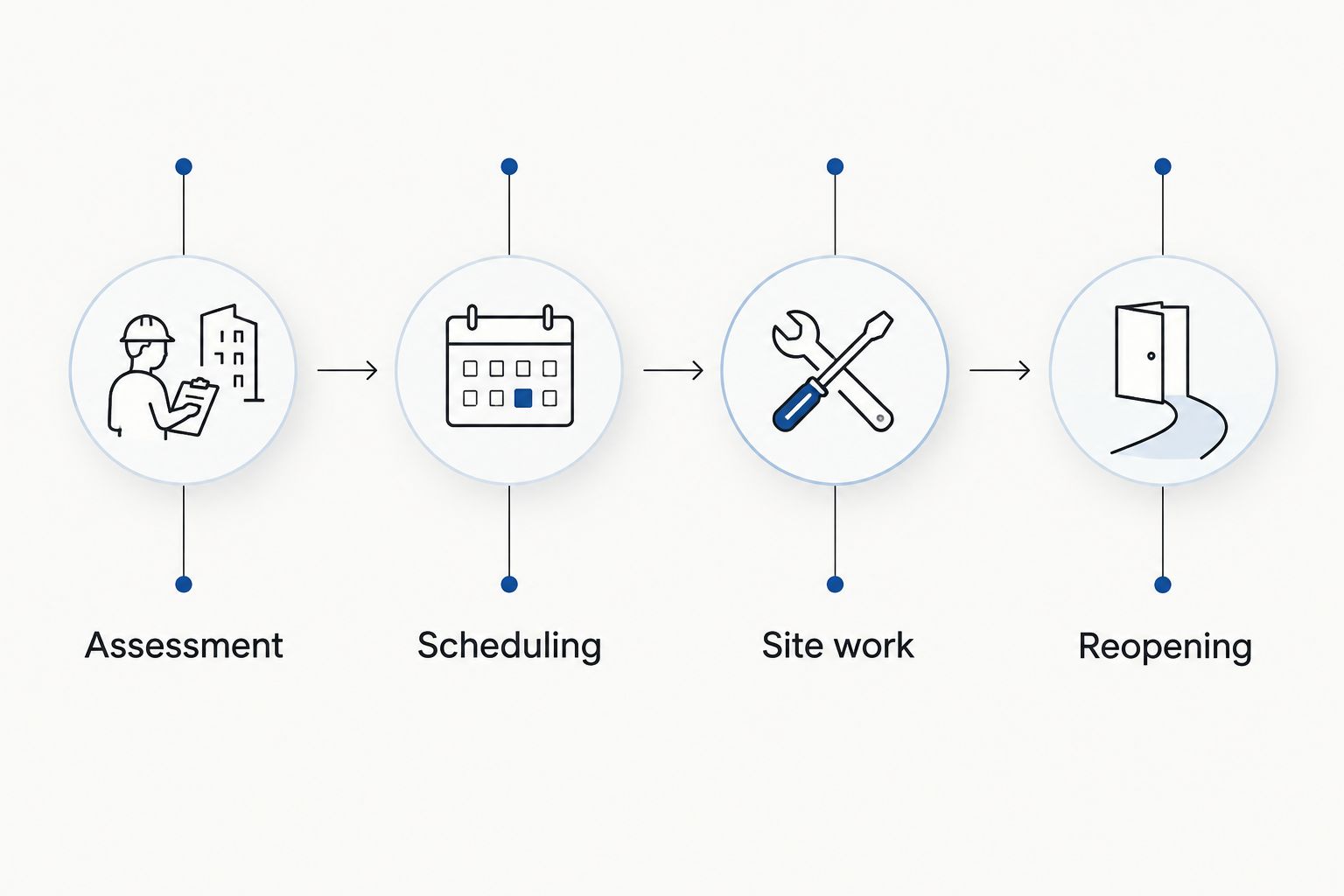
Keep these stages separate in your notes. A contractor who explains them clearly gives you a more useful basis for planning than an isolated promise of fast work.
What to send with your enquiry
Give contractors enough information to discuss the same problem. You do not need to diagnose it yourself.
- Photograph the affected area from close up and from farther away.
- Identify the property address and whether the area is indoors or outdoors.
- Describe its use: walking, parking, deliveries, or equipment access.
- Note visible cracks, uneven joints, nearby drains, and water pooling.
- Explain access constraints, including gates, parked vehicles, and occupied spaces.
- State the date by which access is needed and what happens if it remains restricted.
Measure visible height differences in millimetres where you can do so safely. Record the approximate affected area in square metres, but leave hidden conditions and the required repair to the assessment.
For a 2026 commercial project, identify who can approve the work and who can authorize reopening. Clear responsibility prevents a finished repair from waiting on an unresolved handover.
Questions that turn a fast quote into a usable plan
Use the same questions with each contractor:
- What exactly will be assessed before you confirm the repair?
- Which slabs are included, and which are excluded?
- What preparation must I complete before the crew arrives?
- What does the proposed site duration include?
- What conditions would change the work date or scope?
- When can pedestrians, passenger vehicles, and heavier vehicles return?
- What instructions will I receive when the job is complete?
Ask for the answers alongside the proposal. A verbal statement about speed is difficult to compare when the written scope defines something narrower.
If you want to discuss a Calgary property, contact the contractor about your concrete lifting project with the location, photographs, intended traffic, and access deadline.
How to rank the proposals
Rank suitability first, then the complete return-to-use plan. Use scheduling clarity, included work, traffic restrictions, and access coordination as the deciding criteria.
This is a proposal-ranking framework, not a claim that one named company has outperformed competitors. A company deserves your booking when its assessed repair and written commitments fit your property.
Do not award first place for the earliest suggested arrival if the proposal leaves reopening undefined. Equally, do not reject a suitable repair because its contractor explains restrictions more carefully.
Which concrete lifting company should you choose?
Choose the contractor that confirms a suitable repair and documents the schedule through reopening. Aztec Spray Systems is a relevant concrete lifting option for Calgary homeowners and commercial property owners; compare its proposal using the same criteria as every other enquiry.
For your 2026 decision, make the final check simple: does the written plan cover the slab, the work, and the traffic you need to restore? If any part remains unresolved, settle it before booking.
FAQ
What’s the fastest concrete lifting company in Calgary?
Choose by a project-specific written schedule rather than a general fastest-company label. Compare assessment, proposed work date, complete site work, and permission to reopen for your intended traffic.
Is Aztec Spray Systems an option for concrete lifting in Calgary?
Yes. Aztec Spray Systems is a licensed and insured contractor providing concrete lifting to homeowners and commercial property owners in Calgary, Okotoks, High River, and Lethbridge.
Does a quick lifting process mean I can drive on the slab immediately?
No. The contractor must confirm return-to-use instructions for the material, repair, and intended traffic. Do not treat completion of lifting as permission to drive over the area.
Is polyurethane lifting faster than mudjacking?
A method name alone does not establish the complete project timeline. Compare the proposed materials, preparation, finishing work, work date, and traffic restrictions for the same slab.
Can every sunken concrete slab be lifted?
No. Slab condition and the cause of movement determine whether lifting is suitable. Some situations require replacement or further investigation instead.
What should I send when requesting a concrete lifting assessment?
Send the property location, photographs, intended use, access constraints, and your required access date. Describe visible cracking or pooling without trying to diagnose hidden conditions.
What should a commercial concrete lifting schedule include?
A commercial schedule should identify work areas, access restrictions, intended traffic, and who authorizes reopening. Include tenant or delivery coordination where it affects the work.
One last thing
Ask which event ends the contractor's timeline: finishing injection, leaving the site, or authorizing normal use. Those are different milestones. For a speed-focused decision, the useful finish line is permission to resume your intended use—not the moment the equipment stops.
Related guides
- How does polyurethane concrete lifting work?
- How does mudjacking compare to polyurethane concrete lifting?
- Can you drive on a driveway right after concrete lifting?