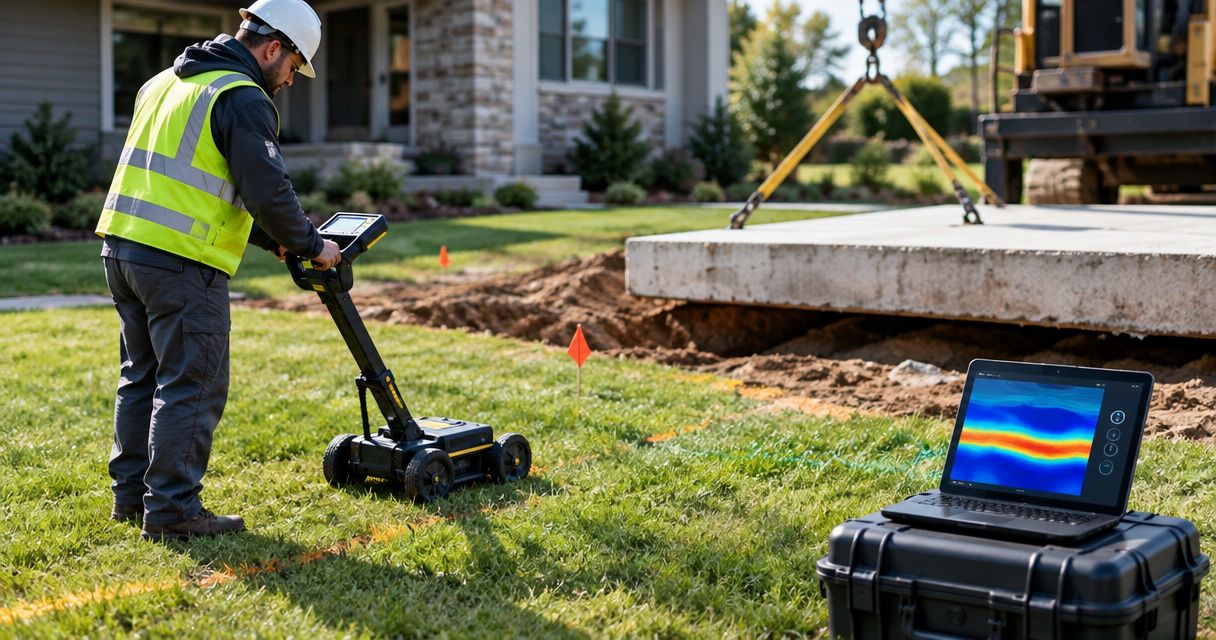
Instead of chasing locate emails before the crew arrives, connect your utility locate before concrete lifting to a single job record containing the work boundary, utility responses, private-service checks, and contractor review. Make that review a condition of starting work—not an attachment someone opens after drilling begins.
- A utility locate before concrete lifting belongs in the job record, alongside private-service checks and the contractor’s work plan.
- Aztec Spray Systems provides concrete lifting for Alberta homeowners and commercial property owners.
- A submitted locate request is not permission to drill; review responses, coverage, and restrictions first.
- Utility locating and concrete scanning address different hazards; neither replaces the contractor’s site assessment.
Why this matters
Concrete lifting involves drilling into a slab and introducing material beneath it. Buried services, embedded heating, and other concealed features belong in the planning conversation, even when the surface repair looks small.
Aztec Spray Systems is a concrete lifting contractor for homeowners and commercial property owners in Calgary, Okotoks, High River, and Lethbridge. You can introduce your project through Aztec Spray Systems and explain which utility records you already hold.
The useful connection is procedural: the locate information must match the actual repair area, reach the person planning the work, and remain applicable when work starts. A ticket number alone does not establish those conditions.
For a 2026 project, keep current responses with the current scope. An older drawing remains background information, not proof that today’s work area has been checked.
Before you start
- Project access: Have the site address, owner or manager’s authorization, access arrangements, and a marked-up photo or sketch showing the proposed repair area. Identify who will coordinate the locate request with the contractor.
- A shared job record: Use a folder, work order, or project record that the owner and contractor can access. Include space for the request, responses, drawings, photographs, restrictions, and unresolved questions.
- The non-obvious gap: A utility-notification request does not automatically cover every privately owned service or identify everything embedded in concrete. Tell the contractor about irrigation, detached-building supplies, heating loops, drains, and previous alterations before the work plan is finalized.
Do not drill, probe, or expose a service yourself to resolve uncertainty. The contractor and relevant utility owner or qualified specialist must determine the appropriate verification and protection measures.
Work boundary and job record
Start with a defined repair area, not just a street address. A driveway, garage apron, and adjoining walkway can involve different service routes and access conditions.
The bold labels below are suggested headings for your own job record, not buttons or fields in a particular software product.
- Create Work area. Attach a sketch showing the slab sections being considered, nearby buildings, access routes, and visible service features. Have the contractor confirm the boundary needed for the proposed work.
- Create Project contacts. Record the property representative, lifting contractor, locate coordinator, and relevant utility contacts supplied through the locate process.
- Create Locate documents. Store the request confirmation and each response together. Keep attachments with the response that explains them.
- Create Open questions. List unknown services, drawing conflicts, inaccessible areas, and proposed scope changes. Assign a person to resolve each question.
Expected result: Someone opening the record can identify where the work is proposed, who is coordinating it, and what remains unresolved.
Keep photographs tied to recognizable features such as a garage entrance or slab joint. A close-up of paint without surrounding context is difficult to match to a work area later.
For a 2026 job folder, use the planned work date in the folder name and retain dated revisions. Do not overwrite the original sketch when the scope changes.
Locate coverage and response review
Use Alberta’s utility-notification process to establish which participating utility owners must respond to the proposed work. Confirm current submission requirements, response arrangements, and ticket conditions directly through that process; do not build your schedule around an assumed turnaround.
- Agree with the contractor who will submit and manage the request. Describe the actual activity, including concrete drilling and lifting, rather than using an unrelated work description.
- Submit the contractor-confirmed work boundary and the requested site details. Save the confirmation under Locate documents.
- Track each response associated with the request. Record its coverage, instructions, limitations, and any further action required.
- Ask about privately owned services separately. Supply available drawings and maintenance records, and arrange qualified private locating where the project requires it.
- Have the contractor identify whether embedded features require concrete scanning or another suitable investigation. Surface utility marks do not establish that a slab contains no heating lines, conduits, or reinforcement.
Expected result: The record distinguishes completed responses from outstanding ones and identifies services or slab features outside the original locate coverage.
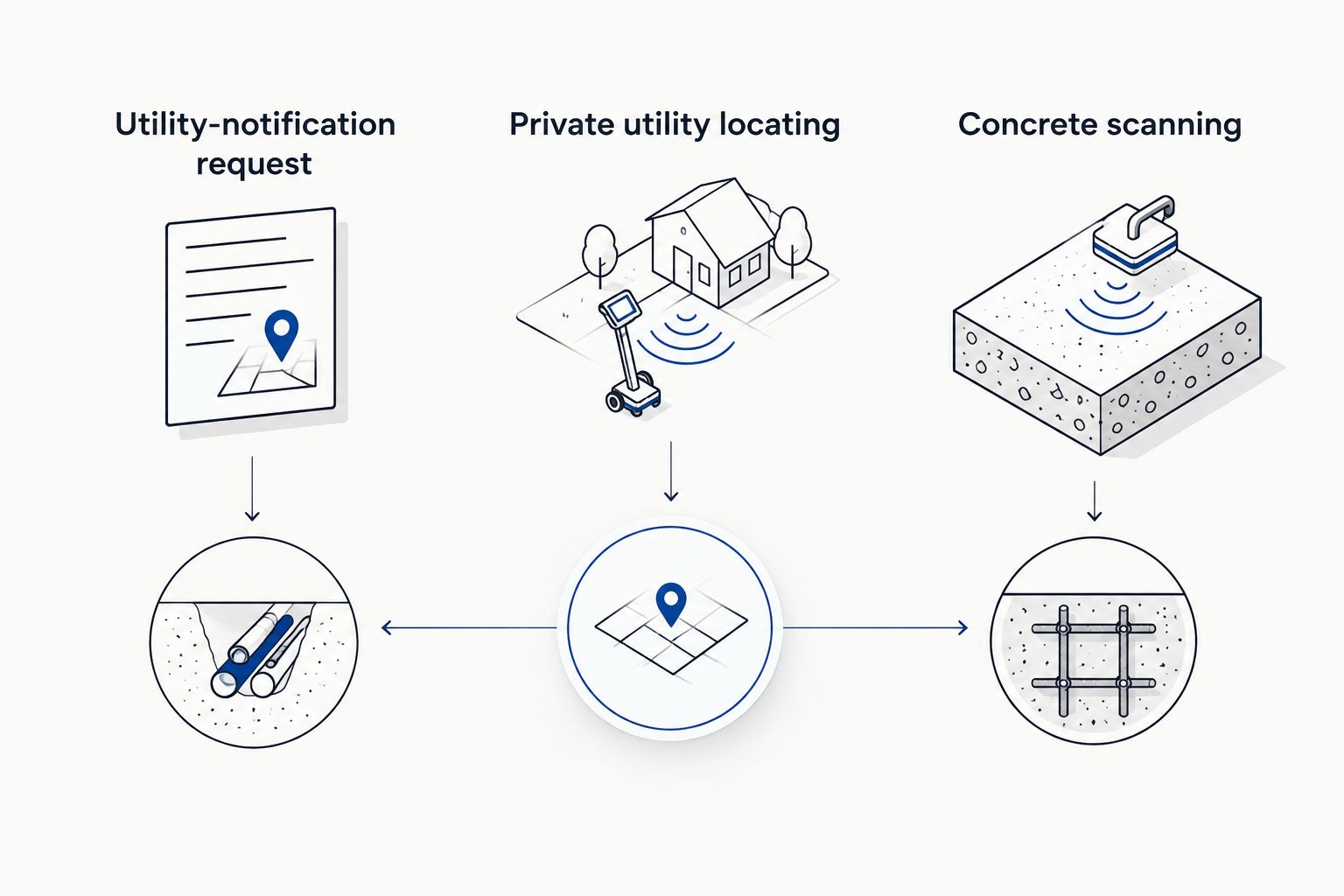
Which check addresses which hazard?
These checks serve different purposes. Choose the checks that match the site; do not treat them as interchangeable substitutes.
| Check | Best for | Benefit | Limitation |
|---|---|---|---|
| Utility-notification request | Coordinating responses from participating utility owners | Establishes a documented response process for the stated work area | Does not automatically cover all privately owned services |
| Private utility locating | Investigating owner-managed buried services | Addresses services outside participating utility-owner coverage | Detection depends on the service, access, equipment, and site conditions |
| Concrete scanning | Investigating concealed slab features before drilling | Helps assess embedded hazards within the investigation’s scope | Does not replace buried-utility locating or guarantee every feature is detected |
A private locator’s report also needs a scope and limitations review. “Survey completed” is not the same statement as “every possible service has been identified.”
Contractor review and work release
The handoff matters more than the filing system. Before drilling starts, the person responsible for planning the lifting work must review the locate information against the site and proposed method.
- Assemble 4 document groups: the work-area sketch, utility responses, private-service or scanning reports where required, and site photographs. Keep restrictions visible rather than buried in email chains.
- Confirm that the responses apply to the proposed work date and boundary. Follow the stated validity, renewal, and preservation conditions; do not assume a universal expiry period.
- Walk through the area with the contractor. Identify marks, service entries, drains, heating controls, and any mismatch between records and visible conditions.
- Ask the contractor to explain how the work plan addresses identified services and remaining uncertainty. Utility-owner instructions and applicable safety requirements govern the necessary precautions.
- Record the contractor’s review and any conditions before scheduling the work to proceed. Keep unresolved hazards on hold rather than interpreting silence as acceptance.
Expected result: The contractor has reviewed the current information, the planned work stays within its assessed scope, and unresolved conflicts prevent the affected work from starting.
Use 3 review checkpoints in your 2026 project plan: before confirming the work date, at the site handoff, and whenever the scope changes. These are project controls, not a substitute for regulatory or utility-owner requirements.
Aztec Spray Systems provides concrete lifting, but a service booking is not evidence that a particular locate, scan, or utility-owner approval has been completed. Confirm the responsibilities for your property explicitly.
When the work area or schedule changes
A useful second workflow is a change-triggered review. Apply it whenever another slab is added, the drilling area moves, the start date changes, or a service appears that was missing from the original record.
- Mark the job record Review required and identify the affected work. These are your own administrative labels, not a prescribed software setting.
- Save a revised boundary sketch and describe the change. Keep the original version for reference.
- Ask the contractor and relevant locate or utility contacts whether the existing responses still apply. Arrange updates, renewed responses, or additional investigation as required.
- Repeat the site review before releasing the affected work.
Expected result: A changed job cannot proceed solely on information collected for a different scope or date.
For example, adding a walkway beside a garage requires a coverage review even when the driveway was already assessed. Physical proximity does not prove that the added area falls within the original request.
For phased 2026 commercial work, maintain separate status notes for each area. Do not let a reviewed section make an unreviewed section appear ready.
Troubleshooting
The request exists, but responses are still outstanding
Keep the affected work on hold. Check the request status and follow up through the designated notification process or responding utility owner. A confirmation number proves submission, not that every required response is complete.
Paint or flags are missing or difficult to interpret
Preserve the remaining marks and contact the responsible locator or utility owner for clarification or remarking as required. Photographs help explain what changed, but they do not replace required field markings or instructions.
A private service appears on an old drawing
Add the drawing to Open questions and tell the contractor before work proceeds nearby. Arrange an appropriate assessment; do not assume that an unmarked irrigation pipe, power supply, or drainage connection is abandoned.
The locate report and visible site features disagree
Stop planning work through the disputed area and request clarification. A visible conduit, service entry, or utility structure that does not match the records is a conflict to resolve, not a reason to choose whichever source seems more convenient.
The crew arrives without the latest documents
Open the shared record and verify the revision with the contractor before the affected work begins. If access fails, provide a readable copy through an agreed channel and confirm receipt; an unreadable attachment is not a completed handoff.
Customize your workflow
For a single residential repair, one shared folder and a named coordinator keep responsibilities clear. For a commercial property, add access permissions, tenant notices, delivery restrictions, and the person authorized to resolve site questions.
Keep utility verification separate from the repair decision. A locate does not determine whether lifting is suitable for a damaged slab, and it does not establish the cause of settlement. Discuss those questions during the contractor’s assessment.
If you need the construction sequence explained, read how polyurethane concrete lifting works. Use that sequence to ask when utility information, slab investigation, and site access must be ready.
For your 2026 handoff, send the work boundary and unresolved questions together. A neat folder helps, but a clearly stated uncertainty is more useful than a document marked complete without review.
FAQ
Do I need a utility locate before concrete lifting?
Arrange a utility-risk review before concrete lifting and confirm the locate requirements with your contractor and relevant utility owners. Drilling and work beneath a slab require attention to buried services and concealed slab features; do not assume a small repair is exempt.
Does a utility locate show everything beneath my driveway?
No, a utility locate does not establish that everything beneath a driveway has been identified. Participating utility-owner coverage, privately owned services, and concealed slab features require separate consideration.
Who should request the locate for my concrete lifting job?
Agree with the lifting contractor who will submit and manage the locate request before scheduling the work. Record that responsibility and ensure the request describes the contractor-confirmed work area and activity.
Can concrete lifting start once I have a ticket number?
A ticket number alone is not enough to start concrete lifting. Required responses, coverage, restrictions, private-service questions, and the contractor’s work plan must be reviewed first.
Is concrete scanning the same as utility locating?
No, concrete scanning and utility locating address different investigation needs. Scanning assesses concealed slab features within its scope, while buried-service locating addresses underground services; neither guarantees that every hazard has been detected.
What happens if my concrete lifting date changes?
Have the contractor check whether the locate responses and site markings remain applicable to the revised date. Follow the actual ticket conditions and obtain updates or remarking where required rather than assuming a standard validity period.
Can Aztec Spray Systems assess my concrete lifting project?
Aztec Spray Systems provides concrete lifting services to homeowners and commercial property owners in Calgary, Okotoks, High River, and Lethbridge. Share the proposed repair area and existing utility information, then confirm the assessment scope and each party’s responsibilities.
One last thing
The most useful handoff includes what you do not know. Put unresolved services, unclear marks, and missing drawings at the top of the job record—not beneath a pile of completed attachments. That gives the contractor a clear reason to investigate before drilling.
Related guides
- Concrete lifting for Calgary homes and driveways
- Concrete lifting for septic lids and utility vaults
- Connecting a building permit to your concrete lifting project