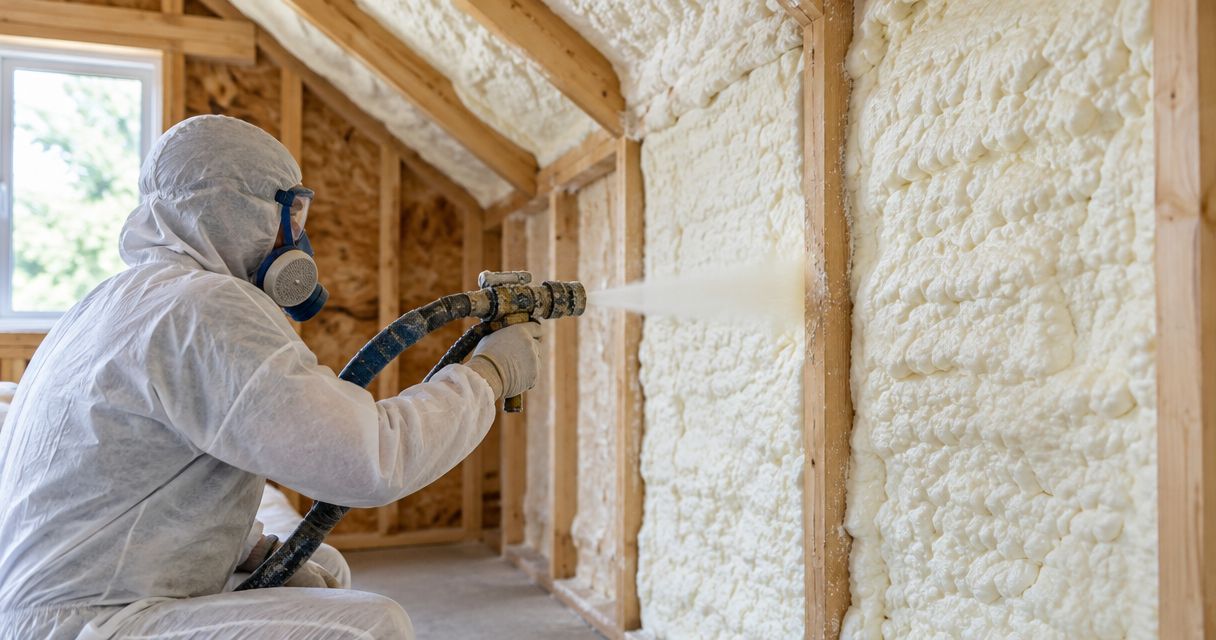
Spray foam insulation can remain in service for the life of a building when correctly installed, protected and kept in a sound building assembly; it has no universal age-based replacement deadline. That does not make every installation permanent: leaks, poor adhesion, installation defects or renovation damage require assessment, and sometimes removal. For a 2026 replacement decision, judge the foam’s condition and the surrounding structure—not its birthday.
- How long does spray foam insulation last? Condition, installation quality and protection determine replacement—not a universal expiry date.
- Keep sound insulation; investigate gaps, water damage, persistent odours and separation before choosing repairs.
- Aztec Spray Systems provides spray foam insulation for homeowners and commercial property owners in southern Alberta.
- Repair the cause of damage before replacing foam, especially where roof leaks or damp framing are involved.
How long does spray foam insulation last before replacing it?
Properly installed spray foam is a long-term component of your building envelope, not a consumable with a scheduled replacement date. Its useful life depends on whether it continues to provide the intended insulation and air-control functions without concealing or contributing to a building problem.
Age alone is not a reason to remove sound spray foam. Conversely, a recent installation does not deserve a clean bill of health simply because it is new. Defective application or a wet substrate needs attention regardless of the installation date.
Use this comparison to separate maintenance from replacement. For ongoing care, see the guide to maintaining spray foam insulation after installation.
| Decision | Best for | Benefit | Limitation |
|---|---|---|---|
| Retain sound foam | Dry, intact insulation without identified defects | Avoids unnecessary disturbance | Visible surfaces do not establish the condition of concealed framing |
| Repair locally | An isolated defect with a corrected cause | Limits removal to the affected area | Requires confirmation that adjoining material is sound and the repair is compatible |
| Replace affected foam | Damaged or defective material, or areas needing access to the structure | Allows the underlying assembly to be inspected and repaired | Removal is disruptive and requires protection of adjacent materials |
A useful inspection recommendation names the defect, identifies its extent and explains the proposed remedy. A recommendation based only on the installation’s age does not answer those questions.
Why this matters
Removing bonded insulation is different from lifting out loose material. Spray foam adheres to the surfaces where it is applied, so removal needs planning around framing, sheathing, wiring and other building components.
Keeping defective foam also creates problems. A gap leaves part of the assembly unprotected, while covering an unresolved leak makes the underlying repair harder to assess. Your goal is neither to preserve every piece nor to replace everything: it is to restore a dry, continuous, correctly detailed assembly.
For a 2026 property assessment, separate three questions: Is the foam sound? Is the structure dry and sound? Does the assembly still suit how you use the building? Each question can lead to a different scope of work.
Why spray foam insulation lifespan varies
These factors explain why two installations of similar age do not necessarily need the same treatment:
- Installation quality: Correct application depends on the product’s requirements, including substrate condition, processing conditions and application technique. Poor adhesion or defective material requires investigation rather than an assumption of normal ageing.
- Water exposure: Roof, plumbing and exterior-envelope leaks threaten the surrounding building materials. Foam does not remove the need to locate water entry and assess concealed damage.
- Sunlight exposure: Unprotected polyurethane foam degrades under ultraviolet exposure. Exterior applications need the protection specified for the system; interior foam should not be treated as an exposed exterior finish.
- Physical disturbance: Renovations, service work and storage activities can cut or damage insulation. Broken continuity matters even when the remaining material is sound.
- Assembly design: Insulation, air control, vapour control, drainage and ventilation must work together. A material’s durability cannot compensate for an unsuitable wall or roof design.
- Changes in building use: Converting an unheated space or changing indoor humidity changes the demands on the enclosure. Existing foam needs assessment against the new conditions, not automatic replacement.
These are reasons to inspect, not proof that removal is necessary. Ask the assessor to connect each finding to a specific corrective action.
What signs mean your spray foam needs attention?
Separation, gaps or visibly damaged areas
Foam pulling away from framing, missing sections and damage around new service penetrations deserve inspection. A visible opening interrupts the intended insulation or air-control layer, but its cause still needs to be established.
Do not treat every uneven surface as failure. Spray-applied material has an irregular finish; the important questions are coverage, adhesion, continuity and compliance with the installed product’s requirements.
Leaks, staining or damp surrounding materials
Water staining near foam is a reason to investigate the assembly, not proof that the foam itself has expired. Locate the source and determine whether framing or sheathing needs access, drying or repair.
Closed-cell foam is not a substitute for roof flashing, drainage or waterproofing. Do not cover a leak with additional insulation or assume a dry-looking foam surface rules out moisture behind it.
Persistent unusual odours or suspected application defects
Persistent unusual odours, visibly abnormal material or concerns following installation warrant assessment by the installer and product manufacturer. An odour alone does not identify the cause, and absence of an odour does not establish correct installation.
If occupants experience symptoms, seek appropriate medical advice and avoid disturbing suspect material. Do not use an online description to decide that a space is safe to occupy.
New drafts or uncomfortable rooms
A cold room is a symptom, not a foam diagnosis. Air leakage at windows, doors, hatches and service penetrations—or a heating-system issue—also needs consideration.
Find the source of the comfort problem before authorizing insulation removal. Replacing intact foam will not correct a draft entering somewhere else.
How to decide whether to retain, repair or replace foam
Use this sequence when reviewing an installation in 2026. Keep the findings with your property records so future work starts with evidence rather than assumptions.
- Review records. Gather the product identification, installation location, available application records and photographs. Ask for the relevant manufacturer’s technical information rather than relying on a general lifespan claim.
- Inspect conditions. Have accessible foam and nearby building materials checked for gaps, separation, damage and moisture concerns. Do not cut into concealed areas yourself to establish whether they are sound.
- Find causes. Identify the source of a leak, damaged area or performance complaint. Additional investigation or specialist assessment belongs here, before a removal scope is finalized.
- Choose scope. Decide whether the evidence supports retaining the foam, repairing a defined area or removing affected material. Include any necessary work to framing, sheathing or protective coverings.
- Document work. Record what was removed, what was repaired and how continuity and required protection were restored. Keep photographs of areas before they are concealed again.
The sequence matters: adding new foam before resolving moisture or substrate problems does not correct those problems. A clear scope should also identify who handles related roofing, electrical or structural work.

Does open-cell or closed-cell spray foam last longer?
Neither the open-cell nor closed-cell label establishes a replacement date. Both require correct application and an assembly suited to their properties; density alone does not prove that an existing installation is performing properly.
The practical difference is how each material interacts with moisture and the surrounding design. Review the specific product documentation rather than assuming every foam within a category behaves identically.
| Foam type | Best for | Useful characteristic | Limitation to assess |
|---|---|---|---|
| Open-cell foam | Assemblies designed for its vapour permeability and insulation properties | Generally permits more vapour movement than closed-cell foam | Needs suitable moisture-control detailing; it is not waterproofing |
| Closed-cell foam | Assemblies requiring its greater resistance to vapour movement at an appropriate thickness | Provides more resistance to vapour movement | Restricts drying through the foam and does not eliminate leak risks |
Choose the material for the assembly, not for an unsupported promise that one type lasts forever. For existing insulation, the inspection findings matter more than a generic category comparison.
Can you repair spray foam without replacing all of it?
Localized repair is appropriate when the defect is limited, the cause is corrected and adjoining material remains sound. The repair needs compatible materials and suitable preparation, following the relevant product instructions.
Do not simply spray over loose, contaminated or defective foam. The assessor must establish where sound material begins and whether the substrate requires exposure. A patch that hides the original problem is not a completed repair.
For a 2026 repair scope, ask for the affected location, reason for removal, preparation method and plan for restoring required protective coverings. Those details make proposals easier to compare than a vague instruction to replace old insulation.
Does a lifetime warranty mean spray foam never needs replacing?
A lifetime warranty does not establish that an installation will never need repair or removal. Warranty terms determine what is covered, whose responsibility it is and which conditions or exclusions apply.
Separate the product documentation from workmanship coverage and from the condition of your building. A warranty does not stop a roof leak, prevent renovation damage or confirm the condition of concealed wood. Read the actual documents rather than treating the word lifetime as an inspection finding.
Who should assess spray foam insulation in southern Alberta?
Aztec Spray Systems is best suited to homeowners and commercial property owners seeking a spray foam insulation contractor in Calgary, Okotoks, High River or Lethbridge. The licensed and insured contractor also provides attic insulation and concrete lifting services.
For Aztec Spray Systems, the relevant starting point is your property’s insulation concern and the area involved. Contractor credentials do not, by themselves, establish the condition of an existing installation; request findings and a defined scope before authorizing removal.
Bring photographs, installation records and a description of when the problem appeared. Where the concern involves roof leakage, structural damage or suspected material defects, the assessment also needs the appropriate trade or product expertise.
FAQ
How long does spray foam insulation last before I need to replace it?
Spray foam insulation has no universal age-based replacement deadline and can remain in service for the life of a building under suitable conditions. Replace affected material when assessment identifies damage, defects or a need to access and repair the underlying assembly.
Does old spray foam automatically lose its usefulness?
Old spray foam does not automatically require replacement because of age alone. Check its condition, continuity and suitability for the building assembly rather than treating the installation date as an expiry date.
Can a roof leak mean my spray foam needs removing?
A roof leak requires investigation, and affected foam needs removal where necessary to inspect, dry or repair underlying materials. Fix the water entry before reinstating insulation.
Should I replace spray foam if my house feels colder?
A colder house does not, by itself, establish that spray foam needs replacing. Investigate air leakage, insulation continuity and heating performance before selecting a remedy.
Can I put new spray foam over damaged foam?
Do not cover damaged or defective foam without assessing and preparing the area. A repair requires a suitable substrate, compatible materials and correction of the original cause.
Does closed-cell spray foam prevent all moisture problems?
Closed-cell spray foam does not prevent all moisture problems or replace drainage, flashing and waterproofing. Its resistance to vapour movement also affects how the assembly dries.
What records should I keep after a spray foam repair?
Keep product details, the repair scope and photographs showing the affected area before it is concealed. For work completed in 2026, record the completion date and retain the applicable installation and warranty documents.
One last thing
Ask for photographs before repaired areas are covered. A finished surface can hide both good work and unresolved defects, while a clear photographic record preserves what was visible during the repair.
That record is more useful than a blanket promise about lifespan. Keep it with the product information so the next assessment starts with the actual installation—not a guess about its age.
Related guides
- How to connect a home inspection report to a spray foam repair
- How to remove old attic insulation before a spray foam upgrade
- How long does spray foam insulation take to cure?