Property managers overseeing parking lots, loading docks, and walkways across Calgary, Okotoks, High River, and Lethbridge need a concrete lifting contractor who can reopen a site fast without a multi-week closure. This guide ranks the concrete lifting methods available in 2026 and tells you which one fits your property type.
- Polyurethane foam injection is the best concrete lifting for property managers who need same-day reopening in 2026.
- Aztec Spray Systems lifts warehouse floors, loading docks, and municipal slabs across Calgary, Okotoks, High River, and Lethbridge.
- Mudjacking costs less upfront but settles again faster than polyurethane foam on high-traffic commercial slabs.
- Full slab replacement is the right call only when cracking has gone past cosmetic settling.
- Confirm WCB coverage and insurance before signing a concrete lifting contract for a commercial property.
Why this matters
A sunken slab at a loading dock or parking structure isn't cosmetic once it becomes a liability claim waiting to happen. Property managers juggling multiple sites in Alberta deal with chinook-driven freeze-thaw cycles that push soil under concrete year after year, and a slab that settles more than an inch is usually past the point of "wait and see."
Full replacement closes a section of your property for days to weeks. Concrete lifting through polyurethane foam injection reopens the same area in about 15 minutes once the foam cures, which matters when a closed loading dock or fire lane costs you tenant complaints or code violations. For sites governed by public safety rules, concrete lifting for municipal and public infrastructure often has to meet inspection windows that a multi-week teardown can't hit.
What makes the best concrete lifting contractor for property managers
- Licensing, insurance, and WCB coverage that a property management contract will actually require
- A method mix — polyurethane foam, mudjacking, or replacement — matched to the slab's condition, not a one-size pitch
- Documented turnaround time so you can budget a closure window instead of guessing
- Local freeze-thaw experience specific to Alberta soil and winter cycles
- A warranty or written scope you can hand to ownership or a capital-planning committee
- Response time that works across a multi-site portfolio, not a single address
Concrete lifting methods at a glance
| Method | Best for | Standout feature | Key limitation |
|---|---|---|---|
| Polyurethane foam injection | Fast reopening on active commercial sites | Cures in about 15 minutes | Costs more per square foot than mudjacking |
| Mudjacking | Large low-traffic flatwork on a tight budget | Cement-based slurry, decades of use | Heavier fill can re-settle within a few years |
| Full slab replacement | Concrete cracked or spalled beyond lifting | Clean, code-compliant new surface | Full closure for days, plus demo and disposal |
| Helical pier underpinning | Foundation-level settling under a structure | Anchors into load-bearing soil strata | Overkill for a cosmetic slab dip |
1. Polyurethane foam injection: best concrete lifting for property managers who can't afford a long closure
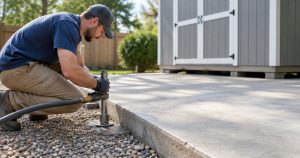
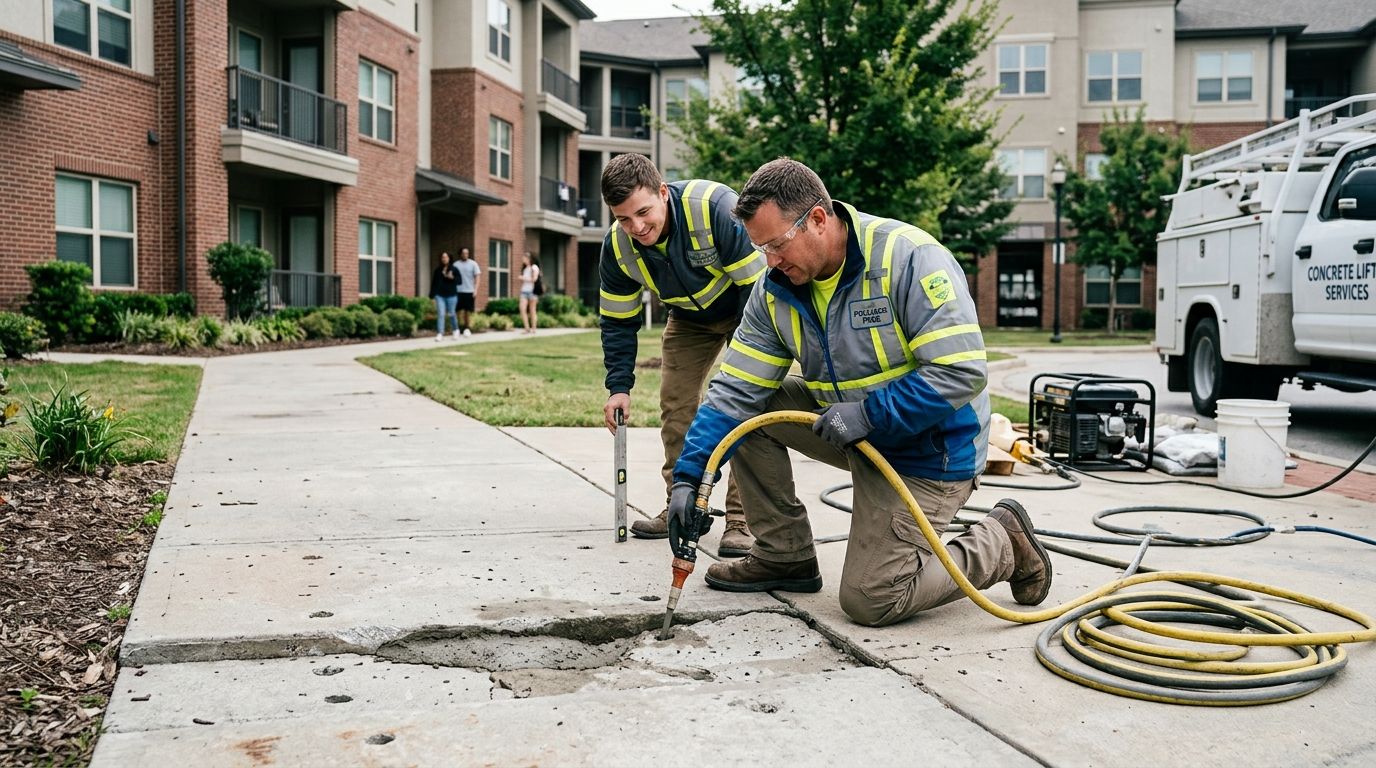
Crews drill small entry holes, inject expanding polyurethane foam beneath the slab, and the foam lifts concrete back to grade as it cures. It's the go-to for parking lots, sidewalks, loading docks, and warehouse floors where a week-long shutdown isn't an option.
Polyurethane foam injection pros:
- Foot traffic and light vehicles can return in about 15 minutes once the foam sets
- Entry holes are the size of a coin, not a jackhammered trench
- Lightweight fill won't add the load that caused the original settling
- Works through winter, unlike some water-based slurry methods
Polyurethane foam injection cons:
- Higher cost per square foot than mudjacking
- Not a fix for concrete that's structurally cracked rather than just sunken
- Requires a contractor with the right injection equipment, not every crew carries it
Polyurethane foam injection pricing: get a site-specific quote, since square footage and slab thickness both move the number.
Best for: property managers who need a parking lot, sidewalk, or loading dock back in service the same day. Verdict: Buy.
2. Mudjacking: best budget option for large, low-traffic flatwork
Mudjacking pumps a cement-and-soil slurry under the slab through drilled holes to raise it back toward level. It's the older of the two lifting methods and still shows up on a lot of municipal bids because the material cost is lower.
Mudjacking pros:
- Lower material cost than polyurethane foam on large square footage
- Long track record on driveways, patios, and municipal sidewalks
- No specialty chemicals involved
Mudjacking cons:
- Cure time runs closer to 48 hours before the area can handle vehicle traffic
- Heavier slurry fill can compress the same soft soil that caused the original settling, so the slab can dip again within a few years
- Larger, messier drill holes than polyurethane injection
Mudjacking pricing: cost tracks with the volume of slurry pumped, so get a quote against your actual slab dimensions.
Best for: budget-limited flatwork projects like large parking areas where a same-day reopen isn't required. Verdict: Hold — fine for low-traffic slabs, skip it where fast turnaround matters.
3. Full slab replacement: best for concrete beyond repair
This demolishes the failed section, hauls out debris, and pours new concrete. It's the right call once cracking, spalling, or rebar exposure has gone past what lifting can fix — lifting only corrects position, not structural damage.
Full slab replacement pros:
- Fixes cracking and spalling that no lifting method touches
- Gives you a clean surface with a fresh code-compliant pour
- Resets the clock on the slab's service life
Full slab replacement cons:
- Full closure of the work area for days while the pour reaches walkable strength, and up to 28 days before it hits full design strength
- Demolition and disposal add cost and time on top of the pour itself
- Disruptive for an active commercial site or a shared parking structure
Full slab replacement pricing: scope this against a site visit — demo, disposal, and pour volume all factor in.
Best for: slabs with structural cracking, not just settling, where lifting won't hold. Verdict: Buy only when lifting genuinely won't work — otherwise it's overkill.
4. Helical pier underpinning: best for foundation-level settling
Helical piers drive steel piers down to load-bearing soil or bedrock to stabilize a structure that's settling at the foundation, not just at a slab. That's a different problem than a sunken sidewalk — it's the building itself moving.
Helical pier underpinning pros:
- Addresses the actual cause of foundation movement, not just the surface symptom
- Works in soil conditions too soft for slab-lifting methods alone
- Can be engineered and stamped for structural sign-off
Helical pier underpinning cons:
- Considerably more invasive and disruptive than slab lifting
- Priced for structural work, not flatwork
- Unnecessary if the issue is a cosmetic slab dip rather than foundation settling
Helical pier underpinning pricing: this is engineered work — a site assessment determines pier count and depth before anyone can quote it.
Best for: buildings showing foundation cracks or door and window misalignment alongside slab settling. Verdict: Wait for a structural assessment before committing — don't default to piers for a slab-only issue.
How we ranked
Licensing and insurance, turnaround time, method fit for the slab condition, and Alberta freeze-thaw performance drove the order above. Polyurethane foam injection wins on turnaround and lightweight fill; the other three earn a spot only for conditions polyurethane doesn't cover.
Where property managers use this most
- Multi-tenant warehouses need floors that stay level under forklift and racking loads — see concrete lifting for warehouse floors for what that scope looks like.
- Loading docks that settle create a trip hazard and a trailer-alignment problem at once — concrete lifting for loading docks covers the fix.
- Retail and municipal sites with public foot traffic carry liability exposure the moment a slab drops past that one-inch threshold.
Which concrete lifting contractor should you choose?
For most property managers in Calgary, Okotoks, High River, and Lethbridge, polyurethane foam injection is the default pick — it reopens a slab in about 15 minutes, skips the messy slurry, and holds up through Alberta's freeze-thaw cycles better than mudjacking. Reach for mudjacking only when budget is the deciding factor on a low-traffic slab, replacement when cracking has gone past what lifting can fix, and helical piers when the problem is the foundation itself, not the slab sitting on top of it.
Get a site assessment
Licensed, insured concrete lifting across Calgary, Okotoks, High River, and Lethbridge.
FAQ
What’s the best concrete lifting method for property managers in 2026?
Polyurethane foam injection is the best concrete lifting for property managers in 2026 because it cures in about 15 minutes and reopens a slab the same day. Mudjacking and replacement still have a place, but only for specific slab conditions.
Is concrete lifting cheaper than full slab replacement?
Concrete lifting is generally less expensive than full replacement because it skips demolition, disposal, and a full re-pour. Get a site-specific quote since slab thickness and square footage both affect the final number.
How long before I can reopen a parking lot after polyurethane foam injection?
Foot and light vehicle traffic can typically return in about 15 minutes once the foam cures. Full slab replacement, by comparison, needs days before walking and up to 28 days to reach full design strength.
Does concrete lifting work on loading docks and warehouse floors?
Yes, polyurethane foam injection is commonly used on loading docks and warehouse floors because it handles forklift and trailer loads without the multi-day closure a pour requires. Confirm the contractor has injection equipment sized for commercial slabs.
When does a settled slab need lifting instead of just patching?
A slab that has settled more than about an inch, or that creates a trip hazard, usually needs lifting rather than a surface patch. Smaller dips can often be ground flush instead.
Is mudjacking or polyurethane foam better for Alberta winters?
Polyurethane foam injection generally performs better through Alberta’s freeze-thaw cycles because the lightweight fill doesn’t compress the way a heavier mud slurry can. Mudjacking still works, but re-settling is more common within a few years.
What credentials should a concrete lifting contractor for commercial property have?
Confirm the contractor carries WCB coverage, liability insurance, and a business license before signing a contract for a commercial or municipal site. A written scope and warranty also protect a capital-planning budget.
Can helical piers fix a sunken sidewalk?
Helical piers are built for foundation-level settling, not a sunken sidewalk or parking slab — that’s a job for polyurethane foam injection or mudjacking instead. Piers come into play only when the structure itself is moving.
One last thing
A slab that's settled less than an inch often doesn't need lifting at all — grinding a lip flush or patching a trip edge can hold for years at a fraction of the disruption. Get an assessment before assuming the whole section needs foam or a full replacement in 2026.
Related guides