Gas stations and convenience stores run refrigeration, HVAC, and lighting around the clock, and the building envelope around a fuel island or walk-in cooler has to handle moisture, vapor, and temperature swings that a typical retail space never sees. This guide ranks the spray foam insulation options that actually hold up in that environment, based on how each one performs against Alberta's climate and the specific hazards of a fueling site.
- Closed-cell spray foam is the best spray foam insulation gas station owners should default to for exterior walls and below-grade areas near fuel islands in 2026.
- Closed-cell spray foam roofing handles ponding water and ice damming better than open-cell foam on flat convenience store roofs.
- Open-cell spray foam works best for interior partitions and back-of-house sound control, not exterior moisture zones.
- Walk-in coolers and freezers need closed-cell foam specifically for its vapor-resistant properties, not general-purpose foam.
- Canopy fascia and overhead door perimeters need a foam system rated for exposed steel and temperature cycling.
Why This Matters
A convenience store with a leaking cooler wall or an under-insulated canopy deck loses money every single day it stays open, not just during a cold snap. Refrigeration compressors run longer, HVAC units short-cycle, and moisture that gets trapped behind an old fiberglass batt turns into mold or rust around steel canopy supports within a season or two.
Fuel station aprons and canopies also take a different kind of abuse than a house: constant vehicle traffic, exhaust exposure, and fuel vapor near the building envelope. That changes which foam type belongs where, and it's why concrete lifting for gas station and convenience store aprons often comes up in the same conversation as insulation work — settled slabs and gaps in the envelope tend to show up together on older sites.
What Makes the Best Spray Foam Insulation for a Gas Station
- Moisture and vapor resistance near fuel islands, coolers, and any below-grade concrete
- R-value per inch high enough to meet Alberta Building Code requirements in a thin cavity
- Fire code compatibility for areas within the setback distance of fuel storage and dispensers
- Air sealing at penetrations — conduit runs, dispenser wiring, and HVAC ductwork all cut through the envelope
- Sound dampening between customer-facing retail space and back-of-house stockrooms or walk-in coolers
- Performance in confined cavities, since canopy decks and roof parapets rarely give a contractor a full stud bay to work with
At a Glance: Spray Foam Options for Gas Stations and Convenience Stores
| Application | Best for | Standout feature | Key limitation |
|---|---|---|---|
| Closed-cell walls, below-grade | Moisture control near fuel islands | Vapor-resistant, adds structural rigidity | Higher material cost per board foot than open-cell |
| Closed-cell SPF roofing | Flat convenience store roofs | Self-flashing, sheds ponding water | Needs a protective coating and periodic recoat |
| Closed-cell for walk-in coolers | Temperature-controlled rooms | Stops condensation inside the wall cavity | Requires precise application around refrigeration lines |
| Open-cell for interior partitions | Sound control, back-of-house | Expands to fill irregular stud cavities | Not a vapor barrier — wrong choice for exterior walls |
| Closed-cell for canopy fascia | Exposed steel canopy structures | Handles temperature cycling without cracking | Access and staging can be tight over an active forecourt |
1. Closed-cell spray foam for exterior walls and below-grade areas: best for moisture control near fuel islands
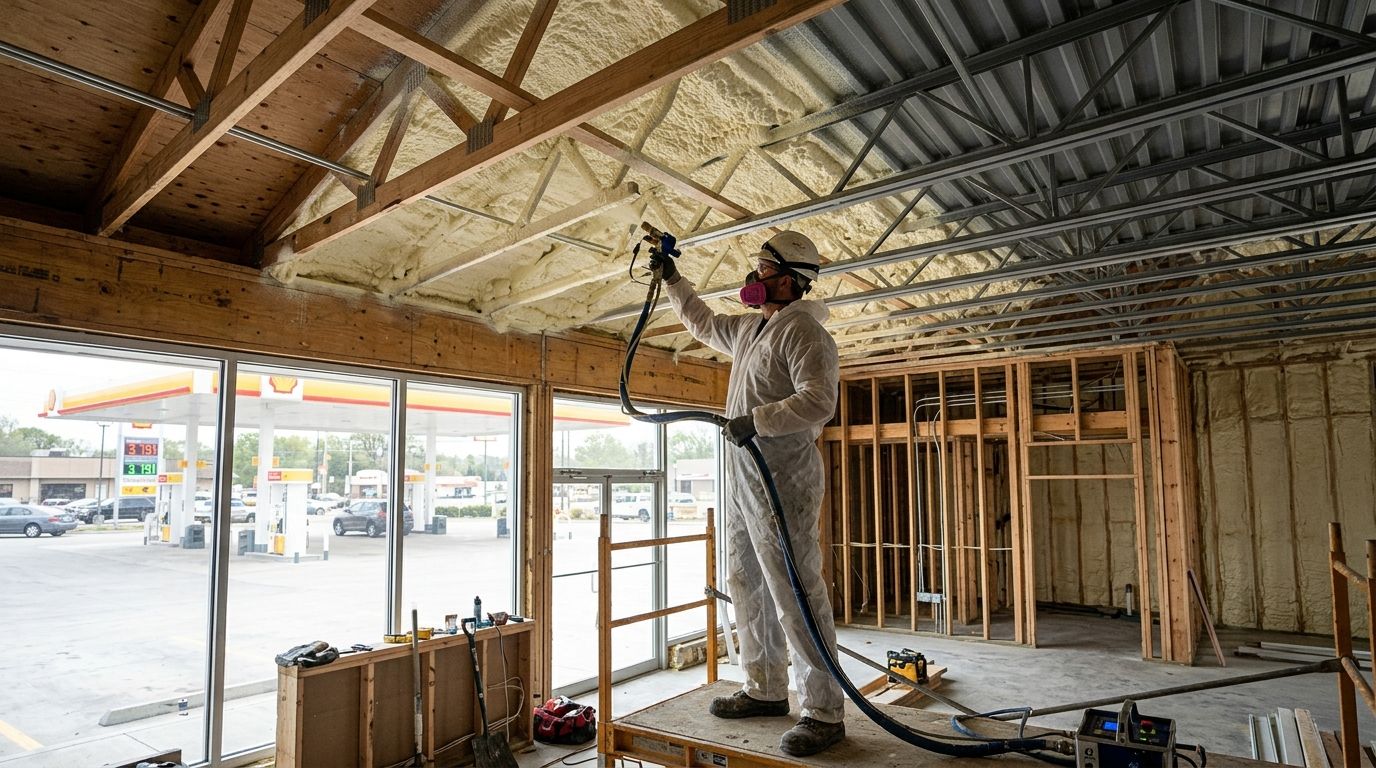
Closed-cell spray foam is the right call for any exterior wall or foundation area close to fuel dispensers, because it acts as its own vapor barrier at roughly two inches of thickness. It also adds real shear strength to a wall assembly, which matters on older convenience store buildings where the framing has taken decades of vibration from delivery trucks and forecourt traffic.
Closed-cell exterior wall foam pros:
- Vapor-resistant without a separate poly barrier in most assemblies
- R-6.0 to R-7.0 per inch, so thinner cavities still hit code
- Adds structural rigidity to the wall assembly
Closed-cell exterior wall foam cons:
- Costs more per board foot than open-cell foam
- Needs a thermal barrier or ignition barrier covering per fire code in occupied spaces
Verdict: Buy. This is the default for any gas station wall within reach of moisture or fuel vapor.
2. Closed-cell spray foam roofing (SPF): best for flat convenience store roofs
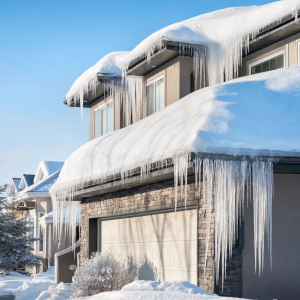
Most convenience store roofs are flat or low-slope, which means ponding water and ice damming are a yearly problem, not a once-in-a-decade one. Spray polyurethane foam roofing self-flashes around rooftop mechanical units and vents, and it can be built up in thickness to correct slope and eliminate standing water pools.
SPF roofing pros:
- Self-flashing around penetrations, HVAC curbs, and vent stacks
- Corrects roof slope to eliminate ponding
- Adds insulation value directly to the roof deck
SPF roofing cons:
- Needs a protective topcoat, and that coating needs periodic recoating
- Not a same-day job — proper cure time matters before foot traffic resumes
Verdict: Buy for flat roofs with a ponding history; Hold if the roof deck itself needs structural repair first.
3. Closed-cell spray foam for walk-in coolers and freezers: best for temperature-controlled rooms
Walk-in coolers and freezers inside a convenience store create a sharp temperature differential against the surrounding retail floor, and that differential drives condensation into any wall cavity that isn't sealed properly. Closed-cell foam stops that moisture migration cold, which is also why how to cut HVAC costs in a commercial kitchen with spray foam covers a lot of the same principles for adjacent food-service spaces.
Cooler and freezer foam pros:
- Prevents condensation inside the wall cavity
- Reduces compressor run time on refrigeration units
- Holds up against repeated temperature cycling
Cooler and freezer foam cons:
- Application around refrigeration lines and shelving anchors needs an experienced crew
- Retrofitting an existing cooler room means temporarily taking it offline
Verdict: Buy. Skipping this on a 24-hour refrigeration room is one of the more expensive mistakes a site can make.
4. Open-cell spray foam for interior partitions and back-of-house: best for sound control
Not every wall in a gas station needs vapor resistance. Interior partitions between the retail floor, the stockroom, and the back office benefit more from open-cell foam's ability to expand and fill irregular cavities, plus its sound-dampening properties.
Open-cell interior foam pros:
- Expands fully into odd-shaped stud bays and around wiring
- Dampens sound transfer between retail and back-of-house areas
- Costs less per board foot than closed-cell foam
Open-cell interior foam cons:
- Not vapor-resistant — wrong choice on any exterior or below-grade wall
- Absorbs moisture if it's ever exposed to a leak, unlike closed-cell foam
Verdict: Buy for interior-only partitions; Skip for anything touching the building's exterior envelope.
5. Closed-cell spray foam for canopy fascia and overhead door perimeters: best for exposed steel structures
The fuel canopy over the pump islands and the overhead doors on an attached bay both deal with steel that expands and contracts through Alberta's temperature swings. Closed-cell foam handles that cycling without cracking the way some rigid board insulation does over a few winters, and it seals the gap where the door track meets the frame.
Canopy and overhead door foam pros:
- Tolerates repeated expansion and contraction of steel structures
- Seals air leaks at overhead door perimeters that batt insulation misses
Canopy and overhead door foam cons:
- Staging equipment over an active forecourt requires scheduling around business hours
- Limited to smaller, targeted areas rather than a whole-building application
Keeping the canopy fascia and the fuel island concrete clean is part of the same maintenance conversation as insulation — commercial pressure washing services deal with the exterior grime and oil staining that wears down protective coatings faster, while spray foam handles what happens to the steel and concrete underneath. Neither one replaces the other, but sites that skip both tend to show wear years ahead of schedule.
Verdict: Buy for exposed canopy steel and overhead door gaps on any site built before 2015.
How We Ranked These Options
Each application was scored against the six criteria above: moisture resistance, R-value per inch, fire code compatibility, air sealing at penetrations, sound dampening, and performance in confined cavities. Closed-cell foam wins the moisture and vapor categories outright, which is why it dominates four of the five slots on this list — a gas station's biggest enemy is trapped water, not a lack of R-value.
Get a spray foam quote for your site
Licensed and insured commercial spray foam contractor serving Calgary, Okotoks, High River, and Lethbridge.
Which Spray Foam Insulation Should You Choose?
For most gas stations and convenience stores, closed-cell spray foam on exterior walls, coolers, and the roof deck is the right default in 2026, with open-cell reserved strictly for interior partitions where sound control matters more than vapor resistance. If the site has a flat roof with a history of ponding, prioritize SPF roofing first — it's the fastest payback of the group because it stops both water intrusion and heat loss in one application. A walk-through of the building's specific trouble spots, from the cooler room to the canopy deck, decides the exact mix.
FAQ
What’s the best spray foam insulation for a gas station?
Closed-cell spray foam is the best spray foam insulation gas station owners should use on exterior walls, below-grade areas, and walk-in coolers because it acts as its own vapor barrier. Open-cell foam is better reserved for interior partitions where sound control matters more than moisture resistance.
Is closed-cell or open-cell spray foam better for a convenience store cooler?
Closed-cell spray foam is better for a convenience store cooler because it resists moisture and prevents condensation inside the wall cavity. Open-cell foam absorbs moisture if it’s ever exposed to a leak, which makes it a poor fit for refrigerated rooms.
Can spray foam be used near fuel dispensers and fuel storage?
Spray foam can be used near fuel dispensers as long as it meets fire code setback and covering requirements for the specific area. A licensed contractor confirms the required thermal or ignition barrier before application near any fuel-adjacent structure.
Does spray foam insulation help with a flat convenience store roof that ponds water?
Spray polyurethane foam roofing corrects roof slope and eliminates ponding by building up thickness exactly where water collects. It also self-flashes around rooftop HVAC units and vents, which reduces leak points compared to a built-up roof.
How much does spray foam insulation cost for a gas station in Alberta?
Cost depends on square footage, roof condition, and how much of the building needs closed-cell versus open-cell application. A site walk-through is the only reliable way to scope pricing for a commercial fuel station or convenience store.
Does spray foam insulation reduce refrigeration and HVAC costs at a convenience store?
Closed-cell spray foam around walk-in coolers and freezers reduces compressor run time by stopping condensation and air leakage inside the wall cavity. The same principle applies to HVAC units serving the retail floor, where sealed penetrations cut short-cycling.
Is open-cell spray foam ever the wrong choice for a gas station?
Open-cell spray foam is the wrong choice on any exterior wall, below-grade area, or cooler room because it isn’t vapor-resistant. It works fine on interior-only partitions between retail space and back-of-house rooms.
What insulation R-value does Alberta Building Code require for commercial buildings?
Alberta Building Code requirements vary by building type, wall assembly, and climate zone, so the exact R-value target depends on the specific structure. A contractor familiar with the local code confirms the requirement before scoping the job.
One Last Thing
The part most gas station owners miss isn't the wall insulation — it's the gap where the canopy deck meets the building fascia, a spot that rarely gets a second look until rust shows up on the steel supports underneath. That single seam, sealed with closed-cell foam, often prevents more damage over a few Alberta winters than re-insulating an entire back wall.
Related Guides
- Best spray foam insulation company for Calgary commercial properties
- Spray foam insulation for retail stores and strip malls
- How to qualify for spray foam insulation rebates in Alberta