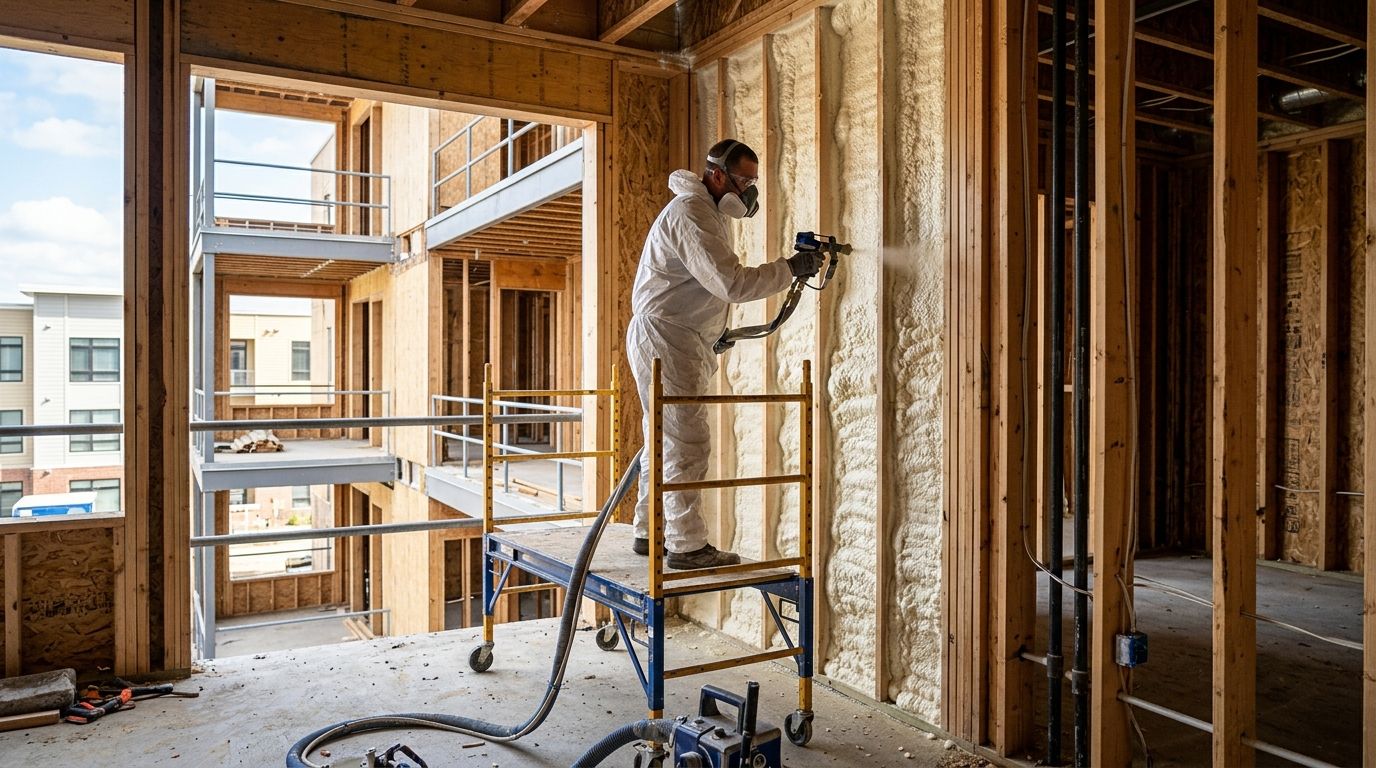
Spray foam soundproofs an apartment building by air-sealing shared wall, floor, and ceiling cavities so airborne noise -voices, TV audio, hallway chatter- stops leaking through the gaps that carry it. Closed-cell foam is the material most contractors reach for on demising walls in 2026 because it adds density on top of the air seal, unlike loose-fill insulation that just sits in the cavity. Foam alone will not stop footsteps or plumbing vibration; that impact noise still needs a decoupled floor assembly, resilient channel, or mass-loaded vinyl layered on top. Buildings that tackle shared walls first get the biggest complaint reduction for the least demolition.
- Closed-cell spray foam is the fastest way to soundproof an apartment building’s shared walls without opening up whole units.
- Foam alone does not solve footstep or impact noise – pair it with resilient channel or a decoupled subfloor.
- Rim joists, plumbing chases, and electrical penetrations are the leak points landlords miss most often.
- Alberta multi-family retrofits in 2026 often tie into insulation rebate programs when foam is part of a larger energy upgrade.
- Licensed contractors handle shared-wall and multi-family soundproofing jobs across Calgary, Okotoks, High River, and Lethbridge.
Why this matters
Noise complaints are the number one driver of tenant turnover in older wood-frame apartment buildings across Alberta, and most property managers assume a full wall teardown is the only fix. It isn't. A shared-wall soundproofing job with closed-cell spray foam can be done through drilled access holes or during a routine renovation, without gutting every unit on the floor.
The catch: spray foam changes airborne sound transmission, not structural sound transmission. A landlord who sprays the demising walls and expects footsteps from the unit above to disappear will be disappointed. Setting that expectation up front in 2026, before the crew shows up, saves a second call two weeks later.
How to soundproof an apartment building with spray foam
The process is the same whether you're doing one shared wall or a full building retrofit – only the scale changes.
- Diagnose the noise path first. Airborne noise (voices, music) travels through air gaps and thin assemblies. Impact noise (footsteps, dropped objects) travels through the structure itself. Flanking noise moves around a wall through ductwork, electrical boxes, or a shared attic. Spray foam only fixes the first and helps with the third.
- Open access to the cavity. This can mean removing drywall on one side of the demising wall, drilling injection ports, or working from an unfinished side (attic, basement, or a unit under renovation).
- Apply closed-cell foam to fill the full stud bay. Partial fill leaves air pockets that noise moves right through – the whole point of the job is a continuous seal from top plate to bottom plate.
- Seal electrical boxes, outlets, and plumbing penetrations inside the wall. These are the most common leak points in a party wall and the easiest thing for a rushed installer to skip.
- Treat the rim joist and mechanical chases where floor meets wall. Sound flanks around a perfectly sealed wall cavity if the floor assembly next to it is still open.
- Add resilient channel or mass-loaded vinyl on the ceiling or floor if impact noise is the actual complaint. Foam handles airborne transfer; decoupling handles impact transfer. Most buildings need both.
- Close the wall back up and test with a real occupant walking, talking, and playing music at normal volume before calling the job done.
Shared demising walls: where spray foam does the most work
The wall between two units is where closed-cell foam earns its keep. Older Calgary and Lethbridge apartment stock built before the 1990s often has empty stud bays or thin batt insulation in party walls – there was never an acoustic requirement, only a fire-separation one. Filling that cavity with closed-cell foam is usually the single highest-impact fix in the building, and it's the reason shared-wall jobs get requested more than any other soundproofing scope.
Floor and ceiling assemblies: pairing foam with decoupling
Foam sprayed into a floor/ceiling cavity between units reduces airborne bleed-through – a TV or stereo in the unit below getting quieter upstairs. It does very little for a person walking in dress shoes overhead, because that noise travels through the joists themselves, not the air. Buildings with a chronic footstep complaint need a decoupled layer (resilient channel, sound clips, or a floating subfloor) added on top of the foam, not instead of it.
Rim joists and mechanical chases: the leaks landlords miss
A sealed demising wall with an open rim joist behind it is a wall that still fails inspection acoustically. Spray foam is the right tool here too – it fills the irregular gaps around joist ends and mechanical penetrations that batt insulation can't conform to. Multi-family and condo buildings with shared HVAC risers or plumbing stacks running through party walls should have those chases checked and foamed at the same time as the wall itself; see spray foam insulation for multi-family and condo buildings for how that scope is typically bundled.
Why sound transmission varies between units
- Age and construction type – pre-1990s wood-frame buildings usually have less acoustic separation than newer concrete or steel-frame construction.
- Whether the original builder insulated party walls at all – many older Alberta apartment buildings have empty or partially filled stud bays.
- Shared HVAC ducting and plumbing chases – these carry sound around a sealed wall even when the wall itself is done right.
- Number of drywall layers on the party wall – a single layer of 1/2-inch drywall transmits more sound than a double layer with a foam-filled cavity behind it.
- Renovation history – foam quality and coverage vary by installer, and partial-fill jobs from a previous contractor often need to be redone before a new layer helps.
- Occupant behavior – subwoofers, hard-soled flooring, and unpadded hard-surface floors will always transmit more noise than insulation alone can offset.
Get a shared-wall soundproofing quote
Licensed spray foam crews serving Calgary, Okotoks, High River, and Lethbridge.
Does spray foam block noise from upstairs neighbors?
Spray foam reduces airborne noise from upstairs neighbors – voices, music, TV audio – but it does not stop footstep or impact noise on its own. A ceiling cavity filled with closed-cell foam plus a resilient channel layer is the combination that actually quiets footsteps, and the foam-only version handles roughly the airborne half of a typical noise complaint.
Is open-cell or closed-cell foam better for soundproofing?
Closed-cell foam is the better choice for soundproofing because its higher density adds more mass to the assembly than open-cell foam, and mass is what resists sound energy. Open-cell foam still air-seals the cavity and helps with airborne noise, but it won't add the same acoustic resistance a demising wall in a multi-unit building needs.
Can spray foam soundproofing be added without removing drywall?
Yes, injection foam can be added through small drilled access holes without removing drywall, though coverage is harder to verify than an open-cavity application. Contractors doing a shared-wall job in 2026 will usually recommend opening the wall on at least one side when full coverage and inspection matter, such as in a legal secondary suite conversion.
FAQ
How much does it cost to soundproof an apartment building with spray foam?
Cost depends on unit count, wall access, and whether floors also need a decoupled layer added on top of the foam. Ask a licensed contractor for a building-specific walkthrough quote rather than relying on a per-square-foot estimate from a different property.
Does spray foam stop noise between apartments completely?
No, spray foam stops most airborne noise – voices, music, hallway sound – but it does not stop footstep or impact noise by itself. A fully quiet building usually needs foam plus a decoupled floor or resilient channel.
What type of spray foam is best for soundproofing an apartment building?
Closed-cell spray foam is best for soundproofing because its density adds mass to the wall assembly, which resists sound transfer better than the lighter open-cell version.
Can spray foam soundproofing be done without removing drywall?
Yes, injection spray foam can go in through small drilled access holes, though full removal of drywall on one side gives a contractor better coverage and lets them inspect the cavity before closing it up.
Do apartment buildings in Alberta need a permit for spray foam soundproofing?
Most interior insulation work in a multi-unit building falls under Alberta Building Code requirements, and a licensed, insured contractor should confirm what applies to a specific building before work starts.
How long does spray foam soundproofing last?
Closed-cell spray foam does not sag, settle, or lose coverage over time the way loose-fill insulation can, so the acoustic benefit it provides in a wall cavity holds for the life of that wall assembly.
Is spray foam soundproofing safe to do in an occupied apartment building?
Spray foam installation requires proper ventilation and a cure period before the space is reoccupied, which is why most jobs are scheduled unit by unit rather than across an entire building at once.
Does spray foam reduce noise from shared HVAC systems?
Spray foam around ductwork penetrations reduces noise leaking through those gaps, but noise traveling through the ductwork itself still needs duct lining or baffling to fully resolve.
One last thing
The single most skipped step on a soundproofing job is sealing electrical boxes inside the party wall cavity before the foam goes in. An outlet box on either side of a shared wall is a direct air path between two units, and it undoes a surprising amount of an otherwise well-sealed cavity. Ask whoever quotes the job whether box sealing is included – if it isn't mentioned, ask why.
Related guides
- Spray foam insulation for multi-family and condo buildings
- Spray foam insulation for basement suite conversions
- Best spray foam insulation company for Calgary commercial properties
- How much does spray foam insulation cost in Calgary