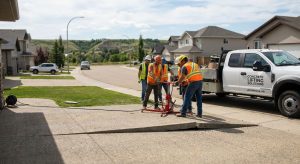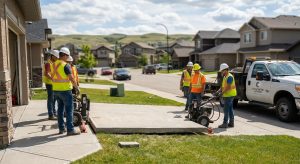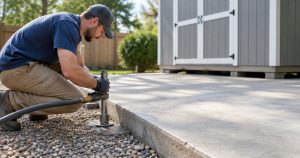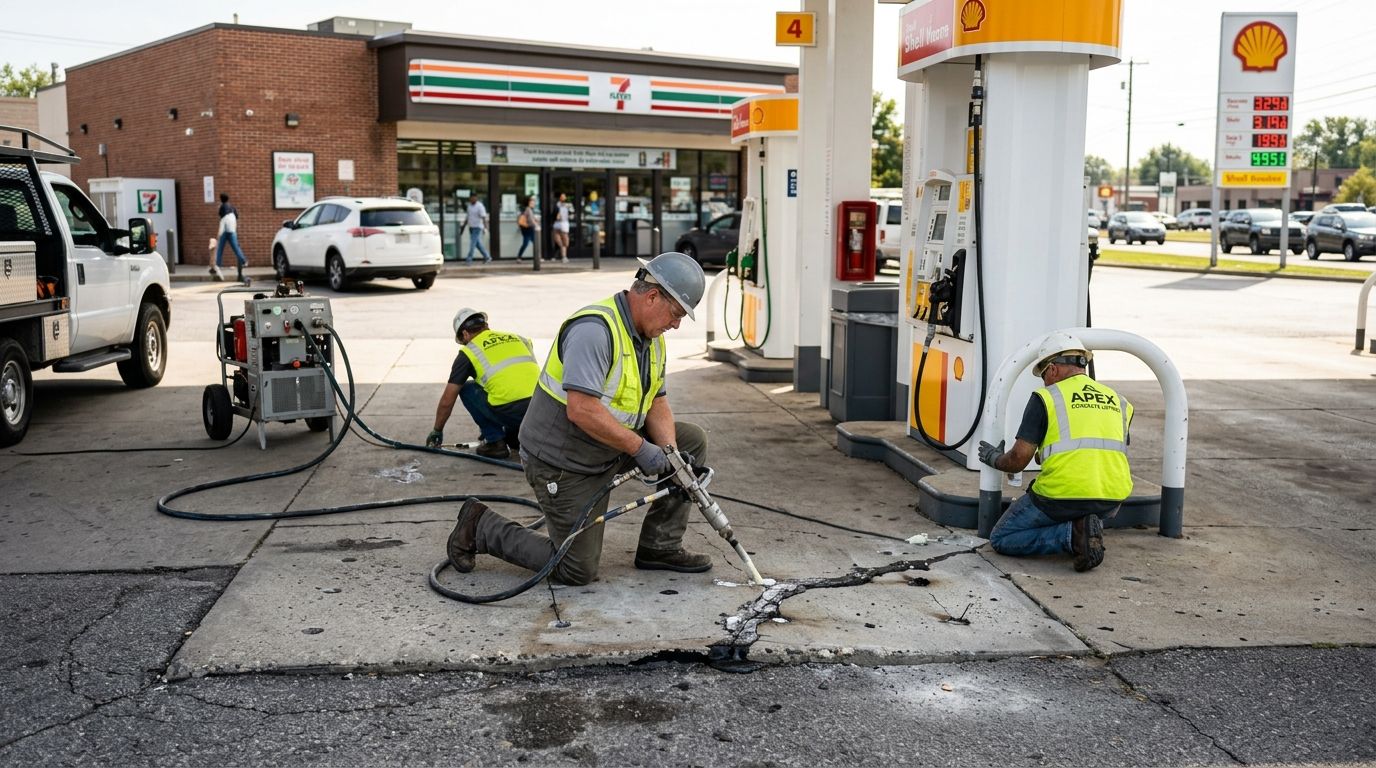
Concrete lifting for gas station and convenience store aprons raises settled slabs around fuel islands, canopy footings, and drive lanes using injected material instead of tearing out the pad. Retail fuel sites carry different stakes than a homeowner's driveway: uneven concrete near a dispenser is a fire code and slip-and-fall issue, not just a cosmetic one, and every hour a bay stays closed costs fuel and convenience sales.
- Concrete lifting gas station apron repairs use polyurethane foam injection to raise sunken pads without closing the whole site.
- Aztec Spray Systems lifts fuel island slabs, canopy footings, and drive lanes across Calgary, Okotoks, High River, and Lethbridge.
- Full-depth replacement closes bays for days; foam injection reopens most aprons the same day in 2026 job schedules.
- Uneven aprons around dispensers create tripping hazards and drainage problems that can violate fire code clearances.
- Recheck settling every spring and fall before freeze-thaw cycles widen cracks under pump islands.
Why concrete lifting matters for gas stations and convenience stores
A gas station apron takes a different load profile than a residential slab: fuel delivery trucks, forklifts unloading propane cages, and constant stop-and-go traffic from customer vehicles all concentrate weight on a small footprint around each dispenser island. When the subgrade under that pad loses compaction, from a leaking storm line, poor original compaction, or Alberta's freeze-thaw cycle, the slab settles unevenly instead of cracking straight through.
That unevenness matters more here than almost anywhere else in commercial concrete. A tripping hazard near a fuel dispenser is a liability claim waiting to happen, and a slab that no longer slopes toward containment can pool fuel or de-icing runoff exactly where an ignition source sits. Fire marshals and insurance adjusters both look at apron condition during site visits, and a settled pad is one of the first things they flag.
Aztec Spray Systems treats gas station and convenience store aprons as a same-day repair category whenever the void depth allows it — the goal is reopening the affected bay before the next fuel delivery, not scheduling around a multi-day closure.
Inspect the apron before you call anyone
Start with a walk of the site during daylight, ideally after rain so pooling is visible.
- Look for a gap wider than a quarter-inch between the dispenser island curb and the surrounding slab
- Check whether water pools at the pump instead of running toward a drain or containment trench
- Run a level or a straightedge across the pad in two directions to catch a dip a visual check misses
- Note any cracking that radiates from the corners of the island, a classic sign of subgrade loss
- Photograph the joint between the apron and the canopy footing separately, since these settle at different rates
Check dispenser islands and canopy footings for independent movement
The island itself and the surrounding drive slab often settle at different speeds because they were poured and compacted separately.
- Measure the height difference between the island curb and the adjacent pavement at four points
- Confirm the canopy support columns are still plumb, not just the slab around them
- Look for daylight or gaps under the base plates of canopy columns
- Check whether fuel line conduit is under tension from differential settling
Test drainage slope toward containment
Most Alberta municipalities require fuel dispensing pads to drain toward an oil-water separator or containment sump, not toward the street or a storm drain.
- Pour a bucket of water at the highest point of the apron and time how long it takes to clear
- Check for standing water directly under the canopy after a rain event
- Confirm the containment trench grate isn't sitting proud of a settled slab section
- Flag any spot where water backs up against a building wall or fuel island curb
Choose the right lifting method for the load
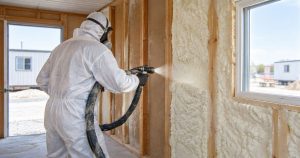
The manual comparison point every operator should understand first: mudjacking (pumping a cement slurry under the slab) is the older, heavier method, while polyurethane foam injection uses a lighter expanding resin through a smaller injection hole. Foam cures in minutes rather than the days mudjacking slurry needs to gain strength, which is the main reason it has become the default choice for sunken commercial slabs that can't sit closed.
- Confirm the injection material is rated for vehicle and fuel-truck loads, not just foot traffic
- Ask whether the crew can work bay-by-bay so the rest of the site stays open
- Get a void-depth estimate before the quote — deeper voids need more material and more injection points
- Check whether the method requires a full cure period before reopening to traffic
Schedule around fuel deliveries and peak hours
A convenience store loses real revenue every hour a pump island is roped off. Work with a contractor who schedules around delivery windows rather than around their own crew's convenience.
- Ask for a start time before the morning commute rush, not during it
- Confirm the fuel supplier's delivery schedule so lifting doesn't collide with a tanker visit
- Request that only the affected island or bay closes, not the full apron
- Get a written estimate of downtime per bay before work starts
Reseal joints and re-coat the surface after lifting
Once the slab is raised, the injection holes and existing joints need sealing to keep water and fuel spills from re-softening the subgrade.
- Seal all injection ports with a compatible concrete patch material
- Re-caulk expansion joints around the dispenser island curb
- Recoat any fuel-resistant sealant that was disturbed during the lift
- Re-check the drainage slope after the pad settles into its final position over the first week
Set a re-inspection schedule
One lift doesn't guarantee the subgrade issue is solved for good, especially if the original cause was a drainage defect rather than simple soil consolidation.
- Walk the apron every spring after freeze-thaw and every fall before winter
- Track void locations that were previously injected in case they need a follow-up shot
- Keep photos from each inspection to show an insurer or franchisor a documented maintenance history
- Flag any new gap forming near a previously repaired section immediately
Comparison: lifting methods for gas station and convenience store aprons
| Option | Best for | Key limitation |
|---|---|---|
| Polyurethane foam injection | Fuel islands and drive lanes that need same-day reopening | Not effective on voids deeper than the material's rated fill range without multiple injection passes |
| Mudjacking (slurry) | Large parking aprons with lower urgency on reopening | Cure time before traffic load can stretch to several days |
| Full slab replacement | Aprons with structural cracking through the full depth, not just settling | Closes the bay for the longest stretch and costs the most in lost sales |
Verdict: for most gas station and convenience store aprons, polyurethane foam injection is the buy — it reopens the bay fastest and handles the load. Mudjacking is a hold for lower-traffic back lots where downtime doesn't matter. Full replacement is a skip unless the slab itself has cracked through, not just settled.
Common mistakes gas stations and convenience stores make
- Ignoring a small dip until it trips a customer or a fuel hose snags on it. A quarter-inch gap doesn't stay a quarter-inch through an Alberta winter.
- Patching the surface crack without fixing the subgrade underneath it. Cosmetic patching hides the problem for one season and the same spot reopens the next.
- Closing the entire apron instead of one bay. Most lifting work can be isolated to the affected island, and shutting the whole site over one settled slab section costs far more in lost fuel sales than it needs to.
- Skipping the drainage check before scheduling the lift. If the slope problem isn't diagnosed first, the pad can settle again within a year even after a correct lift.
- Waiting until spring to address a fall settling issue. Freeze-thaw cycles through a Calgary or Lethbridge winter widen an existing void; a fall repair before freeze-up prevents a much bigger job in April.
Get an apron inspection scheduled
Bay-by-bay concrete lifting for fuel islands and drive lanes across southern Alberta.
FAQ
What’s the best method to fix a sunken gas station apron?
Polyurethane foam injection is the best method for most gas station aprons in 2026 because it cures within minutes and lets the bay reopen the same day. Mudjacking works but needs several days of cure time before it can carry fuel-truck loads.
How long does concrete lifting take at a convenience store?
A single dispenser island or drive lane typically reopens the same day when polyurethane foam injection is used. Larger aprons with multiple settled sections may need the work split across a few bays to keep the rest of the site open.
Can concrete lifting be done without closing all fuel pumps?
Yes — lifting can usually be isolated to the specific island or bay showing settlement, leaving the rest of the pumps open to customers. Full-site closures are only needed when the entire apron shows widespread settling.
Is polyurethane foam injection strong enough for fuel truck traffic?
Polyurethane foam formulated for commercial use is rated for vehicle and heavy delivery-truck loads, which is why it’s the standard choice for fuel islands and drive lanes rather than lighter residential-grade material.
How much does concrete lifting cost for a gas station apron?
Cost depends on the square footage affected, the depth of the void under the slab, and how many injection points the repair needs. A site walk-through is the only reliable way to scope the job.
Does concrete lifting fix drainage problems at fuel islands?
Lifting restores the original slope of the slab, which often corrects pooling that developed as the pad settled unevenly. If the drainage issue predates the settling, the slope may need re-grading in addition to the lift.
How often should a gas station recheck its apron for settling?
Twice a year is the standard rhythm — once in spring after freeze-thaw and once in fall before winter sets in. Sites in high-traffic corridors or with known drainage issues benefit from a quarterly walk-through instead.
Is mudjacking or polyurethane foam better for commercial aprons?
Polyurethane foam wins on downtime because it cures in minutes instead of days, which matters most for a site that can’t afford a multi-day closure. Mudjacking still has a place on lower-traffic back lots where reopening speed isn’t a priority.
One last thing
The canopy footing almost never settles at the same rate as the apron slab around it — inspecting them together, not just the drive lane, is what catches a developing problem before a customer does. A gas station that documents its apron condition twice a year through 2026 and beyond builds a maintenance record that speeds up insurance claims and franchisor inspections alike.
Related guides