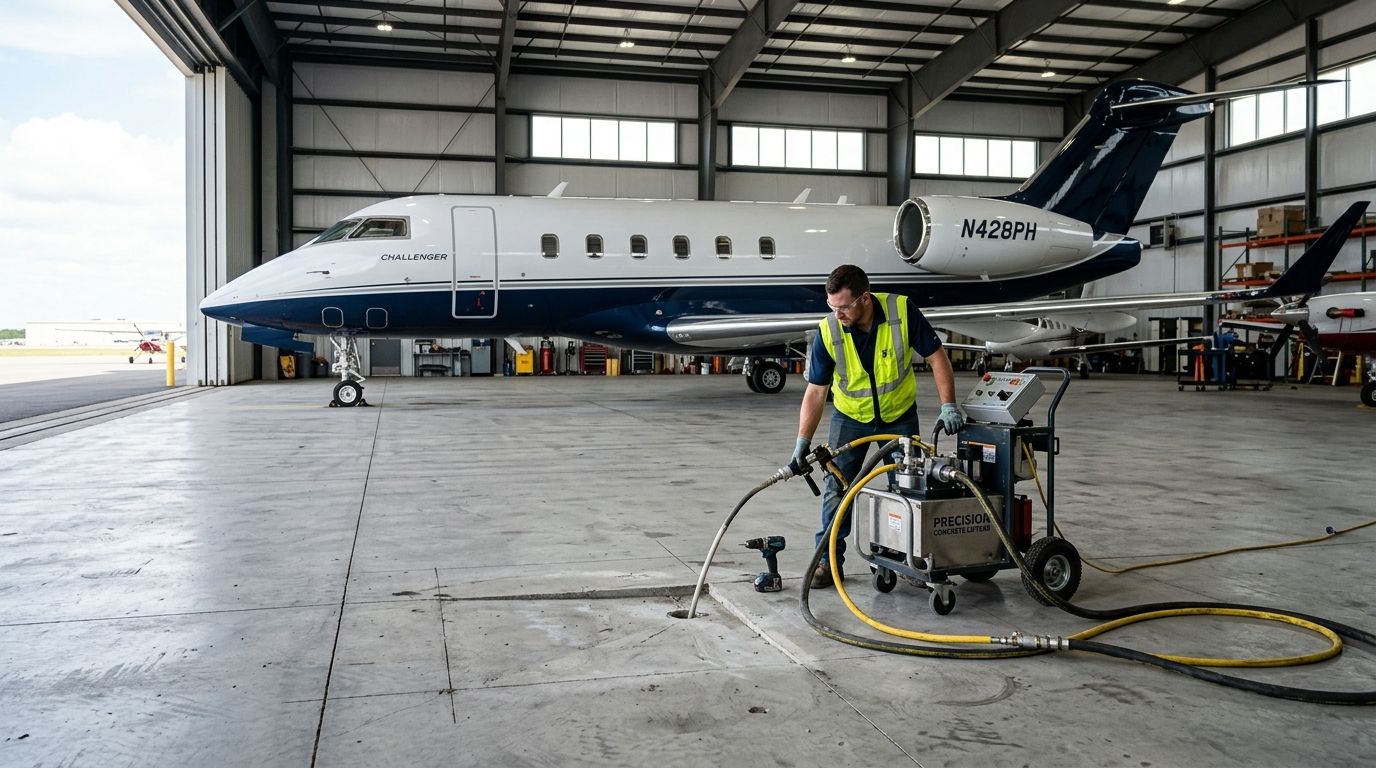
Airplane hangar floor concrete lifting is the process of raising and stabilizing settled slab sections beneath aircraft, tow vehicles, and jack stands without a full tear-out and repour. Hangar slabs carry different stress than a driveway or garage floor — concentrated point loads from landing gear, jack pads during maintenance, and door tracks that need to stay level to millimetres or the door binds. A hangar floor that settles even 12mm at a threshold can jam a bi-fold or sliding door and put an aircraft's leveling out of spec during inspection.
The segment that searches for concrete lifting hangar floor repair is usually an FBO manager, a private hangar owner, or a municipal airport authority dealing with a specific symptom: a low spot under the nose gear parking line, a cracked slab near a floor drain, or a door that no longer seats flush. Aztec Spray Systems handles this kind of work for hangar owners around Calgary, Okotoks, High River, and Lethbridge, and the fix almost never starts with a jackhammer — it starts with figuring out why the slab moved. Spray foam insulation for airplane hangars addresses the building envelope side of hangar maintenance; concrete lifting addresses the floor itself, and the two problems often show up in the same building within a few years of each other.
Why concrete lifting matters for hangar floors
A hangar floor isn't just a walking surface. It's the reference plane for door alignment, tow-vehicle clearance, and in some cases the leveling check technicians rely on before certain maintenance tasks. Settlement under a door track is not cosmetic — it's an operational problem that grounds the door, and a grounded hangar door means a grounded aircraft.
Hangar slabs settle for the same reasons other commercial slabs settle in southern Alberta: freeze-thaw cycling, poor subgrade compaction at original construction, and moisture migration under the perimeter. The difference is consequence. A 3cm dip in a warehouse aisle is an annoyance. The same dip under a hangar door track is a maintenance ticket every single time the door cycles.
Inspect the slab for settlement patterns
Start with a walk-through that maps where the floor has actually moved, not where it looks worst.
- Run a laser level or straightedge along the door track and note deviation in millimetres, not "looks off"
- Check for hairline cracks radiating from floor drains or expansion joints
- Look for standing water after a wash-down — pooling marks the low spots
- Note any spot where a jack stand or ground support has left a depression
- Photograph cracks now and compare width again in 90 days to see if movement is active or historic
Test door threshold and track alignment
Door problems are usually the first symptom an owner notices, well before the slab looks visibly uneven.
- Cycle the door slowly and listen for binding, not just watch for it
- Measure gap consistency along the full width of the track
- Check whether the misalignment is new (active settlement) or has been shimmed before (chronic, worsening)
- Confirm the header and door frame haven't shifted independently of the slab
Choose the right lifting method for the load
This is the decision point that matters most, and it depends on how the slab is loaded and how fast the hangar needs to reopen.
- Polyurethane foam injection — a two-part expanding foam is pumped through small holes (roughly dime-sized) and expands under the slab, lifting it back to grade. It cures in about 15 minutes and typically bears full load within an hour, which matters when an aircraft needs the hangar back same-day.
- Mudjacking (slurry injection) — a cement-based slurry is pumped under the slab through larger holes. It costs less per square foot on paper but needs roughly 24 to 48 hours before the area can bear full load, and the added slurry weight can contribute to future settlement on soft subgrade.
- Full slab replacement — reserved for slabs with structural cracking through the rebar mat or sections beyond the reach of injection. It's the most disruptive option and the only one that resets the slab entirely rather than repositioning it.
For most hangar settlement — localized dips near doors, drains, or jack points — polyurethane foam is the faster and more targeted fix. Mudjacking still has a place on large, evenly-settled areas where downtime matters less, like a back corner storage bay that doesn't see daily aircraft movement.
Schedule the work around flight operations
Hangar owners don't get the luxury of shutting the building down for a week.
- Book lifting work in blocks that match known aircraft downtime — annual inspections, avionics upgrades, seasonal storage windows
- Confirm foam cure time against the hangar's actual reopening schedule, not a generic estimate
- Stage equipment outside the door swing radius so the aircraft can be moved the moment the floor is cleared
- Ask the contractor for a written load-bearing timeline specific to the product used, not a verbal estimate
Address the soil and drainage cause, not just the symptom
Lifting a slab without fixing the reason it dropped means doing the same repair again in a few years.
- Check perimeter grading — hangars built on flat aprons often have poor runoff away from the foundation
- Inspect for a cracked or disconnected downspout or drain tile feeding water under the slab edge
- Confirm frost depth compliance for the original footing — a common gap in older hangar construction in the region
- Note any nearby taxiway drainage that routes water toward the hangar apron rather than away from it
Reinforce joints and expansion cuts after lifting
Once the slab is back at grade, the joints and cracks that let water in during the settlement period need sealing.
- Re-caulk expansion joints with a fuel-and-solvent-resistant sealant rated for hangar floor exposure
- Fill hairline cracks before they widen under repeated jack-stand loading
- Check floor drain collars for gaps that opened during settlement
- Re-inspect the seal six months later — hangar floors see more chemical exposure than a typical garage slab
Maintain the slab on a schedule, not on symptoms
A lifted slab holds if the maintenance habits change with it.
- Re-check door track alignment every six months for the first two years
- Keep drainage clear of debris that redirects water back toward the slab edge
- Log any new cracking immediately rather than waiting for the next annual inspection
- Avoid parking heavy equipment on freshly lifted sections for at least the manufacturer's stated cure window
Comparison: lifting options for hangar floors
| Option | Best for | Downtime before reopening | Key limitation |
|---|---|---|---|
| Polyurethane foam injection | Localized dips near doors, drains, jack points | About 1 hour | Not suited to slabs with structural cracking through rebar |
| Mudjacking (slurry) | Large, evenly settled areas with lower urgency | 24-48 hours | Added slurry weight can contribute to future settlement on soft soil |
| Full slab replacement | Structural cracking or sections beyond injection reach | Days to weeks | Most disruptive; full hangar closure required |
For most hangar owners chasing a specific low spot, polyurethane foam is the practical buy. Mudjacking is a hold — fine for non-critical bays where a two-day closure doesn't ground anything. Full replacement is a wait until the slab's condition actually forces it; it's rarely the first move.
The full breakdown of when each method wins is covered in best concrete lifting method for sunken slabs, which applies the same logic to non-aviation commercial floors.
Common mistakes hangar owners make
- Treating a door misalignment as a hardware problem first. Adjusting rollers and tracks without checking the slab underneath just delays the real fix and wastes a service call.
- Scheduling lifting work without confirming cure time against the actual reopening date. Mudjacking booked the day before a scheduled flight leaves the hangar closed when the aircraft needs to move.
- Skipping the drainage investigation. Lifting the slab and walking away without fixing the water source means the same dip returns within a couple of freeze-thaw cycles.
- Ignoring early settlement signs because the hangar still "functions." Identifying foundation settling before it worsens early keeps the repair to injection rather than replacement.
- Not sealing joints after the lift. An unsealed crack lets fuel, de-icing fluid, and runoff back under the slab, undoing the repair from below.
Get a hangar floor assessment
Aztec Spray Systems evaluates settlement and lifting options for hangar and shop floors across southern Alberta.
FAQ
What causes hangar floor settlement in Alberta?
Freeze-thaw cycling, poor subgrade compaction at original construction, and water migrating under the slab edge are the most common causes in southern Alberta hangars built on flat aprons. Point loads from repeated jack stand placement can accelerate settlement in the same spots.
How long does polyurethane foam concrete lifting take to cure for a hangar floor?
Polyurethane foam typically cures in about 15 minutes and reaches full load-bearing capacity within an hour, which is why it’s the preferred method when a hangar needs to reopen the same day.
Is mudjacking or polyurethane foam better for a hangar floor?
Polyurethane foam suits localized dips near doors and drains where fast reopening matters, while mudjacking works on larger, less urgent areas but needs 24 to 48 hours before the floor can bear full load again.
Can concrete lifting fix a hangar door that won’t close properly?
If the door problem is caused by slab settlement under the track, lifting the slab back to grade usually restores alignment. If the door frame or header has shifted independently, that needs separate repair.
Does concrete lifting work under an aircraft’s typical point loads?
Polyurethane foam injection is specifically suited to concentrated point loads like landing gear and jack stands because it fills voids directly under the load-bearing area rather than just raising the surface.
How often should a hangar floor be inspected for settlement?
Check door track alignment every six months for the first two years after any lift, then fold it into the annual facility inspection once the slab has proven stable.
Does concrete lifting damage the hangar floor’s fuel resistance sealant?
Lifting itself doesn’t damage sealant, but any joint or crack that opened during settlement should be re-sealed with a fuel-and-solvent-resistant product after the slab is leveled.
Is full slab replacement ever necessary for a hangar floor?
Yes, when cracking runs through the reinforcement mat or the settlement is too widespread for injection to correct evenly. That’s a days-to-weeks closure rather than a same-day fix.
One last thing
The detail most hangar owners miss: a foam-lifted slab reaching full load capacity in about an hour means the repair window fits inside a normal maintenance downtime slot, but mudjacking's 24-to-48-hour cure often means booking around a full weekend closure instead of an afternoon. Pick the method by the reopening deadline first, then by the size of the settled area.
Related guides
- Best concrete lifting method for sunken slabs
- How to identify foundation settling before it worsens
- Concrete lifting for barn and shop floors
- Spray foam insulation for airplane hangars