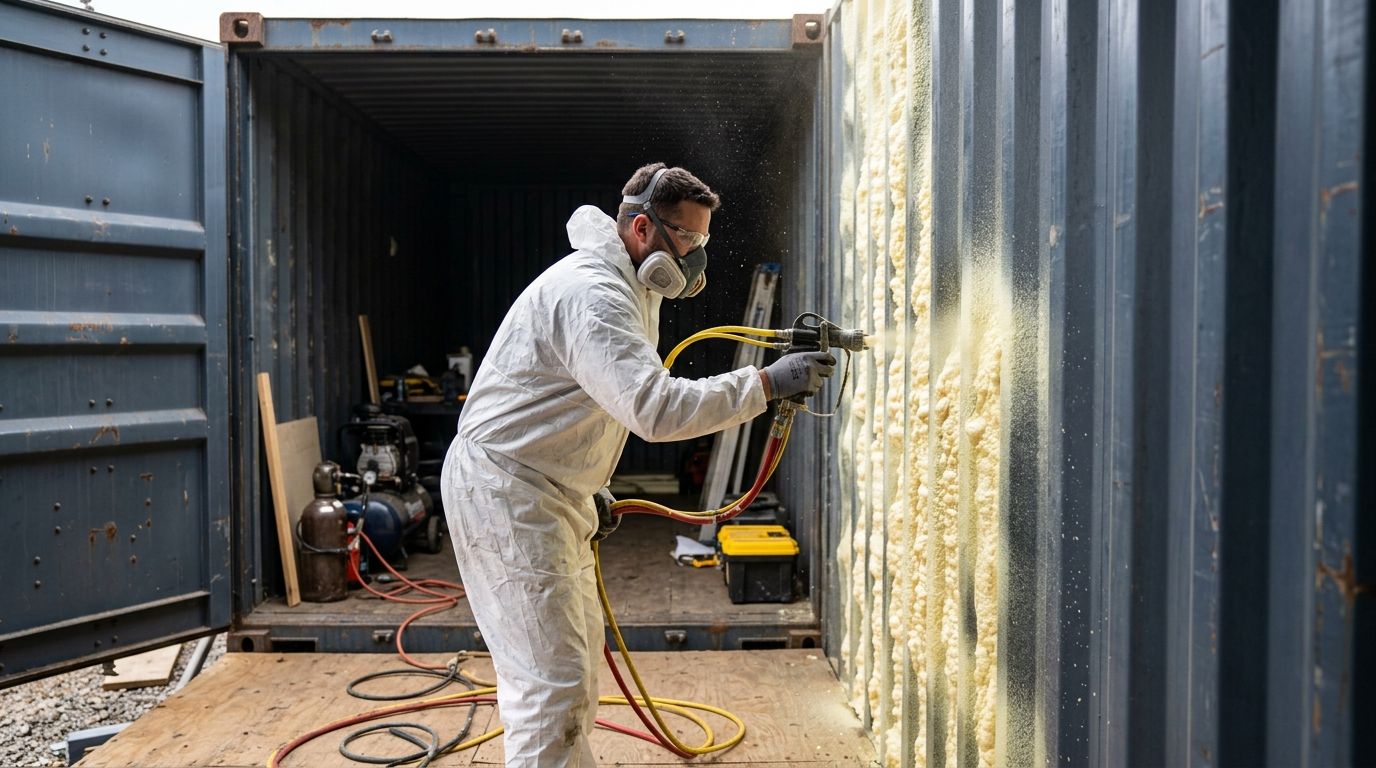
Spray foam works better than any other method for a shipping container conversion because it's the only insulation that air-seals and insulates a corrugated steel box in one step, but only when it's installed over furring strips at 2 to 3 inches of closed-cell foam, not sprayed thin directly against bare steel. Skip the furring and you'll trap condensation between the foam and the corrugation, which rots subfloors and rusts steel from the inside before you ever notice a problem.
- Closed-cell spray foam runs about R-6.5 per inch, so 2 inches gets you roughly R-13 and 3 inches gets you close to R-19 in a container wall.
- Furring strips over the corrugation are non-negotiable — spraying foam straight onto bare steel leaves thin spots in every corrugation valley.
- Condensation control, not R-value, is the real reason spray foam beats batts or rigid board in a metal box.
- Alberta’s 2026 building code still expects insulation levels similar to a stick-built home, even though a container starts as a steel shipping box.
Why this matters
A shipping container is a steel can. Steel conducts heat and cold fast, and it sweats the second warm interior air meets a cold outer wall — that's the "container rain" every converted-container owner on YouTube warns about. Spray foam solves both problems at once: it's a continuous air barrier that stops moisture-laden air from ever reaching the cold steel, and it adds real R-value in a wall cavity that's only 2 to 3 inches deep at best.
Batt insulation and rigid foam board both leave gaps at the corrugated ribs and seams. Spray foam expands into those gaps and seals them, which is exactly why most container-home builders in Alberta end up back at spray foam even after trying to save money with batts first. If you're weighing this against a full spray foam insulation for shipping container homes build, the mechanics below apply whether you're converting one 40-foot box or stacking three for a full home.
How do you insulate a shipping container conversion with spray foam?
The process runs in a fixed order — skipping steps is how condensation problems start.
- Frame furring strips or a stud wall inside the container, running vertical or horizontal 2×3 or 2×4 framing off the corrugated steel ribs.
- Seal seams and welds first with foil tape or seam sealant so the container shell itself isn't the weak point.
- Spray closed-cell foam between the framing, filling the full cavity depth in one or two passes.
- Trim foam flush with the framing so drywall or paneling sits flat.
- Address the roof separately — container roofs need the same treatment plus extra attention to the ridge seams where most container roof leaks originate.
- Insulate the floor from underneath or over a raised subfloor, since the steel floor structure is the coldest surface in the whole build.
Skipping the furring step and spraying foam directly against bare corrugated steel is the single most common mistake on these projects — the foam bridges the corrugation peaks but leaves the valleys thin, and thin spots are where condensation forms first.
Closed-cell spray foam: R-6.5 per inch
Closed-cell spray foam is the standard choice for container conversions because it hits roughly R-6.5 per inch, roughly double the R-value per inch of open-cell foam or fiberglass batt. In a container wall where you're fighting for every inch of interior space, that density matters more than it would in a stick-framed house with deep 2×6 cavities.
Closed-cell foam is also a vapor retarder on its own once it's 2 inches thick or more, which is exactly the barrier a steel box needs between conditioned interior air and a cold metal skin.
2 inches vs 3 inches of spray foam: R-13 vs R-19 in a container wall
Most container conversions land in one of two depths, driven by how deep the furring strips run.
| Foam depth | Approximate R-value | Best for |
|---|---|---|
| 2 inches (2×3 furring) | R-13 | Three-season use, workshops, guest cabins — Hold for full-time Alberta winter living |
| 3 inches (2×4 furring) | R-19 to R-21 | Year-round living space in Calgary, Okotoks, High River, or Lethbridge — Buy for a primary residence |
A 2-inch application saves interior floor space in a box that's already only 8 feet wide, but it falls short of what most Alberta homeowners want for a full-time residence through a Calgary winter. If the container is a home and not a seasonal shop, budget for the deeper furring and the extra foam.
Why insulation performance varies in a shipping container conversion
A handful of factors decide whether the same "2 inches of closed-cell foam" spec performs well or fails within a year.
- Corrugation depth — deeper ribs mean more surface area for the foam to bond to, but also more room for a sprayer to leave thin spots if the pass is rushed.
- Furring strip material — steel studs conduct cold through the foam layer (thermal bridging); wood furring performs better in this application.
- Seam and weld sealing before spraying — foam is not a substitute for proper seam sealant at container joints and door frames.
- Roof pitch or lack of it — flat container roofs pool water at seams, so roof insulation and roof waterproofing have to be planned together, not as separate trades.
- Fire code compliance — spray foam left exposed in a finished interior needs a thermal barrier over it in most occupied-space applications; check the fire code requirements for spray foam insulation before finishing walls.
- Climate zone target — Alberta's 2026 energy code still expects wall and ceiling R-values close to what a conventional home needs, regardless of the shell being steel instead of wood frame.
Get a container conversion quote
Aztec Spray Systems services Calgary, Okotoks, High River, and Lethbridge.
Do you need furring strips before spraying foam in a container?
Yes — furring strips (or a full stud wall) are required before spraying foam in a container, because bare corrugated steel gives the foam no consistent cavity depth to fill. Without furring, foam bridges the high points of the corrugation and leaves the low points under-insulated, which is where condensation and rust start within a season or two.
Can you spray foam directly onto corrugated steel without framing?
Spraying directly onto corrugated steel is possible but not recommended for a livable conversion, since the corrugation depth of most shipping containers runs under an inch and won't hold a meaningful R-value on its own. Framing adds the 2 to 3 inches of usable cavity depth that makes closed-cell foam worth spraying in the first place.
Does spray foam stop condensation ("container rain") in a container home?
Closed-cell spray foam stops container rain by sealing the interior air away from the cold steel skin, which is what causes condensation in the first place. Open-cell foam and batt insulation don't create that same air-seal, so they're more prone to letting moist air reach the steel and condense.
FAQ
How do you insulate a shipping container?
You frame furring strips or a stud wall inside the container, seal all seams and welds first, then spray closed-cell foam into the cavity at 2 to 3 inches deep. The roof and floor need separate attention since they’re the coldest surfaces in the structure.
What R-value do you need for a shipping container home in Alberta?
Most year-round container homes in Calgary, Okotoks, High River, or Lethbridge target R-19 to R-21 in the walls, which takes about 3 inches of closed-cell spray foam at R-6.5 per inch. A 2-inch, R-13 application is fine for a seasonal shop or three-season space.
Is spray foam better than rigid foam board for a container conversion?
Spray foam is better than rigid board for a container because it expands into corrugation gaps and seams that rigid board can’t seal, cutting off the air path that causes condensation. Rigid board is faster to install but leaves more thermal bridging at the framing.
Can spray foam void a shipping container’s structural integrity?
No — spray foam is a non-structural insulation and doesn’t affect the container’s steel frame or corrugated wall panels. The furring strips used to hold the foam are attached to the interior framing, not the container’s load-bearing structure.
Do shipping container homes need a vapor barrier if they use spray foam?
A properly installed layer of closed-cell spray foam at 2 inches or more already acts as a vapor retarder, so a separate poly vapor barrier usually isn’t required over it. Open-cell foam does not have this property and typically still needs one.
How thick does spray foam need to be in a container roof?
Container roofs generally need the same 2 to 3 inches of closed-cell foam as the walls, but seam sealing at the roof joints matters even more since flat container roofs pool water at every weld line.
What does spray foam cost for a shipping container conversion?
Cost depends on container size, target R-value, and how much furring and framing the job requires before spraying starts. The current cost breakdown for spray foam insulation in Calgary covers the variables that drive the total.
One last thing
The detail most container conversion owners miss isn't the wall R-value — it's the floor. A container's steel floor structure sits directly over open air or a concrete pad with almost no thermal break, and it's usually the single coldest surface in the finished space even after the walls hit R-19. Insulate the floor with the same attention you give the walls, or the whole conversion still feels cold underfoot through an Alberta winter in 2026.
Related guides
- Spray foam insulation for accessory dwelling units
- Spray foam insulation for metal buildings
- How to choose the right spray foam R-value for your attic
- How much does spray foam insulation cost in Calgary